Agricultural Chelates Market Overview
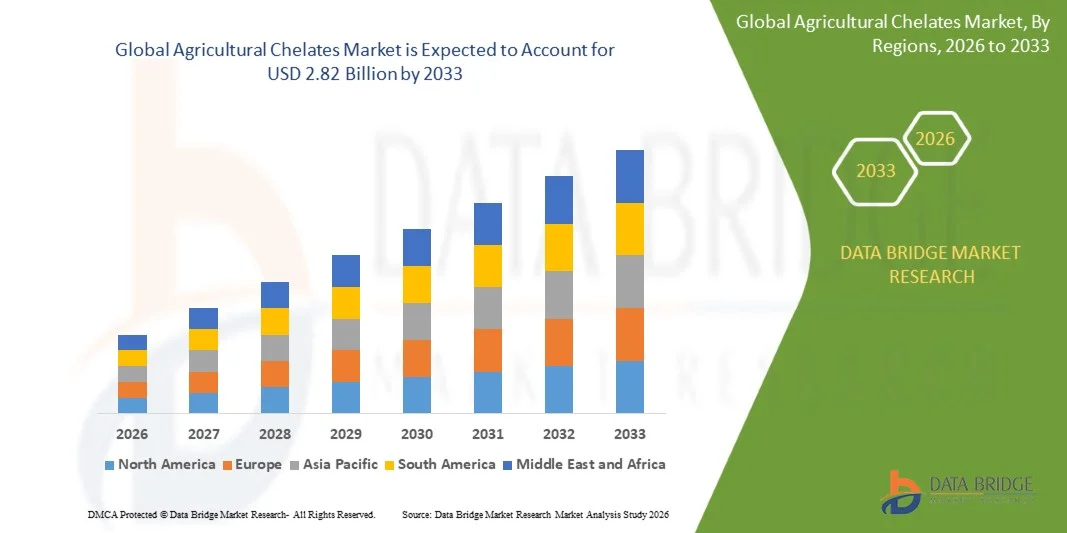
As per Data Bridge Market Research analysis The agricultural chelates market was valued at USD 1.54 billion in 2025 and is projected to reach USD 2.82 billion by 2033, growing at a CAGR of 7.90% from 2026 to 2033. The market is witnessing steady growth driven by rising demand for high-efficiency micronutrient fertilizers, increasing soil nutrient deficiencies, and the growing need to improve crop yield and quality under intensive farming practices.
The increasing degradation of arable land, combined with widespread micronutrient deficiencies such as iron, zinc, manganese, and copper in soils, is pushing farmers and agribusinesses to adopt chelated nutrient solutions. Agricultural chelates enhance nutrient availability and uptake efficiency, especially in alkaline and calcareous soils, making them essential in modern precision agriculture. In addition, the expansion of high-value crop production, hydroponics, and sustainable farming practices is further accelerating the adoption of chelated fertilizers across global agricultural systems.
Market Size & Forecast
- Global Market Value (2025): USD 1.54 Billion
- Expected Market Value (2033): USD 2.82 Billion
- Forecast CAGR (2026–2033): 7.90%
- Leading Region in 2025: North America
- Fastest Growing Region: Asia Pacific
Key Market Trends & Insights
- North America dominated the global agricultural chelates market with the largest revenue share of 34.62% in 2025, supported by large-scale commercial farming operations, advanced precision agriculture practices, and high adoption of micronutrient fertilizers.
- The EDTA segment led the market with a 38.91% share in 2025, driven by its wide availability, cost-effectiveness, and strong stability across a broad range of soil conditions.
- Asia-Pacific is expected to be the fastest-growing region at a CAGR of 6.9% from 2026 to 2033, fueled by expanding agricultural output, rising soil nutrient deficiencies, and increasing use of modern farming inputs in China and India.
- EDDHA are the fastest-growing source type, projected to register a CAGR of 7.4%, reflecting the surge in its superior performance in alkaline and calcareous soils where other chelates show limited efficiency.
- The cereals and grains segment dominated the crop type category with a 41.28% revenue share in 2025, led by the large-scale cultivation of wheat, rice, maize, and barley across major agricultural economies.
- Soil application accounted for 56.47% of the market, preferred by its simplicity, cost-effectiveness, and compatibility with traditional farming practices.
- The zinc segment is the fastest-growing micronutrient type category, with a CAGR of 7.3%, driven by the increasing awareness of zinc deficiency in both soils and crops.
Report Scope and Agricultural Chelates Market Segmentation
|
Attributes |
Agricultural Chelates Key Market Insights |
|
Segments Covered |
|
|
Countries Covered |
North America · U.S. · Canada · Mexico Europe · Germany · France · U.K. · Netherlands · Switzerland · Belgium · Russia · Italy · Spain · Turkey · Rest of Europe Asia-Pacific · China · Japan · India · South Korea · Singapore · Malaysia · Australia · Thailand · Indonesia · Philippines · Rest of Asia-Pacific Middle East and Africa · Saudi Arabia · U.A.E. · South Africa · Egypt · Israel · Rest of Middle East and Africa South America · Brazil · Argentina · Rest of South America |
|
Key Market Players |
· Yara International ASA (Norway) · BASF SE (Germany) · Syngenta Group (Switzerland) · Nutrien Ltd. (Canada) · ICL Group Ltd. (Israel) · Haifa Group (Israel) · Nouryon (Netherlands) · Valagro S.p.A. (Italy) · COMPO EXPERT GmbH (Germany) · The Mosaic Company (U.S.) · Aries Agro Limited (India) · Zuari Agro Chemicals Ltd. (India) · Coromandel International Ltd. (India) · Tradecorp International (Spain) · Atlántica Agrícola S.A. (Spain) · Wilbur-Ellis Company (U.S.) · Koch Agronomic Services (U.S.) · Brandt Consolidated, Inc. (U.S.) · K+S Aktiengesellschaft (Germany) · Timac Agro (France) |
|
Market Opportunities |
· Rising adoption of precision agriculture and fertigation systems · Expanding cultivation of high-value crops such as fruits, vegetables, and horticultural crops · Growing soil degradation and widespread micronutrient deficiencies in arable land |
|
Value Added Data Infosets |
In addition to the insights on market scenarios such as market value, growth rate, segmentation, geographical coverage, and major players, the market reports curated by the Data Bridge Market Research also include import export analysis, production capacity overview, production consumption analysis, price trend analysis, climate change scenario, supply chain analysis, value chain analysis, raw material/consumables overview, vendor selection criteria, PESTLE Analysis, Porter Analysis, and regulatory framework. |
Agricultural Chelates Market Trends
Trend: Rising Adoption of Precision Farming & Micronutrient Management
The agricultural chelates market is increasingly being shaped by the shift toward precision farming, where nutrient application is no longer generalized but highly targeted based on real-time soil and crop requirements. Chelated micronutrients are gaining strong traction because they remain stable in the soil and ensure higher bioavailability compared to conventional fertilizers. Farmers are increasingly using fertigation and foliar spray techniques, which allow direct and efficient delivery of nutrients to plants during critical growth stages. The integration of digital agriculture tools such as soil sensors, satellite imaging, and AI-based nutrient recommendation systems is further improving the accuracy of chelate application, reducing nutrient losses and improving overall farm productivity. This trend is particularly strong in greenhouse farming and controlled-environment agriculture, where consistent nutrient delivery is essential for high-quality output.
For instance, modern hydroponic systems extensively rely on chelated nutrient solutions to maintain optimal plant growth and yield consistency across cycles.
Agricultural Chelates Market Dynamics
Key Market Driver: Rising Soil Nutrient Deficiency & Yield Pressure
One of the strongest growth drivers in the agricultural chelates market is the increasing depletion of essential micronutrients in arable soils due to continuous farming, excessive use of chemical fertilizers, and lack of crop rotation practices. This has led to widespread deficiencies of key elements such as iron, zinc, manganese, and copper, which directly affect plant metabolism, chlorophyll formation, and overall crop productivity. Chelated fertilizers play a critical role in addressing this challenge because they protect nutrients from being fixed or lost in the soil, ensuring better absorption by plant roots even in challenging conditions such as alkaline or calcareous soils. The rising global demand for food, coupled with shrinking arable land per capita, is putting additional pressure on farmers to maximize yield per hectare, further boosting adoption of high-efficiency micronutrient solutions.
For instance, large-scale grain-producing regions are increasingly incorporating iron and zinc chelates into their fertilizer programs to improve both yield quantity and nutritional quality of staple crops.
Key Restraint/Challenge: High Cost of Advanced Chelated Fertilizers
Despite strong demand growth, the agricultural chelates market faces a significant challenge in the form of high production and end-user costs associated with advanced chelating agents such as EDDHA and EDTA derivatives. The manufacturing process of chelates is chemically complex, requiring specialized raw materials and controlled production environments, which increases overall costs compared to traditional micronutrient fertilizers such as sulfates. This price difference creates a major adoption barrier, especially among small and marginal farmers in developing economies who operate under tight cost constraints. In addition, limited awareness about the long-term yield benefits of chelated fertilizers further slows down adoption in price-sensitive regions. Distribution inefficiencies and dependence on agro-dealer networks also contribute to inconsistent availability in rural markets.
For instance, in several emerging agricultural economies, farmers continue to rely on cheaper conventional fertilizers despite visible micronutrient deficiencies in soils, primarily due to affordability concerns and limited technical guidance.
Key Market Opportunity: Expansion of High-Value Crop Cultivation & Sustainable Farming
A major opportunity in the agricultural chelates market lies in the rapid expansion of high-value crop cultivation, including fruits, vegetables, flowers, and horticultural crops, which require precise nutrient management to achieve premium quality and market competitiveness. These crops are highly sensitive to micronutrient deficiencies, making chelated fertilizers essential for improving color, size, taste, and shelf life. At the same time, increasing global demand for residue-free and sustainably produced food is driving the adoption of environmentally compatible and efficient nutrient solutions, including biodegradable and low-impact chelates. The growth of protected farming systems such as greenhouses, vertical farms, and hydroponics is further amplifying demand, as these systems depend heavily on controlled nutrient formulations for consistent productivity.
For instance, commercial greenhouse operators increasingly use customized iron and zinc chelate blends to ensure uniform crop development and maximize export-grade produce quality under controlled environmental conditions.
Agricultural Chelates Market Scope
The agricultural chelates market is segmented on the basis of source type, crop type, mode of application, micronutrient type, and end use.
- By Source Type
On the basis of source type, the agricultural chelates market is segmented into EDTA, DTPA, EDDHA, IDHA, and others. The EDTA segment dominated the market with a 38.91% share in 2025, owing to its wide availability, cost-effectiveness, and strong stability across a broad range of soil conditions. EDTA-based chelates are extensively used in cereals, vegetables, and horticultural crops due to their high compatibility with multiple micronutrients such as iron, zinc, and manganese. They are also preferred in large-scale farming systems because of their proven performance and ease of integration with conventional fertilizers. Continuous demand from commercial agriculture and established supply chains further strengthens its market leadership. However, environmental concerns regarding persistence in soil are gradually encouraging exploration of alternative biodegradable chelates. Despite this, EDTA remains the most widely adopted chelating agent globally due to its reliability and affordability.
The EDDHA segment is expected to register the fastest growth at a CAGR of 7.4% from 2026 to 2033, driven by its superior performance in alkaline and calcareous soils where other chelates show limited efficiency. EDDHA chelates provide highly stable iron availability, making them essential for crops grown in high pH soil conditions. Increasing soil alkalinity in key agricultural regions is significantly boosting adoption. Farmers are increasingly shifting toward EDDHA for high-value crops such as fruits and vegetables to prevent chlorosis and yield loss. Rising awareness of micronutrient efficiency and crop quality improvement is further accelerating demand. Although relatively more expensive, its high effectiveness justifies its use in precision agriculture and export-oriented farming systems.
- By Crop Type
On the basis of crop type, the market is segmented into macro indicators, NPK fertilizers, cereals and grains, oilseeds and pulses, fruits and vegetables, and others. The cereals and grains segment dominated the market with a 41.28% share in 2025, driven by large-scale cultivation of wheat, rice, maize, and barley across major agricultural economies. These crops require continuous micronutrient supplementation to maintain soil fertility and improve yield productivity under intensive farming systems. Chelated fertilizers are widely used in cereals to correct iron and zinc deficiencies that directly impact grain quality and yield output. Government support for food security programs further strengthens demand in this segment. High acreage under cereal cultivation globally ensures consistent and large-volume consumption of chelates. This segment remains the backbone of agricultural chelate utilization worldwide.
The fruits and vegetables segment is expected to register the fastest growth at a CAGR of 7.1% from 2026 to 2033, driven by rising demand for high-quality, nutrient-rich, and visually appealing produce. These crops are highly sensitive to micronutrient deficiencies, making chelates essential for improving color, taste, size, and shelf life. Expansion of greenhouse farming and protected cultivation is significantly boosting adoption. Export-oriented horticulture industries are increasingly relying on chelated fertilizers to meet strict quality standards. Growing consumer preference for healthy diets and fresh produce is further accelerating demand. In addition, precision farming practices in horticulture are enhancing nutrient efficiency and productivity.
- By Mode of Application
On the basis of mode of application, the market is segmented into soil application, seed dressing, foliar sprays, fertigation, and others. The soil application segment dominated the market with a 56.47% share in 2025, due to its simplicity, cost-effectiveness, and compatibility with traditional farming practices. Farmers widely prefer soil application as it integrates easily with existing fertilizer programs without requiring specialized equipment. It is particularly effective for large-scale field crops such as cereals and oilseeds. This method ensures gradual nutrient release and long-term soil enrichment. Strong adoption in developing agricultural regions further supports its dominance. Despite lower efficiency compared to advanced methods, its affordability ensures continued widespread usage.
The fertigation segment is expected to register the fastest growth at a CAGR of 7.6% from 2026 to 2033, driven by rapid adoption of precision agriculture and drip irrigation systems. Fertigation enables efficient and uniform delivery of micronutrients directly to the plant root zone, improving nutrient uptake efficiency. It is widely used in high-value crops such as fruits and vegetables. Increasing greenhouse and controlled-environment farming is accelerating adoption. Water scarcity concerns are also encouraging efficient fertilizer-water integration systems. Growing investment in modern irrigation infrastructure further supports strong future growth.
- By Micronutrient Type
On the basis of micronutrient type, the market is segmented into iron, manganese, zinc, copper, and others. The iron (Fe) chelates segment dominated the market with a 44.73% share in 2025, driven by widespread iron deficiency in soils, especially in alkaline and calcareous regions. Iron is essential for chlorophyll formation and plant metabolism, making it critical for crop productivity. Chelated iron formulations are widely used to prevent chlorosis in fruits, vegetables, and field crops. High demand from horticulture and protected cultivation further strengthens this segment. Farmers prefer iron chelates due to their visible and rapid impact on plant health. Continuous soil degradation trends ensure sustained dominance of this segment.
The zinc chelates segment is expected to register the fastest growth at a CAGR of 7.3% from 2026 to 2033, driven by increasing awareness of zinc deficiency in both soils and crops. Zinc plays a key role in enzyme activation and growth regulation, directly influencing yield and crop quality. Rising focus on biofortification and nutritional security is significantly boosting demand. Governments and agricultural programs are increasingly promoting zinc supplementation in staple crops. High response rates in cereals and grains further support adoption. Expanding use in precision agriculture is also accelerating growth.
- By End Use
On the basis of end use, the market is segmented into agriculture and indoor farming. The agriculture segment dominated the market with a 91.36% share in 2025, driven by extensive global cultivation of field crops, cereals, and horticultural produce. Open-field farming continues to account for the majority of agricultural output worldwide, ensuring strong demand for chelated fertilizers. Large-scale commercial farming operations rely heavily on chelates to improve yield efficiency and soil productivity. Government support programs for food security further strengthen adoption. Established distribution networks and affordability also contribute to dominance. Despite modernization trends, traditional agriculture remains the primary consumption base.
The indoor farming segment is expected to register the fastest growth at a CAGR of 8.1% from 2026 to 2033, driven by the expansion of vertical farming, hydroponics, and greenhouse cultivation systems. These systems require highly controlled nutrient solutions, making chelates essential for consistent plant growth. Urbanization and shrinking arable land are accelerating adoption of indoor farming technologies. Demand for pesticide-free and high-quality produce is further boosting growth. Technological advancements in controlled-environment agriculture are enhancing productivity. Increasing investment in sustainable urban farming systems is expected to further accelerate this segment’s expansion.
Agricultural Chelates Market Regional Analysis
North America dominated the global agricultural chelates market with the largest revenue share of 34.62% in 2025, supported by large-scale commercial farming operations, advanced precision agriculture practices, and high adoption of micronutrient fertilizers. The region benefits from well-developed agribusiness infrastructure, extensive use of soil testing and nutrient management systems, and high awareness regarding soil health and crop productivity improvement. Strong presence of large-scale farms and technologically advanced farming equipment further accelerates chelate adoption across key crop segments such as cereals, oilseeds, and high-value horticultural crops. Increasing focus on sustainable farming practices and yield optimization continues to strengthen North America’s leadership position in the global market.
U.S. Agricultural Chelates Market Insight
The U.S. agricultural chelates market is witnessing strong growth due to high adoption of precision agriculture practices, advanced soil testing systems, and widespread use of micronutrient fertilizers in large-scale commercial farming. The country’s highly developed agribusiness ecosystem, along with increasing focus on soil health management and crop yield optimization, is driving demand across field crops and horticultural applications. Rising adoption of fertigation, foliar sprays, and controlled-environment agriculture is further strengthening market expansion. In addition, growing emphasis on sustainable farming practices and biofortification of crops is accelerating the use of iron, zinc, and manganese chelates across major farming regions.
Europe Agricultural Chelates Market Insight
The Europe agricultural chelates market remains a major contributor to global revenue, driven by strict environmental regulations, strong emphasis on sustainable agriculture, and high awareness of soil nutrient management practices. Widespread adoption of eco-friendly fertilizers and advanced precision farming technologies is supporting market expansion across the region. Increasing use of chelates in high-value crops, horticulture, and greenhouse farming is further boosting demand. In addition, strong government support for reducing chemical fertilizer dependency and improving soil fertility is accelerating the adoption of advanced chelated micronutrient solutions throughout Europe.
U.K. Agricultural Chelates Market Insight
The U.K. agricultural chelates market is experiencing steady growth, supported by rising adoption of precision farming technologies, increasing awareness of soil micronutrient deficiencies, and growing demand for high-quality crop production. Farmers are increasingly integrating chelated fertilizers into nutrient management programs to improve yield efficiency and crop quality. Expanding use in horticulture and protected cultivation systems is further contributing to market growth. Moreover, the integration of digital farming tools and sustainable agriculture practices is enhancing nutrient optimization and driving consistent adoption of chelates across the country.
Germany Agricultural Chelates Market Insight
The Germany agricultural chelates market is expanding steadily due to strong agricultural research capabilities, advanced farming infrastructure, and increasing focus on sustainable crop production systems. High adoption of precision agriculture technologies and soil health monitoring tools is driving demand for efficient micronutrient delivery solutions. Agricultural enterprises and horticulture farms are increasingly using iron and zinc chelates to address soil nutrient deficiencies. Furthermore, Germany’s strong emphasis on environmental protection and efficient resource utilization is encouraging the shift toward high-performance and eco-friendly chelated fertilizers.
Asia-Pacific Agricultural Chelates Market Insight
The Asia-Pacific agricultural chelates market is expected to witness rapid growth, driven by expanding agricultural output, rising population-driven food demand, and increasing soil nutrient deficiencies across major economies such as China and India. Growing adoption of modern farming techniques, precision agriculture tools, and fertigation systems is supporting regional market expansion. Increasing awareness of crop nutrition management and government initiatives to improve agricultural productivity are further accelerating demand. In addition, rapid growth in horticulture and protected farming is enhancing the adoption of advanced chelated micronutrient solutions across the region.
Japan Agricultural Chelates Market Insight
The Japan agricultural chelates market is witnessing consistent growth due to increasing focus on high-quality crop production, advanced agricultural technologies, and sustainable farming practices. Farmers are increasingly adopting precision nutrient management systems to address soil micronutrient deficiencies and improve crop yield efficiency. Strong use of greenhouse and controlled-environment agriculture is further driving demand for chelated fertilizers. In addition, integration of smart farming technologies and Japan’s focus on food quality and safety are supporting steady market adoption of iron, zinc, and manganese chelates.
China Agricultural Chelates Market Insight
The China agricultural chelates market is growing rapidly, driven by large-scale agricultural production, rising soil degradation concerns, and increasing government focus on food security and sustainable farming practices. Expanding adoption of precision agriculture, fertigation systems, and modern irrigation infrastructure is significantly boosting demand for chelated fertilizers. Growing awareness of micronutrient deficiencies in soils and crops is further supporting market expansion. In addition, rapid growth in high-value crop cultivation and horticulture farming is positioning China as one of the fastest-growing markets for agricultural chelates globally.
Agricultural Chelates Market Share
The agricultural chelates industry is primarily led by well-established companies, including:
- Yara International ASA (Norway)
- BASF SE (Germany)
- Syngenta Group (Switzerland)
- Nutrien Ltd. (Canada)
- ICL Group Ltd. (Israel)
- Haifa Group (Israel)
- Nouryon (Netherlands)
- Valagro S.p.A. (Italy)
- COMPO EXPERT GmbH (Germany)
- The Mosaic Company (U.S.)
- Aries Agro Limited (India)
- Zuari Agro Chemicals Ltd. (India)
- Coromandel International Ltd. (India)
- Tradecorp International (Spain)
- Atlántica Agrícola S.A. (Spain)
- Wilbur-Ellis Company (U.S.)
- Koch Agronomic Services (U.S.)
- Brandt Consolidated, Inc. (U.S.)
- K+S Aktiengesellschaft (Germany)
- Timac Agro (France)
Latest Developments in Agricultural Chelates Market
- In April 2024, Nouryon, a global specialty chemicals leader, announced the expansion of its biodegradable chelating agent portfolio under the Dissolvine® GL series, enhancing production capacity in Europe to meet rising demand for sustainable micronutrient solutions in agriculture. These GLDA-based chelates are designed to offer improved environmental compatibility while maintaining strong metal-binding performance for crop nutrition. The expansion supports the shift toward eco-friendly fertilizers in precision agriculture systems
- In October 2023, Syngenta Group highlighted the continued integration and expansion of its biologicals and micronutrient solutions portfolio following the acquisition of Valagro, strengthening its position in high-efficiency crop nutrition and chelated micronutrient technologies. The company emphasized scaling advanced plant nutrition solutions across global markets to support sustainable agriculture and improved crop productivity. This development reinforces Syngenta’s strategy to expand beyond conventional crop protection into integrated crop nutrition systems
- In June 2022, BASF expanded its agricultural micronutrient offerings under the Sequestrene® iron chelate portfolio, focusing on improving iron efficiency in horticultural and field crop applications. The company emphasized enhanced crop uptake efficiency and improved yield outcomes in iron-deficient soils, particularly in high pH regions. This expansion supports BASF’s broader commitment to sustainable agriculture and advanced crop nutrition solutions
- In March 2022, Yara International strengthened its crop nutrition portfolio by enhancing its YaraVita® micronutrient foliar solutions, including formulations with chelated nutrients to improve absorption efficiency and crop response. The development supports precision farming practices and addresses micronutrient deficiencies in high-value crops such as fruits and vegetables. Yara continues to focus on integrated nutrient management systems to improve global food productivity
- In September 2021, Haifa Group expanded its Haifa Micro micronutrient fertilizer portfolio, focusing on chelated nutrient solutions designed for fertigation and foliar application in intensive agriculture systems. The expansion aimed to improve crop quality, yield stability, and nutrient uptake efficiency across horticultural and field crop applications. This development aligns with increasing global demand for high-efficiency specialty fertilizers in precision agriculture

- Interactive Data Analysis Dashboard
- Company Analysis Dashboard for high growth potential opportunities
- Research Analyst Access for customization & queries
- Competitor Analysis with Interactive dashboard
- Latest News, Updates & Trend analysis
- Harness the Power of Benchmark Analysis for Comprehensive Competitor Tracking
Data collection and base year analysis are done using data collection modules with large sample sizes. The stage includes obtaining market information or related data through various sources and strategies. It includes examining and planning all the data acquired from the past in advance. It likewise envelops the examination of information inconsistencies seen across different information sources. The market data is analysed and estimated using market statistical and coherent models. Also, market share analysis and key trend analysis are the major success factors in the market report. To know more, please request an analyst call or drop down your inquiry.
The key research methodology used by DBMR research team is data triangulation which involves data mining, analysis of the impact of data variables on the market and primary (industry expert) validation. Data models include Vendor Positioning Grid, Market Time Line Analysis, Market Overview and Guide, Company Positioning Grid, Patent Analysis, Pricing Analysis, Company Market Share Analysis, Standards of Measurement, Global versus Regional and Vendor Share Analysis. To know more about the research methodology, drop in an inquiry to speak to our industry experts.
Data Bridge Market Research is a leader in advanced formative research. We take pride in servicing our existing and new customers with data and analysis that match and suits their goal. The report can be customized to include price trend analysis of target brands understanding the market for additional countries (ask for the list of countries), clinical trial results data, literature review, refurbished market and product base analysis. Market analysis of target competitors can be analyzed from technology-based analysis to market portfolio strategies. We can add as many competitors that you require data about in the format and data style you are looking for. Our team of analysts can also provide you data in crude raw excel files pivot tables (Fact book) or can assist you in creating presentations from the data sets available in the report.