Agricultural Disinfectants Market Overview
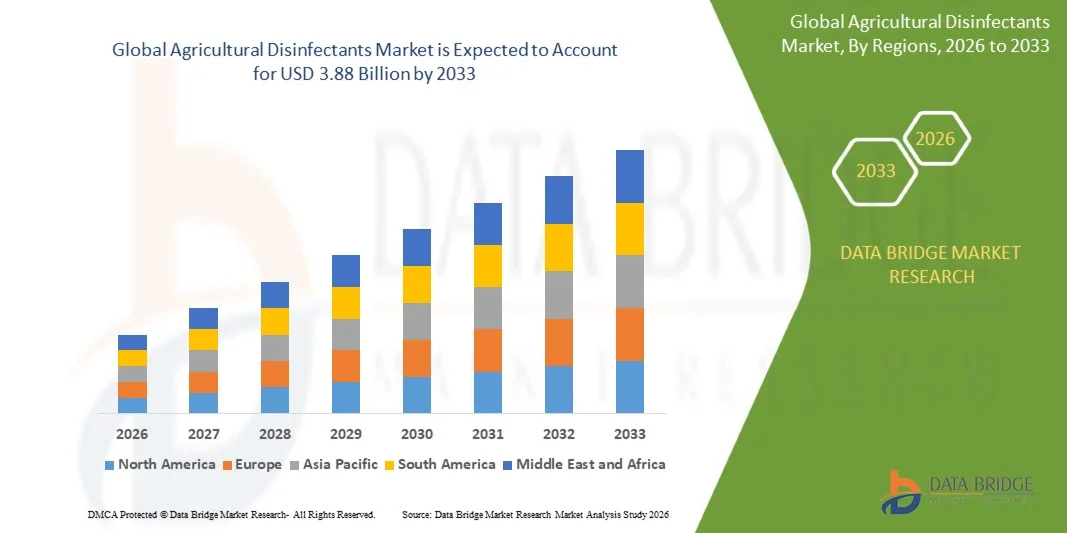
As per Data Bridge Market Research analysis, the agricultural disinfectants market was valued at USD 2.74 billion in 2025 and is projected to reach USD 3.88 billion by 2033, growing at a CAGR of 4.45% from 2026 to 2033. The Market is experiencing steady growth driven by increasing concerns over farm biosecurity, disease prevention, and food safety. Agricultural disinfectants are biological or chemical agents used to eliminate or reduce harmful microorganisms such as bacteria, viruses, fungi, and parasites in agricultural settings, playing a critical role in maintaining biosecurity and ensuring the health and productivity of crops and livestock.
The rising incidence of livestock diseases, bacterial infections in crops, and stricter hygiene regulations are fueling demand for effective disinfectants in agriculture. Farmers and agribusinesses are adopting advanced disinfectant solutions, including quaternary ammonium compounds, hypochlorites, and hydrogen peroxide-based disinfectants, to ensure safer farming environments. With the expansion of precision farming and controlled-environment agriculture, the use of disinfectants is becoming more sophisticated, ensuring higher agricultural productivity while minimizing disease outbreaks.
Key Market Trends & Insights
- Asia-Pacific dominated the global agricultural disinfectants market with the largest revenue share in 2025, supported by stringent regulatory compliance, increasing focus on food safety, rising hygiene awareness, and widespread adoption of sanitizing solutions across healthcare, food processing, agriculture, and commercial sectors.
- North America is expected to be the fastest-growing region from 2026 to 2033, fueled by increasing agricultural activities, modernization of sanitation infrastructure, growing demand for advanced disinfection technologies, and rising adoption of sanitizing chemicals across healthcare, industrial, and commercial applications.
- The quaternary ammonium chloride salts segment led the market by chemical type with the largest share in 2025, driven by its broad-spectrum antimicrobial effectiveness, ease of application, and extensive use in surface disinfection across healthcare facilities, commercial spaces, and food service industries.
- Hydrogen dioxide and peroxyacetic acid are expected to be the fastest-growing chemical type segments during the forecast period, supported by increasing demand for environmentally friendly sanitizing solutions, strong oxidation properties, and growing adoption in food processing, agriculture, and water treatment applications.
- The liquid segment dominated the market by form in 2025, owing to its easy application, rapid surface coverage, and widespread utilization in industrial, institutional, and healthcare sanitization processes.
Market Size & Forecast
- Market Value (2025): USD 2.74 Billion
- Expected Market Value (2033): USD 3.88 Billion
- Forecast CAGR (2026–2033): 4.45%
- Leading Region in 2025: Asia-Pacific
- Fastest Growing Region: North America
Report Scope and Agricultural Disinfectants Market Overview Segmentation
|
Attributes |
Agricultural Disinfectants Key Market Insights |
|
Segments Covered |
|
|
Countries Covered |
North America
Europe
Asia-Pacific
Middle East and Africa
South America
|
|
Key Market Players |
|
|
Market Opportunities |
|
|
Value Added Data Infosets |
In addition to the insights on market scenarios such as market value, growth rate, segmentation, geographical coverage, and major players, the market reports curated by the Data Bridge Market Research also include import export analysis, production capacity overview, production consumption analysis, price trend analysis, climate change scenario, supply chain analysis, value chain analysis, raw material/consumables overview, vendor selection criteria, PESTLE Analysis, Porter Analysis, and regulatory framework. |
Agricultural Disinfectants Market Trends
Trend: Increasing Adoption of Bio-Based and Sustainable Disinfectant Solutions
The agricultural disinfectants market is witnessing a growing shift toward bio-based and environmentally friendly disinfectant solutions as farmers, greenhouse operators, and agricultural companies focus on sustainable farming practices. Conventional disinfectants often rely on chemical formulations that may leave residues, impact soil health, and affect surrounding ecosystems when used extensively. In response, manufacturers are developing safer alternatives based on biodegradable ingredients, hydrogen peroxide, peracetic acid, and plant-derived compounds that provide effective pathogen control while minimizing environmental impact.
The increasing emphasis on sustainable agriculture, food safety, and reduced chemical dependency is encouraging the adoption of eco-friendly disinfectants across crop production, greenhouse farming, and livestock management. These solutions are gaining importance due to their ability to maintain hygiene standards while supporting environmentally responsible farming practices.
Agricultural Disinfectants Market Dynamics
Key Market Driver: Expansion of Protected Cultivation Practices
The expansion of protected cultivation is a major factor driving the growth of the agricultural disinfectants market. The increasing demand for high-quality, pesticide-free, and year-round crop production is encouraging the adoption of greenhouse farming, vertical farming, and controlled-environment agriculture systems. Although protected cultivation reduces exposure to external pathogens, enclosed farming environments can create favorable conditions for the accumulation and spread of microorganisms on surfaces such as growing trays, tools, irrigation systems, benches, and equipment.
Regular sanitization using agricultural disinfectants plays a critical role in preventing disease outbreaks, reducing contamination risks, and maintaining healthy growing conditions. The rising adoption of greenhouse technologies and precision farming practices is expected to further increase the demand for effective disinfectant solutions across commercial farming operations.
Key Restraint/Challenge: High Production Costs and Regulatory Complexities
The agricultural disinfectants market faces challenges related to high production costs, regulatory requirements, and formulation complexities. Developing effective disinfectant products requires significant investment in research, testing, and compliance with agricultural safety standards. These factors can create barriers, particularly for small-scale manufacturers and farmers operating in price-sensitive markets.
Additionally, differences in pathogen profiles across crops, livestock systems, and geographic regions require specialized disinfectant formulations, limiting product standardization. Stringent approval processes and evolving regulations regarding chemical usage and environmental safety further increase development and commercialization challenges for manufacturers.
Key Market Opportunity: Growing Demand in Emerging Agricultural Markets
Emerging markets, particularly in Asia-Pacific, present significant growth opportunities for agricultural disinfectants due to expanding agricultural activities, increasing livestock production, and rising awareness regarding farm hygiene and disease prevention. Countries such as China, India, Japan, Australia, and Indonesia are witnessing growing adoption of sanitization practices across crop cultivation, greenhouse farming, and animal production facilities.
The increasing focus on improving agricultural productivity, reducing crop losses caused by pathogens, and enhancing food safety standards is driving demand for advanced disinfectant solutions. Furthermore, the expansion of commercial farming operations and government initiatives supporting modern agricultural practices are expected to create new opportunities for agricultural disinfectant manufacturers across developing regions.
Agricultural Disinfectants Market Scope
The agricultural disinfectants market is segmented on the basis of chemical type, form, and application.
By Chemical Type
On the basis of chemical type, the global agricultural disinfectants market is segmented into quaternary ammonium chloride salts, hydrogen dioxide and peroxyacetic acid, hypochlorites and halogens, and other chemicals. The quaternary ammonium chloride salts segment dominated the market with the largest share in 2025, owing to its broad-spectrum antimicrobial effectiveness, ease of application, and extensive usage across agricultural facilities, livestock farms, and food processing environments. These disinfectants provide effective control against bacteria, viruses, and fungi, making them a preferred choice for surface sanitation and disease prevention applications.
The hydrogen dioxide and peroxyacetic acid segment is projected to register the fastest growth during the forecast period from 2026 to 2033, driven by increasing demand for environmentally friendly and residue-free disinfectant solutions. The strong oxidation properties, biodegradability, and growing adoption in greenhouse farming, water treatment, and food safety applications are accelerating segment expansion.
By Form
On the basis of form, the global agricultural disinfectants market is segmented into liquid and powder. The liquid segment dominated the market in 2025, supported by its rapid application, efficient surface coverage, and widespread adoption across agricultural facilities, greenhouses, and livestock production units. Liquid disinfectants are preferred due to their ease of dilution, quick action against pathogens, and compatibility with automated spraying and sanitization systems.
The powder segment is expected to witness significant growth from 2026 to 2033, driven by advantages such as longer shelf life, ease of storage, reduced transportation costs, and suitability for large-scale agricultural operations. Increasing demand for convenient and stable disinfectant formulations in remote farming areas is further supporting segment growth.
By Application
On the basis of application, the global agricultural disinfectants market is segmented into surface sanitizing, aerial sanitizing, and water sanitizing. The surface sanitizing segment dominated the market in 2025, owing to the increasing focus on maintaining hygiene across farming equipment, greenhouse structures, tools, storage areas, and livestock facilities. Regular surface disinfection is becoming essential for reducing pathogen transmission and improving biosecurity measures in agricultural operations.
The water sanitizing segment is projected to register the fastest growth during the forecast period, driven by increasing adoption of controlled irrigation systems, hydroponics, and protected cultivation practices. Rising concerns regarding waterborne pathogens and the need for clean water management in crop production are accelerating the adoption of advanced water sanitization solutions across modern agricultural systems.
Agricultural Disinfectants Market Regional Analysis
Asia-Pacific is expected to dominate the global agricultural disinfectants market during the forecast period, supported by extensive agricultural activities, expanding livestock production, and increasing focus on farm biosecurity practices. Countries such as China and India are key contributors to regional growth due to their large-scale food production systems, rising adoption of modern farming techniques, and increasing awareness regarding disease prevention in crop and animal production. Government initiatives aimed at improving agricultural productivity, enhancing food safety standards, and promoting sustainable farming practices are further strengthening the demand for agricultural disinfectants across the region.
North America Agricultural Disinfectants Market Insight
North America is projected to register the fastest growth in the agricultural disinfectants market during the forecast period, driven by the expansion of commercial farming operations, increasing demand for high-quality agricultural products, and growing emphasis on advanced disease management practices. The region’s strong focus on agricultural productivity, livestock health, and food safety regulations is encouraging the adoption of effective sanitization solutions. Additionally, increasing concerns regarding pathogen control, biosecurity measures, and sustainable farming practices are accelerating the use of agricultural disinfectants across crop production, greenhouse farming, and livestock management applications.
Agricultural Disinfectants Market Share
The agricultural disinfectants industry is primarily led by well-established companies, including:
- Lanxess AG (Germany)
- Neogen Corporation (U.S.)
- Nufarm Limited (Australia)
- Stepan Company (U.S.)
- Zoetis Inc. (U.S.)
- Chemours Company (U.S.)
- Entaco NV (Belgium)
- Shandong Daming Disinfection Technology Co., Ltd. (China)
- Diversey Holdings, Ltd. (U.S.)
- Ecolab Inc. (U.S.)
- CID Lines (Belgium)
- Kersia Group (France)
- Virox Technologies Inc. (Canada)
Latest Developments in Agricultural Disinfectants Market
- In April 2024, Neogen Corporation launched Neogen Farm Fluid MAX across Great Britain and other European markets. The dual-action disinfectant is specifically developed to perform under challenging farm conditions and is designed to support comprehensive pathogen control programs in agricultural environments.
- In November 2022, Neogen Corporation expanded the availability of its Synergize disinfectant across Europe, the Middle East, and Africa. The multi-purpose disinfectant combines quaternary ammonium compounds and glutaraldehyde to provide broad-spectrum protection against Gram-negative and Gram-positive bacteria, fungi, spores, and viruses while offering non-corrosive performance on hard surfaces.

- Interactive Data Analysis Dashboard
- Company Analysis Dashboard for high growth potential opportunities
- Research Analyst Access for customization & queries
- Competitor Analysis with Interactive dashboard
- Latest News, Updates & Trend analysis
- Harness the Power of Benchmark Analysis for Comprehensive Competitor Tracking
Data collection and base year analysis are done using data collection modules with large sample sizes. The stage includes obtaining market information or related data through various sources and strategies. It includes examining and planning all the data acquired from the past in advance. It likewise envelops the examination of information inconsistencies seen across different information sources. The market data is analysed and estimated using market statistical and coherent models. Also, market share analysis and key trend analysis are the major success factors in the market report. To know more, please request an analyst call or drop down your inquiry.
The key research methodology used by DBMR research team is data triangulation which involves data mining, analysis of the impact of data variables on the market and primary (industry expert) validation. Data models include Vendor Positioning Grid, Market Time Line Analysis, Market Overview and Guide, Company Positioning Grid, Patent Analysis, Pricing Analysis, Company Market Share Analysis, Standards of Measurement, Global versus Regional and Vendor Share Analysis. To know more about the research methodology, drop in an inquiry to speak to our industry experts.
Data Bridge Market Research is a leader in advanced formative research. We take pride in servicing our existing and new customers with data and analysis that match and suits their goal. The report can be customized to include price trend analysis of target brands understanding the market for additional countries (ask for the list of countries), clinical trial results data, literature review, refurbished market and product base analysis. Market analysis of target competitors can be analyzed from technology-based analysis to market portfolio strategies. We can add as many competitors that you require data about in the format and data style you are looking for. Our team of analysts can also provide you data in crude raw excel files pivot tables (Fact book) or can assist you in creating presentations from the data sets available in the report.