Agricultural Enzymes Market Size
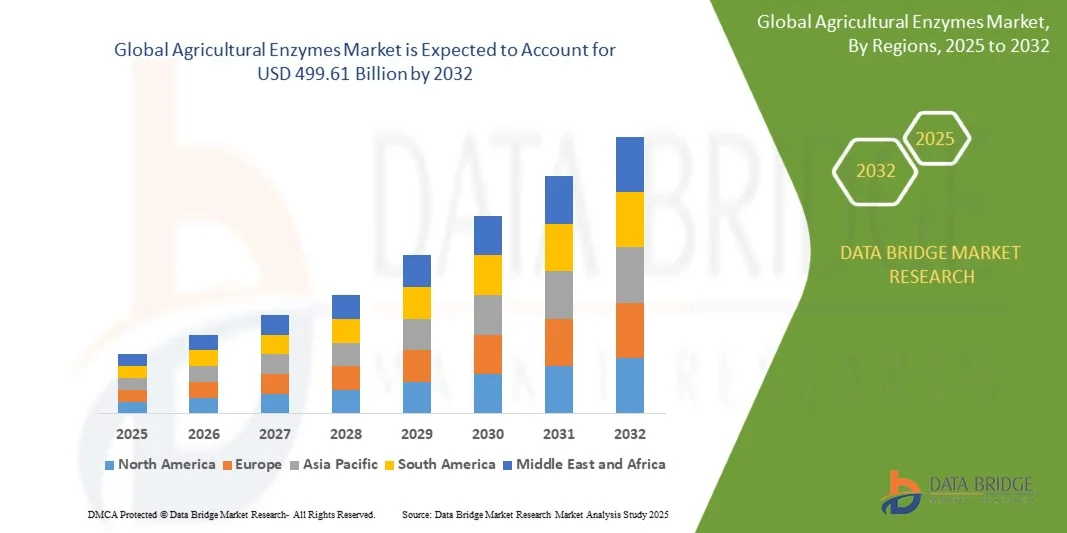
- The global agricultural enzymes market size was valued at USD 264.00 billion in 2024 and is expected to reach USD 499.61 billion by 2032, at a CAGR of 8.30% during the forecast period
- The market growth is largely fuelled by the rising demand for sustainable farming solutions, increasing adoption of organic agricultural practices, and the need to enhance soil fertility and crop productivity through eco-friendly inputs
- Continuous advancements in enzyme formulation and biotechnology innovations are further contributing to improved efficiency and performance of agricultural enzymes, supporting their integration into modern farming system
Agricultural Enzymes Market Analysis
- The agricultural enzymes market is witnessing robust expansion driven by the growing emphasis on environmental sustainability and reduced dependency on chemical fertilizers and pesticides. Enzymes play a critical role in promoting nutrient availability, improving soil structure, and enhancing plant resilience against biotic and abiotic stress
- Increasing awareness among farmers regarding the benefits of bio-based enzyme products in improving crop yield and soil health is accelerating adoption across various crop types. In addition, the rising global population and the resulting food security concerns are further boosting demand for advanced enzyme-based agricultural solutions
- North America dominated the agricultural enzymes market with the largest revenue share of 38.72% in 2024, driven by strong adoption of sustainable farming practices and the widespread use of bio-based agricultural inputs
- Asia-Pacific region is expected to witness the highest growth rate in the global agricultural enzymes market, driven by rapid agricultural modernization, expanding population, and growing adoption of enzyme-based fertilizers to enhance soil productivity
- The cereals & grains segment held the largest market revenue share in 2024, supported by the high global demand for staple crops such as wheat, corn, and rice. The use of enzymes in this segment enhances nutrient assimilation and improves yield efficiency, making them vital for large-scale farming operations
Report Scope and Agricultural Enzymes Market Segmentation
|
Attributes |
Agricultural Enzymes Key Market Insights |
|
Segments Covered |
|
|
Countries Covered |
North America
Europe
Asia-Pacific
Middle East and Africa
South America
|
|
Key Market Players |
|
|
Market Opportunities |
|
|
Value Added Data Infosets |
In addition to the insights on market scenarios such as market value, growth rate, segmentation, geographical coverage, and major players, the market reports curated by the Data Bridge Market Research also include import export analysis, production capacity overview, production consumption analysis, price trend analysis, climate change scenario, supply chain analysis, value chain analysis, raw material/consumables overview, vendor selection criteria, PESTLE Analysis, Porter Analysis, and regulatory framework. |
Agricultural Enzymes Market Trends
“Growing Shift Toward Sustainable And Bio-Based Crop Solutions”
- The agricultural industry is increasingly adopting bio-based enzymes as sustainable alternatives to chemical fertilizers and pesticides. These enzymes enhance soil fertility, promote plant nutrient uptake, and reduce dependency on synthetic agrochemicals, aligning with global sustainability and organic farming goals. The trend is reinforced by stricter regulations on chemical inputs and a rising demand for eco-friendly farming practices. Moreover, enzyme-based inputs minimize soil degradation and water contamination, supporting long-term agricultural productivity and biodiversity preservation
- Farmers are recognizing the economic and environmental advantages of enzyme-based solutions that improve soil microbiome activity and crop resilience. By facilitating better nutrient conversion and reducing fertilizer runoff, these products contribute to higher yields and improved soil health. This shift toward green biotechnology is expanding opportunities for enzyme manufacturers targeting both small-scale and commercial farms. In addition, enzyme-based inputs help reduce greenhouse gas emissions by promoting natural nutrient cycling, aligning with climate-smart agriculture objectives
- The integration of agricultural enzymes in precision farming systems is also gaining traction, supported by technological advancements in biocatalyst formulation and application methods. The combination of enzymes with data-driven agriculture enables more efficient nutrient management and targeted soil treatment, optimizing resource utilization and minimizing waste. Furthermore, real-time monitoring systems integrated with enzyme applications enhance decision-making for farmers, improving productivity and reducing operational costs
- For instance, in 2023, several agri-biotech companies in Europe introduced multi-enzyme formulations designed to boost nitrogen efficiency and phosphorus availability in major crops such as corn and wheat. These innovations reduced chemical fertilizer dependency by over 20%, promoting both yield improvement and environmental sustainability. Such product developments reflect the growing role of biotechnology in creating next-generation enzyme products tailored for different crops and soil types
- While the adoption of enzyme-based agriculture continues to expand, success depends on improving awareness among farmers, ensuring product affordability, and strengthening distribution channels to make bio-based inputs accessible across diverse agricultural landscapes. Strategic collaborations among research institutions, agrochemical firms, and government bodies can accelerate innovation and boost adoption rates. Furthermore, marketing efforts emphasizing long-term yield improvement and soil health benefits can increase farmer confidence in enzyme-based solutions
Agricultural Enzymes Market Dynamics
Driver
“Rising Demand For Organic Farming And Sustainable Crop Production”
- The global shift toward organic and sustainable agriculture is significantly driving demand for agricultural enzymes. These bio-catalysts enhance soil health, promote nutrient cycling, and support eco-friendly pest management practices. Farmers are increasingly using enzyme-based inputs to maintain productivity without compromising soil or environmental quality. The demand is also growing in export-oriented farming operations where compliance with international organic standards is essential
- Growing consumer preference for organic food products and reduced-chemical farming has accelerated the adoption of enzymatic fertilizers and crop protectants. These solutions help farmers comply with organic certification requirements and meet regulatory standards restricting chemical usage, especially in regions such as Europe and North America. In addition, retailers and food brands are increasingly promoting “clean label” and traceable food products, indirectly driving enzyme adoption at the production level
- Governments and agribusiness corporations are actively supporting enzyme adoption through subsidies, partnerships, and training programs that encourage the transition to green agriculture. This push is fostering innovation in enzymatic formulations tailored for specific crops and climatic conditions. Furthermore, advancements in fermentation technologies are reducing production costs, allowing broader accessibility to enzyme-based inputs
- For instance, in 2023, India’s Ministry of Agriculture launched initiatives promoting bio-enzyme-based soil conditioners under its sustainable agriculture mission, resulting in widespread interest among small and mid-scale farmers. The program emphasized reducing dependency on synthetic fertilizers and improving soil organic matter through enzyme integration. This initiative is expected to serve as a model for other developing countries promoting bio-based farming inputs
- As the organic food industry expands and sustainability goals tighten globally, agricultural enzymes are emerging as vital enablers of environmentally responsible farming and resource-efficient crop management. Their ability to enhance nutrient bioavailability and improve crop resilience under stress conditions is making them integral to future-ready farming systems. Continuous innovation in enzyme stabilization and shelf-life improvement will further support global adoption
Restraint/Challenge
“High Production Costs And Limited Farmer Awareness In Developing Regions”
- The high cost of enzyme extraction, purification, and stabilization processes remains a major barrier to large-scale adoption, particularly in developing markets. Production involves complex biotechnological techniques that increase the final product price, restricting access for cost-sensitive farmers. Moreover, small manufacturers face capital constraints in scaling up operations, making enzyme-based products less competitive against conventional fertilizers and pesticides
- Lack of awareness and limited technical knowledge among smallholder farmers further hinder the use of agricultural enzymes. In several rural regions, traditional chemical-based inputs remain preferred due to familiarity and immediate visible results, despite their long-term environmental drawbacks. Educational programs, demonstration projects, and field trials are essential to bridge this knowledge gap and showcase the tangible benefits of enzyme applications
- Inadequate distribution infrastructure and absence of strong supply chains also restrict availability in emerging economies, delaying product penetration and market expansion. Training programs and field demonstrations are still insufficient to build farmer confidence in enzyme-based products. Moreover, limited cold storage and transport facilities often affect enzyme stability and effectiveness, further deterring consistent adoption
- For instance, in 2023, agricultural agencies in Latin America reported that less than 15% of farmers had access to enzymatic bio-fertilizers due to high costs and lack of local production facilities, underscoring the need for regional manufacturing and education initiatives. Similar challenges are observed in parts of Africa and Southeast Asia, where limited technological infrastructure hampers enzyme production scalability. Addressing these gaps will require collaborative investments between governments, private firms, and non-profit organizations
- To overcome these challenges, industry stakeholders must focus on cost reduction through process optimization, farmer outreach, and public-private collaborations that enhance awareness and accessibility across diverse agricultural systems. Establishing decentralized enzyme production units and promoting low-cost bio-catalyst innovations can support affordability. Building strong extension networks and demonstration-based marketing will further strengthen market penetration in developing regions
Agricultural Enzymes Market Scope
The market is segmented on the basis of product, crop type, and functionality.
• By Product
On the basis of product, the agricultural enzymes market is segmented into phosphatases, dehydrogenase, sulfatases, and others. The phosphatases segment held the largest market revenue share in 2024, driven by its essential role in enhancing phosphorus availability in the soil and promoting efficient nutrient uptake by plants. Phosphatase-based enzyme formulations are widely used across diverse crop types due to their proven ability to improve soil fertility and boost crop productivity.
The dehydrogenase segment is expected to witness the fastest growth rate from 2025 to 2032, owing to its critical role in soil microbial activity and overall soil health improvement. Dehydrogenase enzymes serve as key biological indicators of soil quality, driving their growing application in sustainable and organic farming practices.
• By Crop Type
On the basis of crop type, the agricultural enzymes market is segmented into cereals & grains, oilseeds & pulses, fruits & vegetables, turf & ornamentals, and others. The cereals & grains segment held the largest market revenue share in 2024, supported by the high global demand for staple crops such as wheat, corn, and rice. The use of enzymes in this segment enhances nutrient assimilation and improves yield efficiency, making them vital for large-scale farming operations.
The fruits & vegetables segment is expected to witness the fastest growth rate from 2025 to 2032, driven by the increasing focus on quality enhancement, disease resistance, and post-harvest shelf life improvement. Enzymatic treatments are gaining traction in horticultural production systems for their ability to improve soil structure and crop resilience against stress conditions.
• By Functionality
On the basis of functionality, the agricultural enzymes market is segmented into fertility products, growth enhancing products, and control products. The fertility products segment held the largest market revenue share in 2024, attributed to the increasing use of enzymes to improve soil nutrient bioavailability and boost microbial activity. These products play a vital role in reducing chemical fertilizer dependency while enhancing soil productivity in both conventional and organic farming systems.
The growth enhancing products segment is expected to witness the fastest growth rate from 2025 to 2032, driven by their role in accelerating plant development, improving photosynthesis, and increasing crop yields. Continuous innovations in enzyme formulations that combine multiple functionalities are also supporting broader adoption across modern agricultural practices.
Agricultural Enzymes Market Regional Analysis
- North America dominated the agricultural enzymes market with the largest revenue share of 38.72% in 2024, driven by strong adoption of sustainable farming practices and the widespread use of bio-based agricultural inputs
- Farmers in the region are increasingly utilizing enzyme-based fertilizers and soil conditioners to enhance nutrient efficiency and reduce chemical dependency, aligning with stringent environmental regulations and organic certification standards
- This dominance is further reinforced by high agricultural productivity, strong government support for sustainable farming, and the growing shift toward eco-friendly crop enhancement products across the U.S. and Canada
U.S. Agricultural Enzymes Market Insight
The U.S. agricultural enzymes market captured the largest revenue share in 2024 within North America, driven by increasing consumer demand for organic produce and the rising adoption of sustainable agricultural inputs. Farmers across the country are rapidly integrating bio-enzymatic solutions to improve soil fertility, crop resilience, and yield potential. The presence of major agricultural biotechnology companies, coupled with technological advancements in enzyme formulations, is further propelling market growth. Moreover, the country’s robust regulatory framework promoting reduced chemical fertilizer usage supports the expansion of enzyme-based agriculture.
Europe Agricultural Enzymes Market Insight
The Europe agricultural enzymes market is expected to witness the fastest growth rate from 2025 to 2032, primarily driven by the region’s strong emphasis on sustainability and strict regulations governing agrochemical use. The European Union’s “Farm to Fork” strategy is encouraging the adoption of bio-based inputs, fostering the demand for agricultural enzymes in organic and precision farming applications. In addition, rising consumer awareness about food safety and environmental preservation is accelerating the transition toward green biotechnology solutions. Increasing collaborations between enzyme manufacturers and local agricultural cooperatives are further enhancing market penetration.
U.K. Agricultural Enzymes Market Insight
The U.K. agricultural enzymes market is expected to witness the fastest growth rate from 2025 to 2032, supported by a growing focus on climate-smart agriculture and government incentives for sustainable farming. Farmers are increasingly turning to bio-enzymatic soil enhancers and plant growth promoters to maintain productivity amid soil degradation concerns. The country’s strong research infrastructure and expanding organic farming sector are facilitating the development and adoption of enzyme-based agricultural technologies. Furthermore, the U.K.’s efforts to reduce synthetic input dependency post-Brexit are expected to create significant opportunities for enzyme suppliers.
Germany Agricultural Enzymes Market Insight
The Germany agricultural enzymes market is expected to witness the fastest growth rate from 2025 to 2032, driven by the nation’s leadership in sustainable agricultural innovation and its advanced biotechnology ecosystem. German farmers are adopting enzyme-based crop inputs to improve nutrient cycling and reduce greenhouse gas emissions associated with fertilizer use. Moreover, supportive government initiatives promoting soil health and circular agriculture are accelerating the integration of bio-enzymatic products. The presence of major agrochemical companies investing in enzyme R&D is further boosting the country’s market potential.
Asia-Pacific Agricultural Enzymes Market Insight
The Asia-Pacific agricultural enzymes market is expected to witness the fastest growth rate from 2025 to 2032, fuelled by rapid agricultural modernization, population growth, and increasing adoption of sustainable farming practices in countries such as China, India, and Japan. The region’s governments are actively promoting bio-based fertilizers and soil improvement technologies to enhance food security and reduce environmental pollution. Moreover, expanding domestic production capabilities and favorable investment initiatives in agri-biotech sectors are strengthening regional enzyme manufacturing and export potential.
Japan Agricultural Enzymes Market Insight
The Japan agricultural enzymes market is expected to witness the fastest growth rate from 2025 to 2032 due to its advanced agri-technology ecosystem and increasing emphasis on sustainable farming. Japanese farmers are adopting enzyme-based soil conditioners and crop protection products to improve efficiency and reduce reliance on chemical fertilizers. The country’s high adoption of precision agriculture and smart farming technologies is further facilitating the integration of bio-enzymatic inputs. In addition, Japan’s government initiatives supporting eco-friendly agricultural innovation are expected to strengthen long-term market expansion.
China Agricultural Enzymes Market Insight
The China agricultural enzymes market accounted for the largest revenue share in Asia-Pacific in 2024, attributed to large-scale agricultural production, expanding organic farming acreage, and strong governmental promotion of bio-based inputs. The country’s commitment to reducing chemical fertilizer consumption through its “Green Agriculture” initiatives is driving the use of agricultural enzymes across multiple crop segments. Furthermore, the presence of domestic enzyme producers and increasing R&D investments are enhancing local availability and affordability, making China a major hub for agricultural enzyme innovation and application.
Agricultural Enzymes Market Share
The Agricultural Enzymes industry is primarily led by well-established companies, including:
- AB Enzymes (Germany)
- Advanced Enzyme Technologies (India)
- Amano Enzymes Inc. (Japan)
- Antozyme Biotech Pvt Ltd. (India)
- Biolaxi Enzymes Pvt Ltd. (India)
- Biorizon Biotech (Spain)
- Creative Enzymes (U.S.)
- Elemental Enzymes, Inc. (U.S.)
- Field International UK Limited (U.K.)
- Grotech Production Ltd. (U.K.)
- Infinita Biotech Private Limited (India)
- Kemin Industries, Inc. (U.S.)
- Novozymes A/S (Denmark)
Latest Developments in Global Agricultural Enzymes Market
- In February 2024, Elemental Enzymes entered a strategic partnership with Nutrien AG to introduce innovative enzyme-based solutions aimed at combating citrus greening across the North American market. This collaboration focuses on enhancing crop resilience and productivity through advanced biological formulations. The initiative is expected to strengthen sustainable agricultural practices and reduce losses in citrus production, significantly benefiting farmers and improving crop quality across the region
- In February 2023, Ginkgo Bioworks partnered with Zymtronix to co-develop and manufacture a diverse range of industrial enzymes catering to sectors such as food, cosmetics, agriculture, and pharmaceuticals. The partnership leverages synthetic biology and biocatalysis to create efficient enzyme solutions, boosting industrial sustainability and innovation. This collaboration is anticipated to expand the availability of eco-friendly enzymatic products and accelerate advancements in multiple end-use industries
- In January 2023, BASF SE and Cargill, Incorporated expanded their ongoing collaboration to deliver high-performance enzyme solutions for applications in animal health, agriculture, and industrial sectors. The development aims to optimize enzyme functionality and improve process efficiency across multiple production environments. This partnership enhances product performance, promotes sustainable production methods, and strengthens the companies’ position in the global enzyme market

- Interactive Data Analysis Dashboard
- Company Analysis Dashboard for high growth potential opportunities
- Research Analyst Access for customization & queries
- Competitor Analysis with Interactive dashboard
- Latest News, Updates & Trend analysis
- Harness the Power of Benchmark Analysis for Comprehensive Competitor Tracking
Data collection and base year analysis are done using data collection modules with large sample sizes. The stage includes obtaining market information or related data through various sources and strategies. It includes examining and planning all the data acquired from the past in advance. It likewise envelops the examination of information inconsistencies seen across different information sources. The market data is analysed and estimated using market statistical and coherent models. Also, market share analysis and key trend analysis are the major success factors in the market report. To know more, please request an analyst call or drop down your inquiry.
The key research methodology used by DBMR research team is data triangulation which involves data mining, analysis of the impact of data variables on the market and primary (industry expert) validation. Data models include Vendor Positioning Grid, Market Time Line Analysis, Market Overview and Guide, Company Positioning Grid, Patent Analysis, Pricing Analysis, Company Market Share Analysis, Standards of Measurement, Global versus Regional and Vendor Share Analysis. To know more about the research methodology, drop in an inquiry to speak to our industry experts.
Data Bridge Market Research is a leader in advanced formative research. We take pride in servicing our existing and new customers with data and analysis that match and suits their goal. The report can be customized to include price trend analysis of target brands understanding the market for additional countries (ask for the list of countries), clinical trial results data, literature review, refurbished market and product base analysis. Market analysis of target competitors can be analyzed from technology-based analysis to market portfolio strategies. We can add as many competitors that you require data about in the format and data style you are looking for. Our team of analysts can also provide you data in crude raw excel files pivot tables (Fact book) or can assist you in creating presentations from the data sets available in the report.