What is the Agricultural Inoculants Market Size and Growth Rate?
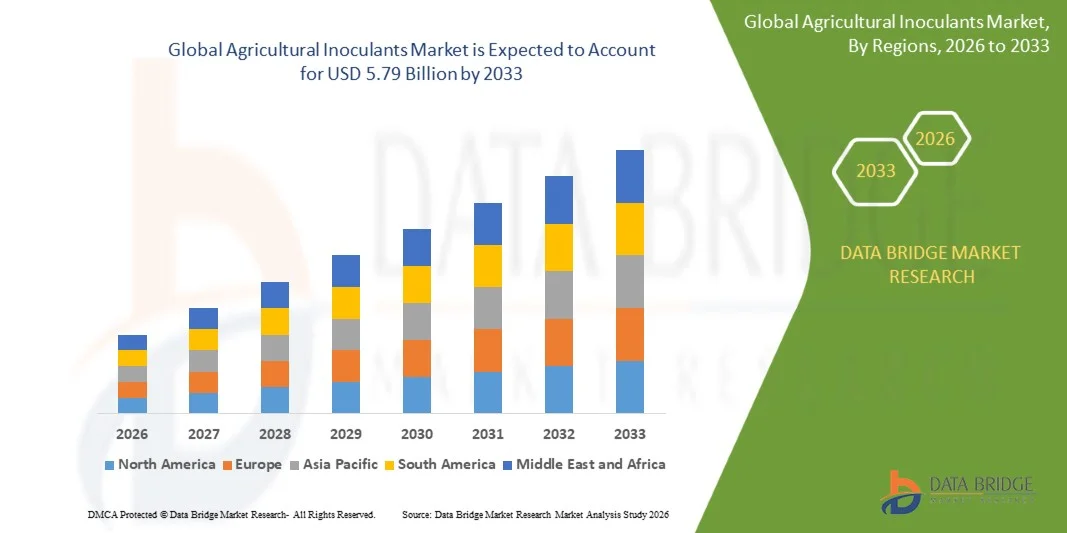
- As per Data Bridge Market Research analysis, the agricultural inoculants market was valued at USD 3.50 billion in 2025 and is projected to reach USD 5.79 billion by 2033, growing at a CAGR of 6.50% from 2026 to 2033.
- The market is experiencing consistent growth driven by the increasing use of agricultural inoculants to enhance crop productivity and growing preferences for organic products and horticulture crops. In addition, increasing government initiatives that provide subsidies to support farmers, along with the growing number of research and development activities, are expected to further support market expansion.
- The increasing adoption of agricultural inoculants for improving crop productivity, combined with the growing focus on organic and sustainable agricultural practices, is encouraging their use in farming. Agricultural inoculants provide beneficial microorganisms that support plant growth, nutrient delivery, and disease suppression. However, lack of awareness among farmers and increasing legislations may impede market growth, while emerging markets and increasing awareness regarding production losses are expected to create lucrative opportunities during the forecast period.
Market Size & Forecast
- Global Market Value (2025): USD 3.50 Billion
- Expected Market Value (2033): USD 5.79 Billion
- Forecast CAGR (2026–2033): 6.50%
- Leading Region in 2025: North America
- Fastest Growing Region: Asia Pacific
What are the Major Takeaways of the Agricultural Inoculants Market?
- North America dominated the agricultural inoculants market with a 32.1% share in 2025, supported by strong retailer networks, advanced agronomic advisory systems, and high adoption across soybean and corn production.
- Asia-Pacific is expected to be the fastest-growing region at a CAGR of 6.8% from 2026 to 2033, fueled by fertilizer cost pressures, government support for biological inputs, and expanding agronomic extension programs.
- The crop protection segment led the market with a 58.1% share in 2025, driven by increasing resistance to synthetic pesticides and stricter regulations on certain chemical active ingredients.
- Crop nutrition are the fastest-growing function type, projected to register a CAGR of 5.1%, reflecting the surge in demand for biological solutions that improve nutrient uptake and nutrient-use efficiency.
- The plant growth promoting microorganisms segment dominated the type category with a 41.7% revenue share in 2025, led by the strong commercial adoption of these products in large-scale agriculture.
- Liquid accounted for 54.6% of the market share in 2025, preferred by its ease of handling, uniform microbial distribution, and compatibility with modern seed-treatment systems.
- The granular segment is the fastest-growing form category, with a CAGR of 5.5%, driven by the increasing demand for convenient soil-application formats.
Report Scope and Agricultural Inoculants Market Segmentation
|
Attributes |
Agricultural Inoculants Key Market Insights |
|
Segments Covered |
|
|
Countries Covered |
North America
Europe
Asia-Pacific
Middle East and Africa
South America
|
|
Key Market Players |
|
|
Market Opportunities |
|
|
Value Added Data Infosets |
In addition to the insights on market scenarios such as market value, growth rate, segmentation, geographical coverage, and major players, the market reports curated by the Data Bridge Market Research also include import export analysis, production capacity overview, production consumption analysis, price trend analysis, climate change scenario, supply chain analysis, value chain analysis, raw material/consumables overview, vendor selection criteria, PESTLE Analysis, Porter Analysis, and regulatory framework. |
What is the Key Trend in the Agricultural Inoculants Market?
- Microbial consortia and multi-strain formulations are increasingly gaining attention, as combinations of microorganisms can provide multiple functions, including nutrient cycling, plant growth promotion, disease suppression, and tolerance to abiotic stresses, compared with single-strain inoculants.
- For instance, in January 2025, a study published in Plants highlighted advances in microbial inoculants for sustainable agriculture, including the development of improved microbial consortia and bioformulations designed to enhance nutrient availability, plant growth, stress tolerance, and soil health, supporting the growing adoption of biological inputs as alternatives to conventional agricultural chemicals.
- Advanced bioformulation and carrier technologies are becoming increasingly important because improved carriers, encapsulation, protective agents, and controlled-release systems can enhance microbial viability, shelf life, storage stability, and field performance of agricultural inoculants.
- Multi-omics and microbiome-based approaches are emerging as important tools for identifying beneficial microorganisms, understanding plant–microbe interactions, and developing more targeted inoculants adapted to particular crops, soils, and agro-climatic conditions.
- For instance, in February 2025, a research article published in Agrochemicals reported that microbial inoculants had reached an estimated 82.6% adoption rate among large-scale soybean farmers across seven major agricultural states in Brazil, demonstrating the increasing integration of biological inoculants into commercial crop production to improve nutrient efficiency and support sustainable farming practices.
- Digital and precision agriculture are also creating opportunities for targeted microbial applications, as soil and crop data can support more precise selection, placement, and management of inoculants according to local environmental and biological conditions, potentially improving consistency in field performance.
What are the Key Drivers of the Agricultural Inoculants Market?
- The growing demand for sustainable agricultural production is increasing the adoption of microbial inoculants, as beneficial microorganisms can support nutrient acquisition, soil fertility, plant growth, and crop productivity while helping reduce reliance on conventional chemical agricultural inputs.
- For instance, in July 2025, a study published in Frontiers in Plant Science reported that Bacillus-based microbial inoculants increased soybean yields by 11.3%–18% across multi-location field trials in Brazil, demonstrating their potential to improve crop productivity and drought resilience and thereby supporting demand for agricultural inoculants.
- Increasing climate-related stresses such as drought, salinity, and heat are strengthening demand for microbial solutions, because plant growth-promoting microorganisms can improve stress tolerance and help maintain crop productivity under unfavorable environmental conditions.
- Growing requirements for improved nutrient-use efficiency are supporting inoculant adoption, particularly because microbial products can facilitate nitrogen fixation, phosphorus solubilization, nutrient mobilization, and beneficial changes in the plant rhizosphere, supporting crop nutrition and productivity.
- For instance, in January 2024, a study published in Soil and Tillage Research found that microbial inoculant applications could mitigate nitrogen losses from fertilized agricultural soils, including reductions in nitrous oxide and ammonia losses. The findings demonstrate the potential of microbial inoculants to improve nitrogen-use efficiency.
- Rising pressure to maintain food production while addressing environmental concerns is accelerating interest in biological agricultural inputs, particularly as conventional fertilizer and pesticide-intensive systems create environmental challenges and microbial products offer alternatives based on naturally occurring beneficial microorganisms.
Which Factors are Challenging the Growth of the Agricultural Inoculants Market?
- Inconsistent field performance remains a major challenge, because inoculant effectiveness can vary according to crop species, soil characteristics, climatic conditions, indigenous microbial communities, and agricultural management practices, limiting predictable results across different environments.
- For instance, in September 2024, a study published in the Journal of Sustainable Agriculture and Environment highlighted that commercialization of microbial inoculants remains limited because of inconsistent field efficacy and difficulties in maintaining microbial viability during storage, transportation, and field application
- Limited microbial stability during storage, transportation, and field application can restrict product effectiveness, creating technical requirements for improved formulations, carriers, protective agents, and production processes that maintain viable microbial populations until application.
- Regulatory complexity and insufficient standardization can delay commercialization, as requirements for product classification, registration, quality control, efficacy validation, and labeling differ across jurisdictions and can increase the complexity of developing and marketing microbial inoculants.
- For instance, in October 2024, a study published in Sustainability reported that bioinoculant production and commercialization continue to face challenges related to environmental interactions, product half-life, large-scale application, and field efficiency.
- Limited farmer awareness and insufficient technical knowledge can also constrain adoption, particularly where producers remain uncertain about appropriate application methods, product compatibility, microbial viability, and the consistency of biological products compared with conventional agricultural inputs.
How is the Agricultural Inoculants Market Segmented?
The agricultural inoculants market is segmented on the basis of function, type, crop type, microbes, application, method, and form.
- By Function
On the basis of function, the agricultural inoculants market is segmented into crop nutrition and crop protection. The crop protection segment dominated the market with 58.1% share in 2025, supported by increasing resistance to synthetic pesticides and stricter regulations on certain chemical active ingredients. Microbial inoculants used for biological control can suppress plant pathogens and harmful organisms while supporting integrated pest-management programs. Their adoption is increasing as farmers seek alternatives to conventional chemical crop-protection products. Growing concerns regarding pesticide residues and environmental contamination are further encouraging biological solutions. Increasing investment in microbial biocontrol technologies is strengthening the commercial availability of these products. Their established use in commercial agriculture continues to support the segment's leading position.
The crop nutrition segment is projected to register the fastest growth at a 5.1% CAGR through 2033, driven by increasing demand for biological solutions that improve nutrient uptake and nutrient-use efficiency. Nitrogen-fixing and phosphate-solubilizing microorganisms can improve the availability of essential nutrients to crops. Rising fertilizer costs are encouraging farmers to integrate inoculants into reduced-rate fertilizer programs. Growing concerns regarding soil degradation and excessive chemical fertilizer use are further supporting adoption. Microbial products can complement conventional fertilizers rather than requiring complete replacement, making adoption easier for commercial growers. Increasing interest in sustainable and low-input agriculture is expanding their application across cereals, oilseeds, pulses, and horticultural crops.
- By Type
On the basis of type, the agricultural inoculants market is segmented into plant growth promoting microorganisms, bio-control agents, plant-resistant stimulants, and others. The plant growth promoting microorganisms segment dominated the market with 41.7% share in 2025, based on Brazil market data, reflecting the strong commercial adoption of these products in large-scale agriculture. These microorganisms improve nutrient mobilization through biological nitrogen fixation, phosphorus solubilization, and production of plant-growth-promoting compounds. Their widespread use in soybean and other major crops supports strong demand. Increasing adoption of microbial fertilizers and biological nutrient-management practices is further strengthening the segment. Advances in microbial screening and genomic technologies are enabling the development of more effective strains. The broad application potential of these microorganisms continues to support their leading position.
The bio-control agents segment is projected to register the fastest growth at a CAGR of 5.6% during forecast period, supported by increasing resistance to synthetic pesticides and stricter restrictions on chemical crop-protection products. Bio-control microorganisms can suppress harmful pathogens through competition, antibiosis, parasitism, and other biological mechanisms. Growing consumer demand for residue-free agricultural products is encouraging growers to adopt biological crop-protection solutions. Increasing adoption of integrated pest-management programs is creating additional opportunities for microbial biocontrol products. Advances in formulation technologies are improving product stability and field performance. Growing organic farming and sustainable agriculture practices are further supporting adoption. These factors are expected to accelerate commercialization of bio-control agents across major crop-producing regions.
- By Crop Type
On the basis of crop type, the agricultural inoculants market is segmented into cereals, oilseeds and pulses, and fruits and vegetables. The cereals segment dominated the market with 44.6% share in 2025, supported by the extensive global cultivation of wheat, maize, rice, and other cereal crops. The large cultivation area provides a substantial addressable market for microbial inoculants. Farmers increasingly use inoculants to improve nutrient availability, root development, and crop productivity. Nitrogen-fixing and phosphate-solubilizing microorganisms are particularly relevant for improving nutrient-use efficiency. Increasing pressure to maintain cereal yields while reducing chemical fertilizer inputs is supporting adoption. The importance of cereals in global food production and commercial farming continues to make this segment a major contributor to agricultural inoculant demand.
The fruits and vegetables segment is projected to register the fastest growth at 11.8% CAGR during forecast period, driven by increasing demand for high-quality and residue-free horticultural products. Microbial inoculants are increasingly used to improve nutrient uptake, root health, plant vigor, and resistance to diseases and environmental stresses. Fruits and vegetables are high-value crops, enabling growers to justify the use of premium biological inputs. Growing consumer preference for organically and sustainably produced food is further supporting adoption. Stricter pesticide-residue requirements for exported produce are encouraging growers to incorporate biological crop-management solutions. Increasing development of crop-specific microbial formulations is also improving the applicability of inoculants in horticulture.
- By Microbes
On the basis of microbes, the agricultural inoculants market is segmented into bacteria, fungi, and others. The bacteria segment dominated the market with a 43.4% share in 2025, making it the largest microbial category. Bacterial inoculants benefit from extensive commercial use of strains such as Bradyrhizobium, Azospirillum, and Bacillus for nitrogen fixation, nutrient mobilization, and plant-growth enhancement. Their widespread application in soybean, pulses, cereals, and other crops supports strong demand. Bacterial products also benefit from established production technologies and farmer familiarity. South America represents an important market because of the extensive use of rhizobial products in soybean cultivation. These established applications and broad crop compatibility continue to make bacteria the dominant microbial segment.
The fungi segment is projected to register the fastest growth at 11.5% CAGR through 2033, supported by increasing use of mycorrhizal fungi and beneficial fungal species in sustainable agriculture. Mycorrhizal fungi can improve phosphorus and micronutrient uptake while strengthening plant root systems. Trichoderma and other beneficial fungi are increasingly used for biological disease suppression and plant-growth promotion. Growing concerns regarding drought, soil degradation, and environmental stresses are creating additional opportunities for fungal inoculants. Advances in encapsulation technologies are improving fungal survival and shelf stability. Increasing adoption of organic and regenerative farming practices is further expanding the use of fungal products.
- By Application
On the basis of application, the agricultural inoculants market is segmented into seed inoculation, soil inoculation, and others. The seed inoculation segment dominated the market with 44.7% share in 2025, owing to its efficient and targeted delivery of beneficial microorganisms to crops. Seed treatment enables microorganisms to establish near emerging roots during the early stages of plant development. The method is particularly important for nitrogen-fixing inoculants used in soybean and pulse cultivation. Seed treatment can also be integrated into commercial seed-processing and mechanized farming systems. The relatively low product requirement per acre makes the approach economically attractive for large-scale agriculture. Increasing adoption of precision seed-treatment technologies is further strengthening the segment's dominance.
The soil inoculation segment is projected to register the fastest growth at a CAGR of 13.5% during forecast period, supported by increasing awareness of soil health and beneficial microbial populations. Soil inoculation allows microorganisms to interact directly with the rhizosphere and surrounding soil environment. These products can improve nutrient cycling, stimulate root development, and suppress soil-borne pathogens. Growing concerns regarding soil degradation from intensive agricultural practices are encouraging farmers to adopt biological soil-management solutions. Advances in microbial formulation technologies are improving survival and effectiveness after soil application. Increasing adoption of regenerative and integrated soil-health practices is further supporting demand. The expanding focus on restoring soil biological activity is expected to create additional opportunities for soil inoculation products.
- By Method
On the basis of method, the agricultural inoculants market is segmented into seed, oil, and others. The seed method dominated the market, with seed treatment accounting for 47.4% of the market in 2025 under the corresponding application classification. Seed-based delivery provides targeted placement of microorganisms around developing roots and supports early microbial establishment. It is particularly well established for rhizobial inoculation of soybean, pulses, and other legumes. The method can be integrated with commercial seed-treatment equipment and large-scale planting operations. Lower application volumes compared with some soil-treatment approaches improve operational efficiency. Increasing adoption of treated and coated seeds is further supporting the continued dominance of seed-based methods.
The oil method is projected to register the fastest growth at a CAGR of 7.0% during forecast period, among the specified methods, supported by increasing development of specialized carrier systems for microbial seed treatment. Oil-based formulations can facilitate uniform microbial coating and improve application efficiency in certain seed-treatment operations. Advances in formulation technologies are helping manufacturers improve microbial stability and survival. Growing commercialization of microbial seed treatments is creating opportunities for alternative carrier systems. Increasing automation of seed-treatment operations is also supporting demand for formulations that can be accurately metered. However, microbial compatibility and formulation stability remain important considerations. Continued product development and improvements in carrier technologies are expected to support the expansion of oil-based inoculant methods.
- By Form
On the basis of form, the agricultural inoculants market is segmented into solid, liquid, granular, and others. The liquid segment dominated the market with 54.6% share in 2025, owing to its ease of handling, uniform microbial distribution, and compatibility with modern seed-treatment systems. Liquid formulations can be accurately metered and applied using automated agricultural equipment. Their compatibility with coated-seed programs makes them particularly attractive for large-scale commercial farming. Advances in microbial stabilization are improving the shelf life and viability of liquid products. Liquid formulations are also increasingly used in both seed and soil applications. These advantages continue to make liquid formulations the leading form of agricultural inoculants globally.
The granular segment is projected to register the fastest growth at 5.5% CAGR through 2033, supported by increasing demand for convenient soil-application formats. Granular inoculants can deliver microorganisms directly into the crop root zone and are compatible with mechanized agricultural application systems. Improvements in encapsulation and carrier technologies are enhancing microbial survival during storage and field application. Granular products can provide controlled and localized microbial delivery, which is increasingly relevant to precision agriculture. They are also attractive in conditions where liquid formulations may experience reduced microbial survival. Increasing adoption of targeted soil biological treatments is creating further opportunities for granular products
Which Region Holds the Largest Share of the Agricultural Inoculants Market?
- North America dominated the agricultural inoculants market with a 32.1% share in 2025, supported by strong retailer networks, advanced agronomic advisory systems, and high adoption across soybean and corn production.
- The region also benefits from established agricultural input distribution networks, advanced farming practices, and increasing adoption of biological inputs to manage fertilizer costs and enhance nutrient efficiency. Growing emphasis on residue control, stronger policy support for biological products, clearer commercialization pathways, and broader retailer acceptance of integrated microbial and conventional-input programs are further strengthening North America's position in the global market.
U.S. Agricultural Inoculants Market Insight
The U.S. agricultural inoculants market is witnessing strong growth due to increasing adoption of biological inputs across large-scale soybean and corn production. The country has a well-established agricultural biotechnology ecosystem, supporting the commercialization of microbial products for nutrient management and crop productivity. Pivot Bio expanded the availability of its microbial nitrogen product through additional agricultural retailers across the U.S., increasing farmer access to biological nitrogen solutions. The expansion reflects growing interest in microbial technologies that can complement conventional nitrogen management. Increasing focus on nutrient-use efficiency and sustainable farming is further supporting adoption
Asia-Pacific Agricultural Inoculants Market Insight
The Asia-Pacific agricultural inoculants market is expected to witness rapid growth, driven by increasing adoption of microbial fertilizers, rising emphasis on soil health, and government support for sustainable agricultural practices. Countries including India and China are increasingly incorporating biological inputs into crop production to improve nutrient efficiency and reduce dependence on conventional agricultural chemicals. Research published in Applied Soil Ecology demonstrated that a biofertilizer containing beneficial bacterial strains increased maize yields by up to 62.47% under one of the tested soil conditions. The findings demonstrate the potential of microbial inputs to improve crop productivity in Asian agricultural systems. Expanding research into region-specific microbial strains is further supporting commercialization. Growing awareness of biological nutrient-management technologies is expected to strengthen regional adoption
Japan Agricultural Inoculants Market Insight
The Japan agricultural inoculants market is witnessing consistent growth due to increasing research into beneficial microorganisms, soil health, and environmentally sustainable crop-production technologies. Japan has established dedicated research capabilities for identifying microorganisms that can improve plant growth and agricultural productivity. The National Agriculture and Food Research Organization (NARO) operates a Biostimulant Research Group that investigates beneficial microorganisms, develops evaluation systems, and conducts field trials for agricultural applications. NARO's research includes microorganisms capable of promoting plant growth and protecting crops from pathogens. Japan also maintains guidelines for biofertilizer quality assurance, including microbial quantification and inoculation procedures. These research and quality-control initiatives support the development of reliable microbial agricultural products.
China Agricultural Inoculants Market Insight
The China agricultural inoculants market is growing rapidly, driven by increasing attention to microbial fertilizers, soil fertility, and sustainable crop production. The country has developed institutional infrastructure for the testing, registration, and quality supervision of microbial fertilizer products. China's Microbial Fertilizer and Edible Fungi Strain Quality Supervision, Inspection and Testing Center operates under the Ministry of Agriculture and Rural Affairs and provides national-level quality testing for microbial fertilizer products. The center was established to support standardized testing and quality control of microbial agricultural inputs. Increasing emphasis on product quality and regulatory compliance is strengthening commercialization of microbial fertilizers. China's extensive agricultural production base provides significant opportunities for microbial inoculants.
U.K. Agricultural Inoculants Market Insight
The U.K. agricultural inoculants market is experiencing steady growth, supported by increasing interest in biological inputs, soil-health management, and sustainable agricultural production. Farmers and researchers are increasingly evaluating microorganisms for their ability to influence soil microbial communities and improve nutrient cycling. In November 2025, research published in Plant and Soil highlighted the potential of microbial inoculants and other plant biologicals to influence microbial diversity, stimulate soil enzymatic activity, and promote nutrient cycling. The research demonstrates increasing scientific interest in integrating microbial technologies into soil-management strategies. The country's established agricultural research infrastructure supports field evaluation of microbial products. Increasing emphasis on sustainable farming and soil health is creating further opportunities for agricultural inoculants.
Germany Agricultural Inoculants Market Insight
The Germany agricultural inoculants market is expanding steadily due to strong agricultural research capabilities and increasing focus on beneficial soil microorganisms. German research institutions are actively investigating the interaction between microbial inoculants, crops, and soil microbiomes. In June 2025, research published in Genome Biology demonstrated that microbial inoculants could modify the rhizosphere microbiome and influence plant stress responses and maize growth under field-scale conditions. The findings provide evidence supporting the development of microbial products for improving crop performance under agricultural conditions. Germany's extensive research infrastructure enables field testing and microbiome analysis of biological agricultural technologies. Growing emphasis on soil health and sustainable nutrient management is further supporting research and adoption.
Which are the Top Companies in Agricultural Inoculants Market?
The agricultural inoculants industry is primarily led by well-established companies, including:
- BASF (Germany)
- Bayer AG (Germany)
- Corteva (U.S.)
- FMC Corporation (U.S.)
- Syngenta (Switzerland)
- Sumitomo Chemical Co., Ltd. (Japan)
- Novonesis Group (Denmark)
- Koppert (Netherlands)
- Rizobacter Argentina S.A. (Argentina)
- Pivot Bio (U.S.)
- Azotic Technologies Limited (U.K.)
- Certis USA L.L.C. (U.S.)
- BioWorks, Inc. (U.S.)
- Helena Agri-Enterprises, LLC (U.S.)
- Indigo Ag, Inc. (U.S.)
- Nufarm (Australia)
- IFFCO (India)
- Groundwork BioAg Ltd. (Israel)
- Lallemand Plant Care (Canada)
What are Latest Developments in Agricultural Inoculants Market?
- In January 2025, Super Crop Safe Ltd. announced the launch of Super Gold WP+, a bio-fertilizer combining mycorrhizal inoculants with essential nutrients to support sustainable crop production. The product was designed to improve nutrient availability and crop productivity while reducing farmers’ dependence on chemical fertilizers such as urea and DAP. The launch expands the commercial availability of mycorrhizal-based biological inputs and reflects growing use of inoculants as part of integrated nutrient-management practices.
- In February 2024, Locus Agriculture announced the launch of six new biological treatments under its Rhizolizer Duo product line for in-furrow and seed-treatment applications. The new products included biological treatments for corn, cotton, legumes, wheat, cereals, soybeans, and corn, expanding the company's microbial solutions across major row crops. The products were made available for on-farm application as well as upstream and downstream seed-treatment systems. The launch strengthened the commercial portfolio of microbial biologicals targeting crop productivity and nutrient efficiency.
- In July 2023, Lallemand Plant Care launched LALRISE START SC, a liquid inoculant based on the plant growth-promoting rhizobacterium Bacillus velezensis for cereal and corn growers. The product was developed to improve crop establishment by increasing root vigor and nutrient availability, with the company reporting up to 50% greater phosphorus solubilization across a wide range of soil pH levels. The launch expands the commercial availability of microbial inoculants designed to improve nutrient access and early crop development.
- In August 2022, TERI and Chambal Fertilisers and Chemicals Limited launched UTTAM SUPERRHIZA, an advanced granular mycorrhizal biofertilizer product. The product was developed using TERI's performance-enhancing biological technology and incorporated beneficial microbial interactions designed to improve mycorrhizal performance. UTTAM SUPERRHIZA was developed to improve soil nutrient utilization across different crops and soil conditions. The launch represented the commercialization of an indigenous microbial technology for agricultural nutrient management.
- In June 2022, ADAMA and Groundwork BioAg announced the launch of Tormos, a granular mycorrhizal inoculant specifically developed for Indian agricultural conditions. The product was introduced for crops including vegetables, sugarcane, potato, corn, and soybeans and was positioned as a biological alternative to synthetic phosphorus fertilizers. Tormos uses mycorrhizal technology to support soil health, nutrient availability, and crop yields. The launch combined Groundwork BioAg's microbial technology with ADAMA India's agricultural distribution network, expanding farmer access to mycorrhizal inoculants in India

- Interactive Data Analysis Dashboard
- Company Analysis Dashboard for high growth potential opportunities
- Research Analyst Access for customization & queries
- Competitor Analysis with Interactive dashboard
- Latest News, Updates & Trend analysis
- Harness the Power of Benchmark Analysis for Comprehensive Competitor Tracking
Data collection and base year analysis are done using data collection modules with large sample sizes. The stage includes obtaining market information or related data through various sources and strategies. It includes examining and planning all the data acquired from the past in advance. It likewise envelops the examination of information inconsistencies seen across different information sources. The market data is analysed and estimated using market statistical and coherent models. Also, market share analysis and key trend analysis are the major success factors in the market report. To know more, please request an analyst call or drop down your inquiry.
The key research methodology used by DBMR research team is data triangulation which involves data mining, analysis of the impact of data variables on the market and primary (industry expert) validation. Data models include Vendor Positioning Grid, Market Time Line Analysis, Market Overview and Guide, Company Positioning Grid, Patent Analysis, Pricing Analysis, Company Market Share Analysis, Standards of Measurement, Global versus Regional and Vendor Share Analysis. To know more about the research methodology, drop in an inquiry to speak to our industry experts.
Data Bridge Market Research is a leader in advanced formative research. We take pride in servicing our existing and new customers with data and analysis that match and suits their goal. The report can be customized to include price trend analysis of target brands understanding the market for additional countries (ask for the list of countries), clinical trial results data, literature review, refurbished market and product base analysis. Market analysis of target competitors can be analyzed from technology-based analysis to market portfolio strategies. We can add as many competitors that you require data about in the format and data style you are looking for. Our team of analysts can also provide you data in crude raw excel files pivot tables (Fact book) or can assist you in creating presentations from the data sets available in the report.