What is the Agricultural Irrigation Automation Market Size and Growth Rate?
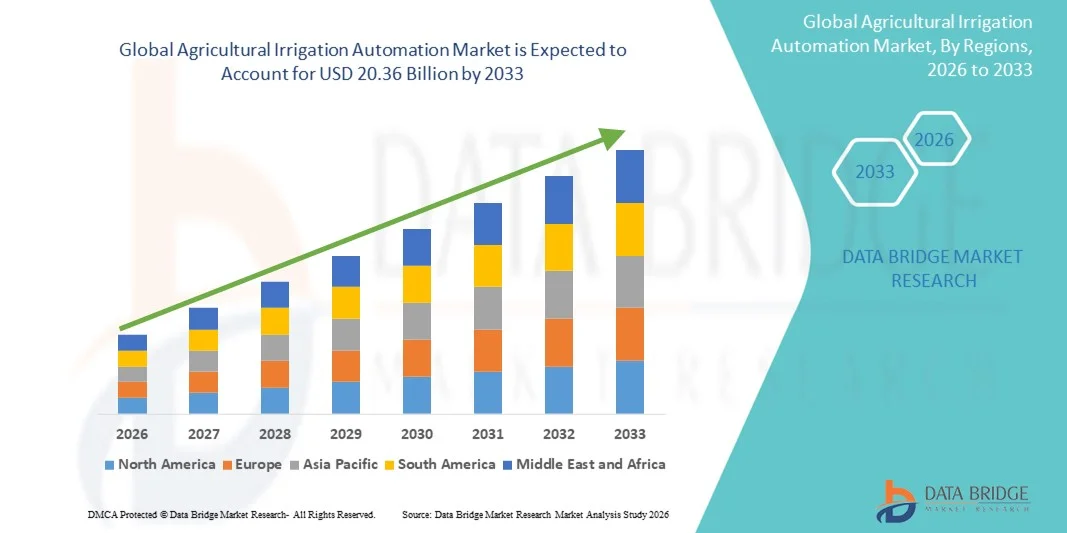
- As per Data Bridge Market Research Analysis the global Agricultural Irrigation Automation Market was valued at USD 6.38 billion in 2025 and is projected to reach USD 20.36 billion by 2033, expanding at a CAGR of 15.60% during the forecast period.
- Market growth is primarily driven by the rising integration of advanced technologies such as IoT, sensors, and data-driven systems, which are transforming traditional irrigation practices and increasing digitalization across agricultural operations.
- Additionally, the growing need for efficient, user-friendly, and interconnected irrigation solutions is positioning automated systems as the preferred choice for modern farm management. These combined influences are accelerating the adoption of irrigation automation technologies, significantly propelling industry growth.
Market Size & Forecast
- Global Market Value (2025): USD 6.38 billion
- Expected Market Value (2033): USD 20.36 billion
- Forecast CAGR (2026–2033): 5.60%
Global Agricultural Irrigation Automation Market Analysis
- Automated irrigation systems, which enable precise, data-driven control of water distribution across farms, are becoming essential components of modern agricultural practices in both small-scale and large-scale operations due to their enhanced efficiency, remote monitoring capabilities, and seamless integration with IoT-enabled farm management platforms.
- The rising demand for irrigation automation is primarily driven by the growing adoption of smart farming technologies, increasing concerns over water scarcity, and a heightened preference for systems that reduce labor requirements while improving crop productivity.
- Asia-Pacific dominated the Global Agricultural Irrigation Automation Market with the largest revenue share of 33.5% in 2025, supported by early adoption of precision agriculture, high investment capacity among farmers, and the strong presence of leading technology providers. The U.S. witnessed substantial growth in automated irrigation deployments, particularly in large commercial farms and tech-enabled agricultural enterprises, driven by innovations in sensors, analytics, and cloud-based control systems.
- North America is expected to be the fastest-growing region in the Global Agricultural Irrigation Automation Market during the forecast period, propelled by rapid agricultural modernization, expanding agricultural mechanization, and increasing government initiatives promoting water-efficient irrigation methods.
- The real-time feedback systems segment dominated the market with the largest revenue share of 38.5% in 2025, driven by the increasing adoption of soil moisture sensors, weather-based irrigation control, and IoT-enabled monitoring platforms.
Report Scope and Global Agricultural Irrigation Automation Market Segmentation
|
Attributes |
Agricultural Irrigation Automation Key Market Insights |
|
Segments Covered |
|
|
Countries Covered |
North America
Europe
Asia-Pacific
Middle East and Africa
South America
|
|
Key Market Players |
|
|
Market Opportunities |
|
|
Value Added Data Infosets |
In addition to the insights on market scenarios such as market value, growth rate, segmentation, geographical coverage, and major players, the market reports curated by the Data Bridge Market Research also include import export analysis, production capacity overview, production consumption analysis, price trend analysis, climate change scenario, supply chain analysis, value chain analysis, raw material/consumables overview, vendor selection criteria, PESTLE Analysis, Porter Analysis, and regulatory framework. |
What is the Key Trend in the Agricultural Irrigation Automation Market?
Enhanced Efficiency Through AI-Driven Irrigation Optimization
- A significant and accelerating trend in the global Agricultural Irrigation Automation Market is the deepening integration of artificial intelligence (AI) and advanced automation ecosystems, enabling farmers to achieve greater precision, efficiency, and control over water management. This convergence of technologies is transforming traditional irrigation into highly responsive, data-driven systems.
- For instance, AI-enabled irrigation controllers from companies such as Netafim and Jain Irrigation Systems analyze weather forecasts, soil moisture data, and crop requirements in real time to automatically adjust watering schedules. Similarly, systems developed by HydroPoint Data Systems integrate predictive analytics to optimize water usage while reducing waste.
- AI integration in irrigation automation allows capabilities such as learning field-specific moisture patterns, identifying potential irrigation inefficiencies, and generating intelligent alerts for anomalies such as leaks or irregular flow rates. Some sensor-based platforms utilize machine learning to refine irrigation timing and volume over multiple growing seasons. Additionally, remote automation features allow farmers to adjust irrigation settings hands-free using mobile apps or connected interfaces.
- The seamless integration of irrigation automation with broader smart farming platforms supports centralized control over multiple farm operations. Through a single dashboard, users can manage irrigation alongside crop health monitoring, weather analytics, and field activity tracking, creating a unified and automated agricultural ecosystem.
- This trend toward more intelligent, intuitive, and interconnected irrigation systems is fundamentally reshaping expectations for modern agriculture. As a result, companies such as Lindsay Corporation and Valmont Industries are developing AI-powered irrigation solutions with automated decision-making, real-time monitoring, and compatibility with major farm management systems.
- The demand for AI-driven and fully automated irrigation solutions is growing rapidly across both small and large farming operations, as producers increasingly prioritize water conservation, productivity gains, and seamless smart farming functionality.
Global Agricultural Irrigation Automation Market Dynamics
Driver
Growing Need Due to Rising Water Scarcity and Smart Farming Adoption
- The increasing pressure of water scarcity worldwide, combined with the accelerating adoption of smart farming ecosystems, is a major driver for the rising demand for automated irrigation solutions.
- For instance, in 2025, several leading players such as Valmont Industries and Netafim expanded their IoT-based irrigation platforms by incorporating advanced soil and climate sensors, enabling farmers to make more accurate, real-time water management decisions. Such developments are expected to strengthen the growth of the irrigation automation market throughout the forecast period.
- As farmers become more aware of the risks associated with inefficient water use and fluctuating climate conditions, automated irrigation systems offer significant advantages through remote monitoring, precise water distribution, and early detection of irrigation issues—representing a major upgrade over manual irrigation practices.
- Moreover, the expanding adoption of smart farming technologies and the growing preference for integrated digital agriculture platforms are making automated irrigation systems an essential part of modern farm management. Their ability to synchronize with sensors, weather stations, and farm management software further enhances operational efficiency.
- The convenience of automated scheduling, remote adjustment of irrigation parameters, and the ability to manage large farm areas through mobile or cloud-based applications are key factors accelerating adoption in both small and large farming operations. The rising popularity of DIY farm technology kits and the availability of user-friendly control interfaces also contribute to market growth.
Restraint/Challenge
Concerns Regarding Cybersecurity and High Initial Costs
- Concerns surrounding the cybersecurity vulnerabilities of connected agricultural devices, including automated irrigation systems, pose a notable challenge to broader market penetration. As these systems rely on wireless networks, cloud platforms, and software, they can be susceptible to unauthorized access or data breaches—raising concerns among farmers about the security of their operational data.
- For instance, reports of vulnerabilities in various IoT-based farm management devices have made some agricultural operators cautious about fully transitioning to automation-dependent systems.
- Addressing these cybersecurity issues through robust encryption, secure data protocols, and regularly updated firmware is essential for strengthening farmer confidence. Companies such as Lindsay Corporation and HydroPoint emphasize advanced cybersecurity features in their platforms to reassure users. Additionally, the relatively high initial investment required for automated irrigation—especially systems integrated with sensors, controllers, and data analytics—can be a barrier for cost-sensitive farmers in developing regions.
- While basic irrigation timers and low-cost automation modules have become more accessible, premium systems equipped with AI analytics, multi-sensor networks, and advanced remote-control capabilities still carry a higher price tag.
- Although prices are gradually decreasing due to technological advancements, the perceived financial burden of high-end automation systems continues to limit adoption among smaller farms. Overcoming these challenges through more affordable product offerings, stronger cybersecurity measures, and farmer education on long-term cost savings will be essential for sustaining market growth.
Global Agricultural Irrigation Automation Market Scope
Agricultural irrigation automation market is segmented on the basis of automation type, system, irrigation type, end-use and component.
- By Automation Type
On the basis of automation type, the Global Agricultural Irrigation Automation Market is segmented into time-based systems, volume-based systems, real-time feedback systems, and computer-based irrigation control systems. The real-time feedback systems segment dominated the market with the largest revenue share of 38.5% in 2025, driven by the increasing adoption of soil moisture sensors, weather-based irrigation control, and IoT-enabled monitoring platforms. Farmers prefer these systems because they automatically adjust water flow based on field conditions, enabling precise irrigation and reducing water wastage. The ability to monitor irrigation performance in real time, generate alerts, and maintain optimal soil moisture levels has positioned real-time feedback systems as the most reliable and efficient automation solution.
The computer-based irrigation control systems segment is projected to witness the fastest growth rate of 22.3% from 2026 to 2033, fueled by advancements in AI-driven analytics, cloud-enabled dashboards, and predictive irrigation technologies that allow farmers to optimize water usage across large farm areas.
- By System
On the basis of system type, the market is divided into automatic and semi-automatic irrigation automation systems. The automatic systems segment dominated the market with the largest revenue share of 57.4% in 2025, supported by the growing transition toward fully autonomous irrigation technologies that minimize labor dependency and increase water-use efficiency. These systems automatically adjust irrigation schedules based on real-time climate conditions, crop needs, and soil parameters, making them suitable for large-scale agriculture and commercial farming operations. Their compatibility with wireless sensors, smart controllers, and mobile applications further enhances convenience and operational efficiency.
The semi-automatic systems segment is anticipated to witness the fastest CAGR of 20.7% from 2026 to 2033, driven by their affordability and suitability for small and medium-sized farms. Semi-automatic systems provide a blend of manual control and automated functionalities, appealing to farmers who seek cost-effective irrigation improvements without fully transitioning to high-investment automated systems.
- By Irrigation Type
On the basis of irrigation type, the Global Agricultural Irrigation Automation Market is segmented into drip irrigation, sprinkler irrigation, and surface irrigation. The drip irrigation segment dominated the market with the largest revenue share of 46.1% in 2025, driven by its superior water efficiency and targeted water delivery directly to plant roots. Drip systems reduce evaporation losses and water runoff, making them ideal for water-scarce regions and high-value crops such as fruits, vegetables, and vineyards. Their strong compatibility with controllers, sensors, and fertigation units enhances adoption across modern farming environments.
The sprinkler irrigation segment is expected to witness the fastest CAGR of 21.9% from 2026 to 2033, fueled by widespread adoption in large open fields and for crops requiring uniform water coverage. Automated sprinkler systems are favored for their scalability, easy installation, and integration with weather-based automation systems that adjust watering schedules dynamically.
- By End-Use
On the basis of end-use, the market is segmented into open fields and greenhouses. The open fields segment dominated the market with the largest revenue share of 64.3% in 2025, attributed to the extensive application of automated irrigation solutions across large farmlands cultivating cereals, oilseeds, pulses, and commercial crops. Farmers benefit from automated irrigation through reduced labor needs, uniform water distribution, and improved crop yield. Advancements in remote-controlled systems, wireless monitoring tools, and IoT-based irrigation platforms continue to reinforce adoption in open-field farming.
The greenhouses segment is expected to register the fastest CAGR of 23.1% from 2026 to 2033, driven by the growing shift toward controlled-environment agriculture and high-value crops. Greenhouse operations require precise irrigation, humidity control, and nutrient dosing—making automation essential. Integration of soil-based sensors, climate sensors, and fertigation systems further supports the rapid growth of irrigation automation in modern greenhouse farming.
- By Component
On the basis of component, the market is segmented into controllers, sensors, weather-based devices, soil-based devices, fertigation sensors, valves, sprinklers, and other components. The controllers segment dominated the market with the largest revenue share of 35.8% in 2025, due to their central role in managing irrigation schedules, analyzing sensor inputs, and enabling multi-zone watering management. Controllers equipped with AI algorithms, mobile connectivity, and cloud-based automation platforms are increasingly preferred across commercial farms. Their ability to integrate data from soil moisture sensors, weather forecasts, and crop requirements positions them as the backbone of advanced irrigation automation.
The sensors segment—including soil moisture, temperature, humidity, and flow sensors—is expected to witness the fastest CAGR of 24.4% from 2026 to 2033, driven by the rising adoption of precision agriculture. Real-time monitoring enabled through sensors enhances decision-making, reduces water consumption, and improves crop productivity, supporting widespread deployment across both open-field and greenhouse environments.
Global Agricultural Irrigation Automation Market Regional Analysis
- Asia-Pacific dominated the Global Agricultural Irrigation Automation Market with the largest revenue share of 33.5% in 2025, driven by rising adoption of precision agriculture technologies, increasing labor shortages in farming, and growing awareness about the benefits of automated irrigation systems.
- Farmers in the region highly value the efficiency, water conservation, and real-time monitoring capabilities offered by automated irrigation solutions, along with their seamless integration with sensors, weather stations, and farm management platforms.
- This widespread adoption is further supported by high agricultural investment capacity, strong technological infrastructure, and growing emphasis on sustainable farming practices. The region’s preference for data-driven crop management and remote irrigation control has positioned automation as a favored solution for both large-scale farming operations and greenhouse environments.
U.S. Agricultural Irrigation Automation Market Insight
The U.S. agricultural irrigation automation market captured the largest revenue share of 81% in 2025 within North America, driven by the increasing adoption of precision farming technologies and automated irrigation solutions. Farmers are prioritizing water-use efficiency, labor reduction, and real-time monitoring capabilities provided by modern irrigation systems. The growing trend of smart farming, supported by mobile application integration and IoT-enabled controllers, is accelerating the market. Moreover, government initiatives promoting sustainable water management and subsidies for high-tech irrigation systems further contribute to the market’s expansion. The integration of weather-based irrigation scheduling and soil moisture sensors allows large-scale farms and greenhouse operators to optimize crop yields and resource utilization, strengthening adoption across the country.
Europe Agricultural Irrigation Automation Market Insight
The Europe market is projected to expand at a significant CAGR during the forecast period, primarily driven by water conservation policies, increasing labor costs, and the growing adoption of precision agriculture. Farmers and commercial growers are investing in automated irrigation systems that reduce water wastage and improve crop productivity. Urbanization and the rise of controlled-environment agriculture, particularly in greenhouse operations, are further fueling market growth. Countries such as France, Spain, and Italy are seeing increased deployment of smart irrigation solutions for high-value crops, with integration of IoT, cloud-based monitoring, and fertigation systems supporting efficient water and nutrient management.
U.K. Agricultural Irrigation Automation Market Insight
The U.K. market is expected to grow at a noteworthy CAGR during the forecast period, driven by the rising demand for water-efficient irrigation technologies and the shift towards modern, automated farming practices. Concerns about water scarcity, sustainability, and climate variability are encouraging farmers to adopt smart irrigation systems. Both open-field and greenhouse operations are increasingly implementing IoT-enabled controllers, sensors, and automated valves to optimize water application and crop yields. Government support, combined with a strong focus on sustainability and precision farming, is expected to stimulate continued market growth.
Germany Agricultural Irrigation Automation Market Insight
The Germany market is anticipated to expand at a considerable CAGR, supported by increasing awareness of water conservation, digital farming technologies, and advanced irrigation solutions. Germany’s well-developed agricultural infrastructure and emphasis on innovation promote the adoption of automated irrigation systems, particularly for high-value crops and controlled-environment agriculture. Integration with soil and weather-based sensors, as well as IoT-enabled farm management platforms, is becoming widespread. The country’s strong focus on sustainability, efficiency, and environmental compliance is driving farmers and commercial growers to adopt intelligent irrigation systems to optimize water usage and reduce operational costs.
Asia-Pacific Agricultural Irrigation Automation Market Insight
The Asia-Pacific market is poised to grow at the fastest CAGR of 24% from 2026 to 2032, driven by increasing population, urbanization, and rising demand for food security across countries such as China, India, and Japan. The region is witnessing rapid adoption of automated irrigation technologies to improve crop productivity and conserve water resources. Government initiatives promoting smart agriculture, coupled with growing investments in precision farming, are fueling market expansion. APAC is also emerging as a hub for manufacturing irrigation components, making automated solutions more affordable and accessible. Both open-field and greenhouse operations are increasingly integrating IoT-enabled controllers, sensors, and fertigation systems for optimized irrigation.
Japan Agricultural Irrigation Automation Market Insight
The Japan market is gaining momentum due to the country’s high-tech farming culture, limited arable land, and focus on sustainable agriculture. Farmers are increasingly adopting automated irrigation systems equipped with real-time soil and weather monitoring to maximize productivity and reduce water consumption. Integration with IoT devices and mobile applications allows remote management of irrigation schedules across farms and greenhouses. Japan’s aging farming population is also driving demand for user-friendly, automated irrigation systems that reduce manual labor while maintaining precision in water and nutrient application.
China Agricultural Irrigation Automation Market Insight
The China market accounted for the largest revenue share in Asia-Pacific in 2025, attributed to rapid urbanization, increasing farmland modernization, and growing adoption of smart farming technologies. Automated irrigation systems are becoming increasingly popular in both open-field and greenhouse cultivation, driven by the need for efficient water management and higher crop yields. Government initiatives supporting precision agriculture, coupled with strong domestic manufacturing of controllers, sensors, and valves, are enhancing the affordability and availability of automated irrigation solutions. The push toward smart agriculture and sustainability, alongside a large consumer base of commercial farms, continues to propel market growth in China.
Which are the Top Companies in Agricultural Irrigation Automation Market?
The Agricultural Irrigation Automation industry is primarily led by well-established companies, including:
- Netafim Ltd. (Israel)
- Rain Bird Corporation (U.S.)
- Lindsay Corporation (U.S.)
- Jain Irrigation Systems Ltd. (India)
- Valmont Industries Inc. (U.S.)
- Toro Company (U.S.)
- Xylem Inc. (U.S.)
- The Climate Corporation (U.S.)
- HydroPoint Data Systems (U.S.)
- Irritec S.p.A. (Italy)
- Hunter Industries Inc. (U.S.)
- Antelco Pty Ltd. (Australia)
- Rivulis Irrigation (Israel)
- Toro Irrigation Solutions (U.S.)
- Ecorobotix (Switzerland)
- Networx Systems (U.S.)
- CropX (Israel)
- SmartFarm Technologies (India)
- AquaSpy (U.S.)
- GreenIQ (Israel)
What are the Recent Developments in Global Agricultural Irrigation Automation Market?
- In April 2024, Netafim Ltd., a global leader in irrigation solutions, launched a strategic initiative in South Africa to promote precision agriculture through its advanced automated irrigation systems. The initiative focuses on improving water efficiency and crop productivity for both smallholder and commercial farms. By leveraging its global expertise in smart irrigation technologies, Netafim is addressing regional agricultural challenges while strengthening its position in the rapidly expanding Global Agricultural Irrigation Automation Market.
- In March 2024, Rain Bird Corporation, a veteran-led company based in California, introduced its Smart Irrigation Pro 2.0 system for commercial farms and greenhouse operations. The system integrates real-time soil and weather data to optimize water usage, enhance crop yield, and reduce operational costs. This launch highlights Rain Bird’s commitment to advancing sustainable farming practices through intelligent irrigation technologies.
- In March 2024, Xylem Inc. successfully deployed the Bengaluru Smart Farm Project, aimed at enhancing agricultural efficiency and sustainability using automated irrigation solutions. The project utilizes IoT-enabled controllers, sensors, and fertigation systems to optimize water distribution and crop management. This initiative demonstrates Xylem’s dedication to leveraging smart technology to support modern, sustainable farming practices in urban and peri-urban environments.
- In February 2024, Lindsay Corporation, a leading provider of irrigation automation solutions, announced a strategic partnership with the Indian Council of Agricultural Research (ICAR) to implement precision irrigation systems for research farms. The collaboration aims to improve water management, crop productivity, and data-driven farm decision-making. This initiative underscores Lindsay’s focus on innovation and operational efficiency in agriculture.
- In January 2024, Valmont Industries Inc., a global leader in center-pivot irrigation solutions, unveiled its Valley Smart Connect IoT Platform at the International Agri-Tech Expo 2024. The platform enables remote monitoring and control of irrigation systems via cloud-based dashboards and mobile apps. This launch highlights Valmont’s commitment to integrating advanced technology into irrigation systems, providing farmers with enhanced convenience, precision, and sustainable water management solutions.

- Interactive Data Analysis Dashboard
- Company Analysis Dashboard for high growth potential opportunities
- Research Analyst Access for customization & queries
- Competitor Analysis with Interactive dashboard
- Latest News, Updates & Trend analysis
- Harness the Power of Benchmark Analysis for Comprehensive Competitor Tracking
Data collection and base year analysis are done using data collection modules with large sample sizes. The stage includes obtaining market information or related data through various sources and strategies. It includes examining and planning all the data acquired from the past in advance. It likewise envelops the examination of information inconsistencies seen across different information sources. The market data is analysed and estimated using market statistical and coherent models. Also, market share analysis and key trend analysis are the major success factors in the market report. To know more, please request an analyst call or drop down your inquiry.
The key research methodology used by DBMR research team is data triangulation which involves data mining, analysis of the impact of data variables on the market and primary (industry expert) validation. Data models include Vendor Positioning Grid, Market Time Line Analysis, Market Overview and Guide, Company Positioning Grid, Patent Analysis, Pricing Analysis, Company Market Share Analysis, Standards of Measurement, Global versus Regional and Vendor Share Analysis. To know more about the research methodology, drop in an inquiry to speak to our industry experts.
Data Bridge Market Research is a leader in advanced formative research. We take pride in servicing our existing and new customers with data and analysis that match and suits their goal. The report can be customized to include price trend analysis of target brands understanding the market for additional countries (ask for the list of countries), clinical trial results data, literature review, refurbished market and product base analysis. Market analysis of target competitors can be analyzed from technology-based analysis to market portfolio strategies. We can add as many competitors that you require data about in the format and data style you are looking for. Our team of analysts can also provide you data in crude raw excel files pivot tables (Fact book) or can assist you in creating presentations from the data sets available in the report.