What is the Agricultural Irrigation Filtration Systems Market Size and Growth Rate?
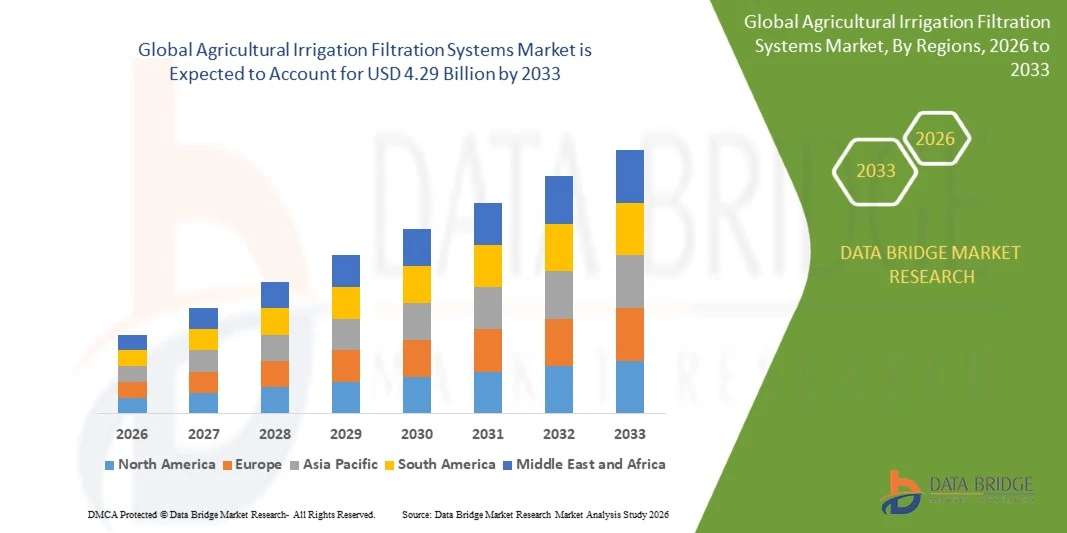
- As per Data Bridge Market Research analysis, the agricultural irrigation filtration systems market was valued at USD 2.35 billion in 2025 and is projected to reach USD 4.29 billion by 2033, growing at a CAGR of 7.80% from 2026 to 2033.
- The market is experiencing consistent growth driven by rising demand for efficient water management, increasing adoption of micro-irrigation systems, and growing emphasis on sustainable agricultural practices across water-intensive farming operations.
- Increasing water scarcity, declining groundwater availability, and the need to improve crop productivity are encouraging farmers to adopt advanced filtration systems. Disc, screen, and media filters help remove suspended solids and debris, prevent clogging of irrigation emitters, and reduce maintenance requirements. The growing use of drip irrigation, greenhouse farming, and automated self-cleaning filtration technologies is further supporting market expansion.
Market Size & Forecast
- Global Market Value (2025): USD 2.35 Billion
- Expected Market Value (2033): USD 4.29 Billion
- Forecast CAGR (2026–2033): 7.80%
- Leading Region in 2025: North America
- Fastest Growing Region: Asia Pacific
What are the Major Takeaways of the Agricultural Irrigation Filtration Systems Market?
- North America dominated the agricultural irrigation filtration systems market with the largest revenue share of 30% in 2025, supported by advanced agricultural infrastructure, widespread adoption of precision irrigation, and increasing investments in water-efficient farming technologies.
- Asia-Pacific is expected to be the fastest-growing region at a CAGR of 8.6% from 2026 to 2033, fueled by rising water scarcity, government support for micro-irrigation, expanding agricultural production, and increasing adoption of modern irrigation technologies in China and India
- The disc filters segment led the market with a 31.4% share in 2025, driven by its effective removal of suspended particles and versatility across agricultural irrigation application
- Cartridge filters are the fastest-growing filtration type, projected to register a CAGR of 8.6%, reflecting the surge in demand for precise filtration in specialized irrigation applications.
- The plastic filters segment dominated the filter material category with a 60% revenue share in 2025, led by its affordability, lightweight construction, and resistance to corrosion from water and commonly used agricultural nutrients.
- Drip irrigation accounted for 45% of the market share in 2025, preferred by its widespread use in water-efficient farming and precision agriculture.
- The greenhouse irrigation segment is the fastest-growing application category, with a CAGR of 9.4%, driven by expansion of controlled-environment agriculture.
Report Scope and Agricultural Irrigation Filtration Systems Market Segmentation
|
Attributes |
Agricultural Irrigation Filtration Systems Key Market Insights |
|
Segments Covered |
|
|
Countries Covered |
North America
Europe
Asia-Pacific
Middle East and Africa
South America
|
|
Key Market Players |
|
|
Market Opportunities |
|
|
Value Added Data Infosets |
In addition to the insights on market scenarios such as market value, growth rate, segmentation, geographical coverage, and major players, the market reports curated by the Data Bridge Market Research also include import export analysis, production capacity overview, production consumption analysis, price trend analysis, climate change scenario, supply chain analysis, value chain analysis, raw material/consumables overview, vendor selection criteria, PESTLE Analysis, Porter Analysis, and regulatory framework. |
What is the Key Trend in the Agricultural Irrigation Filtration Systems Market?
- Agricultural irrigation filtration manufacturers are increasingly developing automatic self-cleaning filters to improve filtration efficiency, reduce manual maintenance, and maintain consistent water flow in modern irrigation networks.
- For instance, in November 2024, Tavlit introduced its TIS Automatic Self-Cleaning Screen Filter at EIMA International, featuring a compact polymeric design, low-energy operation, and a cleaning mechanism designed to reduce water consumption and maintenance.
- Advanced filtration technologies help remove suspended particles and organic contaminants, protecting drip emitters and sprinkler nozzles from clogging while supporting reliable irrigation performance.
- For instance, in May 2021, Netafim launched its AlphaDisc intelligent automated filter, developed in partnership with Amiad, featuring advanced depth filtration, a modular design, and remote monitoring capabilities to protect irrigation systems against organic contaminants.
- Farmers and irrigation equipment manufacturers are increasingly integrating filtration with precision irrigation systems to improve water-use efficiency and reduce operational interruptions across agricultural operations.
What are the Key Drivers of the Agricultural Irrigation Filtration Systems Market?
- The rising water scarcity and the need to improve agricultural water-use efficiency are increasing demand for filtration systems that enable reliable drip and sprinkler irrigation while reducing clogging and water losses.
- For instance, in April 2025, the Government of India approved the Modernization of Command Area Development and Water Management (M-CADWM) scheme with an initial outlay of INR 1,600 crore, focusing on pressurized irrigation infrastructure and improved water-use efficiency, which can support demand for compatible agricultural filtration systems.
- Agricultural filtration systems help remove suspended solids, algae, and other contaminants that can obstruct emitters, damage irrigation components, and reduce uniform water distribution across crop fields.
- For instance, in January 2025, India's Economic Survey 2024–25 reported that irrigation coverage increased from 49.3% to 55% of gross cropped area between FY2015–16 and FY2020–21, highlighting the expansion of irrigation infrastructure and the associated need for effective water filtration to protect irrigation equipment.
- As farmers increasingly adopt micro-irrigation and water-conservation practices, demand for reliable filtration solutions is expected to strengthen, supporting more efficient water delivery and sustainable agricultural productivity.
What Factors are Challenging the Growth of the Agricultural Irrigation Filtration Systems Market?
- Agricultural irrigation filtration systems involve upfront equipment costs, installation expenses, and recurring maintenance requirements, creating financial barriers for farmers operating on limited budgets.
- For instance, in June 2026, a study published in Irrigation and Drainage examined barriers to micro-irrigation adoption in four Indian states, highlighting the importance of financial support, subsidies, and after-sales services in overcoming adoption challenges.
- These costs can restrict adoption among small and marginal farmers, particularly in developing regions where access to agricultural financing and advanced irrigation infrastructure remains limited.
- Filtration performance also depends on appropriate filter selection, regular cleaning, and maintenance suited to the quality of available irrigation water, increasing the operational burden on farms with limited technical support.
- For instance, in May 2021, the World Bank published its overview of Farmer-Led Irrigation Development, identifying limited access to finance, technology, knowledge, and markets as constraints affecting smallholder farmers' ability to expand irrigation infrastructure.
- The combination of installation costs, maintenance demands, and technical requirements continues to challenge widespread adoption, particularly among smaller agricultural operations and price-sensitive markets.
How is the Agricultural Irrigation Filtration Systems Market Segmented?
The agricultural irrigation filtration systems market is segmented on the basis of filtration type, filter material, application, and end user.
- By Filtration Type
On the basis of filtration type, the agricultural irrigation filtration systems market is segmented into disc filters, screen filters, media filters (sand filters), hydrocyclone filters, cartridge filters, and other filtration systems. The disc filters segment dominated the market with 31.4% share in 2025, owing to its effective removal of suspended particles and versatility across agricultural irrigation applications. Disc filters use stacked grooved discs to capture contaminants as water passes through the filtration element. They are widely used in drip and micro-irrigation systems where clean water is essential to prevent emitter clogging. Their compact design and compatibility with automated cleaning mechanisms support their use across different farm sizes
The cartridge filters segment is projected to register the fastest growth at a CAGR of 8.6% during the forecast period, driven by rising demand for precise filtration in specialized irrigation applications. Cartridge filters capture fine particles and help protect sensitive irrigation components from blockage. They are suitable for greenhouse cultivation, nurseries, and selected fertigation operations. Improvements in filter media and cartridge designs are supporting better filtration performance and easier replacement. Their use is particularly relevant where water contains fine suspended solids requiring additional treatment. Increasing adoption of controlled-environment agriculture is expected to support segment growth.
- By Filter Material
On the basis of filter material, the agricultural irrigation filtration systems market is segmented into plastic filters, stainless steel filters, carbon steel filters, and other filter materials. The plastic filters segment is estimated to dominate the market with 60% share in 2025, owing to its affordability, lightweight construction, and resistance to corrosion from water and commonly used agricultural nutrients. Plastic filter housings are widely used in disc and screen filtration systems for drip and micro-irrigation applications. Their relatively low manufacturing and transportation costs make them suitable for farms of different sizes. Compatibility with automated filtration systems further supports their adoption in modern irrigation networks.
The stainless steel filters segment is projected to grow at a CAGR of 7.5% during the forecast period, driven by demand for durable filtration equipment in demanding agricultural environments. Stainless steel components offer resistance to corrosion, mechanical stress, and repeated cleaning cycles. They are suitable for high-pressure irrigation installations and applications involving challenging water conditions. Their strength makes them useful in filtration equipment designed for continuous operation and automated backwashing. Increasing demand for long-lasting equipment may support adoption despite higher initial costs than plastic alternatives. Improvements in filter construction and corrosion-resistant materials can further enhance their suitability for demanding agricultural applications.
- By Application
On the basis of application, the agricultural irrigation filtration systems market is segmented into drip irrigation, micro-sprinkler irrigation, sprinkler irrigation, greenhouse irrigation, flood and surface irrigation, and other agricultural irrigation applications. The drip irrigation segment is estimated to account for 45% share in 2025, supported by its widespread use in water-efficient farming and precision agriculture. Drip irrigation delivers water directly to plant roots through emitters and pipelines, making effective filtration essential for preventing blockages. Filtration systems remove sediments, organic matter, and suspended particles that can disrupt water distribution. Growing cultivation of fruits, vegetables, and other high-value crops further supports demand for dependable filtration. Integration with fertigation equipment increases the importance of maintaining clean irrigation water.
The greenhouse irrigation segment is projected to register the fastest growth at CAGR of 9.4% during the forecast period, driven by expansion of controlled-environment agriculture. Greenhouse operations require consistent water quality to support precise irrigation schedules and uniform crop development. Filtration systems help protect emitters, valves, and nutrient delivery equipment from contamination and clogging. Increasing cultivation of vegetables, berries, flowers, and other high-value crops under protected conditions supports demand for advanced filtration. Recirculating irrigation systems also require effective filtration to remove suspended particles before water is reused. Integration with automated fertigation and irrigation controls further increases the need for reliable filtration technologies.
- By End User
On the basis of end user, the agricultural irrigation filtration systems market is segmented into commercial farms, small and medium-sized farms, large-scale agricultural enterprises, greenhouses and nurseries, horticulture and plantation farms, and other agricultural users. The commercial farms segment is estimated to account for 55.2% share in 2025, supported by the extensive irrigation infrastructure required for commercial crop production. These farms often operate large irrigation networks where sediment accumulation can affect water distribution and crop performance. Filtration systems help protect drip lines, sprinkler nozzles, and fertigation equipment from clogging. Commercial operators also benefit from reduced maintenance interruptions and more consistent irrigation performance. Growing adoption of precision agriculture and automated irrigation systems is supporting investment in filtration equipment.
The greenhouses and nurseries segment is projected to grow at CAGR of 9.4% during the forecast period, driven by the expansion of protected cultivation and high-value crop production. These operations require carefully controlled water delivery to maintain uniform growing conditions and plant health. Filtration systems help prevent fine particles and organic contaminants from obstructing small irrigation outlets. Increasing use of fertigation, automated irrigation controls, and recirculated water systems is strengthening the need for dependable filtration. Nurseries also require consistent irrigation performance to support seedling establishment and plant propagation. Demand for efficient water management in specialized crop production is encouraging investment in advanced filtration solutions.
Which Region Holds the Largest Share of the Agricultural Irrigation Filtration Systems Market?
- North America dominated the agricultural irrigation filtration systems market with the largest revenue share of 30% in 2025, supported by advanced agricultural infrastructure, widespread adoption of precision irrigation, and increasing investments in water-efficient farming technologies.
- The region also benefits from established irrigation equipment distribution networks, growing adoption of automated self-cleaning filtration systems, and increasing demand for reliable filtration in drip and sprinkler irrigation applications. Persistent water scarcity in parts of the United States, investment in modern irrigation infrastructure, and emphasis on improving agricultural water-use efficiency continue to strengthen North America's position in the global market.
U.S. Agricultural Irrigation Filtration Systems Market Insight
The U.S. agricultural irrigation filtration systems market is witnessing steady growth due to rising investments in water-efficient farming practices, precision irrigation technologies, and sustainable agricultural water management. The country’s advanced agricultural infrastructure, along with increasing adoption of drip irrigation, sprinkler systems, and automated filtration technologies, is driving demand across commercial farms, greenhouses, and large-scale agricultural operations. In addition, growing concerns regarding water scarcity, emitter clogging, and efficient fertilizer delivery are accelerating the adoption of reliable filtration solutions.
Asia-Pacific Agricultural Irrigation Filtration Systems Market Insight
The Asia-Pacific agricultural irrigation filtration systems market is expected to witness rapid growth, driven by increasing agricultural modernization, expanding micro-irrigation infrastructure, and rising investments in water conservation across countries such as China, India, and Australia. Growing awareness regarding efficient water use, increasing adoption of drip and sprinkler irrigation, and government initiatives supporting modern farming practices are supporting regional market expansion. In addition, rising demand for filtration systems compatible with fertigation and precision agriculture is accelerating adoption across commercial farms, horticulture, and greenhouse operations.
Japan Agricultural Irrigation Filtration Systems Market Insight
The Japan agricultural irrigation filtration systems market is witnessing consistent growth due to rising investments in precision agriculture, efficient water management, and advanced irrigation technologies. Farmers, greenhouse operators, and agricultural enterprises are increasingly adopting filtration systems to maintain water quality, prevent irrigation equipment blockages, and improve crop production efficiency. Moreover, increasing use of automated filtration solutions, fertigation systems, and resource-efficient farming practices is further contributing to market growth in Japan.
China Agricultural Irrigation Filtration Systems Market Insight
The China agricultural irrigation filtration systems market is growing rapidly, driven by increasing concerns regarding water scarcity, expanding micro-irrigation infrastructure, and government efforts to improve agricultural water-use efficiency. Farmers and agricultural enterprises are increasingly adopting screen, disc, and automated filtration systems to support drip irrigation, protect irrigation equipment, and improve crop productivity. In addition, ongoing agricultural modernization and rising demand for efficient water management technologies are strengthening market growth across China.
U.K. Agricultural Irrigation Filtration Systems Market Insight
The U.K. agricultural irrigation filtration systems market is experiencing steady growth, supported by increasing adoption of water-efficient irrigation technologies, sustainable farming practices, and modern agricultural infrastructure. Farms, horticultural businesses, and greenhouse operators are increasingly using filtration systems to maintain irrigation water quality, reduce clogging, and support reliable drip and sprinkler irrigation. Furthermore, growing interest in precision agriculture, water conservation, and automated filtration solutions is contributing to market development across the U.K.
Germany Agricultural Irrigation Filtration Systems Market Insight
The Germany agricultural irrigation filtration systems market is expanding steadily due to increasing emphasis on efficient water management, agricultural modernization, and sustainable crop production. Commercial farms, greenhouse operators, and horticultural enterprises are adopting advanced filtration systems to prevent irrigation blockages, improve water distribution, and support fertigation applications. Continuous advancements in automated filtration, precision irrigation, and water-reuse technologies, alongside growing concerns about water availability and resource efficiency, are further supporting market growth in Germany.
Which are the Top Companies in Agricultural Irrigation Filtration Systems Market?
The agricultural irrigation filtration systems industry is primarily led by well-established companies, including:
- Amiad Water Systems Ltd. (Israel)
- SISTEMA AZUD, S.A. (Spain)
- Jain Irrigation Systems Limited (India)
- Orbia Advance Corporation, S.A.B. de C.V. (Mexico)
- Rivulis Pte. Ltd. (Singapore)
- The Toro Company (U.S.)
- Rain Bird Corporation (U.S.)
- Lindsay Corporation (U.S.)
- BERMAD CS Ltd. (Israel)
- TAVLIT Plastic Products (Israel)
- YAMIT Filtration & Water Treatment Ltd. (Israel)
- STF-Filters (Spain)
- Forsta Filters, Inc. (U.S.)
- LAMA Sistemas de Filtrado, S.L. (Spain)
- Chinadrip Irrigation Equipment Co., Ltd. (China)
- Antelco Pty Ltd (Australia)
- ELGO Irrigation Ltd. (Israel)
- Metzer Group (Israel)
- Senninger Irrigation, Inc. (U.S.)
- T-L Irrigation Co. (U.S.)
What are Latest Developments in Agricultural Irrigation Filtration Systems Market?
- In April 2025, GreenPlains announced a new filter-hydrocyclone product series designed to improve water filtration for agricultural irrigation systems. The system combines centrifugal separation with automated filtration to remove sand and sediment from irrigation water, helping protect pumps, pipelines, sprinklers, and drip-line emitters from blockages and abrasion.
- In February 2025, Orbia's Precision Agriculture business, Netafim, launched its Hybrid Dripline system, an irrigation innovation that integrates a built-in outlet into an integral dripline. The technology combines features of inline and online dripper systems to provide a clog-resistant solution while reducing labor-intensive installation tasks. Initially introduced within the UniRam dripline range, the system is designed for applications such as greenhouses, orchards, and vineyards, where consistent water delivery and reliable operation are essential.
- In November 2024, Tavlit Smart Filtration showcased its TIS Automatic Self-Cleaning Screen Filter at EIMA International 2024. The filter was developed for agricultural and industrial water applications, with a compact polymeric construction designed to resist corrosion, chemicals, and ultraviolet exposure. Its automatic suction-scanning cleaning mechanism is intended to reduce water and energy consumption during flushing while maintaining filtration performance without interrupting irrigation.
- In January 2023, Netafim USA announced plans to introduce its Hydrocyclone filter to the U.S. market during 2023. The company highlighted the technology at the Southeast Regional Fruit & Vegetable Conference, explaining that its conical separator accelerates water flow to separate sand and other solid particles before they damage irrigation components. The announcement also featured the company's AlphaDisc filter, which protects irrigation systems against clogging caused by organic contaminants.
- In May 2021, Netafim launched its AlphaDisc intelligent automated filter, developed in partnership with Amiad Water Systems to protect irrigation equipment from clogging caused by organic contaminants. The filtration system incorporates precision depth filtration, high dirt-holding capacity, a modular design, and a smart controller that provides access to filtration data. Its design aims to reduce backflushing requirements, minimize water and energy losses, and adapt to changing water quality and flow conditions.
- Interactive Data Analysis Dashboard
- Company Analysis Dashboard for high growth potential opportunities
- Research Analyst Access for customization & queries
- Competitor Analysis with Interactive dashboard
- Latest News, Updates & Trend analysis
- Harness the Power of Benchmark Analysis for Comprehensive Competitor Tracking
Data collection and base year analysis are done using data collection modules with large sample sizes. The stage includes obtaining market information or related data through various sources and strategies. It includes examining and planning all the data acquired from the past in advance. It likewise envelops the examination of information inconsistencies seen across different information sources. The market data is analysed and estimated using market statistical and coherent models. Also, market share analysis and key trend analysis are the major success factors in the market report. To know more, please request an analyst call or drop down your inquiry.
The key research methodology used by DBMR research team is data triangulation which involves data mining, analysis of the impact of data variables on the market and primary (industry expert) validation. Data models include Vendor Positioning Grid, Market Time Line Analysis, Market Overview and Guide, Company Positioning Grid, Patent Analysis, Pricing Analysis, Company Market Share Analysis, Standards of Measurement, Global versus Regional and Vendor Share Analysis. To know more about the research methodology, drop in an inquiry to speak to our industry experts.
Data Bridge Market Research is a leader in advanced formative research. We take pride in servicing our existing and new customers with data and analysis that match and suits their goal. The report can be customized to include price trend analysis of target brands understanding the market for additional countries (ask for the list of countries), clinical trial results data, literature review, refurbished market and product base analysis. Market analysis of target competitors can be analyzed from technology-based analysis to market portfolio strategies. We can add as many competitors that you require data about in the format and data style you are looking for. Our team of analysts can also provide you data in crude raw excel files pivot tables (Fact book) or can assist you in creating presentations from the data sets available in the report.