What is the Agricultural Residue-Based Packaging Materials Market Size and Growth Rate?
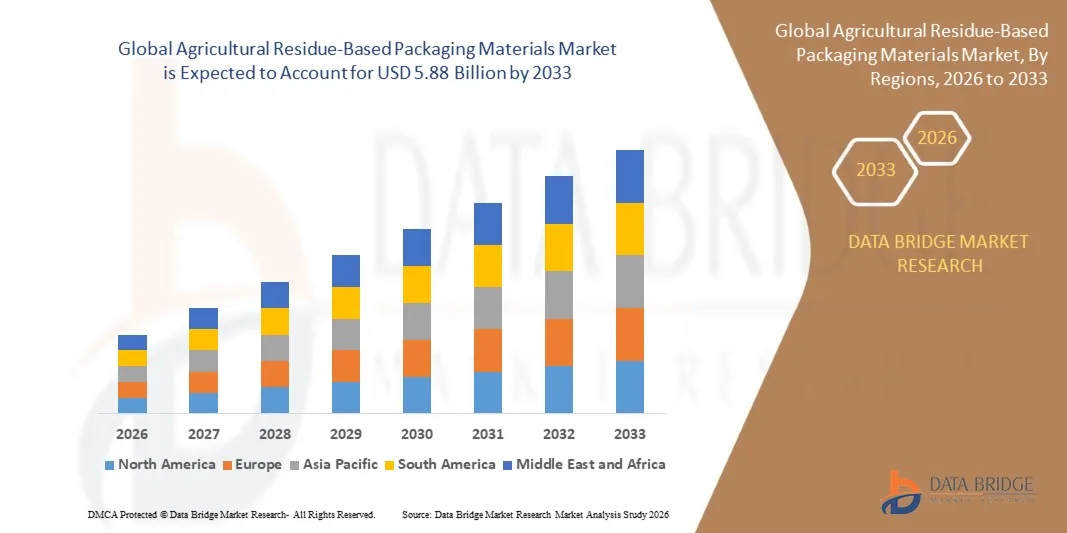
- As per Data Bridge Market Research analysis, the agricultural residue-based packaging materials market was valued at USD 3.70 billion in 2025 and is projected to reach USD 5.88 billion by 2033, growing at a CAGR of 11.35% from 2026 to 2033.
- The market is experiencing consistent growth driven by rising demand for eco-friendly packaging solutions, advancements in agricultural waste processing technologies, and expanding applications across food and beverage, consumer goods, and e-commerce packaging.
- The increasing volume of agricultural waste globally, combined with stricter environmental regulations and growing efforts to reduce plastic pollution, is compelling manufacturers to adopt packaging materials derived from sugarcane bagasse, rice husks, wheat straw, and other agricultural residues. Paper-based, molded fiber, and bio-based packaging solutions are gaining traction as alternatives to conventional plastics, offering opportunities to improve waste utilization, support circular economy practices, and reduce dependence on fossil-based raw materials.
Market Size & Forecast
- Global Market Value (2025): USD 3.70 Billion
- Expected Market Value (2033): USD 5.88 Billion
- Forecast CAGR (2026–2033): 11.35%
- Leading Region in 2025: North America
- Fastest Growing Region: Asia Pacific
What are the Major Takeaways of the Agricultural Residue-Based Packaging Materials Market?
- North America dominated the agricultural residue-based packaging materials market with the largest revenue share of 37.2% in 2025, supported by established packaging infrastructure, rising demand for sustainable materials, and increasing investments in bio-based packaging solutions
- Asia-Pacific is expected to be the fastest-growing region at a CAGR of 11.3% from 2026 to 2033, fueled by expanding food processing industries, abundant agricultural residues, rising packaging demand, and growing adoption in China, India, and Japan. This range is an estimate rather than a verified market-specific forecast.
- The paper and paperboard segment led the market with a 52% share in 2025, driven by its renewability, recyclability, cost-effectiveness, and versatility across food and beverage, e-commerce, and consumer goods packaging
- Bioplastics are the fastest-growing material type, projected to register a CAGR of 14.16%, reflecting the surge in demand for sustainable packaging alternatives and growing adoption of bio-based materials derived from agricultural residues
- The sugarcane bagasse segment dominated the residue type category with a 41% revenue share in 2025, led by its abundant availability as a sugar industry by-product, low raw-material costs, and suitability for producing biodegradable paper, molded fiber containers, and foodservice packaging.
- Boxes and cartons accounted for 52% of the market share in 2025, preferred by food and beverage manufacturers, e-commerce companies, and consumer goods suppliers due to their durability, stackability, printability, and suitability for transportation and storage
- The e-commerce and protective packaging segment is the fastest-growing application category, with a CAGR of 11.13%, driven by the rapid expansion of online retail, rising demand for sustainable shipping materials, and increasing adoption of agricultural residue-based cushioning and protective inserts.
Report Scope and Agricultural Residue-Based Packaging Materials Market Segmentation
|
Attributes |
Agricultural Residue-Based Packaging Materials Key Market Insights |
|
Segments Covered |
|
|
Countries Covered |
North America
Europe
Asia-Pacific
Middle East and Africa
South America
|
|
Key Market Players |
|
|
Market Opportunities |
|
|
Value Added Data Infosets |
In addition to the insights on market scenarios such as market value, growth rate, segmentation, geographical coverage, and major players, the market reports curated by the Data Bridge Market Research also include import export analysis, production capacity overview, production consumption analysis, price trend analysis, climate change scenario, supply chain analysis, value chain analysis, raw material/consumables overview, vendor selection criteria, PESTLE Analysis, Porter Analysis, and regulatory framework. |
What is the Key Trend in the Agricultural Residue-Based Packaging Materials Market?
- Packaging manufacturers are increasingly adopting agricultural residue-based materials to develop sustainable alternatives to conventional plastic and wood-pulp packaging, while improving agricultural waste utilization and reducing environmental impacts.
- For instance, in October 2025, Pakka and Allimand announced a green paper production facility in Ayodhya, supporting the development of sustainable paper and flexible packaging materials derived from agricultural residues.
- Advances in fiber processing and material engineering are enabling manufacturers to convert sugarcane bagasse, rice straw, and wheat straw into packaging products with improved strength, durability, and functional performance.
- Foodservice providers and consumer goods companies are increasingly exploring molded fiber containers, compostable trays, and agricultural fiber-based packaging to reduce reliance on conventional single-use plastics.
- For instance, in May 2025, Pakka discussed its compostable food packaging solutions made primarily from sugarcane bagasse, highlighting the growing role of agricultural residues in sustainable food packaging.
- As businesses increasingly prioritize resource efficiency and sustainable packaging design, agricultural residue-based materials are expected to gain wider adoption across foodservice, e-commerce, and consumer goods applications, strengthening the transition toward circular packaging systems.
What are the Key Drivers of the Agricultural Residue-Based Packaging Materials Market?
- The growing emphasis on reducing plastic pollution and dependence on virgin wood pulp has significantly increased demand for packaging materials manufactured from agricultural residues, including wheat straw, rice husks, and sugarcane bagasse.
- For instance, in July 2025, researchers at the Indian Institute of Technology Madras developed mycelium-based biocomposites using agricultural and paper waste, demonstrating their potential as biodegradable alternatives to conventional plastic foam packaging.
- Food and beverage manufacturers, e-commerce companies, and packaging suppliers are integrating agricultural residue-based materials into their product development strategies to improve resource efficiency and meet sustainability objectives.
- For instance, in February 2025, Amazon India announced a collaboration with the Indian Institute of Technology Roorkee to develop recyclable and home-compostable paper mailers from crop residues such as wheat straw and sugarcane bagasse.
- With increasing investment in bio-based materials, waste valorization, and sustainable packaging innovation, agricultural residue-based packaging is positioned to expand across multiple industries, supporting circular economy objectives and creating additional value from agricultural by-products.
What Factors are Challenging the Growth of the Agricultural Residue-Based Packaging Materials Market?
- Agricultural residue-based packaging materials face challenges related to manufacturing costs, inconsistent feedstock quality, and the need for specialized processing technologies to achieve commercial-scale production.
- For instance, in August 2025, an article published in Polymers highlighted that agricultural residues vary in moisture content, ash content, and chemical composition depending on crop type, soil conditions, and harvest season. This variability complicates processing and makes consistent packaging quality more difficult to achieve at scale.
- These limitations can restrict adoption among smaller packaging manufacturers and price-sensitive end users, particularly when residue-based materials must compete with established plastic and conventional paper packaging solutions.
- The availability of cost-effective processing infrastructure and the ability to deliver consistent packaging performance remain important barriers, particularly for applications requiring high moisture resistance, product protection, and extended shelf life.
- For instance, in June 2025, an article published in Food Research International identified inadequate mechanical strength and water-vapor barrier performance as key limitations of biodegradable food packaging films, requiring additional material modification and reinforcement to meet practical packaging requirements.
- These technical and economic constraints continue to challenge widespread commercialization, making improvements in material performance, feedstock processing, and manufacturing efficiency essential for expanding adoption across food, beverage, and e-commerce packaging applications.
How is the Agricultural Residue-Based Packaging Materials Market Segmented?
The agricultural residue-based packaging materials market is segmented on the basis of material type, residue type, packaging type, and application.
- By Material Type
On the basis of material type, the agricultural residue-based packaging materials market is segmented into paper and paperboard, cellulose-based materials, bioplastics, starch-based polymers, agricultural residue composites, and natural fiber-based materials. The paper and paperboard segment is expected to dominate the market with 52% share in 2025 in the related agricultural waste-based paper market, owing to established manufacturing infrastructure, recyclability, and widespread use in cartons, bags, and food packaging. Agricultural fibers can be processed into pulp and incorporated into paper products, helping reduce dependence on virgin wood fiber. These materials are compatible with many existing packaging conversion processes, supporting commercial adoption. Growing demand from food, beverage, and consumer goods manufacturers is further strengthening the segment.
The bioplastics segment is expected to witness strong growth, with a CAGR of 14.16% from 2026 to 2033. Agricultural residues can provide cellulose, starch, sugars, and other components used in the production of bio-based or biodegradable plastics. These materials can be developed for films, flexible packaging, and selected rigid packaging applications. Advances in biomass conversion and polymer processing are improving the potential for agricultural waste-derived plastics. Growing pressure to reduce dependence on fossil-based materials is encouraging manufacturers to explore these alternatives. Production costs, feedstock pretreatment, and the availability of appropriate composting infrastructure can influence adoption.
- By Residue Type
On the basis of residue type, the agricultural residue-based packaging materials market is segmented into sugarcane bagasse, rice husk and rice straw, wheat straw, corn stalks and corn husks, coconut husk and palm residues, fruit and vegetable processing residues, and other agricultural residues. The sugarcane bagasse segment is expected to dominate the market with 41% share in 2025. Bagasse can be converted into pulp and molded fiber products, including food containers, trays, plates, and protective inserts. Its relatively high cellulose content makes it useful for producing packaging structures with adequate strength. Established sugar-processing industries provide a recurring source of raw material in major producing countries. Growing demand for alternatives to single-use plastic foodservice products is further supporting adoption. However, seasonal supply patterns and processing requirements can affect production consistency.
The rice husk and rice straw segment is expected to witness strong growth, with CAGR of 10.12% from 2026 to 2033, using related agricultural residue packaging market growth estimates as a benchmark. Rice straw contains useful fibrous components that can be processed into pulp, molded packaging, and composite materials. Rice husks can also be incorporated into selected packaging composites and bio-based formulations after suitable treatment. Their utilization can help address residue disposal challenges and reduce the practice of open-field burning in some agricultural regions. Growing packaging demand across Asia-Pacific is creating opportunities to develop local residue collection and processing networks. Research into fiber treatment and composite formulation is improving the potential for commercial use.
- By Packaging Type
On the basis of packaging type, the agricultural residue-based packaging materials market is segmented into bags and pouches, trays and containers, wraps and films, boxes and cartons, molded fiber packaging, protective cushioning and inserts, sacks and liners, and rigid packaging. The boxes and cartons segment is expected to dominate the market with 52% share in 2025 in the related agricultural waste-based paper market, supported by demand for corrugated packaging, cartons, and paper-based shipping materials. Agricultural fibers can be processed into paperboard used in transport and consumer packaging. These formats offer printability, stackability, and compatibility with established distribution systems. E-commerce and foodservice demand further support the adoption of paper-based packaging. Manufacturers can incorporate agricultural residues into pulp blends to reduce reliance on virgin wood fiber.
The wraps and films segment is expected to witness strong growth, with CAGR of 10.12% from 2026 to 2033. Agricultural residues can provide cellulose, starch, and other bio-based components used in developing biodegradable films and coating formulations. These materials can potentially support applications requiring flexibility, transparency, and improved product presentation. Research into cellulose nanofibers and agricultural waste-derived biopolymers is expanding the range of potential film properties. Food manufacturers are exploring renewable alternatives to conventional plastic films as sustainability requirements become more prominent. Improvements in barrier coatings and material blending are helping address functional limitations.
- By Application
On the basis of application, the agricultural residue-based packaging materials market is segmented into food and beverage packaging, fresh produce packaging, takeaway and foodservice packaging, bakery and confectionery packaging, consumer goods packaging, e-commerce and protective packaging, pharmaceutical and healthcare packaging, and agricultural products packaging. The food and beverage packaging segment is expected to dominate the market with 39.3% share in 2025 in the related agricultural waste-derived plastics market, driven by demand for sustainable packaging across food, beverage, and consumer goods applications. Agricultural residues can be converted into paperboard cartons, molded fiber containers, trays, and other packaging formats used for food products. Growing consumer awareness of plastic pollution is encouraging brands to explore renewable and recyclable packaging alternatives. Food manufacturers are evaluating residue-based materials to improve packaging sustainability without compromising product protection. Improvements in fiber processing and food-contact material development are supporting broader adoption.
The e-commerce and protective packaging segment is expected to witness strong growth, with CAGR of 11.13% from 2026 to 2033. Agricultural residues can be converted into cushioning inserts, molded protective components, paper-based fillers, and packaging structures designed to safeguard products during transportation. These solutions can replace selected conventional plastic foams and petroleum-based protective materials. Growing pressure on retailers and logistics companies to reduce packaging waste is encouraging the development of fiber-based protective formats. Advances in molded fiber design are helping manufacturers create customized packaging for electronics, cosmetics, household products, and other fragile goods. Increasing demand for recyclable shipping materials is further supporting the segment.
Which Region Holds the Largest Share of the Agricultural Residue-Based Packaging Materials Market?
- North America dominated the agricultural residue-based packaging materials market with the largest revenue share of 37.2% in 2025, supported by established packaging infrastructure, rising demand for sustainable materials, and increasing investments in bio-based packaging solutions
- The region also benefits from rising adoption of recyclable and biodegradable packaging, increasing emphasis on reducing agricultural waste, and growing demand for sustainable packaging across e-commerce and foodservice applications. Supportive environmental initiatives and continued innovation in agricultural residue-based paper, molded fiber, and bioplastic materials further strengthen North America's position in the global market.
U.S. Agricultural Residue-Based Packaging Materials Market Insight
The U.S. agricultural residue-based packaging materials market is witnessing strong growth due to rising demand for sustainable packaging solutions, increasing investments in bio-based materials, and growing efforts to reduce agricultural waste. The country’s established food and beverage, e-commerce, and consumer goods industries, along with increasing adoption of recyclable paperboard, molded fiber, and biodegradable packaging materials, are driving demand across multiple applications. In addition, growing emphasis on reducing plastic waste and improving packaging sustainability is accelerating the adoption of agricultural residue-based materials among manufacturers and retailers.
Asia-Pacific Agricultural Residue-Based Packaging Materials Market Insight
The Asia-Pacific agricultural residue-based packaging materials market is expected to witness rapid growth, driven by abundant agricultural residue availability, expanding food processing industries, and rising demand for sustainable packaging across countries such as China, India, and Japan. Growing awareness regarding agricultural waste valorization, increasing adoption of biodegradable packaging technologies, and rising demand for cost-effective packaging solutions are supporting regional market expansion. In addition, increasing investments in bio-based material production and the growing use of sugarcane bagasse, rice straw, and other agricultural by-products are accelerating the adoption of residue-based packaging across foodservice, e-commerce, and consumer goods applications.
Japan Agricultural Residue-Based Packaging Materials Market Insight
The Japan agricultural residue-based packaging materials market is witnessing consistent growth due to rising investments in sustainable packaging technologies, increasing environmental awareness, and growing demand for recyclable and biodegradable materials. Packaging manufacturers and food processing companies are increasingly exploring agricultural residue-based paper, molded fiber, and bio-based materials to reduce reliance on conventional plastics and virgin raw materials. Moreover, advancements in material processing, increasing emphasis on resource efficiency, and the country’s focus on circular economy practices are further contributing to market growth.
China Agricultural Residue-Based Packaging Materials Market Insight
The China agricultural residue-based packaging materials market is growing rapidly, driven by expanding food and beverage production, increasing e-commerce activities, and rising government focus on plastic waste reduction and resource utilization. Growing adoption of agricultural by-products such as rice straw, wheat straw, and sugarcane residues in paper-based packaging, molded fiber products, and biodegradable materials is significantly boosting market demand. In addition, rising investments in sustainable packaging manufacturing, increasing awareness regarding circular economy practices, and rapid advancements in bio-based material technologies are positioning China as a key growth market for agricultural residue-based packaging materials.
U.K. Agricultural Residue-Based Packaging Materials Market Insight
The U.K. agricultural residue-based packaging materials market is experiencing steady growth, supported by rising adoption of sustainable packaging in foodservice, retail, and e-commerce applications. Increasing investments in recyclable and compostable packaging solutions and growing demand for alternatives to conventional plastic materials are contributing to market growth. Furthermore, the development of agricultural residue-based paperboard, molded fiber packaging, and bio-based coatings is improving packaging performance and resource efficiency, positioning the U.K. as an important market for sustainable packaging innovation.
Germany Agricultural Residue-Based Packaging Materials Market Insight
The Germany agricultural residue-based packaging materials market is expanding steadily due to the country’s strong packaging manufacturing base, advanced material research capabilities, and increasing adoption of circular economy practices. Packaging producers and consumer goods manufacturers are increasingly exploring agricultural residue-based paper, molded fiber, and biodegradable materials for food packaging, protective inserts, and transport applications. Continuous advancements in fiber processing, barrier coatings, and bio-based material technologies, along with strong emphasis on recycling, waste reduction, and sustainable product design, are further driving market growth in Germany.
Which are the Top Companies in Agricultural Residue-Based Packaging Materials Market?
The agricultural residue-based packaging materials industry is primarily led by well-established companies, including:
- Agropack Limited (U.K.)
- Huhtamaki Oyj (Finland)
- Mondi plc (U.K.)
- Stora Enso Oyj (Finland)
- Graphic Packaging International, LLC (U.S.)
- International Paper Company (U.S.)
- Smurfit Westrock plc (Ireland)
- Novolex Holdings, LLC (U.S.)
- Sabert Corporation (U.S.)
- Dart Container Corporation (U.S.)
- Genpak, LLC (U.S.)
- CKF Inc. (Canada)
- Biotrem Sp. z o.o. (Poland)
- Footprint (U.S.)
- Vegware Ltd (U.K.)
- Earthpac Limited (New Zealand)
- Cane India (India)
- Fibmold (India)
- Oxylus Ecogreen LLP (India)
- Paras Pack (India)
What are Latest Developments in Agricultural Residue-Based Packaging Materials Market?
- In July 2025, IIT Madras researchers announced the development of agriculture waste-based packaging materials using mycelium-based biocomposites grown on agricultural and paper waste. The materials demonstrated potential as biodegradable alternatives to conventional plastic foam packaging, addressing both agricultural waste disposal and plastic pollution. The research team also established NatureWrks Technologies to support commercialization and industry collaboration, highlighting progress in transforming agricultural residues into practical protective packaging solutions.
- In May 2024, Palouse Fiber Packaging announced the public availability of its new four-cup carriers made from wheat straw pulp. The product uses agricultural fiber as an alternative to conventional foam packaging and reduces dependence on virgin wood pulp and other traditional packaging materials. The development highlights the growing commercial application of wheat straw, an agricultural by-product, in molded fiber packaging for foodservice applications.
- In May 2023, Dharaksha Ecosolutions received media attention for its technology that converts paddy straw stubble into biodegradable protective packaging using mushroom mycelium. The Faridabad-based startup developed an alternative to plastic and thermocol cushioning materials, helping address crop-residue burning while creating value from agricultural waste. Its material is designed for protective packaging during transportation, with properties such as moisture resistance, thermal resistance, and biodegradability. This development demonstrates the potential of agricultural residue-based materials in sustainable logistics and e-commerce packaging.
- In October 2022, Test Valley Packaging announced a partnership with envoPAP to introduce RAW (Reused Agricultural Waste) Packaging into its product portfolio. The material is produced using agricultural waste from sugarcane farms in India and can be used for cartons, printing paper, and mailing bags. The initiative aimed to convert previously discarded sugarcane by-products into useful packaging materials, creating alternatives to conventional wood-pulp-based paper products and expanding the commercial applications of agricultural residue-derived packaging.
- 5. In December 2021, CHUK introduced 100% compostable, bagasse-based food delivery packaging designed for quick-service restaurants, cloud kitchens, and other foodservice businesses. The product range included containers in multiple capacities with lids designed to help prevent spillage during delivery. By using sugarcane bagasse, a by-product of sugar production, the launch supported the shift toward compostable alternatives to conventional plastic food containers and demonstrated the growing commercial adoption of agricultural residue-based packaging

- Interactive Data Analysis Dashboard
- Company Analysis Dashboard for high growth potential opportunities
- Research Analyst Access for customization & queries
- Competitor Analysis with Interactive dashboard
- Latest News, Updates & Trend analysis
- Harness the Power of Benchmark Analysis for Comprehensive Competitor Tracking
Global Agricultural Residue Based Packaging Materials Market, Supply Chain Analysis and Ecosystem Framework
To support market growth and help clients navigate the impact of geopolitical shifts, DBMR has integrated in-depth supply chain analysis into its Global Agricultural Residue Based Packaging Materials Market research reports. This addition empowers clients to respond effectively to global changes affecting their industries. The supply chain analysis section includes detailed insights such as Global Agricultural Residue Based Packaging Materials Market consumption and production by country, price trend analysis, the impact of tariffs and geopolitical developments, and import and export trends by country and HSN code. It also highlights major suppliers with data on production capacity and company profiles, as well as key importers and exporters. In addition to research, DBMR offers specialized supply chain consulting services backed by over a decade of experience, providing solutions like supplier discovery, supplier risk assessment, price trend analysis, impact evaluation of inflation and trade route changes, and comprehensive market trend analysis.
Data collection and base year analysis are done using data collection modules with large sample sizes. The stage includes obtaining market information or related data through various sources and strategies. It includes examining and planning all the data acquired from the past in advance. It likewise envelops the examination of information inconsistencies seen across different information sources. The market data is analysed and estimated using market statistical and coherent models. Also, market share analysis and key trend analysis are the major success factors in the market report. To know more, please request an analyst call or drop down your inquiry.
The key research methodology used by DBMR research team is data triangulation which involves data mining, analysis of the impact of data variables on the market and primary (industry expert) validation. Data models include Vendor Positioning Grid, Market Time Line Analysis, Market Overview and Guide, Company Positioning Grid, Patent Analysis, Pricing Analysis, Company Market Share Analysis, Standards of Measurement, Global versus Regional and Vendor Share Analysis. To know more about the research methodology, drop in an inquiry to speak to our industry experts.
Data Bridge Market Research is a leader in advanced formative research. We take pride in servicing our existing and new customers with data and analysis that match and suits their goal. The report can be customized to include price trend analysis of target brands understanding the market for additional countries (ask for the list of countries), clinical trial results data, literature review, refurbished market and product base analysis. Market analysis of target competitors can be analyzed from technology-based analysis to market portfolio strategies. We can add as many competitors that you require data about in the format and data style you are looking for. Our team of analysts can also provide you data in crude raw excel files pivot tables (Fact book) or can assist you in creating presentations from the data sets available in the report.