Agricultural Soil Testing Equipment Market Size
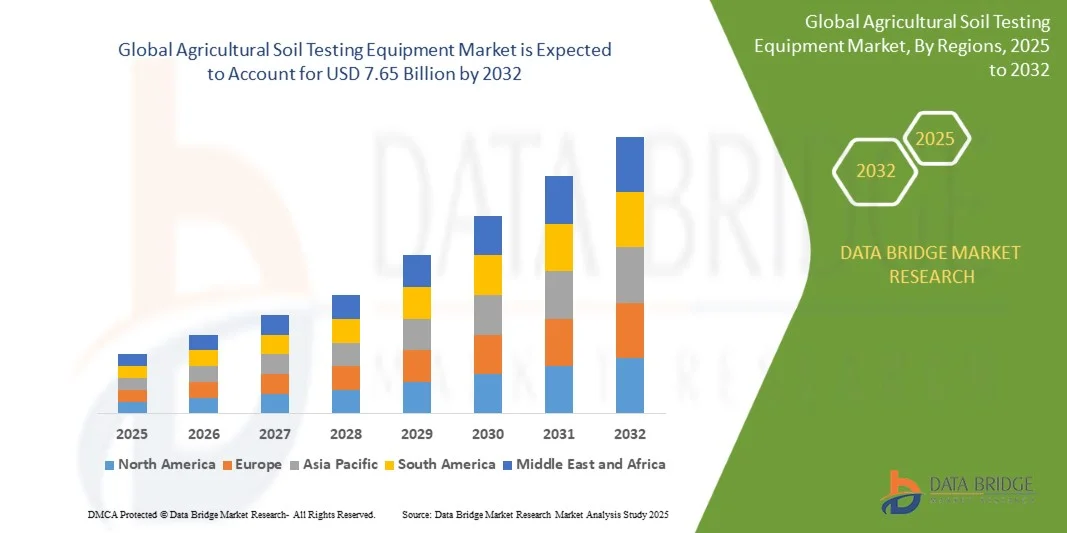
- The global agricultural soil testing equipment market size was valued at USD 3.52 billion in 2024 and is expected to reach USD 7.65 billion by 2032, at a CAGR of 10.20% during the forecast period
- The market growth is largely fueled by the increasing adoption of precision agriculture and technological advancements in soil analysis, enabling farmers to make data-driven decisions for optimizing crop productivity and resource management. The rising emphasis on soil health monitoring to enhance fertility and sustainability is driving the demand for advanced soil testing equipment across both commercial and research applications
- Furthermore, growing awareness regarding efficient nutrient management and the need to reduce chemical fertilizer dependency is accelerating the use of soil testing tools and analyzers. These factors are significantly boosting the adoption of automated, portable, and digital soil testing solutions, thereby driving steady market expansion
Agricultural Soil Testing Equipment Market Analysis
- Agricultural soil testing equipment, which includes devices and kits used to analyze soil composition, nutrients, and contaminants, plays a critical role in precision farming and sustainable agriculture. The equipment supports accurate fertilizer application, improved yield prediction, and efficient resource utilization by providing reliable soil data
- The rising global focus on sustainable farming practices, government-led soil health initiatives, and increased R&D investments in advanced testing technologies are key factors propelling market growth. In addition, the demand for portable and real-time soil testing equipment is expanding rapidly as farmers and agronomists seek faster, more accurate insights for effective crop management
- North America dominated the agricultural soil testing equipment market with a share of 41.7% in 2024, due to increasing awareness of soil health management and the adoption of precision agriculture technologies
- Asia-Pacific is expected to be the fastest growing region in the agricultural soil testing equipment market during the forecast period due to rapid agricultural modernization, government initiatives for soil health improvement, and increasing food demand across countries such as China, India, and Japan
- Automatic segment dominated the market with a market share of 47.8% in 2024, due to its ability to deliver precise, consistent, and high-throughput testing results with minimal human intervention. Automatic soil testing equipment is widely adopted by large-scale agricultural laboratories and research institutions where accuracy and efficiency are critical. The integration of sensors, data logging, and cloud-based reporting systems enhances operational efficiency and reduces the likelihood of human error. Increased investments in smart agriculture and precision farming technologies further support the adoption of automatic soil testing solutions
Report Scope and Agricultural Soil Testing Equipment Market Segmentation
|
Attributes |
Agricultural Soil Testing Equipment Key Market Insights |
|
Segments Covered |
|
|
Countries Covered |
North America
Europe
Asia-Pacific
Middle East and Africa
South America
|
|
Key Market Players |
|
|
Market Opportunities |
|
|
Value Added Data Infosets |
In addition to the insights on market scenarios such as market value, growth rate, segmentation, geographical coverage, and major players, the market reports curated by the Data Bridge Market Research also include import export analysis, production capacity overview, production consumption analysis, price trend analysis, climate change scenario, supply chain analysis, value chain analysis, raw material/consumables overview, vendor selection criteria, PESTLE Analysis, Porter Analysis, and regulatory framework. |
Agricultural Soil Testing Equipment Market Trends
“Rising Demand for Rapid and On-Site Soil Testing”
- The global agricultural soil testing equipment market is witnessing notable expansion driven by the increasing demand for rapid and on-site soil testing solutions that enable accurate decision-making for crop and nutrient management. Farmers and agronomists are increasingly adopting portable testing devices to assess soil fertility, pH, moisture, and nutrient composition in real-time for improved crop productivity and sustainability outcomes
- For instance, companies such as Agilent Technologies and Hanna Instruments have launched portable multi-parameter soil testing kits equipped with digital sensors and data-logging features. These innovations highlight the shift toward easily deployable field instruments that eliminate the need for prolonged laboratory analysis while offering reliable performance for small and large farming operations
- Advancements in sensor and spectroscopy technologies are enabling faster and more precise soil profiling. Systems integrating infrared (IR) and X-ray fluorescence (XRF) are enhancing the ability to detect macro- and micronutrients in varying soil types, supporting both large-scale commercial farms and precision agriculture initiatives
- The growing integration of IoT and mobile-based connectivity in soil testing devices is transforming data management practices. Cloud-linked soil analyzers now allow farmers to transmit test results instantly, facilitating digital recordkeeping and enabling predictive recommendations on fertilizer applications and irrigation cycles
- Government and private sector initiatives promoting sustainable land use and balanced fertilizer application are further accelerating demand. These initiatives emphasize soil health improvement through science-based cultivation practices, where rapid soil analysis plays a key role
- As agriculture increasingly embraces digitalization, rapid and on-site soil testing equipment is emerging as a cornerstone of precision farming. Its growing deployment is expected to redefine global soil management and boost productivity through smarter, data-driven agricultural practices
Agricultural Soil Testing Equipment Market Dynamics
Driver
“Growth of Precision and Sustainable Farming”
- The rise of precision farming and sustainable agricultural practices is significantly contributing to the market growth for advanced soil testing equipment. Farmers are adopting data-based approaches to enhance productivity, conserve resources, and ensure optimal nutrient balance in soil for long-term soil fertility management
- For instance, LaMotte Company and SGS SA have developed advanced soil testing systems designed to provide precise analytical insights critical for precision agriculture. These systems allow real-time monitoring of nutrient deficiencies, enabling accurate fertilizer recommendations tailored to crop and soil type variations
- The adoption of GPS and GIS-based soil mapping technologies is expanding the role of soil testing beyond routine analyses. Farmers are utilizing this data to create detailed fertility maps that optimize seeding, irrigation, and crop rotation schedules, reducing waste and environmental impact
- Sustainability-focused agricultural programs emphasizing organic farming and regenerative practices are encouraging frequent soil health assessments. This approach supports reduced chemical dependency and promotes efficient use of fertilizers and water resources based on accurate testing results
- The continuous evolution of farming techniques and integration of digital technologies are reshaping how soil health is monitored, managed, and improved. This strong alignment between digital agriculture and sustainability initiatives is expected to propel the long-term demand for efficient soil testing equipment globally
Restraint/Challenge
“High Cost and Low Awareness Among Small Farmers”
- The high cost of advanced soil testing equipment and limited awareness among small-scale farmers remain major challenges inhibiting widespread market adoption. The initial investment required for digital and portable soil testing systems often exceeds the affordability threshold in developing agricultural economies
- For instance, many smallholder farmers in regions such as Sub-Saharan Africa and Southeast Asia continue to rely on traditional soil observation methods due to high equipment costs and limited access to technical support. This gap in technological literacy restricts the potential benefits of rapid soil testing across vast agricultural regions
- Periodic maintenance, calibration, and the need for consumables or specialized reagents further add to long-term expenses. These operational constraints make advanced instruments less economically viable for small-scale farms despite their efficiency benefits
- Limited institutional support and insufficient extension services also contribute to the slow adoption of modern testing technologies. Farmers often lack awareness of how soil analysis can enhance productivity, reduce input costs, and prevent overuse of fertilizers
- Reducing equipment costs through subsidies, local manufacturing, and training initiatives will be vital to bridging technological disparities in soil analysis. Expanding farmer education and partnerships with agricultural extension networks will play a pivotal role in fostering adoption of soil testing innovations across diverse farming communities worldwide
Agricultural Soil Testing Equipment Market Scope
The market is segmented on the basis of test type, degree of automation, site, and sales channel.
• By Test Type
On the basis of test type, the agricultural soil testing equipment market is segmented into physical tests, residual tests, and chemical tests. The chemical tests segment dominated the market with the largest revenue share in 2024, driven by the increasing need for precise nutrient analysis and soil fertility management. Farmers and agronomists often prioritize chemical testing equipment for its ability to provide accurate pH, nitrogen, phosphorus, and potassium levels, which are critical for maximizing crop yield. The segment benefits from technological advancements in automated analyzers and integrated software solutions, enhancing the speed and reliability of results. Rising awareness of sustainable farming practices and government initiatives for soil health monitoring further bolster the demand for chemical testing instruments.
The residual tests segment is anticipated to witness the fastest growth from 2025 to 2032, fueled by the growing adoption of advanced residue detection techniques to monitor pesticide and heavy metal levels in soil. For instance, companies such as Thermo Fisher Scientific are introducing portable residual testing devices that enable farmers and researchers to quickly assess soil safety. The increasing regulatory focus on soil contamination and food safety is driving demand for residue testing equipment in both commercial farms and research institutions. The ease of deployment and quick result turnaround offered by these instruments also contributes to their rising popularity among end-users.
• By Degree of Automation
On the basis of degree of automation, the market is segmented into manual, automatic, and semi-automatic equipment. The automatic segment dominated the market in 2024, accounting for the largest revenue share of 47.8% due to its ability to deliver precise, consistent, and high-throughput testing results with minimal human intervention. Automatic soil testing equipment is widely adopted by large-scale agricultural laboratories and research institutions where accuracy and efficiency are critical. The integration of sensors, data logging, and cloud-based reporting systems enhances operational efficiency and reduces the likelihood of human error. Increased investments in smart agriculture and precision farming technologies further support the adoption of automatic soil testing solutions.
The semi-automatic segment is expected to witness the fastest growth from 2025 to 2032, driven by its balance of automation and cost-effectiveness for mid-sized farms and field applications. For instance, companies such as AgriTech Instruments have developed semi-automatic analyzers that simplify sample preparation and testing while reducing dependency on skilled technicians. The flexibility to perform multiple types of soil tests without full automation makes this segment appealing for emerging markets. Growing awareness of optimized fertilizer usage and soil management practices also fuels the uptake of semi-automatic testing equipment.
• By Site
On the basis of site, the market is segmented into laboratory and on-site equipment. The laboratory segment dominated the market in 2024, driven by the high precision, advanced instrumentation, and comprehensive testing capabilities offered in controlled laboratory environments. Laboratories often serve as central hubs for large-scale soil testing, providing detailed analysis for government programs, research institutions, and commercial farms. The ability to perform complex chemical and residual tests with minimal contamination risk supports the continued dominance of laboratory-based solutions. Technological integration with automated sample handling and data management software further enhances efficiency and reliability.
The on-site segment is anticipated to witness the fastest growth from 2025 to 2032, fueled by the demand for rapid, field-based soil testing solutions that enable real-time decision-making. For instance, companies such as Yara International have introduced portable soil testing kits that allow farmers to instantly measure soil nutrient levels and adjust fertilizer application. The convenience, cost savings, and ability to monitor soil health across multiple farm locations are key drivers for on-site equipment adoption. In addition, the rise of precision farming and smart agriculture practices further accelerates the demand for mobile soil testing solutions.
• By Sales Channel
On the basis of sales channel, the market is segmented into aftermarket and manufacturer/distributor/service provider channels. The manufacturer/distributor/service provider segment dominated the market in 2024, capturing the largest revenue share due to direct access to advanced soil testing equipment, technical support, and installation services. This channel is preferred by commercial labs and large-scale farms that require specialized instruments and expert guidance for setup and maintenance. Established companies offering comprehensive product portfolios, such as Horiba and Eijkelkamp, strengthen the dominance of this segment through bundled solutions and long-term service contracts.
The aftermarket segment is expected to witness the fastest growth from 2025 to 2032, driven by increasing demand for replacement parts, calibration services, and refurbished soil testing instruments. For instance, aftermarket providers such as Labtronics supply cost-effective components and maintenance solutions that extend the operational life of existing equipment. Rising adoption of automated and semi-automatic testing systems increases the need for regular servicing and spare parts. The convenience of localized support and lower total cost of ownership encourages end-users to rely on aftermarket solutions for ongoing equipment maintenance and upgrades.
Agricultural Soil Testing Equipment Market Regional Analysis
- North America dominated the agricultural soil testing equipment market with the largest revenue share of 41.7% in 2024, driven by increasing awareness of soil health management and the adoption of precision agriculture technologies
- Farmers in the region are focusing on optimizing crop yields and nutrient management through accurate soil diagnostics
- The presence of advanced agricultural infrastructure, coupled with strong government initiatives for sustainable farming, supports the growth of soil testing equipment. The U.S. plays a leading role due to the extensive use of automated and portable soil analyzers across large-scale farms and research institutions
U.S. Agricultural Soil Testing Equipment Market Insight
The U.S. agricultural soil testing equipment market captured the largest share in 2024 within North America, fueled by the rising adoption of digital agriculture tools and an emphasis on data-driven decision-making. Farmers are increasingly using advanced soil testing instruments to monitor nutrient content, pH levels, and contamination, enhancing fertilizer efficiency and crop productivity. The market growth is supported by government programs promoting soil health awareness and sustainable farming practices. The presence of key equipment manufacturers and research collaborations further accelerates the country’s market expansion.
Europe Agricultural Soil Testing Equipment Market Insight
The Europe agricultural soil testing equipment market is projected to expand at a substantial CAGR during the forecast period, primarily driven by stringent regulations on soil conservation and environmental sustainability. Farmers are increasingly adopting soil testing solutions to comply with nutrient management and pollution control standards. The region’s focus on organic farming, soil biodiversity, and resource-efficient agriculture enhances the demand for both laboratory and portable soil testing devices. Continuous innovation in automation and data integration technologies further strengthens the European market’s growth outlook.
U.K. Agricultural Soil Testing Equipment Market Insight
The U.K. agricultural soil testing equipment market is anticipated to grow at a noteworthy CAGR during the forecast period, supported by the government’s emphasis on improving soil health and sustainable crop production. The increasing need for nutrient optimization and compliance with environmental policies drives the demand for advanced soil testing equipment. Moreover, the adoption of precision agriculture and digital farm management solutions is boosting the integration of real-time soil monitoring systems across the country’s agricultural landscape.
Germany Agricultural Soil Testing Equipment Market Insight
The Germany agricultural soil testing equipment market is expected to expand at a considerable CAGR over the forecast period, driven by technological advancements and growing awareness of soil fertility management. German farmers are adopting automated and semi-automatic testing instruments to ensure accurate soil assessment and efficient fertilizer application. The country’s strong focus on sustainability and innovation in agri-tech promotes the use of laboratory-based and portable testing solutions, particularly in precision farming and research institutions.
Asia-Pacific Agricultural Soil Testing Equipment Market Insight
The Asia-Pacific agricultural soil testing equipment market is poised to grow at the fastest CAGR from 2025 to 2032, fueled by rapid agricultural modernization, government initiatives for soil health improvement, and increasing food demand across countries such as China, India, and Japan. The growing adoption of precision farming techniques and the rising awareness of soil nutrient management are key drivers. The availability of affordable, easy-to-use testing kits and digital soil sensors is expanding accessibility among small and mid-sized farmers in the region.
China Agricultural Soil Testing Equipment Market Insight
The China agricultural soil testing equipment market accounted for the largest share in Asia-Pacific in 2024, attributed to its robust agricultural base and strong government support for sustainable farming. The expansion of smart agriculture initiatives and rising investments in soil research institutions propel demand for advanced testing systems. The widespread use of portable analyzers and sensor-based soil assessment tools supports large-scale monitoring across vast farmlands, positioning China as a key growth center in the regional market.
India Agricultural Soil Testing Equipment Market Insight
The India agricultural soil testing equipment market is expected to register the fastest growth within Asia-Pacific during the forecast period, driven by the government’s Soil Health Card initiative and rising farmer awareness. Increasing investments in agricultural technology and digital soil testing centers are enhancing soil data accuracy and availability. The adoption of cost-effective portable kits and semi-automatic analyzers across smallholder farms is accelerating market penetration, supporting the country’s move toward sustainable and precision-driven farming practices.
Agricultural Soil Testing Equipment Market Share
The agricultural soil testing equipment industry is primarily led by well-established companies, including:
- Agilent Technologies, Inc. (U.S.)
- Geotechnical Testing Equipment UK Ltd (U.K.)
- Shambhavi Impex (India)
- PerkinElmer Inc. (U.S.)
- ELE International (U.K.)
- Controls S.p.A. (Italy)
- Merck KGaA (Germany)
- M & L Testing Equipment (Canada)
- LaMotte Company (U.S.)
- S.W. COLE Engineering, Inc. (U.S.)
- Thermo Fisher Scientific Inc. (U.S.)
- ALFA (U.S.)
- Eurofins Scientific (Luxembourg)
- EIE Instruments (India)
- Aimil Ltd. (India)
- Martin Lishman Ltd (U.K.)
- GlobalGilson (U.S.)
- Matest S.p.A. (Italy)
- Humboldt Mfg. Co. (U.S.)
- Sun LabTek Equipments (I) Pvt. Ltd. (India)
Latest Developments in Global Agricultural Soil Testing Equipment Market
- In May 2024, Merck KGaA inaugurated a new Life Science research center in Darmstadt, Germany, marking a significant advancement in analytical testing innovation. This development strengthens the company’s research capabilities in genomics, proteomics, and cell biology, which are essential for creating next-generation analytical tools. The expansion is expected to enhance precision and efficiency in agricultural soil testing applications by fostering cross-disciplinary innovation and supporting advancements in laboratory-based analytical equipment used for soil composition and nutrient analysis
- In April 2024, Agilent Technologies Inc. launched the Agilent 8850 Gas Chromatograph (GC) system, reinforcing its position in the analytical instrumentation market. The new GC system enhances detection accuracy and operational efficiency in chemical analysis, offering improved reliability for environmental and agricultural testing laboratories. This innovation is anticipated to accelerate the adoption of advanced testing solutions in the agricultural soil testing equipment market, where precise chemical assessments of soil nutrients and contaminants are increasingly vital
- In March 2024, Eurofins Scientific SE expanded its footprint in biopharmaceutical and environmental testing by acquiring Katairo GmbH, a contract research organization based in Europe. This strategic acquisition strengthens Eurofins’ analytical capabilities and broadens its service offerings across research and testing domains. The move is expected to indirectly benefit the agricultural soil testing equipment market by increasing the demand for high-performance testing instruments and standardized analytical processes across European laboratories
- In December 2023, Martin Lishman Ltd. introduced a new range of soil testing kits designed for rapid and accurate field analysis, directly addressing market needs following the discontinuation of Palintest’s soil test range. The launch includes digital meters and professional test kits for nitrogen (N), phosphorus (P), and potassium (K) analysis, ensuring continuity in soil health monitoring for farmers. This innovation significantly strengthens the company’s presence in the agricultural soil testing equipment market by improving accessibility to reliable, portable, and cost-effective field testing solutions
- In August 2023, Thermo Fisher Scientific Inc. launched the iCAP RQplus ICP-MS Analyzer and the iSC-65 Autosampler to enhance trace elemental analysis across testing laboratories. The introduction of these advanced tools improves accuracy, automation, and stability in analyzing high-matrix samples, boosting productivity in environmental and agricultural testing sectors. The innovation is expected to positively impact the agricultural soil testing equipment market by setting higher standards for precision and efficiency in laboratory-based soil testing operations

- Interactive Data Analysis Dashboard
- Company Analysis Dashboard for high growth potential opportunities
- Research Analyst Access for customization & queries
- Competitor Analysis with Interactive dashboard
- Latest News, Updates & Trend analysis
- Harness the Power of Benchmark Analysis for Comprehensive Competitor Tracking
Data collection and base year analysis are done using data collection modules with large sample sizes. The stage includes obtaining market information or related data through various sources and strategies. It includes examining and planning all the data acquired from the past in advance. It likewise envelops the examination of information inconsistencies seen across different information sources. The market data is analysed and estimated using market statistical and coherent models. Also, market share analysis and key trend analysis are the major success factors in the market report. To know more, please request an analyst call or drop down your inquiry.
The key research methodology used by DBMR research team is data triangulation which involves data mining, analysis of the impact of data variables on the market and primary (industry expert) validation. Data models include Vendor Positioning Grid, Market Time Line Analysis, Market Overview and Guide, Company Positioning Grid, Patent Analysis, Pricing Analysis, Company Market Share Analysis, Standards of Measurement, Global versus Regional and Vendor Share Analysis. To know more about the research methodology, drop in an inquiry to speak to our industry experts.
Data Bridge Market Research is a leader in advanced formative research. We take pride in servicing our existing and new customers with data and analysis that match and suits their goal. The report can be customized to include price trend analysis of target brands understanding the market for additional countries (ask for the list of countries), clinical trial results data, literature review, refurbished market and product base analysis. Market analysis of target competitors can be analyzed from technology-based analysis to market portfolio strategies. We can add as many competitors that you require data about in the format and data style you are looking for. Our team of analysts can also provide you data in crude raw excel files pivot tables (Fact book) or can assist you in creating presentations from the data sets available in the report.