What is the Agricultural Weather Intelligence Market?
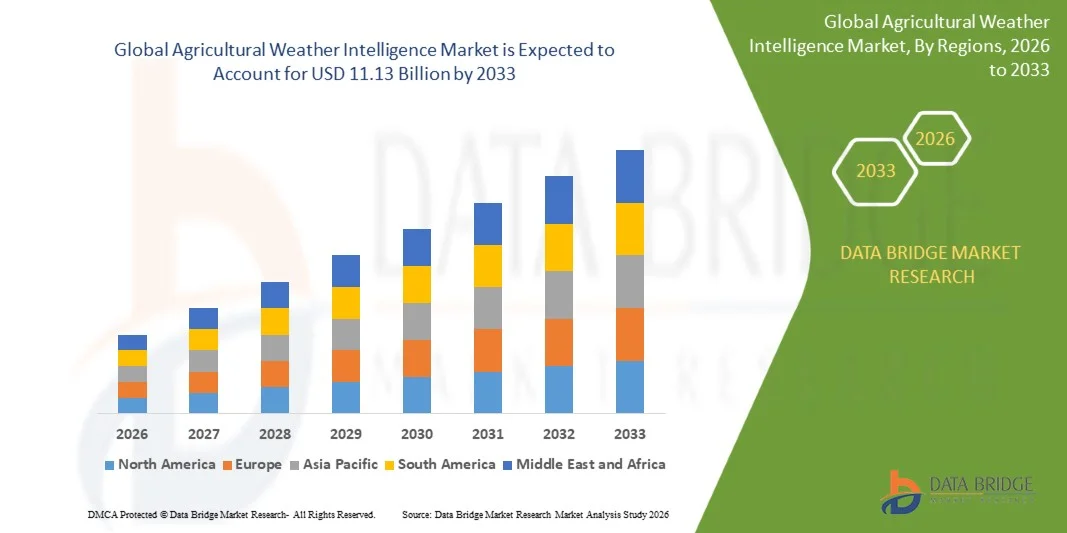
- As per Data Bridge Market Research analysis, the agricultural weather intelligence market was valued at USD 4.10 billion in 2025 and is projected to reach USD 11.13 billion by 2033, growing at a CAGR of 13.30% from 2026 to 2033.
- The market is experiencing robust growth driven by the increasing adoption of precision agriculture, rising climate variability, and the growing demand for real-time weather intelligence to optimize crop management, irrigation planning, pest and disease forecasting, and yield prediction.
- Government initiatives promoting climate-smart agriculture, advancements in artificial intelligence (AI), IoT-enabled weather monitoring, satellite-based remote sensing, and numerical weather prediction (NWP) models are further accelerating market expansion. Farmers, agribusinesses, and government agencies are increasingly adopting weather intelligence solutions to improve operational efficiency, minimize weather-related risks, enhance crop productivity, and strengthen climate resilience.
Market Size & Forecast
- Market Value (2025): USD 4.10 Billion
- Expected Market Value (2033): USD 11.13 Billion
- Forecast CAGR (2026–2033): 13.30%
- Leading Region in 2025: North America
- Fastest Growing Region: Asia-Pacific
What are the Major Takeaways of the Agricultural Weather Intelligence Market?
- North America dominated the agricultural weather intelligence market with the largest revenue share in 2025, supported by the widespread adoption of precision agriculture technologies, advanced digital farming infrastructure, and the strong presence of leading weather intelligence and agri-tech companies across the U.S. and Canada
- The Asia-Pacific agricultural weather intelligence market is expected to witness the fastest growth from 2026 to 2033, driven by increasing adoption of precision agriculture, expanding government support for climate-smart farming, rising investments in AI-powered weather forecasting, and growing deployment of satellite- and IoT-based weather monitoring technologies.
- The solutions segment held the largest market revenue share in 2025, driven by the increasing adoption of AI-powered weather forecasting platforms, precision agriculture software, satellite-based weather intelligence, and integrated farm decision-support systems that enable real-time crop monitoring, irrigation optimization, and climate risk management.
- The services segment is expected to witness the fastest growth during the forecast period from 2026 to 2033, driven by rising demand for professional consulting, system integration, managed weather intelligence services, cloud-based analytics, and continuous technical support as farmers and agribusinesses increasingly deploy digital weather intelligence solutions.
- The satellite-based segment held the largest market revenue share in 2025, driven by its ability to provide continuous large-scale monitoring of weather patterns, vegetation health, soil moisture, and climate conditions, enabling accurate crop monitoring and timely farm management decisions across extensive agricultural areas.
- The IoT sensors segment is expected to witness the fastest growth during the forecast period from 2026 to 2033, driven by the increasing deployment of connected weather stations and field sensors that deliver real-time, hyperlocal weather data for precision irrigation, pest and disease forecasting, microclimate monitoring, and data-driven farm management.
Report Scope and Agricultural Weather Intelligence Market Segmentation
|
Attributes |
Agricultural Weather Intelligence Key Market Insights |
|
Segments Covered |
|
|
Countries Covered |
North America
Europe
Asia-Pacific
Middle East and Africa
South America
|
|
Key Market Players |
|
|
Market Opportunities |
|
|
Value Added Data Infosets |
In addition to the insights on market scenarios such as market value, growth rate, segmentation, geographical coverage, and major players, the market reports curated by the Data Bridge Market Research also include import export analysis, production capacity overview, production consumption analysis, price trend analysis, climate change scenario, supply chain analysis, value chain analysis, raw material/consumables overview, vendor selection criteria, PESTLE Analysis, Porter Analysis, and regulatory framework. |
What is the Key Trend in the Agricultural Weather Intelligence Market?
- Increasing climate variability, unpredictable rainfall patterns, and extreme weather events are creating significant challenges for agricultural productivity and farm profitability. Farmers are increasingly seeking advanced weather intelligence solutions that provide accurate, timely, and location-specific insights to optimize planting, irrigation, harvesting, and crop protection decisions.
- The key trend shaping the agricultural weather intelligence market is the transition from traditional regional weather forecasting toward AI-powered, hyperlocal weather intelligence integrated into precision agriculture platforms. Advanced weather solutions are increasingly combining artificial intelligence, satellite data, IoT sensors, and machine learning models to deliver field-level forecasts, enabling farmers to make proactive decisions based on real-time climate conditions.
- For instance, in June 2025, OneSoil partnered with Rainbow Weather to introduce hyperlocal precipitation forecasting capabilities within the OneSoil Pro platform. The integration enables farmers to access detailed rainfall predictions based on specific field locations, helping improve planning for field operations, crop management, and resource utilization.
- As climate risks continue to increase across agricultural regions, the integration of AI-driven, field-specific weather intelligence into farm management platforms is expected to become a key differentiating factor, supporting the adoption of precision agriculture solutions worldwide.
What are the Key Drivers of the Agricultural Weather Intelligence Market?
- Agriculture in climate-sensitive regions is increasingly exposed to extreme weather events, including droughts, floods, storms, and irregular rainfall patterns, creating significant risks for crop productivity and farm profitability. These challenges are encouraging governments, agritech companies, and farmers to adopt advanced weather intelligence solutions that provide real-time climate insights, improve preparedness, and support data-driven agricultural decision-making.
- Growth in the agricultural weather intelligence market is being driven by rising climate volatility and the increasing need for localized forecasting solutions across vulnerable farming regions. Agritech companies are partnering with weather intelligence providers to deliver hyperlocal, AI-powered forecasts that enable farmers, particularly smallholder farmers, to optimize field operations, manage weather-related risks, and improve crop resilience. Government initiatives focused on climate-smart agriculture and disaster preparedness are further supporting the adoption of digital weather monitoring technologies.
- For instance, in December 2025, Agrilever, an agritech company supporting smallholder rice farmers in the Philippines, partnered with Tomorrow.io to integrate hyperlocal, AI-powered weather forecasting capabilities into its agricultural platform. The collaboration aims to provide farmers with localized weather insights to improve planning, enhance preparedness for extreme weather events, and support faster decision-making during adverse climatic conditions.
- As climate-related agricultural risks continue to increase, the integration of AI-powered weather intelligence into digital farming platforms is expected to accelerate market growth by enabling proactive crop management, improving resource efficiency, and strengthening climate resilience across farming communities.
Which Factors are Challenging the Agricultural Weather Intelligence Market?
- Despite advancements in AI-based weather forecasting technologies, limited farmer awareness, digital literacy, connectivity issues, and concerns regarding technology reliability remain key challenges affecting widespread adoption, particularly among smallholder farmers in developing regions.
- The central challenge affecting the agricultural weather intelligence market is the slow transition from technology availability to practical farm-level adoption. Farmers often require proven benefits, ease of integration, and reliable performance before adopting advanced forecasting tools. In addition, limited access to high-speed internet and digital infrastructure in rural areas can restrict the effective use of real-time weather intelligence platforms.
- For instance, in June 2025, Bayer Crop Science Canada highlighted that emerging AI-powered weather forecasting technologies, including solutions developed by companies such as Aardvark Weather and Rainbow AI, must demonstrate measurable value before achieving widespread farmer adoption. The company noted that technology adoption in agriculture typically occurs gradually as farmers evaluate performance and benefits within their existing workflows. Bayer also emphasized the importance of integrating advanced weather insights into established platforms such as Climate FieldView to improve accessibility and usability for growers.
- Until AI-powered weather intelligence solutions demonstrate consistent field-level benefits and become more accessible through existing agricultural platforms, adoption barriers related to trust, connectivity, and technology acceptance are expected to remain key challenges for market expansion.
How is the Agricultural Weather Intelligence Market Segmented?
The agricultural weather intelligence market is segmented on the basis of component, weather data source, application, and end user.
- By Component
On the basis of component, the agricultural weather intelligence market is segmented into solutions and services. The solutions segment held the largest market revenue share in 2025, driven by the increasing adoption of AI-powered weather forecasting platforms, precision agriculture software, satellite-based weather intelligence, and integrated farm decision-support systems that enable real-time crop monitoring, irrigation optimization, and climate risk management.
The services segment is expected to witness the fastest growth during the forecast period from 2026 to 2033, driven by rising demand for professional consulting, system integration, managed weather intelligence services, cloud-based analytics, and continuous technical support as farmers and agribusinesses increasingly deploy digital weather intelligence solutions.
- Weather Data Source
On the basis of weather data source, the agricultural weather intelligence market is segmented into satellite-based, IoT sensors, and numerical weather prediction (NWP) models. The satellite-based segment held the largest market revenue share in 2025, driven by its ability to provide continuous large-scale monitoring of weather patterns, vegetation health, soil moisture, and climate conditions, enabling accurate crop monitoring and timely farm management decisions across extensive agricultural areas.
The IoT sensors segment is expected to witness the fastest growth during the forecast period from 2026 to 2033, driven by the increasing deployment of connected weather stations and field sensors that deliver real-time, hyperlocal weather data for precision irrigation, pest and disease forecasting, microclimate monitoring, and data-driven farm management.
- Application
On the basis of application, the agricultural weather intelligence market is segmented into crop monitoring, irrigation management, pest & disease forecasting, yield forecasting, and disaster & early warning management. The crop monitoring segment held the largest market revenue share in 2025, driven by the increasing adoption of satellite imagery, AI-powered analytics, and real-time weather intelligence to monitor crop health, detect stress conditions, optimize field operations, and improve overall farm productivity.
The disaster & early warning management segment is expected to witness the fastest growth during the forecast period from 2026 to 2033, driven by the rising frequency of extreme weather events, increasing investments in climate risk management, and growing demand for early warning systems that help farmers mitigate the impact of droughts, floods, storms, frost, and heatwaves while improving agricultural resilience.
- End User
On the basis of end user, the agricultural weather intelligence market is segmented into farmers & growers, agribusiness companies, government & meteorological agencies, and crop insurance providers. The farmers & growers segment held the largest market revenue share in 2025, driven by the increasing adoption of precision agriculture technologies, AI-powered weather forecasting, and real-time decision-support tools to optimize irrigation, planting schedules, crop protection, and overall farm productivity.
The crop insurance providers segment is expected to witness the fastest growth during the forecast period from 2026 to 2033, driven by the growing need for accurate weather intelligence, climate risk assessment, and predictive analytics to improve underwriting, assess weather-related crop losses, streamline claims processing, and support the development of weather-indexed insurance products.
Which Region Holds the Largest Share of the Agricultural Weather Intelligence Market?
North America Agricultural Weather Intelligence Market Insight
- North America dominated the agricultural weather intelligence market with the largest revenue share in 2025, supported by the widespread adoption of precision agriculture technologies, advanced digital farming infrastructure, and the strong presence of leading weather intelligence and agri-tech companies across the U.S. and Canada. The region has also witnessed increasing investments in AI-powered weather forecasting, satellite-based monitoring, IoT-enabled weather stations, and climate risk management solutions.
- The region further benefits from high adoption of precision farming, strong government support for climate-smart agriculture, expanding deployment of connected agricultural technologies, and increasing demand for real-time weather intelligence to optimize irrigation, crop monitoring, pest and disease forecasting, and yield management. Continuous innovation in artificial intelligence, remote sensing, and predictive weather analytics continues to strengthen North America's leadership position in the global agricultural weather intelligence market.
U.S. Agricultural Weather Intelligence Market Insight
The U.S. agricultural weather intelligence market is witnessing robust growth due to the increasing adoption of precision agriculture, AI-powered weather forecasting, and digital farm management solutions. Farmers are increasingly utilizing satellite imagery, IoT-enabled weather sensors, and hyperlocal weather intelligence to optimize irrigation scheduling, planting and harvesting operations, crop monitoring, and pest and disease management. In addition, supportive government initiatives promoting climate-smart agriculture, expanding investments in agricultural technology, and the presence of leading weather intelligence and agri-tech companies are further driving market expansion.
Asia-Pacific Agricultural Weather Intelligence Market Insight
The Asia-Pacific agricultural weather intelligence market is expected to witness the fastest growth from 2026 to 2033, driven by increasing adoption of precision agriculture, expanding government support for climate-smart farming, rising investments in AI-powered weather forecasting, and growing deployment of satellite- and IoT-based weather monitoring technologies. Farmers are increasingly utilizing AI-powered weather forecasting, satellite imagery, IoT-enabled weather sensors, and hyperlocal weather intelligence to optimize irrigation, crop monitoring, planting schedules, and disaster preparedness. In addition, growing smartphone penetration, increasing awareness of climate risk management, and the expansion of digital agricultural advisory services are further accelerating market growth across the region.
Japan Agricultural Weather Intelligence Market Insight
The Japan agricultural weather intelligence market is witnessing steady growth due to the increasing adoption of precision agriculture, strong government support for smart farming, and rising investments in AI-powered weather forecasting technologies. Farmers are increasingly utilizing satellite imagery, IoT-enabled weather sensors, and predictive weather analytics to optimize irrigation, crop monitoring, and disaster preparedness. Furthermore, the country's focus on digital agriculture, climate resilience, and advanced farm management technologies is supporting continued market expansion.
China Agricultural Weather Intelligence Market Insight
The China agricultural weather intelligence market is growing rapidly, driven by the country's large agricultural sector, increasing government initiatives promoting smart agriculture, and expanding adoption of digital farming technologies. The widespread deployment of AI-based weather forecasting, satellite remote sensing, IoT weather monitoring systems, and precision agriculture platforms is significantly boosting market demand. In addition, investments in climate-smart agriculture, expanding digital rural infrastructure, and increasing emphasis on improving agricultural productivity and weather risk management are positioning China as one of the fastest-growing markets for agricultural weather intelligence globally.
Europe Agricultural Weather Intelligence Market Insight
The Europe agricultural weather intelligence market is experiencing steady growth, driven by increasing adoption of precision agriculture, stringent climate adaptation policies, and rising investments in digital farming technologies. The region is witnessing growing deployment of AI-powered weather forecasting, satellite-based monitoring, and IoT-enabled weather stations to improve crop management, irrigation efficiency, and climate risk mitigation. In addition, supportive government initiatives promoting sustainable agriculture and the expansion of smart farming practices continue to strengthen market demand across several European countries.
Germany Agricultural Weather Intelligence Market Insight
The Germany agricultural weather intelligence market is expanding steadily due to strong government support for smart farming, increasing investments in agricultural digitalization, and growing adoption of AI-based weather forecasting solutions. Rising implementation of precision agriculture technologies, satellite remote sensing, and IoT-enabled weather monitoring systems, coupled with the country's emphasis on climate resilience and sustainable food production, are contributing significantly to market growth.
U.K. Agricultural Weather Intelligence Market Insight
The U.K. agricultural weather intelligence market is gaining momentum owing to increasing adoption of climate-smart agriculture, growing investments in precision farming technologies, and rising demand for advanced weather analytics. Farmers are increasingly utilizing AI-powered forecasting, satellite imagery, and hyperlocal weather intelligence to optimize field operations, reduce climate-related risks, and improve crop productivity. In addition, supportive government initiatives promoting sustainable agriculture and digital innovation are supporting the continued expansion of the market.
Which are the Top Companies in Biochar for Agricultural Weather Intelligence Market?
The agricultural weather intelligence industry is primarily led by well-established companies, including:
- IBM Corporation (U.S.)
- DTN, LLC (U.S.)
- The Tomorrow Companies Inc. (U.S.)
- aWhere, Inc. (U.S.)
- AccuWeather, Inc. (U.S.)
- Vaisala Oyj (Finland)
- Spire Global, Inc. (U.S.)
- Planet Labs PBC (U.S.)
- Trimble Inc. (U.S.)
- Hexagon AB (Sweden)
- Iteris, Inc. (U.S.)
- CropX Technologies Ltd. (Israel)
- Fujitsu Limited (Japan)
- Descartes Labs, Inc. (U.S.)
- Skymet Weather Services Pvt. Ltd. (India)
What are Latest Developments in Agricultural Weather Intelligence Market?
- In June 2026, OneSoil partnered with Rainbow Weather to introduce an AI-powered Hyperlocal Precipitation Forecast feature within the OneSoil Pro platform. The solution provides field-level rainfall probability and intensity forecasts for specific coordinates within a four-hour window, enabling farmers to optimize planting, spraying, irrigation, and harvesting decisions. The platform serves more than 1.16 million farmers worldwide.
- In June 2025, Tomorrow.io partnered with the National Irrigation Administration (NIA) of the Philippines to deploy AI-powered weather forecasting for farmers. The collaboration leverages satellite-based weather intelligence and artificial intelligence to provide localized weather forecasts, helping farmers improve irrigation planning, strengthen climate resilience, and increase agricultural productivity.

- Interactive Data Analysis Dashboard
- Company Analysis Dashboard for high growth potential opportunities
- Research Analyst Access for customization & queries
- Competitor Analysis with Interactive dashboard
- Latest News, Updates & Trend analysis
- Harness the Power of Benchmark Analysis for Comprehensive Competitor Tracking
Data collection and base year analysis are done using data collection modules with large sample sizes. The stage includes obtaining market information or related data through various sources and strategies. It includes examining and planning all the data acquired from the past in advance. It likewise envelops the examination of information inconsistencies seen across different information sources. The market data is analysed and estimated using market statistical and coherent models. Also, market share analysis and key trend analysis are the major success factors in the market report. To know more, please request an analyst call or drop down your inquiry.
The key research methodology used by DBMR research team is data triangulation which involves data mining, analysis of the impact of data variables on the market and primary (industry expert) validation. Data models include Vendor Positioning Grid, Market Time Line Analysis, Market Overview and Guide, Company Positioning Grid, Patent Analysis, Pricing Analysis, Company Market Share Analysis, Standards of Measurement, Global versus Regional and Vendor Share Analysis. To know more about the research methodology, drop in an inquiry to speak to our industry experts.
Data Bridge Market Research is a leader in advanced formative research. We take pride in servicing our existing and new customers with data and analysis that match and suits their goal. The report can be customized to include price trend analysis of target brands understanding the market for additional countries (ask for the list of countries), clinical trial results data, literature review, refurbished market and product base analysis. Market analysis of target competitors can be analyzed from technology-based analysis to market portfolio strategies. We can add as many competitors that you require data about in the format and data style you are looking for. Our team of analysts can also provide you data in crude raw excel files pivot tables (Fact book) or can assist you in creating presentations from the data sets available in the report.