What is the Agricultural Weather Stations Market Size and Growth Rate?
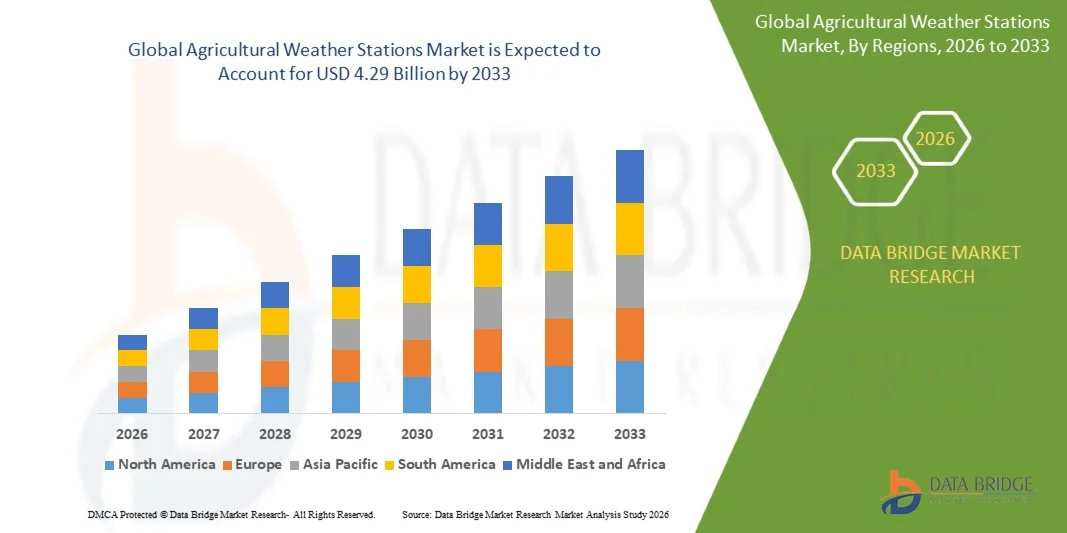
- As per Data Bridge Market Research analysis, the agricultural weather stations market was valued at USD 2.50 billion in 2025 and is projected to reach USD 4.29 billion by 2033, growing at a CAGR of 7.00% from 2026 to 2033.
- The market is experiencing consistent growth driven by increasing adoption of precision agriculture, rising demand for real-time weather monitoring, advancements in IoT-enabled weather stations, and expanding applications in crop management, irrigation, and farm productivity optimization.
- The increasing impact of climate variability, extreme weather events, and water scarcity, combined with the growing need for data-driven agricultural decision-making, is compelling farmers, agricultural enterprises, and government agencies to adopt advanced weather monitoring systems. Automated and IoT-connected weather stations are increasingly replacing conventional monitoring methods by providing accurate, real-time data on temperature, humidity, rainfall, wind speed, and soil conditions, enabling more efficient irrigation, pest management, crop protection, and yield planning.
Market Size & Forecast
- Global Market Value (2025): USD 2.50 Billion
- Expected Market Value (2033): USD 4.29 Billion
- Forecast CAGR (2026–2033): 7.00%
What are the Major Takeaways of the Agricultural Weather Stations Market?
- North America dominated the agricultural weather stations market with the largest revenue share of 38.9% in 2025, supported by widespread adoption of precision agriculture, advanced farming technologies, and strong investments in IoT-enabled agricultural monitoring systems.
- Asia-Pacific is expected to be the fastest-growing region at a CAGR of 8.2% from 2026 to 2033, fueled by expanding precision farming practices, increasing agricultural modernization, climate variability, and growing adoption of smart weather monitoring technologies across China, India, Japan, and Australia.
- The fixed agricultural weather stations segment led the market with a 40% share in 2025, driven by their ability to provide continuous and reliable monitoring of localized weather conditions.
- Automatic weather stations are the fastest-growing product type, projected to register a CAGR of 9%, reflecting the surge in demand for continuous and automated collection of agricultural weather information
- The cellular segment dominated the technology category with a 35% revenue share in 2025, led by the broad availability of cellular networks and their suitability for transmitting weather information from geographically dispersed agricultural locations.
- Hardware accounted for 70% of the market share in 2025, preferred by farmers, agricultural producers, and research organizations because physical sensors, data loggers, communication modules, and power systems are essential for collecting accurate, real-time field weather data.
- The software segment is the fastest-growing component category, with a CAGR of 11%, driven by increasing demand for data analytics, visualization, remote monitoring, and decision-support capabilities.
Report Scope and Agricultural Weather Stations Market Segmentation
|
Attributes |
Agricultural Weather Stations Key Market Insights |
|
Segments Covered |
|
|
Countries Covered |
North America
Europe
Asia-Pacific
Middle East and Africa
South America
|
|
Key Market Players |
|
|
Market Opportunities |
|
|
Value Added Data Infosets |
In addition to the insights on market scenarios such as market value, growth rate, segmentation, geographical coverage, and major players, the market reports curated by the Data Bridge Market Research also include import export analysis, production capacity overview, production consumption analysis, price trend analysis, climate change scenario, supply chain analysis, value chain analysis, raw material/consumables overview, vendor selection criteria, PESTLE Analysis, Porter Analysis, and regulatory framework. |
What is the Key Trend in the Agricultural Weather Stations Market?
- Increasing integration of IoT connectivity with agricultural weather stations is enabling continuous field-level monitoring, remote access, and faster transmission of temperature, rainfall, humidity, wind, soil, and leaf-wetness data for precision farming operations and farm management.
- For instance, in September 2025, ICAR-CIARI licensed the “Dweep Microclimate Monitor,” a smart agricultural device providing real-time temperature and humidity monitoring, IoT-based remote data transmission, and vertical microclimate profiling for farms and other agricultural environments.
- Weather stations are increasingly shifting from standalone measurement devices toward integrated decision-support platforms combining sensor observations, forecasts, crop models, evapotranspiration calculations, disease alerts, and irrigation recommendations to convert weather data into actionable farm decisions daily.
- Solar-powered and low-power wireless stations are gaining traction across remote agricultural fields because they reduce dependence on grid electricity while supporting continuous monitoring through cellular, LoRaWAN, satellite, and other long-range communication technologies for distributed farms.
- For instance, in November 2025, Sencrop launched its new generation of 4G agricultural weather stations after testing with 100 farmers across several countries, adding universal connectivity, solar power, and modular sensors for precision farming globally
- Integration of weather stations with farm management software, irrigation controllers, satellite imagery, and artificial intelligence is strengthening demand for interoperable systems that combine hyperlocal weather observations with crop and field information for automated agricultural decision-making.
What are the Key Drivers of the Agricultural Weather Stations Market?
- The rising climate variability and extreme weather risks are increasing demand for weather observations that help farmers protect crops, optimize planting schedules, manage irrigation, and reduce losses associated with frost, heat, drought, heavy rainfall, and storms.
- For instance, in July 2025, farmers in Pollachi, Tamil Nadu, installed 10 mini meteorological stations to monitor real-time temperature and humidity data for coconut and nutmeg cultivation, helping assess the effects of erratic weather and climate change on crop yields and support climate-resilient farming decisions.
- Growing adoption of precision agriculture is encouraging farms to deploy weather stations alongside soil sensors, satellite imagery, drones, and farm management platforms, enabling decisions that improve input efficiency, crop productivity, and operational timing across fields.
- Demand for efficient water management is strengthening adoption because weather stations provide rainfall, temperature, humidity, solar radiation, and evapotranspiration measurements that support precise irrigation scheduling and help reduce unnecessary water consumption during variable growing conditions.
- For instance, in April 2025, Kerala’s Agriculture Department partnered with Ingen Technologies to establish 950 weather stations across 14 districts under the WINDS initiative, including automatic weather stations at the block level and automatic rain gauges at the panchayat level, providing farmers with real-time temperature, humidity, wind, and rainfall data for improved agricultural planning and climate-risk management.
- Expansion of connected agriculture infrastructure is supporting market growth as cellular, LoRaWAN, satellite, and cloud technologies make real-time weather information accessible across large and remote farms, while automated alerts improve responses to weather-sensitive farming operations.
Which Factors are Challenging the Growth of the Agricultural Weather Stations Market?
- High upfront equipment costs can constrain adoption among small and medium-sized farms, particularly when installations require multiple sensors, communications equipment, solar power systems, mounting infrastructure, subscriptions, and recurring calibration or maintenance services for long-term operation.
- For instance, in July 2025, Andhra Pradesh reported that 1,332 of its 2,817 weather stations were non-functional, with repair and maintenance issues affecting the accuracy of real-time rainfall data used for agricultural and weather-related decision-making. The state subsequently approved an in-house maintenance plan to restore the inactive stations.
- Limited rural connectivity can restrict real-time data transmission from remote agricultural fields, reducing the effectiveness of cloud-connected weather stations where cellular, broadband, LoRaWAN, or satellite communication infrastructure remains unavailable, unreliable, or economically difficult to deploy.
- For instance, in June 2025, a research study published in Results in Engineering developed a low-cost agricultural weather station priced at approximately USD 170, specifically to address the cost barrier associated with conventional weather-monitoring systems. The study noted that affordability is important for enabling wider deployment of weather stations in agricultural environments, indicating that equipment cost can constrain adoption among cost-sensitive users.
- Sensor calibration, maintenance, battery replacement, and environmental exposure can create recurring operational challenges because agricultural stations must continuously withstand rainfall, dust, temperature fluctuations, corrosion, and other field conditions while maintaining measurement accuracy throughout growing seasons.
How is the Agricultural Weather Stations Market Segmented?
The agricultural weather stations market is segmented on the basis of product type, technology, component, and end user.
- By Product Type
On the basis of product type, the agricultural weather stations market is segmented into portable agricultural weather stations, fixed agricultural weather stations, automatic weather stations, manual weather stations, and wireless weather stations. The fixed agricultural weather stations segment dominated the market with 40% share in 2025, owing to their ability to provide continuous and reliable monitoring of localized weather conditions. These stations are permanently installed across farms, orchards, vineyards, research fields, and other agricultural locations. Their fixed configuration supports long-term collection of temperature, humidity, rainfall, wind, solar radiation, and other environmental data. Farmers and research organizations use these systems for irrigation planning, crop monitoring, disease forecasting, and yield optimization. Their robust construction and ability to support multiple sensors make them suitable for comprehensive field monitoring.
The automatic weather stations segment is projected to register the fastest growth at 9% CAGR during forecast period, driven by increasing demand for continuous and automated collection of agricultural weather information. Automatic stations reduce dependence on manual observations and can collect weather measurements at regular intervals. These systems enable farmers and agricultural organizations to receive timely information on temperature, humidity, rainfall, wind, and other conditions. Integration with digital agriculture platforms allows collected data to be remotely accessed and analyzed. Increasing adoption of precision irrigation, crop-protection systems, and climate-smart farming is creating additional demand for automated monitoring. Government and research organizations are also expanding automated weather-monitoring networks to improve localized agricultural forecasting.
- By Technology
On the basis of technology, the agricultural weather stations market is segmented into cellular, radio frequency (RF), satellite, wired transmission, wireless transmission, and IoT cloud platform. The cellular segment dominated the market with 35% share in 2025, supported by the broad availability of cellular networks and their suitability for transmitting weather information from geographically dispersed agricultural locations. Cellular-enabled stations can transmit measurements without requiring extensive physical communication infrastructure. This makes them particularly useful for farms where wired connectivity is difficult to establish. Cellular communication also supports remote monitoring and timely transmission of weather information to centralized platforms. Farmers and agricultural organizations can use connected systems to access weather information without being physically present at the monitoring location.
The IoT cloud platform segment is projected to witness the fastest growth at 10% CAGR during forecast period, driven by the increasing integration of agricultural weather stations with connected farming ecosystems. IoT cloud platforms enable weather data to be transmitted, stored, visualized, and analyzed through centralized digital systems. Farmers can remotely monitor weather conditions through web-based dashboards and connected applications. These platforms can also integrate weather information with soil sensors, irrigation systems, crop-management tools, and other agricultural technologies. Cloud-based analytics can support more informed irrigation, spraying, crop-protection, and weather-risk decisions. Increasing adoption of smart farming and connected agricultural infrastructure is strengthening demand for cloud-enabled weather monitoring.
- By Component
On the basis of component, the agricultural weather stations market is segmented into hardware and software. The hardware segment dominated the market with 70% share in 2025, as physical equipment forms the core of agricultural weather-monitoring systems. Hardware includes sensors, data loggers, power systems, communication modules, mounting structures, and related field equipment. These components are essential for collecting measurements such as temperature, humidity, rainfall, wind speed, wind direction, and solar radiation. Increasing deployment of weather stations across farms and agricultural research locations directly contributes to hardware demand. Advances in sensor accuracy, low-power equipment, and solar-powered systems are also improving the suitability of hardware for remote agricultural environments.
The software segment is projected to register the fastest growth at 11% CAGR during forecast period, supported by increasing demand for data analytics, visualization, remote monitoring, and decision-support capabilities. Software converts measurements collected by weather-station hardware into actionable information for agricultural users. Modern platforms provide dashboards, alerts, historical weather trends, reports, and remote-access capabilities. Integration with cloud platforms and agricultural management systems is further expanding the role of software within weather-monitoring solutions. Advanced software can help farmers interpret weather patterns and support irrigation, crop-protection, and field-management decisions. Increasing deployment of IoT-connected weather stations is also creating demand for software capable of managing large volumes of environmental data.
- By End User
On the basis of end user, the agricultural weather stations market is segmented into farmers, agrochemical companies, government agencies, and research institutes. The farmers segment dominated the market with 45% share in 2025, owing to increasing use of localized weather information for precision farming and crop-management activities. Farmers use weather stations to monitor temperature, humidity, rainfall, wind, and other conditions affecting crop development. Real-time weather information supports irrigation scheduling, crop protection, spraying decisions, and preparation for adverse weather conditions. Weather stations are particularly useful for farms where microclimatic variations can influence crop productivity and disease development. Increasing availability of connected and relatively affordable monitoring systems is also making these technologies more accessible to agricultural producers.
The agrochemical companies segment is projected to witness the fastest growth at 9% CAGR, during forecast period driven by increasing use of localized weather information for crop-protection and agrochemical application strategies. Weather conditions influence pest development, disease occurrence, chemical efficacy, and the appropriate timing of spraying operations. Agrochemical companies can use weather-station data to develop more precise recommendations and digital advisory services for farmers. Integration of weather information with agronomic platforms can support localized crop-protection decisions. Increasing emphasis on precision application and efficient use of agricultural inputs is further strengthening the value of weather data for agrochemical businesses. These companies are also increasingly incorporating digital agriculture tools into their farmer-support programs.
Which Region Holds the Largest Share of the Agricultural Weather Stations Market?
- North America dominated the agricultural weather stations market with the largest revenue share of 38.9% in 2025, supported by widespread adoption of precision agriculture, advanced farming technologies, and strong investments in IoT-enabled agricultural monitoring systems.
- The region also benefits from high adoption of IoT-enabled weather monitoring systems, strong government support for agricultural innovation, and growing demand for real-time field-level weather data. Increasing use of weather stations for crop monitoring, irrigation management, pest and disease control, and climate-risk management continues to strengthen North America’s leadership position in the global market.
U.S. Agricultural Weather Stations Market Insight
The U.S. agricultural weather stations market is witnessing strong growth due to rising adoption of precision agriculture, increasing investments in smart farming technologies, and growing demand for real-time field-level weather information. The country’s large-scale commercial farming ecosystem, along with increasing deployment of IoT-enabled weather stations, is driving demand across crop production, irrigation management, and agricultural research applications. In addition, growing emphasis on climate-resilient farming, water conservation, and accurate weather forecasting is accelerating weather station adoption among farmers and agricultural organizations.
Asia-Pacific Agricultural Weather Stations Market Insight
The Asia-Pacific agricultural weather stations market is expected to witness rapid growth, driven by expanding agricultural production, increasing adoption of precision farming, and rising investments in smart agriculture infrastructure across countries such as China, India, and Japan. Growing awareness regarding climate variability, rising adoption of IoT-enabled monitoring systems, and increasing demand for localized weather information are supporting regional market expansion. In addition, the growing implementation of automated weather stations for irrigation planning, crop protection, and agricultural research is accelerating market adoption across the region.
Japan Agricultural Weather Stations Market Insight
The Japan agricultural weather stations market is witnessing consistent growth due to rising investments in smart farming technologies, agricultural automation, and climate-resilient farming practices. Farmers, agricultural organizations, and research institutes are increasingly adopting advanced weather stations for crop monitoring, irrigation management, frost protection, and localized weather forecasting. Moreover, increasing integration of IoT, wireless connectivity, and cloud-based data platforms, along with Japan’s focus on efficient and sustainable agriculture, is further contributing to market growth.
China Agricultural Weather Stations Market Insight
The China agricultural weather stations market is growing rapidly, driven by increasing adoption of precision agriculture, expanding smart farming infrastructure, and rising government focus on agricultural modernization. Growing deployment of automated and IoT-enabled weather monitoring systems across commercial farming, agricultural research, and crop management applications is significantly boosting market demand. In addition, rising investments in digital agriculture, increasing awareness regarding climate-related risks, and rapid development of agricultural sensing technologies are positioning China as one of the fastest-growing markets for agricultural weather stations globally.
U.K. Agricultural Weather Stations Market Insight
The U.K. agricultural weather stations market is experiencing steady growth, supported by rising adoption of precision agriculture, climate monitoring technologies, and data-driven farming practices. Increasing investments in advanced weather monitoring infrastructure and growing demand for accurate localized weather information are contributing to market growth. Furthermore, integration of IoT, wireless connectivity, and cloud-based analytics is improving weather data accessibility and supporting more efficient irrigation, crop protection, and farm management, positioning the U.K. as a key market for agricultural weather monitoring technologies.
Germany Agricultural Weather Stations Market Insight
The Germany agricultural weather stations market is expanding steadily due to the country’s advanced agricultural technology ecosystem, strong research capabilities, and increasing adoption of precision farming solutions. Farmers, agricultural organizations, and research institutes are increasingly utilizing weather stations for crop monitoring, irrigation optimization, disease prevention, and climate-risk management. Continuous advancements in sensor technologies, IoT integration, and automated data collection, along with strong emphasis on sustainable agriculture and resource efficiency, are further driving market growth in Germany.
Which are the Top Companies in Agricultural Weather Stations Market?
The agricultural weather stations industry is primarily led by well-established companies, including:
- Campbell Scientific, Inc. (U.S.)
- Pessl Instruments GmbH (Austria)
- Sencrop SAS (France)
- Arable (U.S.)
- METER Group, Inc. USA (U.S.)
- Vaisala Oyj (Finland)
- Environdata Australia Pty Ltd (Australia)
- Skye Instruments Limited (U.K.)
- EKO Instruments Co., Ltd. (Japan)
- Columbia Weather Systems, Inc. (U.S.)
- ENVIRA (Spain)
- Honde Technology Co., Ltd. (China)
- Changsha Zoko Link Technology Co., Ltd. (China)
- Shandong Fengtu IOT Technology Co., Ltd (China)
- Hunan Rika Electronic Tech Co.,Ltd (China)
- Adolf Thies GmbH & Co. KG (Germany)
- Pinova d.o.o. (Serbia)
- WiseConn (Chile)
- LI-COR, Inc. (U.S.)
- Meteomatics AG (Switzerland)
What are Latest Developments in Agricultural Weather Stations Market?
- In July 2025, Odisha University of Agriculture and Technology (OUAT) launched a climate-resilient farming project in Ganjam district that incorporated automated weather stations into newly established Climate Adaptation and Information Centres. The stations were designed to provide current and future weather information to farmers, while a dedicated mobile application delivered weather updates and agricultural guidance. The initiative integrates weather monitoring with water-saving technologies and climate-resilient farming practices, strengthening the use of localized weather data for agricultural decision-making
- In November 2024, the India Meteorological Department (IMD) confirmed the installation of Agro-Automated Weather Stations at Krishi Vigyan Kendras (KVKs) under the Indian Council of Agricultural Research network. The initiative was intended to strengthen agricultural weather monitoring and provide more localized meteorological information for farming activities. The stations support the generation of weather observations that can contribute to agricultural advisories and climate-informed decision-making.
- In July 2023, the Ministry of Agriculture and Farmers’ Welfare launched the Weather Information Network Data Systems (WINDS) portal to strengthen weather-data availability for agriculture. The initiative emphasized the development of a broad network of weather stations at the block and gram panchayat levels to provide accurate and timely weather information. The system is designed to support weather monitoring, agricultural planning, risk assessment, and responses to meteorological events.
- In January 2022, Pessl Instruments announced the launch of its new nMETOS category of agricultural weather stations, designed to support connected-field farming. The new stations were developed to measure important environmental parameters and provide farmers with information for irrigation, spraying, crop protection, and other field activities. The nMETOS platform uses cellular connectivity and low-power technologies to enable remote access to field-level weather information.
- In November 2021, BASF’s xarvio FIELD MANAGER expanded weather-station connectivity through integration with METOS by Pessl Instruments and Sencrop. The collaboration enabled farmers to connect additional weather-station devices and integrate hyperlocal, real-time weather information into agronomic models. The connected data supported crop-growth monitoring, disease modelling, and crop-protection timing, helping farmers make more informed field-management decisions.

- Interactive Data Analysis Dashboard
- Company Analysis Dashboard for high growth potential opportunities
- Research Analyst Access for customization & queries
- Competitor Analysis with Interactive dashboard
- Latest News, Updates & Trend analysis
- Harness the Power of Benchmark Analysis for Comprehensive Competitor Tracking
Data collection and base year analysis are done using data collection modules with large sample sizes. The stage includes obtaining market information or related data through various sources and strategies. It includes examining and planning all the data acquired from the past in advance. It likewise envelops the examination of information inconsistencies seen across different information sources. The market data is analysed and estimated using market statistical and coherent models. Also, market share analysis and key trend analysis are the major success factors in the market report. To know more, please request an analyst call or drop down your inquiry.
The key research methodology used by DBMR research team is data triangulation which involves data mining, analysis of the impact of data variables on the market and primary (industry expert) validation. Data models include Vendor Positioning Grid, Market Time Line Analysis, Market Overview and Guide, Company Positioning Grid, Patent Analysis, Pricing Analysis, Company Market Share Analysis, Standards of Measurement, Global versus Regional and Vendor Share Analysis. To know more about the research methodology, drop in an inquiry to speak to our industry experts.
Data Bridge Market Research is a leader in advanced formative research. We take pride in servicing our existing and new customers with data and analysis that match and suits their goal. The report can be customized to include price trend analysis of target brands understanding the market for additional countries (ask for the list of countries), clinical trial results data, literature review, refurbished market and product base analysis. Market analysis of target competitors can be analyzed from technology-based analysis to market portfolio strategies. We can add as many competitors that you require data about in the format and data style you are looking for. Our team of analysts can also provide you data in crude raw excel files pivot tables (Fact book) or can assist you in creating presentations from the data sets available in the report.