What is the Agrigenomics Market Size and Growth Rate?
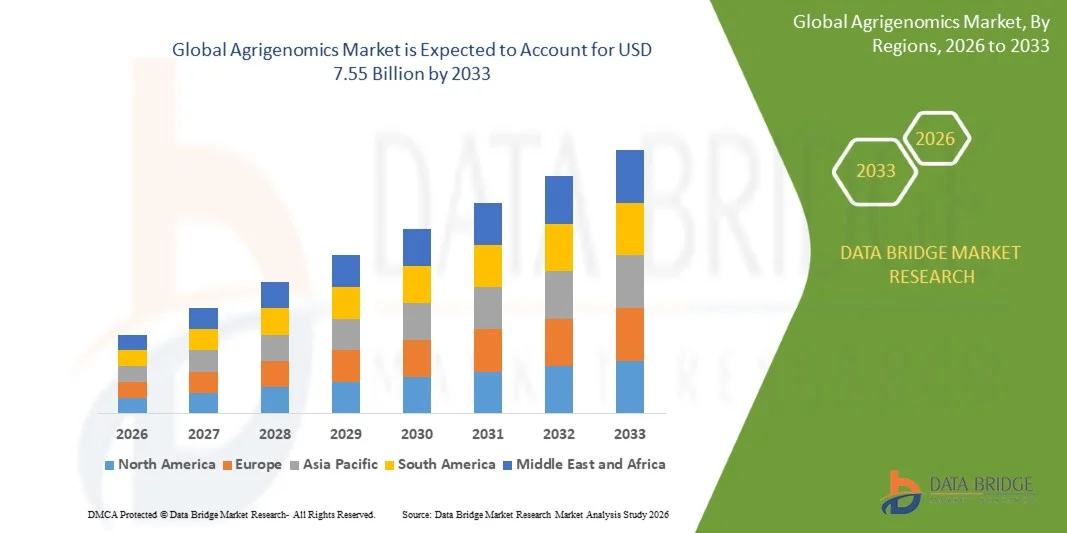
- As per Data Bridge Market Research analysis the agrigenomics market was valued at USD 4.13 billion in 2025 and is projected to reach USD 7.55 billion by 2033, growing at a CAGR of 7.85% from 2026 to 2033.
- The market is experiencing steady growth, driven by increasing demand for high-yielding, disease-resistant, and climate-resilient crops, advancements in genomic sequencing and bioinformatics, and expanding applications of genomics across crop breeding, animal genetics, and precision agriculture.
- Growing concerns regarding food security, climate change, crop losses, and agricultural productivity are encouraging governments, research organizations, breeding institutions, and agribusiness companies to invest in genomic technologies. Next-generation sequencing, genotyping, marker-assisted selection, genomic selection, and molecular breeding are increasingly being used to identify desirable traits and accelerate the development of improved crop and livestock varieties.
Market Size & Forecast
- Market Value (2025): USD 4.13 Billion
- Expected Market Value (2033): USD 7.55 Billion
- Forecast CAGR (2026–2033): 7.85%
- Leading Region in 2025: North America
- Fastest Growing Region: Asia-Pacific
What are the Major Takeaways of the Agrigenomics Market?
- North America dominated the global agrigenomics market with the largest revenue share in 2025, supported by strong investments in agricultural biotechnology, advanced genomic research infrastructure, established breeding programs, and widespread adoption of precision breeding technologies.
- Asia-Pacific is expected to be the fastest-growing region from 2026 to 2033, driven by rising food demand, agricultural modernization, increasing investments in biotechnology and genomic research, and growing adoption of genomic technologies across China, India, Japan, and other developing agricultural markets.
- The crops segment dominated the agrigenomics market in 2025, supported by the increasing use of genomic technologies for crop breeding, trait identification, disease and pest resistance, yield improvement, and the development of climate-resilient crop varieties.
- The livestock segment is expected to be the fastest-growing application segment during the forecast period, driven by increasing use of genomic testing and selection for animal breeding, disease resistance, reproductive efficiency, feed utilization, and improvements in meat and milk production.
- The illumina HiSeq family segment held a significant share of the agrigenomics market, supported by its high-throughput sequencing capabilities, scalability, accuracy, and broad application across plant and animal genomic research.
Report Scope and Agrigenomics Market Segmentation
|
Attributes |
Agrigenomics Key Market Insights |
|
Segments Covered |
|
|
Countries Covered |
North America
Europe
Asia-Pacific
Middle East and Africa
South America
|
|
Key Market Players |
|
|
Market Opportunities |
|
|
Value Added Data Infosets |
In addition to the insights on market scenarios such as market value, growth rate, segmentation, geographical coverage, and major players, the market reports curated by the Data Bridge Market Research also include import export analysis, production capacity overview, production consumption analysis, price trend analysis, climate change scenario, supply chain analysis, value chain analysis, raw material/consumables overview, vendor selection criteria, PESTLE Analysis, Porter Analysis, and regulatory framework. |
What is the Key Trend in the Agrigenomics Market?
- The increasing integration of long-read sequencing, pangenomics, multi-omics, machine learning, and advanced genomic analysis is emerging as a key trend in the agrigenomics market, enabling researchers and breeders to identify complex genetic variations and improve breeding decisions.
- For instance, in January 2025, PacBio highlighted the use of HiFi long-read sequencing in plant breeding, noting that the technology can identify single-nucleotide polymorphisms as well as larger structural variants and support the development of more complete reference genomes and pangenomes for agricultural species.
- Agrigenomics is increasingly moving beyond conventional DNA sequencing toward genomic selection, marker-assisted breeding, trait prediction, pangenome analysis, and the integration of genomic and phenotypic datasets, allowing breeders to identify desirable characteristics more efficiently.
- Machine learning is also becoming increasingly important for interpreting large genomic datasets and improving crop trait prediction. A January 2025 review in Nature Communications highlighted how machine learning can combine genomic, phenotypic, environmental, and other biological datasets to improve crop improvement and breeding efficiency.
- As sequencing technologies improve their ability to characterize complex genomes and genomic information becomes increasingly integrated with phenotyping, environmental data, and computational analytics, agrigenomics is expected to become an increasingly important component of precision breeding and the development of higher-performing and climate-resilient crops.
What are the Key Drivers of the Agrigenomics Market?
- Rising global food demand, climate-related agricultural challenges, and the need to improve productivity with limited natural resources are major drivers of the agrigenomics market. FAO estimates that global food production will need to increase by approximately 50% by 2050 to meet the needs of a growing population, while around 80% of the projected additional food demand is expected to come from plant products.
- Agrigenomics directly supports these requirements through DNA sequencing, genotyping, genomic selection, molecular breeding, and trait identification, helping breeders develop crop varieties with improved yield, nutritional characteristics, pest and disease resistance, and tolerance to environmental stresses.
- The increasing need for climate-resilient agriculture is further supporting the adoption of genomic technologies. By enabling breeders to identify genetic variants associated with desirable traits, agrigenomics can help accelerate breeding programs and improve the efficiency of selecting plants with improved adaptation to changing environmental conditions.
- Plant pests and diseases are another important factor supporting demand for genomic approaches. FAO estimates that up to 40% of global crop production is lost annually because of plant pests and diseases, resulting in economic losses exceeding USD 220 billion. Genomic approaches can support the identification and incorporation of resistance-related traits into breeding programs.
- As agricultural land, water resources, and climatic conditions place increasing constraints on food production, the need to improve genetic gain, develop resilient crop varieties, reduce production losses, and strengthen food security is expected to support continued adoption of agrigenomics technologies.
Which Factors are Challenging the Growth of the Agrigenomics Market?
- High sequencing, data-processing, and infrastructure costs continue to challenge the adoption of advanced agrigenomics technologies, particularly among smaller breeding organizations, research institutions, and agricultural programs with limited financial and technical resources.
- Although sequencing costs have declined and new approaches are improving the efficiency of genomic analysis, advanced technologies such as long-read sequencing, pangenomics, and multi-omics can still require significant investment in sequencing platforms, computing infrastructure, data storage, and specialized expertise.
- The increasing volume and complexity of genomic datasets also create challenges related to bioinformatics capabilities, computational resources, data integration, and interpretation of complex genetic variations. The integration of genomic information with phenotypic and environmental datasets further increases analytical requirements.
- Limited availability of high-quality genomic and phenotypic datasets can also restrict the effectiveness of advanced analytical approaches, particularly for underutilized and orphan crops. Research published in Nature Communications in 2025 noted that many orphan crops have comparatively limited genomic and phenotypic resources, creating challenges for the development and training of machine-learning models.
- In addition, translating genomic discoveries into commercially successful crop varieties remains challenging because complex characteristics such as yield, stress tolerance, and flowering time are influenced by multiple genes and interactions with environmental conditions.
- Consequently, high technology costs, infrastructure requirements, shortages of specialized bioinformatics expertise, limited datasets, and the complexity of translating genomic findings into field-level outcomes can slow the adoption of advanced agrigenomics technologies, particularly in resource-constrained agricultural markets.
How is the Agrigenomics Market Segmented?
The agrigenomics market is segmented on the basis of application and sequencer type.
- By Application
On the basis of application, the agrigenomics market is segmented into crops and livestock. The crops segment dominated the market, supported by the increasing use of genomic technologies for crop breeding, trait identification, disease and pest resistance, yield improvement, and development of climate-resilient crop varieties. Advances in next-generation sequencing, genotyping, marker-assisted selection, and bioinformatics are enabling researchers and breeders to analyze plant genomes more efficiently and identify genetic markers associated with desirable traits. Growing concerns regarding food security, climate variability, crop losses, and the need to improve agricultural productivity are further encouraging the adoption of agrigenomics technologies across crop research and breeding programs.
The livestock segment is expected to witness the fastest growth during the forecast period, driven by the increasing use of genomic testing and genomic selection for animal breeding, disease resistance, reproductive efficiency, feed utilization, and improvement of meat and milk production. Genomic technologies enable livestock breeders to identify desirable genetic characteristics at an earlier stage and improve the accuracy of breeding decisions, potentially reducing generation intervals. In addition, rising demand for animal protein, increasing focus on livestock productivity and health, and the adoption of precision livestock farming technologies are supporting the expansion of genomic applications in the livestock sector.
- By Sequencer Type
On the basis of sequencer type, the agrigenomics market is segmented into Illumina HiSeq family, Sanger sequencing, PacBio sequencing, SOLiD sequencers, and others. The Illumina HiSeq family segment holds a significant market position, supported by its high-throughput sequencing capabilities, scalability, accuracy, and broad use in genomic research. Illumina sequencing technologies are widely applied in whole-genome sequencing, genotyping, transcriptomic analysis, variant identification, and population genomics, making them suitable for large-scale plant and animal research and breeding programs.
The PacBio sequencing segment is expected to register strong growth during the forecast period, driven by increasing demand for long-read sequencing technologies that can characterize complex genomic regions, structural variations, repetitive sequences, and large genomic assemblies more effectively. Long-read sequencing is particularly useful for de novo genome assembly, reference genome improvement, pangenomic studies, and detailed characterization of crop and livestock genomes. Growing adoption of precision breeding, advancements in genomic research, and the need for more comprehensive characterization of complex genomes are expected to further support the use of PacBio sequencing technologies in agrigenomics.
Which Region Holds the Largest Share of the Agrigenomics Market?
- North America dominated the agrigenomics market with the largest revenue share in 2025, supported by substantial investments in agricultural biotechnology, advanced genomic research infrastructure, precision breeding, and molecular biology.
- The region benefits from established agricultural research institutions, biotechnology companies, sequencing technology providers, and sophisticated crop and livestock breeding programs. Increasing adoption of genomic selection, next-generation sequencing, genotyping, and bioinformatics for crop improvement and livestock productivity is further strengthening North America's position in the agrigenomics market.
- The region's focus on improving agricultural productivity, developing disease- and stress-resistant varieties, and applying data-driven breeding approaches is expected to support continued market growth during the forecast period.
U.S. Agrigenomics Market Insight
The U.S. agrigenomics market accounted for a major share of the North American market in 2025, supported by substantial investments in agricultural biotechnology, genomic research, precision agriculture, and advanced breeding technologies. The country has an established ecosystem of agricultural universities, research organizations, biotechnology companies, sequencing providers, and breeding institutions supporting the adoption of genomic technologies. Increasing use of DNA sequencing, genotyping, genomic selection, and bioinformatics for crop trait development, disease resistance, livestock breeding, and productivity improvement is further supporting market expansion. In addition, the growing focus on sustainable agriculture and climate-resilient production is encouraging the development of crop and livestock varieties with improved performance under changing environmental conditions.
Europe Agrigenomics Market Insight
The Europe agrigenomics market is expected to witness significant growth from 2026 to 2033, supported by increasing adoption of genomic technologies for sustainable agriculture, crop improvement, livestock breeding, and food security. The region's emphasis on improving agricultural productivity while reducing resource consumption and environmental impacts is encouraging the use of advanced breeding technologies. Strong research capabilities, established agricultural institutions, biotechnology expertise, and investments in sequencing and bioinformatics are further supporting market development. Growing applications of genomic selection, molecular breeding, and genomic analysis are expected to create additional opportunities across European crop and livestock breeding programs.
U.K. Agrigenomics Market Insight
The U.K. agrigenomics market is expected to witness strong growth from 2026 to 2033, driven by increasing investments in agricultural research, precision breeding, biotechnology, and genomic analysis. The country's established research ecosystem supports the application of sequencing, genotyping, bioinformatics, and genomic selection across crop and livestock research. Increasing focus on sustainable agriculture, climate resilience, food security, and improved agricultural productivity is encouraging the development of varieties and livestock with desirable genetic characteristics. In addition, the growing integration of genomic data with phenotypic and environmental information is supporting more efficient and data-driven breeding programs.
Germany Agrigenomics Market Insight
The Germany agrigenomics market is expected to witness significant growth from 2026 to 2033, supported by the country's strong biotechnology and agricultural research capabilities and increasing adoption of precision agriculture and advanced breeding technologies. Research institutions and agricultural organizations are increasingly applying genomic sequencing, genotyping, and bioinformatics to improve crop characteristics and livestock performance. Growing demand for resource-efficient agricultural production, disease-resistant varieties, and improved productivity is further encouraging the use of genomic approaches. Continued development of agricultural biotechnology and data-driven breeding methods is expected to support the expansion of agrigenomics applications in Germany.
Asia-Pacific Agrigenomics Market Insight
The Asia-Pacific agrigenomics market is expected to witness the fastest growth from 2026 to 2033, supported by rising food demand, agricultural modernization, increasing investments in biotechnology, and expanding genomic research capabilities. Countries such as China, Japan, India, and Australia are increasingly adopting sequencing, genotyping, molecular breeding, and bioinformatics technologies to improve crop yields, livestock productivity, and resistance to diseases and environmental stresses. The region's large agricultural base and growing need to improve productivity with limited land and water resources are creating significant opportunities for agrigenomics. Furthermore, increasing efforts to strengthen food security and develop climate-resilient agricultural systems are expected to accelerate adoption across the region.
Japan Agrigenomics Market Insight
The Japan agrigenomics market is expected to witness strong growth from 2026 to 2033, supported by advanced biotechnology capabilities, established agricultural research infrastructure, and increasing adoption of precision breeding technologies. Genomic approaches are being applied to improve crop characteristics, including yield, quality, disease resistance, and tolerance to environmental stresses. The use of genomic selection and genetic analysis in livestock breeding is also supporting efforts to improve animal productivity and desirable traits. In addition, continued investments in sequencing, bioinformatics, and agricultural biotechnology are supporting the development of more efficient and data-driven breeding programs.
China Agrigenomics Market Insight
The China agrigenomics market accounted for a significant share of the Asia-Pacific market in 2025, supported by the country's large agricultural sector, increasing investments in biotechnology, and growing demand for improved crop and livestock productivity. The adoption of genomic sequencing, genotyping, molecular breeding, and genetic selection is increasing as agricultural researchers and breeding organizations seek to develop high-yielding, disease-resistant, and stress-tolerant varieties. Government emphasis on agricultural modernization, food security, biotechnology development, and improved agricultural productivity is further supporting investment in genomic research and breeding technologies. The expansion of genomic research capabilities and increasing integration of genomic data into crop and livestock improvement programs are expected to support continued growth of the agrigenomics market in China.
Which are the Top Companies in Agrigenomics Market?
The agrigenomics industry is primarily led by well-established companies, including:
- Illumina, Inc. (U.S.)
- Thermo Fisher Scientific Inc. (U.S.)
- Eurofins Scientific SE (Luxembourg)
- Agilent Technologies, Inc. (U.S.)
- Neogen Corporation (U.S.)
- Pacific Biosciences of California, Inc. (U.S.)
- Oxford Nanopore Technologies plc (U.K.)
- KeyGene N.V. (Netherlands)
- Corteva, Inc. (U.S.)
- Bio-Rad Laboratories, Inc. (U.S.)
- Bayer AG (Germany)
- BGI Genomics Co., Ltd. (China)
- Cibus, Inc. (U.S.)
- Genus plc (U.K.)
- Inari Agriculture, Inc. (U.S.)
What are Latest Developments in Agrigenomics Market?
- In June 2023, Complete Genomics, Inc. launched updated vision/mission to reflect transformed drives for a better world. The new mission will help Complete Genomics to announce several donations for evolving cancer care and genomics education, as well as crucial partnerships with numerous biotechnology companies.
- In April 2023, Singrow, an Agri-genomics startup company announced its business expansion by opening a new indoor farm to serve as its main R&D hub in Singapore. The hub will improve novel crop varieties using Singrow's proprietary genomics technology in Singapore.
- In April 2022, PacBio collaborated with Corteva Agriscience to develop pest, custom, end-to-end workflows for plant, custom, and microbial sequencing. The collaboration will focuses on establishing high-throughput workflows in library preparation and DNA extraction in alignment with the tens of thousands of samples sequenced annually as share of Corteva's crop and seed safety production and research pipelines.
- In February 2023, Tecan Genomics Inc. collaborated with Singular Genomics to use the MagicPrep NGS system to create sequencing-ready libraries for the G4 sequencing platform.

- Interactive Data Analysis Dashboard
- Company Analysis Dashboard for high growth potential opportunities
- Research Analyst Access for customization & queries
- Competitor Analysis with Interactive dashboard
- Latest News, Updates & Trend analysis
- Harness the Power of Benchmark Analysis for Comprehensive Competitor Tracking
Data collection and base year analysis are done using data collection modules with large sample sizes. The stage includes obtaining market information or related data through various sources and strategies. It includes examining and planning all the data acquired from the past in advance. It likewise envelops the examination of information inconsistencies seen across different information sources. The market data is analysed and estimated using market statistical and coherent models. Also, market share analysis and key trend analysis are the major success factors in the market report. To know more, please request an analyst call or drop down your inquiry.
The key research methodology used by DBMR research team is data triangulation which involves data mining, analysis of the impact of data variables on the market and primary (industry expert) validation. Data models include Vendor Positioning Grid, Market Time Line Analysis, Market Overview and Guide, Company Positioning Grid, Patent Analysis, Pricing Analysis, Company Market Share Analysis, Standards of Measurement, Global versus Regional and Vendor Share Analysis. To know more about the research methodology, drop in an inquiry to speak to our industry experts.
Data Bridge Market Research is a leader in advanced formative research. We take pride in servicing our existing and new customers with data and analysis that match and suits their goal. The report can be customized to include price trend analysis of target brands understanding the market for additional countries (ask for the list of countries), clinical trial results data, literature review, refurbished market and product base analysis. Market analysis of target competitors can be analyzed from technology-based analysis to market portfolio strategies. We can add as many competitors that you require data about in the format and data style you are looking for. Our team of analysts can also provide you data in crude raw excel files pivot tables (Fact book) or can assist you in creating presentations from the data sets available in the report.