What is the AI Accelerator Market Size and Growth Rate?
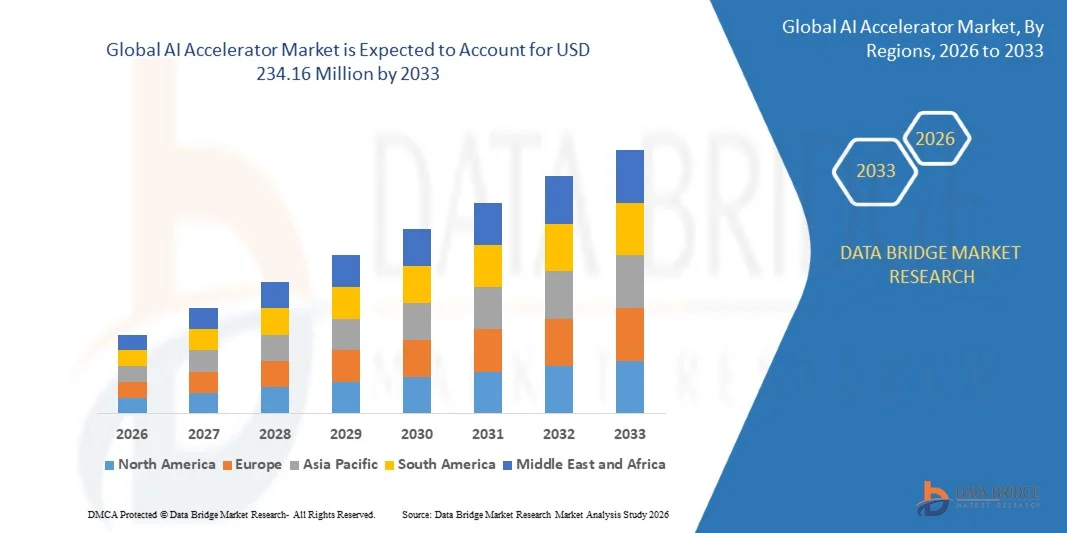
- As per Data Bridge Market Research analysis, the AI accelerator market was valued at USD 32.70 million in 2025 and is projected to reach USD 234.16 million by 2033, growing at a CAGR of 27.90% from 2026 to 2033.
- The market is expanding at an exceptional pace, driven by the rapid scale-up of generative AI training and inference, multi-gigawatt compute commitments by hyperscalers and frontier AI labs, the arrival of new accelerator generations from both merchant chip vendors and custom-silicon programmes, and growing deployment of AI at the edge.
- AI accelerators are specialized processors, including graphic processing unit (GPUs), custom ASICs such as tensor and neural processing units, FPGAs, and wafer-scale or inference-specific architectures, designed to execute the matrix-heavy computations of machine learning far more efficiently than general-purpose CPUs. They are typically paired with high bandwidth memory, advanced packaging, and high-speed interconnects, and are increasingly sold as rack-scale systems rather than individual chips. As inference grows to represent roughly two-thirds of AI compute spend, competition is shifting from raw training performance toward cost per token, memory capacity, power efficiency, and software ecosystem breadth.
Market Size & Forecast
- Global Market Value (2025): USD 32.70 Million
- Expected Market Value (2033): USD 234.16 Million
- Forecast CAGR (2026–2033): 27.90%
- Leading Region in 2025: North America
- Fastest Growing Region: Asia-Pacific
What are the Major Takeaways of the AI Accelerator Market?
- North America dominated the global AI accelerator market with the largest revenue share of 54.26% in 2025, supported by the concentration of leading accelerator designers, hyperscalers, and frontier AI labs in the region, and by a continuous cycle of gigawatt-scale deployments announced by U.S. cloud and AI companies.
- Asia-Pacific is expected to be the fastest-growing region at a CAGR of 31.6% from 2026 to 2033, driven by the region’s central role in advanced semiconductor manufacturing, memory supply, and packaging, rising domestic AI infrastructure investment, and growing development of home-grown accelerators.
- The GPU segment led the accelerator type category with a 68.42% share in 2025, owing to its mature software ecosystem, broad workload coverage, and the rapid ramp of rack-scale platforms.
- The inference segment is also expected to witness the fastest CAGR of 30.6% from 2026 to 2033, driven by purpose-built inference chips, rising token volumes, and the focus of buyers on cost per token.
- The cloud & data center segment accounted for 83.46% of the market by deployment in 2025, reflecting the concentration of accelerator purchases in hyperscale and neocloud facilities building out gigawatt-scale AI capacity.
- High bandwidth memory (HBM) led the memory technology category with a 71.28% share in 2025, as leading training and inference accelerators rely on stacked HBM for the memory capacity and bandwidth that large models require, with per-device capacity rising sharply across new generations.
- The AI labs & neoclouds segment is expected to witness the fastest CAGR of 33.7% from 2026 to 2033, driven by frontier model developers contracting directly with chip suppliers for multi-gigawatt capacity and by specialized GPU cloud providers expanding capacity for AI customers.
Report Scope and AI Accelerator Market Segmentation
|
Attributes |
AI Accelerator Key Market Insights |
|
Segments Covered |
|
|
Countries Covered |
North America
Europe
Asia-Pacific
Middle East and Africa
South America
|
|
Key Market Players |
|
|
Market Opportunities |
|
|
Value Added Data Infosets |
In addition to the market insights such as market value, growth rate, market segments, geographical coverage, market players, and market scenario, the market report curated by the Data Bridge Market Research team includes in-depth expert analysis, import/export analysis, pricing analysis, production consumption analysis, and pestle analysis. |
What is the Key Trend in the AI Accelerator Market?
- Accelerator vendors are increasingly splitting their product lines by workload, designing separate chips for training and for inference rather than a single general-purpose part, as inference economics, memory bandwidth, and cost per token become the primary purchase criteria.
- This specialization is most visible in the custom-silicon programmes of the largest cloud providers, which can tailor chips to their own models and serving stacks.
- For instance, in April 2026, at Google Cloud Next announced its eighth generation of tensor processing units as two purpose-built chips, the TPU 8t for training and the TPU 8i for inference, with a TPU 8t superpod scaling to 9,600 chips, two petabytes of shared high bandwidth memory, and 121 exaflops of FP4 compute.
- At the same time, frontier AI labs are signing multi-gigawatt, multi-vendor compute agreements that spread demand across GPUs and custom accelerators rather than relying on a single supplier.
- For instance, in July 2026, AMD announced an agreement with Anthropic for up to 2 gigawatts of Instinct MI450 Series GPUs in Helios rack-scale systems beginning in the first half of 2027, while in April 2026 Anthropic expanded its partnership with Google and Broadcom to secure up to 5 gigawatts of next-generation TPU capacity starting in 2027.
- As workload-specific chips and multi-vendor, gigawatt-scale agreements become the norm, diversification beyond a single architecture and supplier is expected to remain the defining trend in the AI accelerator market through the forecast period.
What are the Key Drivers of the AI Accelerator Market?
- The scale-up of generative AI, reasoning models, and AI agents is driving unprecedented demand for compute, with new accelerator generations entering production to meet it as customers commit capacity years ahead of delivery.
- For instance, in January 2026, at CES, NVIDIA stated that its Rubin platform had entered full production with cloud availability planned for the second half of 2026, and on September 16, 2026 CoreWeave announced that it had brought up a multi-rack Vera Rubin NVL72 cluster connecting hundreds of Rubin GPUs on its cloud.
- Competition among accelerator suppliers is widening customer choice and pulling additional capacity into the market, as large buyers secure second sources for AI compute.
- For instance, in October 2025, AMD and OpenAI announced a 6-gigawatt agreement across multiple generations of AMD Instinct GPUs, with the first 1 gigawatt of MI450 Series deployment beginning in the second half of 2026, and on October 14, 2025, Oracle Cloud Infrastructure named itself a launch partner for an initial 50,000 AMD Instinct MI450 GPUs from calendar Q3 2026.
- Custom-silicon design partners are also expanding rapidly, with Broadcom announcing on June 9, 2026 its AI XPV Platform, with Apollo and Blackstone as initial anchor investors, designed to enable more than 20 gigawatts of compute capacity through 2028 using custom XPUs and networking for frontier AI labs.
- With generative AI demand rising, multiple accelerator generations ramping in 2026, and large buyers diversifying suppliers, demand for AI accelerators is expected to remain exceptionally strong throughout the forecast period.
What Factors are Challenging the Growth of the AI Accelerator Market?
- AI accelerator supply remains constrained by limited advanced semiconductor manufacturing capacity, advanced packaging availability, and high-bandwidth memory (HBM) production. These interdependent bottlenecks can delay chip deliveries and limit the pace of data-center expansion.
- For instance, in April 2026, TrendForce reported that surging AI demand had tightened 3 nm and 2 nm wafer capacity alongside 2.5D and 3D advanced packaging, highlighting persistent constraints across the semiconductor supply chain.
- Software ecosystem lock-in creates additional challenges because accelerators often require vendor-specific compilers, libraries, and optimization tools. Moving workloads between platforms can require code modifications, performance tuning, and additional engineering resources.
- High acquisition costs, substantial power consumption, cooling requirements, and supporting infrastructure expenses can further restrict AI accelerator adoption, particularly among smaller organizations. The combined impact of supply constraints, infrastructure investment, and software migration complexity can delay deployments and limit vendor flexibility, moderating market expansion despite strong demand for AI computing.
How is the AI Accelerator Market Segmented?
The AI accelerator market is segmented on the basis of accelerator type, workload, deployment, memory technology, process node, application and end user.
- By Accelerator Type
On the basis of accelerator type, the global AI accelerator market is segmented into GPUs, custom ASICs (TPUs, NPUs, XPUs), FPGAs, and other architectures (wafer-scale, LPU, neuromorphic). The GPU segment dominated the market with a 68.42% share in 2025, owing to GPUs' highly mature software ecosystem, parallel processing capabilities, and versatility across diverse AI workloads, including model training, fine-tuning, and inference. Their compatibility with established development frameworks and extensive developer support further strengthen adoption across enterprises, cloud service providers, and research institutions. Additionally, the rapid deployment of rack-scale AI platforms by leading suppliers is supporting demand for integrated computing infrastructure capable of handling increasingly complex generative AI workloads.
The custom ASICs segment is projected to record the fastest growth at a CAGR of 33.6% from 2026 to 2033, driven by hyperscalers and leading AI laboratories investing in proprietary silicon architectures to improve computational efficiency, reduce inference costs, and strengthen supply chain control. Dedicated accelerators, including successive generations of tensor processing units (TPUs) and programmes such as AWS Trainium, Microsoft Maia, and Meta MTIA, illustrate this shift toward application-specific hardware. Through closer collaboration with semiconductor design and manufacturing partners, companies are optimizing chips for their specific AI workloads, improving performance per watt and reducing dependence on general-purpose accelerators.
- By Workload
On the basis of workload, the global AI accelerator market is segmented into inference and training. The inference segment dominated the market with a share of 59.74% in 2025, reflecting the fact that inference now represents roughly two-thirds of AI compute spend as deployed models, AI agents, and reasoning workloads generate continuous, large-scale serving demand.
The inference segment is also expected to witness the fastest CAGR of 30.6% from 2026 to 2033, driven by the growing deployment of generative AI applications, large language models, and real-time AI services. Rising token volumes are increasing demand for efficient, low-latency inference capabilities across cloud data centers, enterprise systems, and edge devices.
- By Deployment
On the basis of deployment, the global AI accelerator market is segmented into cloud & data center, edge & on-device, and on-premises enterprise. The cloud & data center segment dominated the market with a share of 83.46% in 2025, reflects the concentration of AI infrastructure investments among hyperscale cloud providers and neocloud operators expanding computing capacity to support generative AI, large language models, and high-performance computing workloads. The deployment of gigawatt-scale AI infrastructure is driving substantial demand for GPUs, custom ASICs, and other specialized processors. Additionally, the availability of scalable computing resources, centralized infrastructure management, and cloud-based AI services continues to strengthen accelerator adoption across enterprises and research institutions.
The edge & on-device segment is expected to witness the fastest CAGR of 34.2% from 2026 to 2033, driven by increasing integration of low-power AI accelerators into autonomous vehicles, robotics, industrial machinery, smartphones, and other consumer electronics. These applications require real-time data processing, low latency, enhanced privacy, and reduced dependence on cloud connectivity. Edge accelerators enable AI workloads to run directly on local devices, minimizing data transmission costs and improving responsiveness. Furthermore, advancements in energy-efficient chip architectures, embedded AI processors, and edge computing technologies are expanding deployment opportunities across manufacturing, automotive, healthcare, and smart consumer devices, supporting strong growth throughout the forecast period.
- By Memory Technology
On the basis of memory technology, the global AI accelerator market is segmented into high bandwidth memory (HBM), GDDR, and on-chip SRAM-centric & LPDDR-based designs. The HBM segment dominated the market with a share of 71.28% in 2025, growing computational and memory requirements of large language models, generative AI applications, and high-performance computing workloads. Leading AI accelerators increasingly rely on stacked HBM technology to deliver the high memory bandwidth and capacity required for efficient model training and inference. Furthermore, rising memory capacity per device across successive accelerator generations is supporting demand for advanced HBM solutions. The expansion of hyperscale data centers and the deployment of increasingly complex AI models are further reinforcing the segment's leadership.
The on-chip SRAM-centric & LPDDR-based designs segment is expected to witness the fastest CAGR of 36.4% from 2026 to 2033, driven by development of inference-optimized architectures designed to improve processing efficiency while reducing reliance on HBM. By leveraging on-chip static random-access memory (SRAM) and low-power double data rate (LPDDR) memory, these architectures can reduce data movement, lower power consumption, and improve cost efficiency for selected AI workloads. As inference volumes and token-generation requirements increase, cloud providers and AI developers are prioritizing lower costs per token and more efficient hardware utilization. These factors are expected to accelerate adoption of alternative memory architectures, particularly in specialized inference systems and edge AI applications.
- By Process Node
On the basis of process node, the global AI accelerator market is segmented into 7nm & above, 5nm–4nm, and 3nm & below. The 5nm–4nm segment dominated the market with a share of 51.64% in 2025, widespread adoption of established accelerator architectures, including NVIDIA’s Blackwell-class and previous-generation platforms manufactured using 4nm-class process technologies. These nodes offer a favorable balance of computing performance, power efficiency, manufacturing maturity, and production scalability, making them well suited for large-scale AI training and inference workloads.
The 3nm & below segment is expected to witness the fastest CAGR of 41.8% from 2026 to 2033, driven by the transition toward more advanced semiconductor manufacturing processes, which enable higher transistor density, improved performance per watt, and greater computational capacity. The anticipated adoption of TSMC’s N3P technology for NVIDIA’s Rubin generation and advanced process technologies for AMD’s MI450 platform highlights the industry's shift toward next-generation chip architectures. Increasing demand for energy-efficient AI infrastructure, rising computational requirements of large language models, and the expansion of hyperscale data centers are expected to accelerate this transition.
- By Application
On the basis of application, the global AI accelerator market is segmented into generative AI & large language models, recommendation & ranking systems, computer vision & video analytics, conversational AI & NLP, autonomous systems & robotics, and scientific & HPC computing. The generative AI & large language models segment dominated the market with a share of 46.72% in 2025, reflects the substantial computing resources required to train, fine-tune, and deploy advanced language models and generative AI applications. The growing adoption of AI-powered content generation, coding assistants, enterprise copilots, and multimodal systems is driving demand for high-performance accelerators. Furthermore, the increasing deployment of frontier AI models across cloud platforms and enterprise environments is supporting investments in accelerator-intensive infrastructure to improve processing speed, scalability, and inference efficiency.
The autonomous systems & robotics segment is expected to witness the fastest CAGR of 32.9% from 2026 to 2033, driven by he expanding adoption of physical AI across autonomous vehicles, industrial robotics, smart manufacturing, and automated logistics. These applications require specialized accelerators capable of processing sensor data, recognizing objects, and making real-time decisions with minimal latency. On-board inference enables systems to operate reliably without continuous cloud connectivity while improving responsiveness and reducing data transmission requirements. Advancements in energy-efficient processors, edge computing, machine vision, and AI-enabled control systems are expected to accelerate adoption, positioning autonomous systems and robotics as a significant growth opportunity throughout the forecast period.
- By End User
On the basis of end user, the global AI accelerator market is segmented into hyperscalers & cloud service providers, AI labs & neoclouds, enterprises, and government & research institutions. The hyperscalers & cloud service providers segment dominated the market with a share of 61.38% in 2025, reflecting their substantial capital expenditure on AI data centers, high-performance computing infrastructure, and large-scale GPU deployments. Major cloud providers are investing heavily in advanced accelerators to support generative AI, large language models, and enterprise AI services. Their dual role as buyers of merchant accelerators and developers of custom silicon further strengthens market demand. Additionally, expanding cloud-based AI offerings and the growing need for scalable computing capacity are supporting continued investments in accelerator technologies.
The AI labs & neoclouds segment is expected to witness the fastest CAGR of 33.7% from 2026 to 2033, driven by frontier AI developers securing large-scale computing capacity through direct agreements with chip suppliers and infrastructure partners. At the same time, specialized GPU cloud providers, commonly known as neoclouds, are expanding their infrastructure to meet rising demand from AI startups, research organizations, and enterprises requiring high-performance computing resources. Their focus on accelerator-intensive workloads, flexible capacity provisioning, and optimized AI infrastructure is strengthening their market position. Furthermore, increasing demand for model training, inference, and dedicated AI computing environments is expected to accelerate investment in this segment.
Which Region Holds the Largest Share of the AI Accelerator Market?
- North America dominated the AI accelerator market and accounted for the largest revenue share of 54.26% in 2025, supported by the concentration of the world’s leading accelerator designers, hyperscale cloud providers, and frontier AI labs in the United States, and by a continuous cycle of gigawatt-scale deployment announcements.
- The region also benefits from deep venture and public-market funding for specialist accelerator companies, close collaboration between chip designers and AI model developers, and a large base of cloud capacity that is first to deploy new platforms. Continued launches of rack-scale systems and custom-silicon programmes are expected to reinforce North America’s leadership through the forecast period.
U.S. AI Accelerator Market Insight
The U.S. AI accelerator market holds the leading position within North America, underpinned by the headquarters of NVIDIA, AMD, Broadcom, Intel, and the largest hyperscalers, and by the concentration of frontier AI labs that contract directly for multi-gigawatt capacity. New platforms are typically deployed first by U.S. cloud providers, such as the multi-rack Vera Rubin NVL72 cluster brought up by CoreWeave on September 16, 2026 and the 50,000-GPU AMD MI450 supercluster planned for Oracle Cloud Infrastructure from Q3 2026. The recent public listing of Cerebras in May 2026 has further deepened the pool of specialist accelerator companies in the country.
Canada AI Accelerator Market Insight
Canada’s AI accelerator market is expanding rapidly, driven by growing demand for high-performance computing, generative AI, and machine learning applications. Investments in data centers, cloud infrastructure, and AI research are increasing adoption of GPUs, specialized processors, and advanced computing hardware. Government initiatives, strong academic research, and technology innovation support market development. However, high hardware costs, energy consumption, supply chain constraints, and global competition remain significant challenges, creating opportunities for semiconductor manufacturers, cloud providers, and AI infrastructure developers.
Asia-Pacific AI Accelerator Market Insight
The Asia-Pacific AI accelerator market is expected to witness the fastest growth globally, driven by the region’s central role in semiconductor manufacturing, high bandwidth memory production in South Korea, rising domestic AI infrastructure investment, and growing development of home-grown accelerators. South Korean memory makers supply the HBM on which leading accelerators rely, while regional start-ups and national champions are building inference-focused chips for data center and edge applications.
China AI Accelerator Market Insight
The China AI accelerator market is expanding rapidly, shaped by strong domestic demand for AI compute and a policy emphasis on self-sufficiency in advanced semiconductors. Domestic suppliers such as Huawei and Cambricon are developing data center accelerators for training and inference, while access to the most advanced foreign accelerators and manufacturing processes remains constrained, reinforcing investment in local chip design, packaging, and software ecosystems.
Japan AI Accelerator Market Insight
Japan’s AI accelerator market is growing steadily, driven by increasing investments in generative AI, robotics, autonomous systems, and high-performance computing. Demand for GPUs, application-specific integrated circuits, and specialized AI processors is rising across manufacturing, healthcare, automotive, and data center applications. Government initiatives supporting digital transformation and domestic semiconductor production further strengthen market development. However, high development costs, energy requirements, and global supply chain dependencies remain challenges, creating opportunities for semiconductor manufacturers, cloud providers, and AI infrastructure innovators.
Which are the Top Companies in AI Accelerator Market?
The AI accelerator industry is primarily led by well-established companies, including:
- NVIDIA Corporation (U.S.)
- Advanced Micro Devices, Inc. (U.S.)
- Intel Corporation (U.S.)
- Broadcom Inc. (U.S.)
- Marvell Technology, Inc. (U.S.)
- Alphabet Inc. (Google) (U.S.)
- Amazon Web Services, Inc. (U.S.)
- Microsoft Corporation (U.S.)
- Meta Platforms, Inc. (U.S.)
- Qualcomm Incorporated (U.S.)
- Cerebras Systems, Inc. (U.S.)
- Groq, Inc. (U.S.)
- SambaNova Systems, Inc. (U.S.)
- Graphcore Limited (U.K.)
- Tenstorrent Inc. (Canada)
- Etched.ai, Inc. (U.S.)
- d-Matrix Corporation (U.S.)
- Huawei Technologies Co., Ltd. (China)
- Cambricon Technologies Corporation Limited (China)
- Samsung Electronics Co., Ltd. (South Korea)
- SK hynix Inc. (South Korea)
- Micron Technology, Inc. (U.S.)
- Taiwan Semiconductor Manufacturing Company Limited (Taiwan)
- Alchip Technologies, Limited (Taiwan)
- MediaTek Inc. (Taiwan)
- Rebellions Inc. (South Korea)
- Preferred Networks, Inc. (Japan)
- CoreWeave, Inc. (U.S.)
What are Latest Developments in AI Accelerator Market?
- In September 2026, CoreWeave announced that it had brought up a multi-rack NVIDIA Vera Rubin NVL72 cluster connecting hundreds of Rubin GPUs on its cloud, one of the first public deployments of NVIDIA’s Rubin generation following the platform’s entry into full production announced at CES in January 2026.
- In September 2026, Broadcom reported AI semiconductor revenue of USD 16.7 billion for the third quarter of fiscal 2026, up 221% year over year, reflecting rapid growth in custom accelerator and AI networking sales to hyperscalers and frontier AI labs.
- In July 2026, AMD announced a strategic partnership with Anthropic to deploy up to 2 gigawatts of AMD Instinct MI450 Series GPUs, in the form of Helios rack-scale solutions featuring MI455X GPUs, EPYC “Venice” CPUs, Pensando networking, and ROCm software, beginning in the first half of 2027.
- In May 2026, Cerebras Systems completed its initial public offering, becoming one of the largest U.S. technology listings in recent years and giving the wafer-scale accelerator specialist access to public capital to expand its data center capacity.
- In April 2026, at Google Cloud Next, Google announced its eighth-generation TPUs as two purpose-built chips, the TPU 8t for training and the TPU 8i for inference, with a TPU 8t superpod scaling to 9,600 chips, two petabytes of shared HBM, and 121 exaflops of FP4 compute.

- Interactive Data Analysis Dashboard
- Company Analysis Dashboard for high growth potential opportunities
- Research Analyst Access for customization & queries
- Competitor Analysis with Interactive dashboard
- Latest News, Updates & Trend analysis
- Harness the Power of Benchmark Analysis for Comprehensive Competitor Tracking
Data collection and base year analysis are done using data collection modules with large sample sizes. The stage includes obtaining market information or related data through various sources and strategies. It includes examining and planning all the data acquired from the past in advance. It likewise envelops the examination of information inconsistencies seen across different information sources. The market data is analysed and estimated using market statistical and coherent models. Also, market share analysis and key trend analysis are the major success factors in the market report. To know more, please request an analyst call or drop down your inquiry.
The key research methodology used by DBMR research team is data triangulation which involves data mining, analysis of the impact of data variables on the market and primary (industry expert) validation. Data models include Vendor Positioning Grid, Market Time Line Analysis, Market Overview and Guide, Company Positioning Grid, Patent Analysis, Pricing Analysis, Company Market Share Analysis, Standards of Measurement, Global versus Regional and Vendor Share Analysis. To know more about the research methodology, drop in an inquiry to speak to our industry experts.
Data Bridge Market Research is a leader in advanced formative research. We take pride in servicing our existing and new customers with data and analysis that match and suits their goal. The report can be customized to include price trend analysis of target brands understanding the market for additional countries (ask for the list of countries), clinical trial results data, literature review, refurbished market and product base analysis. Market analysis of target competitors can be analyzed from technology-based analysis to market portfolio strategies. We can add as many competitors that you require data about in the format and data style you are looking for. Our team of analysts can also provide you data in crude raw excel files pivot tables (Fact book) or can assist you in creating presentations from the data sets available in the report.