


What is AI Assistant Market Size and Overview ?
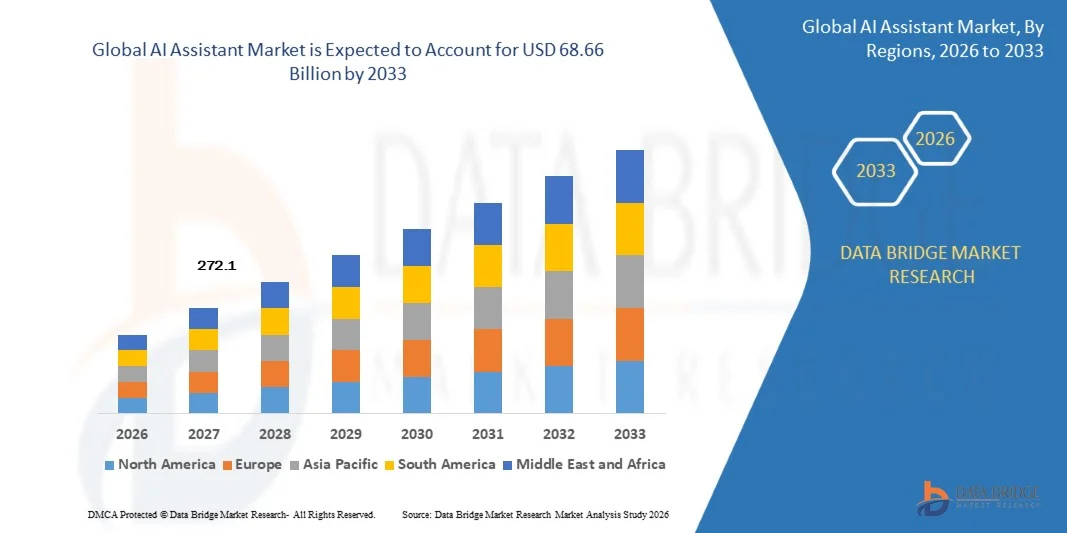
- The AI assistant market was valued at USD 17.50 billion in 2025 and is projected to reach USD 68.66 billion by 2033, growing at a CAGR of 18.70% from 2026 to 2033. The market is experiencing remarkable growth as organizations increasingly integrate artificial intelligence into customer engagement, workplace productivity, software development, business operations, and enterprise decision-making. AI assistants have evolved from basic rule-based chatbots into sophisticated intelligent systems capable of understanding natural language, generating human-like responses, executing complex workflows, and supporting multimodal interactions across text, voice, image, and video.
- The rapid commercialization of generative AI, large language models (LLMs), multimodal AI, and agentic AI frameworks is fundamentally transforming how businesses and consumers interact with digital technologies. Organizations are deploying AI assistants to automate repetitive tasks, enhance customer experiences, improve employee productivity, accelerate software development, optimize knowledge management, and streamline enterprise operations. The growing adoption of cloud computing, increasing enterprise digital transformation initiatives, expanding availability of AI foundation models, and significant investments by technology companies are further strengthening market expansion. As AI assistants become increasingly capable of reasoning, contextual understanding, multilingual communication, and autonomous task execution, their role is expected to expand across virtually every industry over the forecast period.
Market Size & Forecast
- Market Value (2025): USD 17.50 Billion
- Expected Market Value (2033): USD 68.66 Billion
- Forecast CAGR (2026–2033): 18.70%
- Leading Region in 2025: North America
- Fastest Growing Region: Asia-Pacific
Key Market Trends & Insights
- North America dominated the AI assistant market with the largest revenue share of 42.80% in 2025, supported by early adoption of generative AI technologies, strong cloud infrastructure, significant investments by major technology companies, mature enterprise digital transformation initiatives, and favorable innovation ecosystems.
- The software segment accounted for the largest market share of 67.66% in 2025, driven by widespread deployment of conversational AI platforms, enterprise AI copilots, virtual assistants, customer engagement solutions, and AI-powered productivity applications.
- Asia-Pacific is expected to be the fastest-growing regional market, registering a CAGR of 20.40% from 2026 to 2033, fueled by rapid digitalization, expanding cloud adoption, increasing AI investments across China, India, Japan, South Korea, and Southeast Asia, and rising enterprise automation initiatives.
- The generative AI & large language models (LLMs) segment is projected to witness the fastest growth with a CAGR of 39.48%, owing to continuous improvements in foundation models, multimodal AI capabilities, enterprise copilots, domain-specific AI models, and autonomous AI agents.
- The cloud deployment segment dominated the deployment category with a 71.30% revenue share in 2025, supported by scalable AI infrastructure, lower implementation costs, seamless model updates, API-based integrations, and growing adoption of AI-as-a-Service platforms.
- Customer Service & Virtual Support represented the leading application segment, accounting for 31.85% of the market in 2025 due to increasing automation of contact centers, multilingual conversational AI, personalized customer engagement, and 24/7 support capabilities.
- The software development assistance application is expected to register one of the highest growth rates throughout the forecast period, supported by increasing adoption of AI coding assistants, automated debugging, code generation, software testing, and DevOps optimization.
- Large enterprises held the largest market share in 2025 as organizations increasingly invest in enterprise AI platforms to automate workflows, improve operational efficiency, strengthen cybersecurity, and enhance employee productivity.
Report Scope and AI Assistant Market Segmentation
|
Attributes |
AI Assistant Key Market Insights |
||
|
Segments Covered |
|
||
|
Countries Covered |
North America
Europe
Asia-Pacific
Middle East and Africa
South America
|
||
|
Key Market Players |
|
||
|
Market Opportunities |
|
||
|
Value Added Data Infosets |
In addition to the market insights such as market value, growth rate, market segments, geographical coverage, market players, and market scenario, the market report curated by the Data Bridge Market Research team includes in-depth expert analysis, import/export analysis, pricing analysis, production consumption analysis, and pestle analysis. |
What is Key Trend in AI Assistant Market ?
Trend: Rapid Adoption of AI Copilots and Autonomous AI Agents Across Enterprises
The AI assistant market is witnessing rapid growth due to the increasing adoption of AI copilots and autonomous AI agents that automate workflows, improve decision-making, and enhance employee productivity. Powered by large language models (LLMs), retrieval-augmented generation (RAG), and multimodal AI, modern AI assistants are evolving from basic conversational tools into intelligent digital collaborators capable of content creation, data analysis, document summarization, coding assistance, workflow automation, and enterprise knowledge retrieval.
Organizations across healthcare, banking, retail, manufacturing, education, and professional services are integrating AI assistants with enterprise applications, CRM platforms, ERP systems, and collaboration tools to improve operational efficiency and deliver personalized experiences. Continuous advancements in reasoning capabilities, multilingual support, and secure enterprise deployment models are enabling AI assistants to support complex business processes while maintaining governance and compliance requirements.
For instance,
- In May 2025, Microsoft enhanced Microsoft 365 Copilot with autonomous AI agent capabilities to automate complex business workflows and improve productivity across enterprise applications.
- In April 2025, Google expanded Gemini for Workspace capabilities by integrating advanced generative AI features across Gmail, Docs, Sheets, and Meet to support content creation, meeting summaries, workflow automation, and enterprise knowledge retrieval.
These advancements highlight the growing transition of AI assistants from productivity tools to strategic enterprise platforms, enabling organizations to achieve higher levels of automation, efficiency, and intelligent decision support.
AI Assistant Market Dynamics
Key Market Driver: Increasing Enterprise Adoption of Generative AI and Workflow Automation
Growing enterprise investment in generative AI and intelligent workflow automation is a major factor driving the AI assistant market. Organizations are adopting AI assistants to automate repetitive tasks, reduce operational costs, improve customer engagement, and accelerate decision-making. AI-powered assistants are increasingly being used for report generation, email drafting, software development, data analysis, customer support, and enterprise knowledge management.
The integration of AI assistants with cloud platforms, enterprise applications, cybersecurity solutions, and business intelligence systems is simplifying adoption across industries. The availability of AI-as-a-Service platforms, low-code AI development environments, and enterprise-grade security frameworks is further enabling organizations to deploy AI assistants at scale. Advancements in multimodal AI, contextual reasoning, and industry-specific foundation models are expanding their applications across healthcare, finance, government, and legal sectors.
For instance,
- In April 2026, Salesforce introduced Agentforce Operations, a solution designed to transform manual back-office processes into automated workflows managed by specialized AI agents for tasks such as process coordination, data verification, compliance management, and approvals.
- In May 2023, ServiceNow introduced generative AI capabilities for the Now Platform, including Generative AI Controller and Now Assist for Search, enabling faster workflow automation and improved enterprise productivity.
Such innovations demonstrate the increasing integration of AI assistants into core business operations, further accelerating enterprise adoption and supporting market expansion.
Key Restraint/Challenge: Data Privacy, Security Risks, and Regulatory Compliance
Data privacy concerns, cybersecurity risks, and evolving regulatory requirements remain major challenges for AI assistant adoption. AI assistants often process sensitive corporate information, customer records, financial data, healthcare information, and proprietary business knowledge, increasing concerns related to unauthorized access, data leakage, model hallucinations, and compliance risks.
Enterprises also face challenges in integrating AI assistants with existing IT infrastructure while ensuring transparency, human oversight, ethical AI usage, and responsible governance. Technology providers are addressing these concerns through secure AI architectures, private deployments, governance frameworks, and enhanced enterprise security controls.
For instance,
-
The European Union’s AI Act introduced phased compliance obligations for high-risk AI systems, encouraging organizations to strengthen transparency, risk management, and governance practices for enterprise AI deployments.
-
OpenAI expanded ChatGPT Enterprise security and administrative controls to support enterprise data protection, user management, compliance, and secure deployment of generative AI solutions.
These developments emphasize the importance of secure, transparent, and compliant AI frameworks in building enterprise trust and enabling broader adoption of AI assistants.
Key Market Opportunity: Growing Adoption of Industry-Specific AI Assistants and Vertical AI Solutions
The rising demand for industry-specific AI assistants presents significant growth opportunities for technology providers. Enterprises are increasingly moving beyond general-purpose AI tools toward specialized solutions designed for healthcare, financial services, legal operations, manufacturing, retail, cybersecurity, and software development applications.
Advancements in retrieval-augmented generation, private foundation models, enterprise vector databases, multimodal AI, and agentic AI architectures are enabling organizations to develop customized assistants trained on proprietary enterprise data while maintaining security and compliance. These solutions are supporting applications such as clinical documentation, contract analysis, financial advisory services, supply chain optimization, and intelligent customer engagement.
For instance,
- In October 2024, Oracle expanded AI Agent capabilities across Oracle Fusion Cloud Applications to automate workflows in finance, supply chain, human resources, and customer experience functions.
- In May 2024, SAP expanded Joule, its enterprise AI copilot, with industry-focused capabilities supporting procurement, finance, human resources, supply chain management, and enterprise analytics.
The increasing development of vertical AI assistants is expected to create new growth opportunities by enabling customized automation, improving operational outcomes, and addressing industry-specific business requirements.
AI Assistant Market Scope
The AI assistant market is segmented on the basis of component, deployment mode, technology, application, end user, and enterprise size.
By Component
On the basis of component, the market is segmented into software and services. In 2026, the software segment is expected to dominate the market with a market share of 67.62%, owing to the increasing deployment of enterprise AI assistant platforms, conversational AI applications, AI copilots, virtual assistants, and generative AI solutions across business functions. Organizations are rapidly integrating AI software into customer engagement, productivity enhancement, workflow automation, and knowledge management systems to improve operational efficiency while reducing manual intervention. Continuous advancements in foundation models, multimodal AI capabilities, and enterprise-grade AI platforms are further strengthening the adoption of software solutions across industries.
The services segment is expected to witness the fastest CAGR of 19.4% from 2026 to 2033, driven by the growing demand for AI consulting, implementation, customization, system integration, managed services, employee training, and continuous model optimization. As enterprises increasingly deploy customized AI assistants tailored to their business requirements, professional and managed services are becoming essential for ensuring successful implementation, governance, scalability, and long-term operational performance.
By Deployment Mode
On the basis of deployment mode, the market is segmented into cloud-based, on-premises, and hybrid. In 2026, the cloud-based segment is expected to dominate the market with a market share of 71.35%, supported by increasing enterprise migration toward cloud-native AI platforms, lower infrastructure costs, faster deployment, seamless software updates, scalable computing resources, and easier integration with enterprise applications. Cloud deployment enables organizations to access continuously updated AI foundation models while reducing capital expenditure and simplifying maintenance, making it the preferred deployment model for businesses of all sizes.
The hybrid segment is expected to register the fastest CAGR of 20.6% from 2026 to 2033, owing to the increasing demand for flexible AI deployment strategies that combine cloud scalability with on-premises security and regulatory compliance. Hybrid deployment is gaining traction among highly regulated industries such as healthcare, banking, government, and defense, where organizations require sensitive data to remain within private infrastructure while leveraging cloud-based AI capabilities for advanced analytics and intelligent automation.
By Technology
On the basis of technology, the market is segmented into Natural Language Processing (NLP), Machine Learning & Deep Learning, Generative AI & Large Language Models (LLMs), Speech Recognition, and Others. In 2026, the Generative AI & Large Language Models (LLMs) segment is expected to dominate the market with a market share of 39.84%, owing to the rapid commercialization of foundation models capable of generating human-like text, images, code, audio, and multimodal content. Large language models have significantly expanded the capabilities of AI assistants by enabling contextual reasoning, multilingual communication, enterprise knowledge retrieval, intelligent workflow execution, and autonomous task completion. Continuous innovation in model efficiency, reasoning capabilities, and enterprise customization is further accelerating adoption across industries.
The Speech Recognition segment is expected to witness the fastest CAGR of 20.8% from 2026 to 2033, driven by increasing demand for voice-enabled AI assistants across smartphones, automobiles, smart homes, healthcare applications, enterprise collaboration platforms, and customer service operations. Improvements in multilingual voice recognition, real-time transcription, and conversational speech intelligence are expanding the commercial applications of voice-based AI technologies worldwide.
By Application
On the basis of application, the market is segmented into Customer Service & Virtual Support, Content Generation, Productivity & Workflow Automation, Software Development Assistance, Knowledge Management & Enterprise Search, and Others. In 2026, the Customer Service & Virtual Support segment is expected to dominate the market with a market share of 31.82%, owing to the widespread deployment of AI assistants for automated customer interactions, intelligent chatbots, virtual agents, multilingual support, and personalized customer engagement across banking, retail, healthcare, telecommunications, and travel industries. Organizations are increasingly leveraging AI assistants to improve response times, reduce operational costs, enhance customer satisfaction, and provide round-the-clock support services.
The Software Development Assistance segment is expected to witness the fastest CAGR of 21.3% from 2026 to 2033, driven by the growing adoption of AI coding assistants capable of code generation, debugging, documentation, automated testing, software optimization, and DevOps support. Increasing demand for accelerated software development, developer productivity enhancement, and intelligent programming assistance is significantly contributing to segment growth.
By End User
On the basis of end user, the market is segmented into BFSI, Healthcare, Retail & E-commerce, IT & Telecommunications, Manufacturing, Government & Public Sector, Education, Media & Entertainment, and Others. In 2026, the IT & Telecommunications segment is expected to dominate the market with a market share of 24.73%, owing to the industry's rapid adoption of AI assistants for software engineering, customer support, cybersecurity operations, network management, knowledge management, and enterprise productivity enhancement. Technology companies continue to be among the earliest adopters of generative AI solutions, driving continuous innovation and large-scale deployment across digital business operations.
The Healthcare segment is expected to witness the fastest CAGR of 20.9% from 2026 to 2033, driven by increasing adoption of AI assistants for clinical documentation, medical imaging support, patient engagement, hospital workflow automation, telemedicine, virtual health assistants, and healthcare decision support. Rising investments in digital healthcare infrastructure and increasing physician demand for administrative automation are further supporting market expansion.
By Enterprise Size
On the basis of enterprise size, the market is segmented into Large Enterprises and Small & Medium Enterprises (SMEs). In 2026, the Large Enterprises segment is expected to dominate the market with a market share of 69.14%, owing to significant investments in enterprise artificial intelligence, advanced cloud infrastructure, cybersecurity, digital transformation initiatives, and intelligent business process automation. Large organizations possess greater financial resources, technical expertise, and enterprise data required to deploy AI assistants at scale across multiple departments while maintaining governance, compliance, and security standards.
The Small & Medium Enterprises (SMEs) segment is expected to witness the fastest CAGR of 20.2% from 2026 to 2033, driven by increasing availability of affordable AI-as-a-Service platforms, subscription-based pricing models, no-code AI development tools, and cloud-native AI assistants. These solutions are enabling SMEs to automate business operations, improve customer engagement, optimize marketing activities, and enhance employee productivity without requiring significant upfront investments in IT infrastructure.
AI Assistant Market Regional Analysis
North America dominated the AI assistant market with the largest revenue share of 42.80% in 2025, supported by the presence of leading artificial intelligence developers, rapid enterprise adoption of generative AI technologies, robust cloud infrastructure, high digital transformation spending, and favorable investments in AI research and innovation. The region benefits from a mature technology ecosystem comprising hyperscale cloud providers, enterprise software vendors, semiconductor manufacturers, and AI startups that continue to accelerate the commercialization of advanced AI assistant platforms. Furthermore, increasing deployment of AI copilots across customer service, software development, healthcare, financial services, and enterprise productivity applications is strengthening market growth across the region.
U.S. AI Assistant Market Insight
The U.S. AI assistant market is witnessing substantial growth due to the country's leadership in artificial intelligence research, strong presence of technology companies, increasing enterprise investment in generative AI, and rapid adoption of AI-powered productivity solutions across industries. Organizations are integrating AI assistants into software engineering, customer relationship management, business intelligence, cybersecurity, healthcare, financial services, and legal operations to improve operational efficiency and accelerate digital transformation. Continuous innovation by major technology companies, increasing venture capital investments, expanding cloud infrastructure, and favorable enterprise adoption of AI copilots are further supporting market expansion. In addition, growing demand for secure enterprise AI solutions and autonomous AI agents is expected to strengthen long-term market growth.
Europe AI Assistant Market Insight
The Europe AI assistant market represents a significant share of the market, driven by increasing enterprise digitalization, growing investments in artificial intelligence innovation, expanding adoption of cloud computing, and rising demand for intelligent business automation solutions. Organizations across manufacturing, banking, healthcare, retail, and government sectors are increasingly deploying AI assistants to improve operational productivity, customer engagement, and data-driven decision-making. The region is also witnessing increased adoption of responsible AI frameworks, enterprise governance solutions, and privacy-focused AI deployments, encouraging organizations to integrate artificial intelligence while maintaining regulatory compliance. Continuous investment in AI research and innovation across the European Union is expected to further support market growth.
U.K. AI Assistant Market Insight
The U.K. AI assistant market is experiencing steady growth, supported by increasing adoption of generative AI technologies across financial services, professional services, healthcare, education, and public sector organizations. Businesses are increasingly deploying AI assistants to automate customer interactions, improve workplace productivity, support software development, and enhance enterprise knowledge management. Growing government initiatives promoting artificial intelligence innovation, expanding cloud adoption, and increasing investments in AI startups are contributing to market expansion. Furthermore, organizations are adopting AI governance frameworks and responsible AI practices to ensure secure deployment across enterprise environments.
Germany AI Assistant Market Insight
The Germany AI assistant market is expanding steadily owing to the country's strong industrial base, increasing adoption of Industry 4.0 technologies, growing enterprise automation initiatives, and significant investments in artificial intelligence research. Manufacturing companies are integrating AI assistants into production planning, predictive maintenance, quality management, supply chain optimization, and industrial knowledge management to improve operational efficiency and reduce production costs. The growing adoption of AI-powered enterprise software, intelligent automation platforms, and digital engineering solutions is further strengthening market demand across the country. In addition, increasing collaboration between technology providers, research institutions, and industrial enterprises is accelerating AI innovation throughout Germany.
Asia-Pacific AI Assistant Market Insight
The Asia-Pacific AI assistant market is expected to witness the fastest growth during the forecast period, driven by rapid digital transformation, increasing cloud adoption, expanding investments in artificial intelligence infrastructure, and growing enterprise automation across emerging economies. Countries such as China, India, Japan, South Korea, and Singapore are investing significantly in AI research, intelligent manufacturing, digital government initiatives, and enterprise modernization, creating substantial opportunities for AI assistant providers. Rising smartphone penetration, expanding digital commerce, increasing adoption of multilingual AI applications, and strong government support for artificial intelligence development are further accelerating market expansion. The region's large developer community and rapidly growing startup ecosystem are also contributing to continuous innovation in AI assistant technologies.
Japan AI Assistant Market Insight
The Japan AI assistant market is witnessing consistent growth due to increasing adoption of artificial intelligence across manufacturing, healthcare, financial services, retail, and consumer electronics industries. The country's aging workforce and ongoing labor shortages are encouraging organizations to deploy AI assistants for workflow automation, intelligent customer support, knowledge management, and operational optimization. Japanese enterprises are also investing in multilingual AI assistants, robotics integration, and advanced conversational AI technologies to improve workforce productivity and enhance customer experiences. Continuous government support for AI innovation and digital transformation initiatives is expected to sustain long-term market growth.
China AI Assistant Market Insight
The China AI assistant market is experiencing rapid expansion owing to increasing investments in artificial intelligence, widespread digitalization across industries, strong government support for AI innovation, and the presence of leading domestic technology companies. Enterprises are increasingly deploying AI assistants across e-commerce, financial services, manufacturing, education, healthcare, and public administration to automate business processes and improve customer engagement. Continuous advancements in large language models, intelligent cloud services, and enterprise AI platforms are strengthening domestic AI capabilities. Furthermore, the country's large digital population, growing cloud infrastructure, and expanding enterprise adoption of intelligent automation solutions position China as one of the fastest-growing AI assistant markets ly.
AI Assistant Market Share
The AI assistant industry is primarily led by well-established companies, including:
- OpenAI (U.S.)
- Microsoft Corporation (U.S.)
- Alphabet Inc. (Google) (U.S.)
- Amazon Web Services, Inc. (U.S.)
- Anthropic PBC (U.S.)
- Meta Platforms, Inc. (U.S.)
- IBM Corporation (U.S.)
- Oracle Corporation (U.S.)
- Salesforce, Inc. (U.S.)
- SAP SE (Germany)
- NVIDIA Corporation (U.S.)
- Baidu, Inc. (China)
- Tencent Holdings Ltd. (China)
- Alibaba Cloud (China)
- Huawei Technologies Co., Ltd. (China)
- Infosys Limited (India)
- Tata Consultancy Services Ltd. (India)
- HCLTech (India)
- ServiceNow, Inc. (U.S.)
- Zoom Communications, Inc. (U.S.)
- Grammarly Inc. (U.S.)
- GitHub, Inc. (U.S.)
- Adobe Inc. (U.S.)
- Samsung Electronics Co., Ltd. (South Korea)
- Lenovo Group Limited (China)
- ByteDance Ltd. (China)
- Cohere Inc. (Canada)
- Mistral AI (France)
- DeepSeek AI (China)
- xAI Corp. (U.S.)
Latest Developments in AI Assistant Market
- In May 2025, Microsoft announced significant enhancements to Microsoft 365 Copilot by introducing autonomous AI agents capable of independently executing business tasks across Microsoft applications. The update enables organizations to automate complex enterprise workflows, improve employee productivity, and accelerate intelligent business process automation through agentic AI capabilities.
- In April 2025, Google expanded Gemini for Workspace with advanced multimodal AI capabilities, enabling users to generate documents, summarize meetings, analyze spreadsheets, automate email responses, and improve collaboration across enterprise productivity applications. The enhancements strengthen Google's position in enterprise AI assistant solutions.
- In April 2026, Salesforce introduced Agentforce Operations, a solution that takes outdated, manual back-office processes and turns them into a clear set of tasks so that specialized agents can do the work for you: process coordination, verifying data, clearing compliance, hunting down approvals, and more.
- In May 2023, ServiceNow, the leading digital workflow company making the world work better for everyone, announced new generative AI capabilities for the Now Platform to help deliver faster, more intelligent workflow automation. The new solutions—ServiceNow Generative AI Controller and Now Assist for Search—expand ServiceNow’s already extensive AI functionality with built‑in capabilities that apply the power of generative AI to enterprise applications.

- Interactive Data Analysis Dashboard
- Company Analysis Dashboard for high growth potential opportunities
- Research Analyst Access for customization & queries
- Competitor Analysis with Interactive dashboard
- Latest News, Updates & Trend analysis
- Harness the Power of Benchmark Analysis for Comprehensive Competitor Tracking
Data collection and base year analysis are done using data collection modules with large sample sizes. The stage includes obtaining market information or related data through various sources and strategies. It includes examining and planning all the data acquired from the past in advance. It likewise envelops the examination of information inconsistencies seen across different information sources. The market data is analysed and estimated using market statistical and coherent models. Also, market share analysis and key trend analysis are the major success factors in the market report. To know more, please request an analyst call or drop down your inquiry.
The key research methodology used by DBMR research team is data triangulation which involves data mining, analysis of the impact of data variables on the market and primary (industry expert) validation. Data models include Vendor Positioning Grid, Market Time Line Analysis, Market Overview and Guide, Company Positioning Grid, Patent Analysis, Pricing Analysis, Company Market Share Analysis, Standards of Measurement, Global versus Regional and Vendor Share Analysis. To know more about the research methodology, drop in an inquiry to speak to our industry experts.
Data Bridge Market Research is a leader in advanced formative research. We take pride in servicing our existing and new customers with data and analysis that match and suits their goal. The report can be customized to include price trend analysis of target brands understanding the market for additional countries (ask for the list of countries), clinical trial results data, literature review, refurbished market and product base analysis. Market analysis of target competitors can be analyzed from technology-based analysis to market portfolio strategies. We can add as many competitors that you require data about in the format and data style you are looking for. Our team of analysts can also provide you data in crude raw excel files pivot tables (Fact book) or can assist you in creating presentations from the data sets available in the report.













