


AI-Augmented Medtech Quality Management Systems Market Size
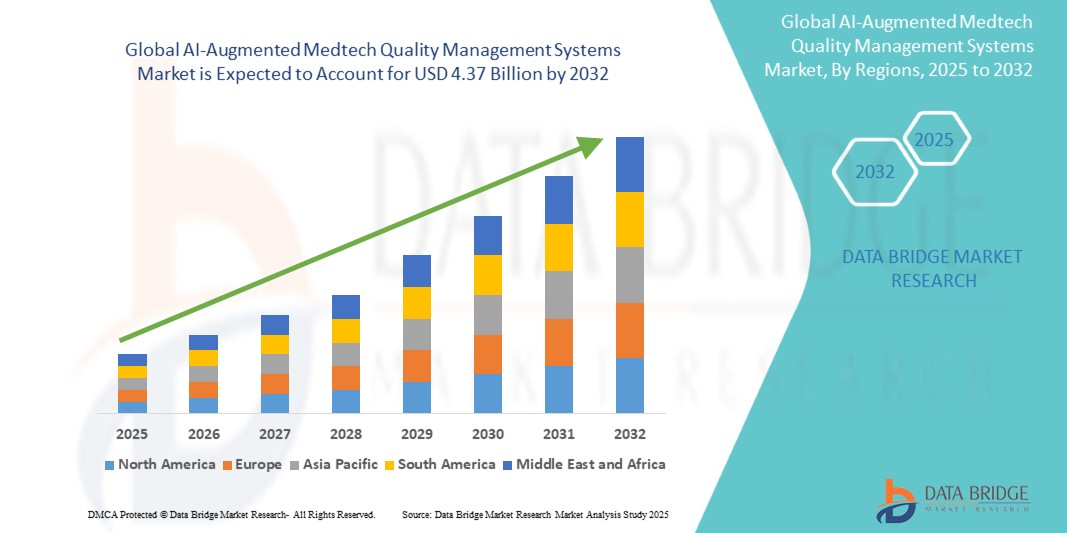
- The global AI-augmented medtech quality management systems market size was valued at USD 1.18 billion in 2024 and is expected to reach USD 4.37 billion by 2032, at a CAGR of 17.70% during the forecast period
- The market growth is largely fueled by the growing adoption and technological advancements in healthcare facilities, medical device manufacturing, and regulatory compliance systems, leading to increased digitalization and process automation across hospitals, clinics, and research laboratories
- Furthermore, rising demand for secure, user-friendly, and AI-enabled quality management solutions in medtech is driving the adoption of AI-Augmented Medtech Quality Management Systems. These solutions help organizations ensure compliance, enhance operational efficiency, and reduce errors in medical device production and clinical processes
AI-Augmented Medtech Quality Management Systems Market Analysis
- AI-Augmented Medtech Quality Management Systems, offering advanced automation and real-time analytics for medical device quality assurance, are increasingly vital components of modern healthcare operations in hospitals, diagnostic centers, and research institutions due to their ability to improve compliance, enhance patient safety, and streamline regulatory processes
- The escalating demand for AI-augmented medtech quality management systems is primarily fueled by the growing complexity of healthcare regulations, rising emphasis on product quality, and the need for efficient, data-driven monitoring solutions across the medtech industry
- North America dominated the AI-augmented medtech quality management systems market with the largest revenue share of 49.3% in 2024, characterized by early adoption of AI technologies, advanced healthcare infrastructure, and the strong presence of leading industry players, with the U.S. experiencing substantial growth in system installations in hospitals, diagnostic centers, and research institutions, driven by innovations from both established companies and AI-focused startups
- Asia-Pacific is expected to be the fastest-growing region in the AI-augmented medtech quality management systems market during the forecast period, due to increasing healthcare digitalization, rising investments in AI technologies, and expanding adoption of quality management solutions in hospitals and research facilities
- The AI-Powered Controls segment dominated the AI-augmented medtech quality management systems market with a revenue share of 48.1% in 2024, as it enables predictive quality assurance, automated risk detection, and intelligent decision-making
Report Scope and AI-Augmented Medtech Quality Management Systems Market Segmentation
|
Attributes |
AI-Augmented Medtech Quality Management Systems Key Market Insights |
|
Segments Covered |
|
|
Countries Covered |
North America
Europe
Asia-Pacific
Middle East and Africa
South America
|
|
Key Market Players |
|
|
Market Opportunities |
|
|
Value Added Data Infosets |
In addition to the insights on market scenarios such as market value, growth rate, segmentation, geographical coverage, and major players, the market reports curated by the Data Bridge Market Research also include in-depth expert analysis, pricing analysis, brand share analysis, consumer survey, demography analysis, supply chain analysis, value chain analysis, raw material/consumables overview, vendor selection criteria, PESTLE Analysis, Porter Analysis, and regulatory framework. |
AI-Augmented Medtech Quality Management Systems Market Trends
Enhanced Efficiency and Compliance Through AI Integration
- A significant and accelerating trend in the global AI-augmented medtech quality management systems market is the deepening integration of artificial intelligence (AI) for improving operational efficiency, predictive analytics, and regulatory compliance. AI-enabled systems are increasingly assisting healthcare and medtech companies in monitoring product quality, detecting anomalies, and optimizing processes in real time
- For instance, several AI-augmented platforms now provide predictive insights that can alert quality teams to potential deviations in manufacturing, enabling proactive corrective actions and reducing the risk of non-compliance with stringent regulatory standards
- AI integration in medtech quality management systems enables features such as automated risk assessment, trend analysis, and predictive maintenance of medical devices. These intelligent capabilities help manufacturers reduce operational errors, improve process reliability, and ensure consistent product quality
- The integration of AI with centralized quality management platforms allows companies to oversee multiple production sites, track compliance metrics, and generate comprehensive reports from a single interface. This facilitates better coordination across departments and enhances transparency for audits and regulatory reviews
- This trend towards more intelligent, data-driven, and automated quality management systems is fundamentally reshaping expectations in the medtech industry. Consequently, companies are developing AI-enabled solutions that optimize workflows, ensure real-time monitoring of device performance, and support faster, more accurate decision-making
- The demand for AI-augmented medtech quality management systems is growing rapidly across hospitals, diagnostics centers, and manufacturing facilities, as stakeholders increasingly prioritize efficiency, compliance, and high-quality standards in medical device production
AI-Augmented Medtech Quality Management Systems Market Dynamics
Driver
Growing Need Due to Expanding Digitalization in Healthcare
- The rapid digital transformation in healthcare, coupled with increasing emphasis on patient safety, regulatory compliance, and operational efficiency, is driving the growing demand for AI-Augmented Medtech Quality Management Systems. These systems enable healthcare providers to monitor, analyze, and optimize quality management processes in real time, ensuring adherence to stringent medical standards
- For instance, in April 2024, Onity, Inc. (Honeywell International, Inc.) announced advancements in IoT-enabled monitoring technologies, highlighting the potential of integrated AI solutions to streamline medical device quality management. Such initiatives by leading companies are expected to significantly contribute to market growth over the forecast period
- Healthcare institutions are increasingly deploying AI-augmented systems to automate routine quality checks, reduce manual errors, and maintain comprehensive compliance records. This not only improves operational efficiency but also enhances patient safety by minimizing risks associated with faulty or non-compliant devices
- Furthermore, rising awareness about the importance of continuous quality monitoring, coupled with the need for faster reporting and predictive analytics, is encouraging hospitals, clinics, and research centers to adopt AI-driven solutions. These systems facilitate early detection of anomalies, optimize workflow management, and support data-driven decision-making across multiple healthcare operations
- The integration of AI into quality management allows for predictive insights, anomaly detection, and automated corrective actions, creating a more proactive approach to maintaining compliance and operational excellence. This growing capability is driving wider adoption across healthcare organizations seeking to improve both efficiency and patient outcomes
Restraint/Challenge
Concerns Regarding Implementation Complexity and High Initial Costs
- The significant upfront investment required for advanced AI-augmented medtech quality management systems can act as a barrier, particularly for smaller clinics, emerging hospitals, and budget-constrained healthcare providers
- Implementation challenges, such as integrating these systems with existing IT infrastructure and ensuring staff are adequately trained, may slow adoption in some facilities
- Overcoming these obstacles will require solutions that are user-friendly, modular, and compatible with existing hospital technologies, along with comprehensive training programs for medical and administrative personnel
- Manufacturers are increasingly focusing on developing scalable, cost-effective, and interoperable systems to drive adoption across diverse healthcare settings, including hospitals, specialty clinics, and research institutions
- Addressing these challenges through flexible pricing models, strong post-implementation support, and demonstrable improvements in operational efficiency and compliance will be essential for sustaining long-term growth in the AI-augmented medtech quality management systems market
AI-Augmented Medtech Quality Management Systems Market Scope
The market is segmented on the basis of type, data transmission mode, control mechanism, and application.
• By Type
On the basis of type, the AI-augmented medtech quality management systems market is segmented into Software Solutions, Hardware Solutions, Hybrid Solutions, and Others. The Software Solutions segment dominated the market with the largest revenue share of 46.7% in 2024, owing to its ability to provide real-time monitoring, predictive analytics, compliance reporting, and seamless integration with existing hospital and laboratory information systems. Hospitals and diagnostic centers increasingly prefer software-driven quality management systems for their flexibility, scalability, and cost-effectiveness. These solutions enable centralized data collection, automated alerts, and analytics-driven insights, improving overall operational efficiency and patient safety. Continuous software innovations, such as AI-based anomaly detection and integration with IoT-enabled medical devices, further reinforce the dominance of this segment.
The Hybrid Solutions segment is expected to witness the fastest CAGR of 17.2% from 2025 to 2032, driven by the growing demand for combined software-hardware systems that offer enhanced automation, robust data security, and real-time control. Hybrid systems allow healthcare facilities to leverage the strengths of both platforms—hardware for on-site control and software for remote monitoring and analytics. The rising adoption of hybrid systems in hospitals, research laboratories, and specialized clinics seeking high-performance, integrated quality management solutions is fueling rapid market growth in this segment.
• By Data Transmission Mode
On the basis of data transmission mode, the AI-augmented medtech quality management systems market is segmented into cloud-based systems, on-premises systems, hybrid systems, and others. The Cloud-Based Systems segment dominated with a revenue share of 44.3% in 2024, attributed to their capability to enable remote access, secure data storage, and centralized monitoring across multiple facilities. Cloud-based systems support real-time analytics, AI-assisted insights, and seamless integration with mobile and desktop applications, allowing healthcare administrators to proactively manage quality processes. The scalability, lower upfront costs, and continuous updates make cloud systems particularly attractive to hospitals and research centers aiming to reduce IT overhead while maintaining compliance with regulatory standards.
The Hybrid Systems segment is projected to witness the fastest CAGR of 16.8% from 2025 to 2032, driven by the growing requirement for flexible deployment models that combine the benefits of on-premises control with cloud-based accessibility. This approach ensures high data security for sensitive patient and device information while enabling remote monitoring and analytics. Healthcare facilities implementing hybrid systems benefit from optimized workflows, enhanced compliance reporting, and resilience against network disruptions, driving strong adoption across mature and emerging markets.
• By Control Mechanism
On the basis of control mechanism, the AI-augmented medtech quality management systems market is segmented into Automated Alerts, AI-Powered Controls, Manual Override, Remote Access Controls, and Others. The AI-Powered Controls segment dominated the market with a revenue share of 48.1% in 2024, as it enables predictive quality assurance, automated risk detection, and intelligent decision-making. AI-powered controls analyze historical and real-time data to suggest corrective actions, identify anomalies, and optimize device performance, ensuring high reliability and patient safety. Hospitals and research laboratories are increasingly investing in AI-driven control mechanisms to reduce human error, enhance operational efficiency, and comply with stringent regulatory standards.
The Remote Access Controls segment is expected to witness the fastest CAGR of 18.4% from 2025 to 2032, fueled by the growing adoption of telehealth, remote monitoring, and decentralized laboratory operations. Remote control mechanisms allow quality managers and clinicians to supervise system performance, configure alerts, and access analytics from anywhere, ensuring uninterrupted quality assurance. The rise of connected medical devices and cloud-based platforms further accelerates the demand for remote access capabilities across healthcare facilities globally.
• By Application
On the basis of application, the AI-augmented medtech quality management systems market is segmented into hospitals, diagnostic centers, clinics, research laboratories, and others. The hospitals segment dominated the market with a revenue share of 51.2% in 2024, owing to high patient volumes, complex workflows, and the critical need for regulatory compliance. Hospitals implement AI-augmented quality management systems to enhance device reliability, monitor procedural outcomes, and reduce operational risks. The adoption of these systems is particularly high in tertiary care centers and multi-specialty hospitals, where continuous quality monitoring and predictive insights are essential for patient safety.
The research laboratories segment is projected to witness the fastest CAGR of 19.1% from 2025 to 2032, driven by the increasing complexity of biomedical research, rising demand for high-precision experiments, and stringent quality standards. Research labs adopt AI-augmented systems to automate quality monitoring, track equipment performance, and ensure reproducibility of results. Integration with laboratory information management systems (LIMS) and IoT-enabled instrumentation further supports rapid growth in this segment.
AI-Augmented Medtech Quality Management Systems Market Regional Analysis
- North America dominated the AI-augmented medtech quality management systems market with the largest revenue share of 49.3% in 2024, supported by the region’s early adoption of AI-driven technologies and advanced healthcare infrastructure
- The presence of leading medtech companies, combined with strong research and development capabilities, has fueled the deployment of AI-augmented quality management platforms across hospitals, diagnostic centers, and research institutions
- The growing focus on regulatory compliance, operational efficiency, predictive maintenance, and enhanced patient safety is driving widespread integration of AI tools in quality monitoring workflows, making North America the most mature and influential market globally
U.S. AI-Augmented Medtech Quality Management Systems Market Insight
The U.S. AI-augmented medtech quality management systems market captured the largest revenue share of 85% within North America in 2024, reflecting the country’s dominant role in adopting advanced AI-enabled quality management systems in medtech and healthcare facilities. Hospitals and research centers are increasingly leveraging AI for real-time monitoring, predictive analytics, and streamlined compliance management. These innovations enhance process efficiency, reduce operational errors, and ensure adherence to stringent regulatory standards, positioning the U.S. as the global leader in AI-driven quality management adoption.
Europe AI-Augmented Medtech Quality Management Systems Market Insight
The Europe AI-augmented medtech quality management systems market is projected to expand at a substantial CAGR during the forecast period, largely driven by rigorous regulatory frameworks, growing digital transformation in healthcare, and rising investments in AI-based quality management solutions. Healthcare facilities and medtech manufacturers across Europe are adopting AI-augmented systems to enable automated quality control, centralized oversight of operations, and predictive insights for risk mitigation. Countries like Germany, France, and the U.K. are leading in the implementation of these intelligent platforms, reflecting a strong market growth trajectory.
U.K. AI-Augmented Medtech Quality Management Systems Market Insight
The U.K. AI-augmented medtech quality management systems market is expected to witness notable growth during the forecast period, fueled by increasing investment in AI technologies for healthcare quality management. Hospitals, clinics, and research institutions are leveraging these systems to enhance operational efficiency, improve patient safety, and maintain compliance with regulatory standards. The country’s emphasis on innovation, coupled with robust digital infrastructure in healthcare, is accelerating adoption and enabling more intelligent and automated quality management practices.
Germany AI-Augmented Medtech Quality Management Systems Market Insight
The Germany AI-augmented medtech quality management systems market is anticipated to expand at a considerable CAGR during the forecast period, driven by increasing awareness of AI-enabled process optimization and quality assurance in healthcare and medtech manufacturing. The nation’s well-developed healthcare infrastructure, focus on sustainability, and strong research ecosystem facilitate the adoption of AI-augmented quality management systems. Hospitals and medtech manufacturers are increasingly integrating AI technologies to enhance operational efficiency, predictive monitoring, and compliance management.
Asia-Pacific AI-Augmented Medtech Quality Management Systems Market Insight
The Asia-Pacific AI-augmented medtech quality management systems market is poised to grow at the fastest CAGR during the forecast period, propelled by rapid healthcare digitalization, growing investments in AI technologies, and the rising adoption of quality management systems in hospitals, research centers, and medtech manufacturing facilities. Countries such as China, Japan, and India are witnessing increased demand for AI-driven process monitoring, predictive analytics, and compliance optimization. Government initiatives supporting digital healthcare transformation and AI integration further reinforce market expansion in the region.
Japan AI-Augmented Medtech Quality Management Systems Market Insight
The Japan AI-augmented medtech quality management systems market is experiencing rapid growth, driven by the country’s advanced digital healthcare infrastructure, high adoption of AI-based solutions, and strong emphasis on operational efficiency, compliance, and patient safety. Hospitals and research centers are deploying AI-augmented quality management platforms to streamline monitoring, enhance predictive capabilities, and optimize overall healthcare workflows. This trend is expected to continue, supported by Japan’s technology-friendly ecosystem and demand for advanced healthcare solutions.
China AI-Augmented Medtech Quality Management Systems Market Insight
The China AI-augmented medtech quality management systems market accounted for the largest revenue share in the Asia-Pacific region in 2024, supported by rapid urbanization, increasing investments in AI-enabled healthcare technologies, and a growing medtech manufacturing base. Hospitals and research institutions are adopting AI-augmented quality management systems for predictive maintenance, compliance monitoring, and operational efficiency improvements. National initiatives promoting digital healthcare and AI adoption are further driving the market, making China a key growth hub in the region.
AI-Augmented Medtech Quality Management Systems Market Share
The AI-augmented medtech quality management systems industry is primarily led by well-established companies, including:
- Honeywell International Inc (U.S.)
- IQVIA Inc. (U.S.)
- Medidata (U.S.)
- Veeva Systems Inc. (U.S.)
- CitiusTech Inc (India)
- Aidoc (Israel)
- MicroPort Scientific Corporation (China)
- SimplerQMS (U.S.)
- Oracle (U.S.)
- MasterControl Solutions, Inc. (U.S.)
- Greenlight Guru (U.S.)
- Siemens Healthineers AG (Germany)
- Dassault Systèmes (France)
Latest Developments in Global AI-Augmented Medtech Quality Management Systems Market
- In March 2024, the U.S. Food and Drug Administration (FDA) published the document titled “Artificial Intelligence and Medical Products: How CBER, CDER, CDRH, and OCP are Working Together.” This publication outlines the FDA's coordinated approach to the development and regulation of AI in medical products, aiming to ensure safety and efficacy across various medical disciplines
- In May 2025, MedTech Dive reported that the FDA had updated its list of AI/ML-enabled medical devices, with the latest update on July 10, 2025. This list includes devices that incorporate AI/ML technologies across medical disciplines, reflecting the agency's ongoing efforts to track and regulate AI-enabled medical innovations
- In February 2025, the World Health Organization (WHO) highlighted the transformative potential of digital tools, including artificial intelligence, in healthcare. During the event “Health systems of the future: harnessing technology and innovation in health for everyone, everywhere,” the WHO emphasized that AI has the potential to prevent, diagnose, and treat diseases, ultimately improving people's health and well-being
- In September 2024, Philips CEO Roy Jakobs discussed the company's focus on AI integration for diagnostics and quality management in healthcare. He emphasized the importance of responsible AI use, including rigorous testing and validation, to ensure patient safety and compliance with regulatory standards

- Interactive Data Analysis Dashboard
- Company Analysis Dashboard for high growth potential opportunities
- Research Analyst Access for customization & queries
- Competitor Analysis with Interactive dashboard
- Latest News, Updates & Trend analysis
- Harness the Power of Benchmark Analysis for Comprehensive Competitor Tracking
Data collection and base year analysis are done using data collection modules with large sample sizes. The stage includes obtaining market information or related data through various sources and strategies. It includes examining and planning all the data acquired from the past in advance. It likewise envelops the examination of information inconsistencies seen across different information sources. The market data is analysed and estimated using market statistical and coherent models. Also, market share analysis and key trend analysis are the major success factors in the market report. To know more, please request an analyst call or drop down your inquiry.
The key research methodology used by DBMR research team is data triangulation which involves data mining, analysis of the impact of data variables on the market and primary (industry expert) validation. Data models include Vendor Positioning Grid, Market Time Line Analysis, Market Overview and Guide, Company Positioning Grid, Patent Analysis, Pricing Analysis, Company Market Share Analysis, Standards of Measurement, Global versus Regional and Vendor Share Analysis. To know more about the research methodology, drop in an inquiry to speak to our industry experts.
Data Bridge Market Research is a leader in advanced formative research. We take pride in servicing our existing and new customers with data and analysis that match and suits their goal. The report can be customized to include price trend analysis of target brands understanding the market for additional countries (ask for the list of countries), clinical trial results data, literature review, refurbished market and product base analysis. Market analysis of target competitors can be analyzed from technology-based analysis to market portfolio strategies. We can add as many competitors that you require data about in the format and data style you are looking for. Our team of analysts can also provide you data in crude raw excel files pivot tables (Fact book) or can assist you in creating presentations from the data sets available in the report.













