


What is the AI-Based Pharmacovigilance Platforms Market Size and Growth Rate?
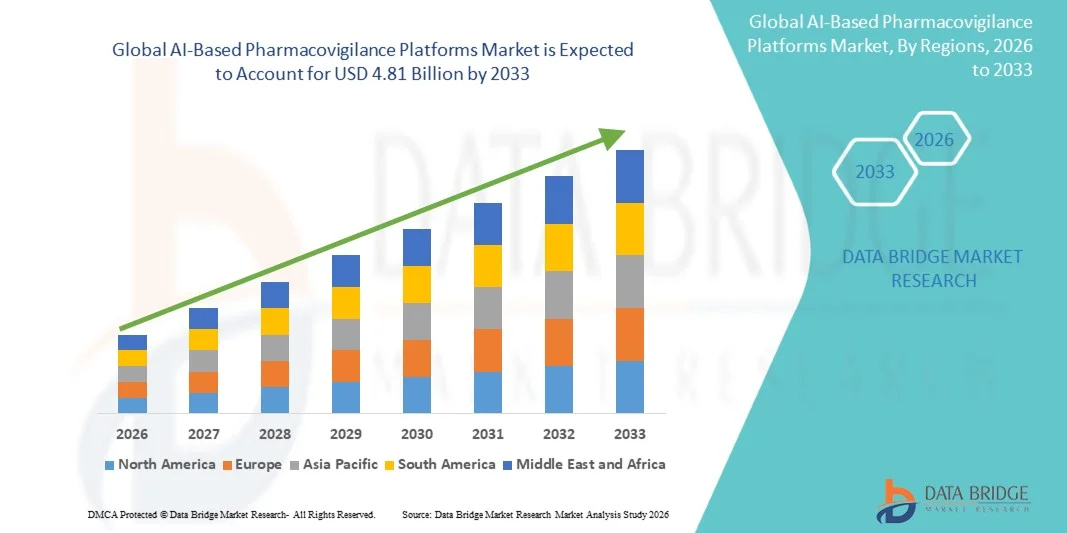
As per Data Bridge Market Research analysis, the AI-based pharmacovigilance platforms market was valued at USD 1.48 billion in 2025 and is projected to reach USD 4.81 billion by 2033, growing at a CAGR of 15.90% from 2026 to 2033. The market is experiencing consistent growth driven by the increasing adoption of artificial intelligence, machine learning, and natural language processing technologies for improving drug safety monitoring and adverse event reporting. The market is expanding as pharmaceutical and biotechnology companies increasingly integrate AI-enabled solutions to automate pharmacovigilance workflows, enhance signal detection capabilities, and improve regulatory compliance.
The rising volume of healthcare data, growing complexity of clinical trials, increasing regulatory requirements for drug safety surveillance, and demand for faster adverse event processing are accelerating the adoption of AI-based pharmacovigilance platforms. These platforms enable automated case processing, literature monitoring, individual case safety report (ICSR) management, and predictive safety analytics, reducing manual efforts and improving efficiency across pharmacovigilance operations.
Market Size & Forecast
- Global Market Value (2025): USD 1.48 Billion
- Expected Market Value (2033): USD 4.81 Billion
- Forecast CAGR (2026–2033):15.90%
- Leading Region in 2025: North America
- Fastest Growing Region: Asia Pacific
Key Market Trends & Insights
- North America dominated the AI-based pharmacovigilance platforms market with the largest revenue share of 33.6% in 2025, supported by the presence of major pharmaceutical and biotechnology companies, advanced healthcare IT infrastructure, and early adoption of artificial intelligence solutions for drug safety monitoring and compliance management
- The natural language processing (NLP) segment led the market with a 38.42% share in 2025, driven by its extensive adoption for extracting, processing, and analyzing large volumes of unstructured safety data from scientific literature, electronic health records, social media sources, and adverse event reports
- Asia-Pacific is expected to be the fastest-growing region at a CAGR of 18.0% from 2026 to 2033, fueled by expanding pharmaceutical research activities, increasing clinical trial volumes, and growing investments in artificial intelligence-based pharmacovigilance solutions across China, India, and Japan
- Large language models (LLMs) are the fastest-growing technology type, projected to register a CAGR of 22.5%, reflecting the surge in adoption of generative AI technologies in pharmacovigilance workflows
- The cloud-based segment dominated the deployment mode category with a 55.60% revenue share in 2025, led by demand for scalable, flexible, and cost-efficient pharmacovigilance infrastructure among pharmaceutical companies and healthcare organizations
- Signal detection and management accounted for 30.35% of the market, preferred by the increasing adoption of AI and machine learning technologies for identifying potential safety signals from large and complex healthcare datasets
- The literature monitoring segment is the fastest-growing application category, with a CAGR of 20.3%, driven by increasing volumes of scientific publications and the need for automated screening solutions
Report Scope and AI-Based Pharmacovigilance Platforms Market Segmentation
|
Attributes |
AI-Based Pharmacovigilance Platforms Key Market Insights |
|
Segments Covered |
|
|
Countries Covered |
North America
Europe
Asia-Pacific
Middle East and Africa
South America
|
|
Key Market Players |
|
|
Market Opportunities |
|
|
Value Added Data Infosets |
In addition to the insights on market scenarios such as market value, growth rate, segmentation, geographical coverage, and major players, the market reports curated by the Data Bridge Market Research also include in-depth expert analysis, patient epidemiology, pipeline analysis, pricing analysis, and regulatory framework. |
What is the Key Trend in the AI-Based Pharmacovigilance Platforms Market?
Trend: Increasing Adoption of AI-Driven Automation in Drug Safety Monitoring
Pharmaceutical and biotechnology companies are increasingly adopting AI-based pharmacovigilance platforms to automate adverse event processing, improve individual case safety report (ICSR) management, and enhance signal detection capabilities. The integration of natural language processing (NLP), machine learning, and large language models enables faster extraction of safety information from structured and unstructured healthcare data sources. Regulatory agencies and life sciences organizations are leveraging AI technologies to improve pharmacovigilance efficiency, reduce manual workload, and support proactive risk identification across the drug lifecycle. For instance, in March 2024, the U.S. Food and Drug Administration (FDA) established the Center for Drug Evaluation and Research (CDER) Emerging Drug Safety Technology Program (EDSTP) to facilitate collaboration with stakeholders on emerging technologies, including artificial intelligence, for improving drug safety surveillance, adverse event data analysis, and pharmacovigilance processes.
The increasing adoption of AI-powered automation is transforming pharmacovigilance operations by improving accuracy, scalability, and speed of drug safety assessments.
AI-Based Pharmacovigilance Platforms Market Dynamics
Key Market Driver: Rising Demand for Automated Signal Detection and Regulatory Compliance
The increasing volume of adverse event reports, growing complexity of clinical trials, and stringent global pharmacovigilance regulations are creating substantial demand for AI-based platforms capable of automating safety monitoring processes. AI-enabled solutions analyze large-scale healthcare datasets, detect potential safety signals, and support regulatory reporting requirements with improved efficiency and consistency. Pharmaceutical companies, contract research organizations, and regulatory stakeholders are deploying AI platforms to optimize case processing workflows, accelerate safety evaluations, and enhance compliance with evolving drug safety standards. For instance, in July 2023, the European Medicines Agency (EMA) published a reflection paper on the use of artificial intelligence (AI) in the medicinal product lifecycle, highlighting AI applications in post-authorisation activities, including pharmacovigilance processes such as adverse event report management and signal detection.
Growing regulatory pressure and increasing data complexity are accelerating the adoption of AI-based pharmacovigilance platforms across the pharmaceutical ecosystem.
Key Restraint/Challenge: Data Quality, Integration Complexity, and Regulatory Concerns
A significant challenge in the AI-based pharmacovigilance platforms market is the availability of high-quality standardized data required for accurate AI model performance. Pharmacovigilance systems must integrate diverse data sources, including electronic health records, clinical trial databases, scientific literature, and spontaneous reporting systems, creating challenges related to interoperability, data privacy, and regulatory acceptance. Organizations also face difficulties in validating AI-generated outputs and ensuring transparency in automated decision-making processes, which can slow implementation among highly regulated pharmaceutical companies. For instance, in October 2023, the World Health Organization (WHO) released “Regulatory considerations on artificial intelligence for health,” emphasizing the importance of AI governance, transparency, risk assessment, data quality, safety, and performance monitoring to ensure responsible implementation of AI technologies in healthcare applications.
Data governance, regulatory validation, and interoperability challenges remain key barriers affecting the widespread implementation of AI-based pharmacovigilance solutions.
Key Market Opportunity: Integration of Generative AI and Advanced Analytics in Pharmacovigilance Workflows
The integration of generative AI, machine learning algorithms, and predictive analytics presents a significant market opportunity for AI-based pharmacovigilance platforms. Advanced AI systems can automate literature review, summarize safety cases, assist medical reviewers, and enhance early identification of emerging drug safety risks. The adoption of cloud-based AI platforms and scalable analytics solutions is creating new opportunities for pharmaceutical companies and contract research organizations to improve operational efficiency and manage increasing pharmacovigilance workloads. For instance, in December 2023, the European Medicines Agency (EMA) and Heads of Medicines Agencies (HMA) adopted the “Multi-annual Artificial Intelligence Workplan 2023–2028,” highlighting opportunities for AI adoption in medicines regulation, including automation of processes, improved data analysis, enhanced decision support, and applications across the medicine lifecycle such as safety monitoring.
The integration of generative AI and predictive analytics is expected to create new growth opportunities by improving automation, intelligence, and efficiency across pharmacovigilance operations.
How is the AI-Based Pharmacovigilance Platforms Market Segmented?
The AI-based pharmacovigilance platforms market is segmented on the basis of technology, deployment mode, application, and end user.
- By Technology
On the basis of technology, the AI-based pharmacovigilance platforms market is segmented into natural language processing (NLP), machine learning (ML), artificial intelligence (AI) analytics, large language models (LLMs), and other AI technologies. The natural language processing (NLP) segment dominated the market with 38.42% revenue share in 2025, owing to its extensive adoption for extracting, processing, and analyzing large volumes of unstructured safety data from scientific literature, electronic health records, social media sources, and adverse event reports. NLP-based pharmacovigilance solutions enable automated case intake, literature screening, medical coding, and information extraction, reducing manual workload and improving operational efficiency. Pharmaceutical companies and contract research organizations are increasingly adopting NLP technologies to accelerate individual case safety report (ICSR) processing and regulatory compliance activities. The ability of NLP solutions to improve data processing speed and support real-time safety monitoring continues to drive its leading position in the market.
The large language models (LLMs) segment is projected to register the fastest growth at a CAGR of 22.5% from 2026 to 2033, driven by increasing adoption of generative AI technologies in pharmacovigilance workflows. LLM-based platforms provide advanced capabilities for summarizing safety reports, assisting medical reviewers, automating documentation, and improving regulatory communication. These models can process complex medical information from multiple sources, enabling faster identification of potential drug safety concerns. Growing investments by pharmaceutical companies in generative AI applications are accelerating the integration of LLMs into drug safety operations. The ability of LLMs to enhance productivity while reducing repetitive manual tasks is creating significant adoption opportunities. Increasing regulatory interest in responsible AI implementation across healthcare is further supporting the expansion of LLM-based pharmacovigilance solutions.
- By Deployment Mode
On the basis of deployment mode, the AI-based pharmacovigilance platforms market is segmented into cloud-based, on-premise, and hybrid. The cloud-based segment dominated the market with 55.60% revenue share in 2025, supported by increasing demand for scalable, flexible, and cost-efficient pharmacovigilance infrastructure among pharmaceutical companies and healthcare organizations. Cloud-based AI platforms enable real-time access to safety data, seamless software updates, and integration with multiple data sources across global operations. These solutions reduce the need for extensive IT infrastructure investments and allow organizations to manage increasing volumes of adverse event information efficiently. The growing adoption of digital transformation initiatives within life sciences organizations is further supporting cloud deployment. Enhanced data processing capabilities and accessibility continue to make cloud-based platforms the preferred deployment model.
The hybrid deployment segment is projected to be the fastest-growing segment at a CAGR of 18.1% from 2026 to 2033, driven by increasing demand for flexible infrastructure that combines cloud scalability with on-premise data security. Hybrid platforms allow pharmaceutical organizations to maintain sensitive patient and regulatory data within controlled environments while utilizing cloud-based AI capabilities for analytics and automation. Highly regulated industries are adopting hybrid models to address concerns related to data privacy, compliance, and operational efficiency. The growing complexity of global pharmacovigilance operations is increasing the need for adaptable deployment approaches. Integration of advanced AI tools with existing enterprise safety systems is further supporting hybrid adoption. Rising demand for secure yet scalable pharmacovigilance solutions is expected to accelerate segment growth.
- By Application
On the basis of application, the AI-based pharmacovigilance platforms market is segmented into adverse event case processing, individual case safety reports (ICSR) management, signal detection and management, literature monitoring, regulatory reporting, risk management, and post-market surveillance. The signal detection and management segment dominated the market with 30.35% revenue share in 2025, driven by increasing adoption of AI and machine learning technologies for identifying potential safety signals from large and complex healthcare datasets. AI-powered signal detection solutions analyze multiple data sources to identify emerging drug safety risks more efficiently than traditional manual approaches. Pharmaceutical companies are increasingly using predictive analytics to improve early detection of adverse reactions and strengthen benefit-risk assessment. These platforms improve decision-making by prioritizing relevant safety concerns and reducing review timelines. Increasing drug approvals and expanding post-market surveillance requirements continue to strengthen demand for automated signal detection technologies.
The literature monitoring segment is projected to register the fastest growth at a CAGR of 20.3% from 2026 to 2033, fueled by increasing volumes of scientific publications and the need for automated screening solutions. AI-based literature monitoring platforms use NLP and machine learning algorithms to identify relevant safety information from medical journals, databases, and regulatory sources. These solutions help pharmacovigilance teams reduce manual review efforts and improve compliance with global reporting requirements. The rising complexity of drug safety information is increasing demand for automated literature surveillance tools. Pharmaceutical companies and CROs are adopting AI-powered monitoring systems to enhance efficiency and accuracy. Growing regulatory expectations for comprehensive safety monitoring are further accelerating segment growth.
- By End User
On the basis of end user, the AI-based pharmacovigilance platforms market is segmented into pharmaceutical companies, biotechnology companies, contract research organizations (CROS), medical device companies, regulatory authorities, and healthcare organizations. The pharmaceutical companies segment dominated the market with 45.50% revenue share in 2025, owing to increasing adoption of AI-based solutions for managing large-scale drug safety operations and regulatory compliance requirements. Pharmaceutical companies generate significant volumes of adverse event data throughout clinical development and post-market monitoring phases, creating demand for automated pharmacovigilance platforms. These organizations are investing in AI technologies to improve case processing efficiency, reduce operational costs, and enhance safety surveillance capabilities. The segment continues to maintain its leadership due to strong investment capacity and high demand for advanced drug safety technologies.
The contract research organizations (CROs) segment is expected to be the fastest-growing end-user segment at a CAGR of 19.2% from 2026 to 2033, driven by increasing outsourcing of pharmacovigilance activities by pharmaceutical and biotechnology companies. CROs are adopting AI-based platforms to improve efficiency, manage growing volumes of safety data, and provide advanced drug safety services to clients. Rising clinical trial activities worldwide are increasing demand for outsourced pharmacovigilance solutions. AI technologies enable CROs to automate case processing, enhance reporting accuracy, and reduce turnaround times. Growing partnerships between pharmaceutical companies and specialized CROs are further supporting segment expansion. The increasing need for cost-effective and scalable safety management solutions is expected to accelerate CRO adoption of AI-based pharmacovigilance platforms.
Which Region Holds the Largest Share of the AI-Based Pharmacovigilance Platforms Market?
North America dominated the AI-based pharmacovigilance platforms market with the largest revenue share of 33.6% in 2025, supported by the presence of major pharmaceutical and biotechnology companies, advanced healthcare IT infrastructure, and early adoption of artificial intelligence solutions for drug safety monitoring and compliance management. The region also benefits from early implementation of machine learning, natural language processing, and automated safety surveillance platforms across clinical research and post-marketing pharmacovigilance operations. Growing investments in digital health transformation, real-world evidence analytics, and regulatory technology solutions are accelerating market development. Increasing focus on improving adverse event reporting efficiency, strengthening patient safety monitoring, and reducing manual pharmacovigilance workload continues to reinforce North America's leadership position in the global market.
U.S. AI-Based Pharmacovigilance Platforms Market Insight
The U.S. AI-based pharmacovigilance platforms market is witnessing strong growth due to rising adoption of artificial intelligence in drug safety monitoring, increasing regulatory focus on automated adverse event reporting, and expanding digital transformation initiatives across pharmaceutical companies. The country’s mature pharmaceutical ecosystem, along with increasing implementation of NLP-based literature monitoring, machine learning-driven signal detection, and cloud-based safety platforms, is driving demand across clinical research and post-market surveillance applications. In addition, the U.S. FDA’s establishment of the Center for Drug Evaluation and Research (CDER) Emerging Drug Safety Technology Program (EDSTP) explore emerging technologies for improving drug safety surveillance is accelerating AI adoption in pharmacovigilance operations.
Europe AI-Based Pharmacovigilance Platforms Market Insight
The Europe AI-based pharmacovigilance platforms market remains a major contributor to global revenue, driven by strong regulatory frameworks, advanced pharmaceutical research infrastructure, and increasing demand for automated drug safety solutions. The widespread adoption of AI technologies for signal detection, adverse event processing, and regulatory reporting is supporting market expansion across the region. Increasing investments in digital medicines regulation, coupled with growing emphasis on data-driven safety monitoring and responsible AI implementation, continue to enhance the adoption of AI-based pharmacovigilance platforms throughout Europe. In December 2023, the European Medicines Agency (EMA) and Heads of Medicines Agencies (HMA) adopted the Multi-annual Artificial Intelligence Workplan, outlining the use of AI to improve process automation, data analysis, decision support, and regulatory activities across the medicines lifecycle, including pharmacovigilance applications
U.K. AI-Based Pharmacovigilance Platforms Market Insight
The U.K. AI-based pharmacovigilance platforms market is experiencing steady growth, supported by increasing adoption of artificial intelligence in healthcare research, regulatory innovation, and pharmaceutical safety monitoring. Increasing investments in AI-enabled healthcare solutions and growing demand for automated pharmacovigilance workflows are contributing to market growth. Furthermore, integration of machine learning, NLP, and advanced analytics technologies is improving adverse event identification, literature surveillance, and regulatory reporting efficiency, positioning the U.K. as a key innovation hub in the AI-driven drug safety ecosystem. In April 2024, the U.K. Medicines and Healthcare products Regulatory Agency (MHRA) published its AI regulatory strategy, outlining its approach to responsible artificial intelligence adoption across medicines and medical device regulation, with focus on safety, transparency, governance, and innovation in healthcare
Germany AI-Based Pharmacovigilance Platforms Market Insight
The Germany AI-based pharmacovigilance platforms market is expanding steadily due to the country’s strong pharmaceutical manufacturing base, advanced healthcare research capabilities, and increasing adoption of digital health technologies. Pharmaceutical companies and research organizations are increasingly utilizing AI-based solutions for automated case processing, safety signal identification, and regulatory compliance activities. Continuous advancements in healthcare data analytics, AI research, and regulatory technology, along with Germany’s focus on digital transformation in healthcare, are further driving market growth. The German Federal Ministry of Health’s Digitalisation Strategy promotes the use of digital technologies and data-driven healthcare solutions.
Asia-Pacific AI-Based Pharmacovigilance Platforms Market Insight
The Asia-Pacific AI-based pharmacovigilance platforms market is expected to witness rapid growth, driven by increasing pharmaceutical manufacturing, expanding clinical trial activities, and rising adoption of artificial intelligence technologies across healthcare systems in countries such as China, India, and Japan. Growing awareness regarding drug safety monitoring, increasing regulatory requirements, and demand for scalable pharmacovigilance solutions are supporting regional market expansion. In addition, the increasing outsourcing of pharmacovigilance activities to CROs and growth of digital health infrastructure are accelerating AI platform adoption across pharmaceutical and biotechnology sectors. The Asia-Pacific region has become a major hub for clinical trials, with increasing adoption of digital technologies to manage complex safety data.
Japan AI-Based Pharmacovigilance Platforms Market Insight
The Japan AI-based pharmacovigilance platforms market is witnessing consistent growth due to rising investments in healthcare artificial intelligence, advanced pharmaceutical research, and regulatory modernization initiatives. Pharmaceutical manufacturers and research organizations are increasingly adopting AI-powered solutions for adverse event analysis, drug safety evaluation, and automated reporting processes. Moreover, increasing integration of AI analytics and Japan’s focus on improving healthcare efficiency through digital transformation are further contributing to market growth. The Japanese Pharmaceuticals and Medical Devices Agency (PMDA) has promoted the use of AI and advanced technologies to enhance regulatory science and safety monitoring.
China AI-Based Pharmacovigilance Platforms Market Insight
The China AI-based pharmacovigilance platforms market is growing rapidly, driven by expanding pharmaceutical innovation, increasing regulatory emphasis on drug safety, and rising adoption of AI technologies across healthcare applications. Growing investments in artificial intelligence, increasing clinical trial activity, and modernization of pharmacovigilance systems are significantly boosting market demand. In addition, increasing adoption of automated safety monitoring platforms and digital healthcare infrastructure is positioning China as one of the fastest-growing markets for AI-based pharmacovigilance solutions globally. The National Medical Products Administration (NMPA) of China issued the “14th Five-Year Plan for National Drug Safety and High-Quality Development,” emphasizing the enhancement of smart regulatory systems, improvement of drug safety monitoring capabilities, and modernization of regulatory infrastructure through digital technologies.
Which are the Top Companies in AI-Based Pharmacovigilance Platforms Market?
The AI-based pharmacovigilance platforms industry is primarily led by well-established companies, including:
- IQVIA (U.S.)
- Oracle (U.S.)
- Veeva Systems (U.S.)
- ArisGlobal (U.S.)
- SAS Institute Inc. (U.S.)
- Accenture (Ireland)
- Cognizant (U.S.)
- Tata Consultancy Services Limited (India)
- Tech Mahindra Limited (India)
- Capgemini France)
- ICON plc (Ireland)
- Parexel International Corporation (U.S.)
- Labcorp. (U.S.)
- Thermo Fisher Scientific Inc. (U.S.)
- ClinChoice Inc. (U.S.)
- Ennov (France)
- Merative (U.S.)
- HCL Technologies Limited (India)
- Saama (U.S.)
What are Latest Developments in Latest Developments in AI-Based Pharmacovigilance Platforms Market?
- In July 2025, EVERSANA launched EVERSANA ORCHESTRATE PV, an AI-powered pharmacovigilance solution designed to streamline drug safety workflows, including literature monitoring, aggregate reporting, and safety operations. The platform uses artificial intelligence to automate complex pharmacovigilance processes, improve operational efficiency, and reduce manual workload for life sciences organizations. This launch highlights the growing adoption of AI-driven platforms to enhance speed, accuracy, and scalability in global drug safety management
- In March 2025, Tech Mahindra and NVIDIA announced the development of an agentic AI-powered pharmacovigilance solution to advance drug safety management. The solution leverages NVIDIA AI technologies and Tech Mahindra’s TENO framework to automate pharmacovigilance workflows, improve adverse event processing efficiency, and address challenges related to increasing safety data volumes. This collaboration demonstrates the growing integration of advanced AI infrastructure into next-generation pharmacovigilance platforms
- In October 2024, Sorcero and Springer Nature launched Sorcero Safety, an AI-powered literature monitoring and safety surveillance solution designed for pharmacovigilance teams. The platform combines artificial intelligence capabilities with scientific literature expertise to automate literature review, support safety signal detection, and improve monitoring of adverse events. This launch addresses the growing need for scalable AI solutions to manage increasing volumes of drug safety information
- In January 2024, PubHive launched its centralized Summary of Product Characteristics (SmPC) management solution with AI-powered pharmacovigilance workflows for pharmaceutical companies, CROs, and drug safety teams. The platform uses AI-driven automation to simplify document analysis, version control, safety information management, and compliance workflows. This development reflects the increasing use of AI technologies to improve efficiency across pharmacovigilance operations and regulatory processes
- In February 2022, Digital Intelligence Systems (DISYS) launched PVAutomate, an AI-powered pharmacovigilance automation solution designed to automate critical drug safety workflows, including compliance processes, adverse event data management, reporting, and safety analytics. The platform combines artificial intelligence, cognitive automation, robotic process automation, and advanced analytics to help pharmaceutical and life sciences organizations improve efficiency, reduce manual processing, and manage increasing volumes of pharmacovigilance data

- Interactive Data Analysis Dashboard
- Company Analysis Dashboard for high growth potential opportunities
- Research Analyst Access for customization & queries
- Competitor Analysis with Interactive dashboard
- Latest News, Updates & Trend analysis
- Harness the Power of Benchmark Analysis for Comprehensive Competitor Tracking
Data collection and base year analysis are done using data collection modules with large sample sizes. The stage includes obtaining market information or related data through various sources and strategies. It includes examining and planning all the data acquired from the past in advance. It likewise envelops the examination of information inconsistencies seen across different information sources. The market data is analysed and estimated using market statistical and coherent models. Also, market share analysis and key trend analysis are the major success factors in the market report. To know more, please request an analyst call or drop down your inquiry.
The key research methodology used by DBMR research team is data triangulation which involves data mining, analysis of the impact of data variables on the market and primary (industry expert) validation. Data models include Vendor Positioning Grid, Market Time Line Analysis, Market Overview and Guide, Company Positioning Grid, Patent Analysis, Pricing Analysis, Company Market Share Analysis, Standards of Measurement, Global versus Regional and Vendor Share Analysis. To know more about the research methodology, drop in an inquiry to speak to our industry experts.
Data Bridge Market Research is a leader in advanced formative research. We take pride in servicing our existing and new customers with data and analysis that match and suits their goal. The report can be customized to include price trend analysis of target brands understanding the market for additional countries (ask for the list of countries), clinical trial results data, literature review, refurbished market and product base analysis. Market analysis of target competitors can be analyzed from technology-based analysis to market portfolio strategies. We can add as many competitors that you require data about in the format and data style you are looking for. Our team of analysts can also provide you data in crude raw excel files pivot tables (Fact book) or can assist you in creating presentations from the data sets available in the report.












