


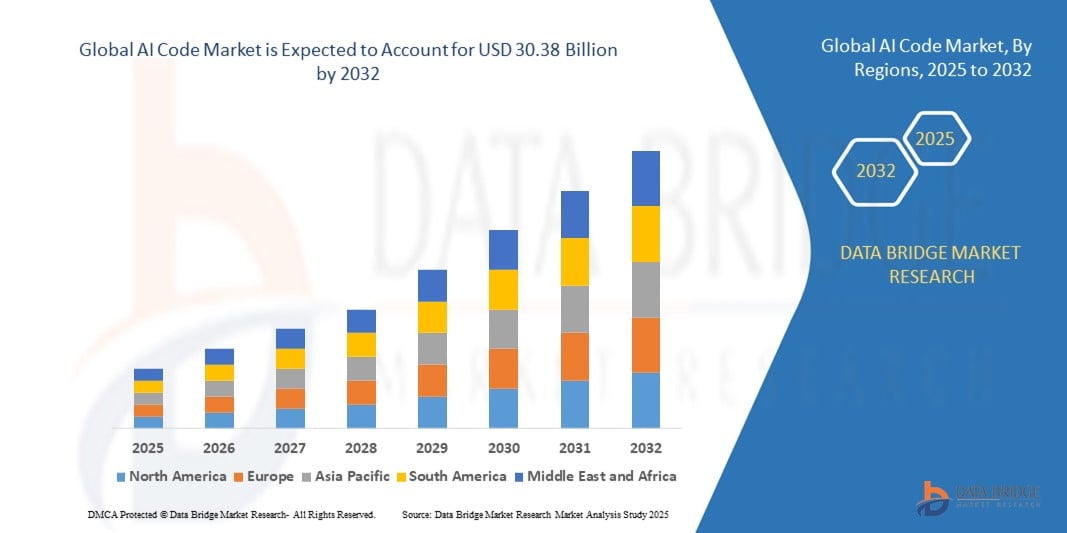
AI Code Market Size
- The global AI Code market size was valued at USD 5.33 billion in 2024 and is expected to reach USD 30.38 billion by 2032, at a CAGR of 24.30% during the forecast period
- The market growth is largely fueled by the rapid integration of artificial intelligence into software development life cycles, enabling automation of code generation, bug detection, and predictive coding workflows
- Furthermore, rising demand for faster time-to-market, improved code quality, and reduced development costs is establishing AI-powered coding tools as essential assets across industries. These converging factors are accelerating the adoption of AI-driven development platforms, thereby significantly boosting the industry's growth
AI Code Market Analysis
- AI code tools, which leverage machine learning and natural language processing to assist or automate code generation, are becoming critical components of modern software development environments across various sectors due to their ability to enhance productivity, accuracy, and scalability
- The escalating demand for AI coding solutions is primarily fueled by the global shortage of skilled developers, rising complexity in software architecture, and increasing pressure to accelerate release cycles in competitive markets
- North America dominated the AI code market with the largest revenue share of 41.7% in 2024, characterized by strong technological infrastructure, early adoption by enterprises, and the presence of major AI and cloud service providers, with the U.S. leading advancements in AI-assisted programming tools across startups and large tech firms asuch as
- Asia-Pacific is expected to be the fastest growing region in the AI code market during the forecast period due to expanding IT sectors, government initiatives in AI research, and growing interest in low-code and no-code development platforms
- The code generation segment dominated the AI code market with a market share of 47.2% in 2024, driven by increasing use of AI to automate repetitive coding tasks and boost developer efficiency in both enterprise and open-source projects
Report Scope and AI Code Market Segmentation
|
Attributes |
AI Code Key Market Insights |
|
Segments Covered |
|
|
Countries Covered |
North America
Europe
Asia-Pacific
Middle East and Africa
South America
|
|
Key Market Players |
|
|
Market Opportunities |
|
|
Value Added Data Infosets |
In addition to the insights on market scenarios such as market value, growth rate, segmentation, geographical coverage, and major players, the market reports curated by the Data Bridge Market Research also include in-depth expert analysis, pricing analysis, brand share analysis, consumer survey, demography analysis, supply chain analysis, value chain analysis, raw material/consumables overview, vendor selection criteria, PESTLE Analysis, Porter Analysis, and regulatory framework. |
AI Code Market Trends
Enhanced Developer Productivity Through AI and Natural Language Processing (NLP)
- A significant and accelerating trend in the global AI code market is the integration of advanced natural language processing (NLP) and machine learning algorithms into developer tools, allowing users to generate and modify code using simple, human-such as prompts. This shift is revolutionizing software development workflows by making them more intuitive, efficient, and accessible
- For instance, GitHub Copilot, powered by OpenAI’s Codex, allows developers to generate code snippets, complete functions, and even write full modules based on natural language inputs. Similarly, tools such as Amazon CodeWhisperer and Tabnine offer intelligent code completions and context-aware suggestions that speed up development
- AI-enabled coding assistants can learn from existing codebases, detect bugs, suggest optimizations, and tailor responses to individual coding styles. These tools evolve over time, improving accuracy and context relevance as they are exposed to more programming scenarios. Furthermore, their ability to work across multiple programming languages enhances their appeal to a diverse developer audience
- The seamless integration of AI code assistants within popular integrated development environments (IDEs) such as Visual Studio Code, JetBrains, and Eclipse facilitates real-time collaboration, code review, and debugging in a unified development environment
- This trend towards increasingly intelligent, contextual, and conversational coding platforms is redefining the developer experience. As a result, leading tech companies such as Google and Meta are investing in advanced AI code-generation models that support cross-platform development and DevOps automation
- The demand for AI-assisted coding tools that streamline development, reduce cognitive load, and support rapid prototyping is growing rapidly across startups, enterprises, and freelance developers as the need for agile and high-quality software continues to rise
AI Code Market Dynamics
Driver
Accelerated Software Development Amid Rising Demand for Automation
- The rising complexity of modern software, combined with the increasing pressure to deliver products quickly and at scale, is a major driver for the adoption of AI code generation tools
- For instance, in March 2024, Microsoft introduced new Copilot integrations within Azure DevOps and GitHub Enterprise, enhancing CI/CD automation and enabling real-time code suggestions throughout the development lifecycle. Such innovations are expected to propel the AI code market forward during the forecast period
- AI-powered code assistants offer real-time suggestions, automatically generate boilerplate code, and detect bugs early in the development process, leading to reduced development time and fewer coding errors
- Furthermore, the shortage of skilled developers globally is compelling organizations to adopt AI tools that can supplement human capabilities and enable non-technical users to contribute to application development through low-code/no-code platforms
- The ability of these tools to accelerate onboarding, increase collaboration, and improve code quality is also attracting widespread adoption across industries such as finance, healthcare, and retail. As businesses strive to digitize operations and build new digital services faster, AI coding platforms are becoming essential for development teams
Restraint/Challenge
Bias in Training Data and Compliance With Software Licensing
- One of the key challenges facing the AI code market is the potential for code generation tools to reproduce insecure, incorrect, or biased code based on the data they were trained on. If the training data includes flawed or copyrighted code, there is a risk of legal and functional issues arising from its output
- For instance, some developers have raised concerns that AI-generated code from tools such as Copilot may inadvertently reproduce snippets from open-source projects under restrictive licenses, creating intellectual property concerns for commercial applications
- To address this, developers must implement rigorous code review processes and ensure compliance with open-source licensing norms. Companies are also working to improve transparency in model training data and refine filtering mechanisms to mitigate legal risks
- In addition, AI coding tools often lack full contextual understanding of complex applications, which can result in suboptimal or insecure suggestions, especially for mission-critical systems. Continuous model refinement and human oversight are necessary to ensure code reliability
- Despite the growing benefits, initial skepticism from developers, potential legal risks, and the need for explainability in AI decisions remain hurdles to adoption. Overcoming these challenges through better licensing transparency, improved model performance, and developer education will be essential for long-term market growth
AI Code Market Scope
The market is segmented on the basis of operation, application, and vertical.
- By Operation
On the basis of operation, the AI code market is segmented into code generation, code enhancement, language translation, and code reviews. The code generation segment dominated the market with the largest revenue share of 47.2% in 2024, owing to the increasing demand for automated coding solutions that accelerate development cycles and reduce the burden on developers. Tools leveraging AI for code generation, such as GitHub Copilot and Amazon CodeWhisperer, are being widely adopted by enterprises and freelancers for rapid prototyping, boilerplate creation, and multilingual code output.
The code enhancement segment is anticipated to witness the fastest CAGR from 2025 to 2032, driven by the rising emphasis on code quality, bug detection, and performance optimization. AI-powered tools in this segment assist in refactoring, security patching, and improving code readability, making them indispensable in DevOps pipelines and large-scale software maintenance workflows.
- By Application
On the basis of application, the AI code market is segmented into data science and analytics, game development and design, web and application development, and IoT and smart devices. The web and application development segment held the largest revenue share in 2024, supported by the widespread adoption of AI-assisted development environments across startups, SMEs, and large tech firms. These tools streamline frontend and backend development, facilitate API integration, and accelerate full-stack deployment, particularly in agile and low-code/no-code development models.
The data science and analytics segment is expected to register the highest growth rate during the forecast period. The increasing complexity of data models and the shortage of skilled data engineers are boosting the adoption of AI tools that can auto-generate scripts, optimize data pipelines, and automate exploratory data analysis.
- By Vertical
On the basis of vertical, the AI code market is segmented into BFSI, media and entertainment, IT & telecom, healthcare and life sciences, transport & logistics, and retail & e-commerce. The IT & telecom segment dominated the market with the largest revenue share in 2024 due to its early adoption of AI development tools and demand for scalable, automated coding environments to support diverse application needs such as network management, cybersecurity, and cloud services.
The healthcare and life sciences segment is projected to grow at the fastest CAGR from 2025 to 2032, driven by the need for precise, regulation-compliant, and secure coding solutions in areas such as medical software, diagnostic tools, and patient data management systems. AI coding tools are increasingly used to ensure accuracy, reduce development time, and support innovation in healthtech platforms.
AI Code Market Regional Analysis
- North America dominated the AI code market with the largest revenue share of 41.7% in 2024, characterized by strong technological infrastructure, early adoption by enterprises, and the presence of major AI and cloud service providers, with the U.S. leading advancements in AI-assisted programming tools across startups and large tech firms asuch as
- Developers and enterprises in the region highly value the productivity gains, automation capabilities, and advanced code intelligence offered by AI-powered coding tools, which are often integrated with existing development environments and DevOps workflows
- This widespread adoption is further supported by robust R&D investments, a mature startup ecosystem, and growing demand for faster software delivery cycles, establishing AI-assisted coding platforms as critical tools for modern software development across sectors
U.S. AI Code Market Insight
The U.S. AI code market captured the largest revenue share of 79.5% in 2024 within North America, fueled by widespread digital transformation and early adoption of AI development tools across industries. Organizations are rapidly integrating AI into software engineering workflows to boost productivity, reduce technical debt, and accelerate deployment. The rise of generative AI platforms such as GitHub Copilot, Amazon CodeWhisperer, and Google’s Gemini has further advanced the mainstream use of AI code assistants. In addition, the U.S. benefits from strong venture capital activity, developer communities, and enterprise demand for scalable, secure AI-powered development environments.
Europe AI Code Market Insight
The Europe AI code market is projected to expand at a substantial CAGR throughout the forecast period, primarily driven by the growing digitalization of public services and industry sectors, along with strong regulatory focus on AI transparency and ethics. European enterprises are increasingly adopting AI-powered coding tools to meet efficiency and compliance standards. The region’s active participation in open-source communities, as well as investments in sovereign AI infrastructure, is further driving market growth. The EU’s digital strategy encourages AI integration across sectors such as fintech, manufacturing, and education, fostering demand for robust AI code solutions.
U.K. AI Code Market Insight
The U.K. AI code market is anticipated to grow at a noteworthy CAGR during the forecast period, driven by rising investments in AI research and the rapid digital transformation of businesses. Startups and enterprises are leveraging AI-assisted coding tools to scale development teams and improve software delivery times. The government’s National AI Strategy and a well-established fintech sector further support the market. In addition, the growing emphasis on ethical AI and secure software practices aligns with the adoption of intelligent coding tools capable of enhancing transparency and reducing coding errors.
Germany AI Code Market Insight
The Germany AI code market is expected to expand at a considerable CAGR during the forecast period, supported by strong industrial automation demand, digital innovation initiatives, and a highly skilled software engineering workforce. Germany’s robust infrastructure and focus on data security have driven the integration of AI in software development, particularly within automotive, industrial, and healthcare domains. The preference for efficient, auditable, and privacy-preserving AI coding tools is shaping the landscape. Adoption is also being fueled by collaboration between research institutions and enterprise technology providers.
Asia-Pacific AI Code Market Insight
The Asia-Pacific AI code market is poised to grow at the fastest CAGR of 23.8% during the forecast period of 2025 to 2032, driven by expanding developer populations, digital upskilling initiatives, and enterprise IT modernization in countries such as China, India, and Japan. Governments in the region are investing heavily in AI research and education, fostering a strong ecosystem for AI-powered development. The region’s rapid economic growth and increasing demand for localized AI applications are accelerating the adoption of AI coding tools across industries including e-commerce, mobile apps, and smart manufacturing.
Japan AI Code Market Insight
The Japan AI code market is gaining momentum due to the country’s advanced technology landscape, automation priorities, and strong emphasis on precision and quality in software development. AI code tools are being adopted to enhance productivity in enterprises managing legacy systems and to support innovation in robotics, IoT, and fintech. The integration of AI into existing engineering workflows is seen as a strategic enabler, especially as Japan deals with an aging workforce and the need for efficient digital infrastructure.
India AI Code Market Insight
The India AI code market accounted for the largest revenue share in Asia Pacific in 2024, attributed to the country's growing IT services industry, vibrant startup ecosystem, and strong focus on AI adoption across sectors. India is witnessing rapid uptake of AI development platforms in education, fintech, and enterprise tech, with domestic and global companies investing in tools that automate code generation and review. Government programs such as Digital India and Skill India are also supporting workforce development and increasing accessibility to AI-based coding tools, thereby driving sustained market expansion.
AI Code Market Share
The AI code industry is primarily led by well-established companies, including:
- GitHub, Inc. (U.S.)
- Amazon Web Services, Inc. (U.S.)
- Google LLC (U.S.)
- Replit, Inc. (U.S.)
- Tabnine Ltd. (Israel)
- Microsoft Corporation (U.S.)
- IBM Corporation (U.S.)
- JetBrains s.r.o. (Czech Republic)
- Salesforce, Inc. (U.S.)
- Oracle Corporation (U.S.)
- Meta Platforms, Inc. (U.S.)
- SAP SE (Germany)
- Tencent Holdings Ltd. (China)
- Alibaba Group Holding Limited (China)
- Infosys Limited (India)
- Wipro Limited (India)
- HCL Technologies Limited (India)
- NVIDIA Corporation (U.S.)
- Accenture plc (Ireland)
- Cognizant Technology Solutions Corporation (U.S.)
What are the Recent Developments in Global AI Code Market?
- In April 2023, GitHub, a Microsoft subsidiary, launched the public beta of GitHub Copilot X, an advanced iteration of its AI-powered code assistant. Copilot X introduces features such as voice-based coding via natural language prompts, real-time code explanation, and context-aware pull request responses. This development reflects GitHub’s commitment to transforming software development by integrating generative AI tools directly into developers’ workflows, thereby enhancing efficiency and collaboration across teams
- In March 2023, Amazon Web Services (AWS) announced the general availability of Amazon CodeWhisperer, an AI coding companion integrated into IDEs such as Visual Studio Code and JetBrains. Trained on billions of lines of code, CodeWhisperer enables developers to generate real-time code suggestions across multiple programming languages, helping reduce errors and speed up development. AWS positioned this launch as part of its broader strategy to accelerate cloud-native and AI-driven software engineering
- In March 2023, Google Cloud introduced Codey, a code generation and completion model under its Vertex AI platform. Codey leverages Google's PaLM 2 language model to provide high-quality code completions, explanations, and chat-based development assistance. Targeting enterprise developers, Codey supports application modernization, integration with Google Cloud services, and AI-assisted troubleshooting, underlining Google’s focus on AI-enhanced productivity for professional development environments
- In February 2023, Replit, a collaborative coding platform, unveiled Ghostwriter Chat, a conversational AI tool built to support end-to-end software development within its browser-based environment. Ghostwriter Chat enables developers to receive real-time help, generate code, and debug programs using natural language. This launch demonstrates Replit’s mission to democratize access to software development through AI, particularly for learners and solo developers
- In January 2023, Tabnine, an AI coding assistant known for privacy-focused deployments, released Tabnine Pro Teams, designed for enterprise-grade coding environments. This version supports self-hosted models, compliance controls, and team-level code learning, making it suitable for businesses concerned with data confidentiality and collaborative AI-assisted development. The release highlights the increasing demand for customizable, secure AI tools tailored to specific organizational needs in software development workflows

- Interactive Data Analysis Dashboard
- Company Analysis Dashboard for high growth potential opportunities
- Research Analyst Access for customization & queries
- Competitor Analysis with Interactive dashboard
- Latest News, Updates & Trend analysis
- Harness the Power of Benchmark Analysis for Comprehensive Competitor Tracking
Data collection and base year analysis are done using data collection modules with large sample sizes. The stage includes obtaining market information or related data through various sources and strategies. It includes examining and planning all the data acquired from the past in advance. It likewise envelops the examination of information inconsistencies seen across different information sources. The market data is analysed and estimated using market statistical and coherent models. Also, market share analysis and key trend analysis are the major success factors in the market report. To know more, please request an analyst call or drop down your inquiry.
The key research methodology used by DBMR research team is data triangulation which involves data mining, analysis of the impact of data variables on the market and primary (industry expert) validation. Data models include Vendor Positioning Grid, Market Time Line Analysis, Market Overview and Guide, Company Positioning Grid, Patent Analysis, Pricing Analysis, Company Market Share Analysis, Standards of Measurement, Global versus Regional and Vendor Share Analysis. To know more about the research methodology, drop in an inquiry to speak to our industry experts.
Data Bridge Market Research is a leader in advanced formative research. We take pride in servicing our existing and new customers with data and analysis that match and suits their goal. The report can be customized to include price trend analysis of target brands understanding the market for additional countries (ask for the list of countries), clinical trial results data, literature review, refurbished market and product base analysis. Market analysis of target competitors can be analyzed from technology-based analysis to market portfolio strategies. We can add as many competitors that you require data about in the format and data style you are looking for. Our team of analysts can also provide you data in crude raw excel files pivot tables (Fact book) or can assist you in creating presentations from the data sets available in the report.













