


AI Detector Market Size
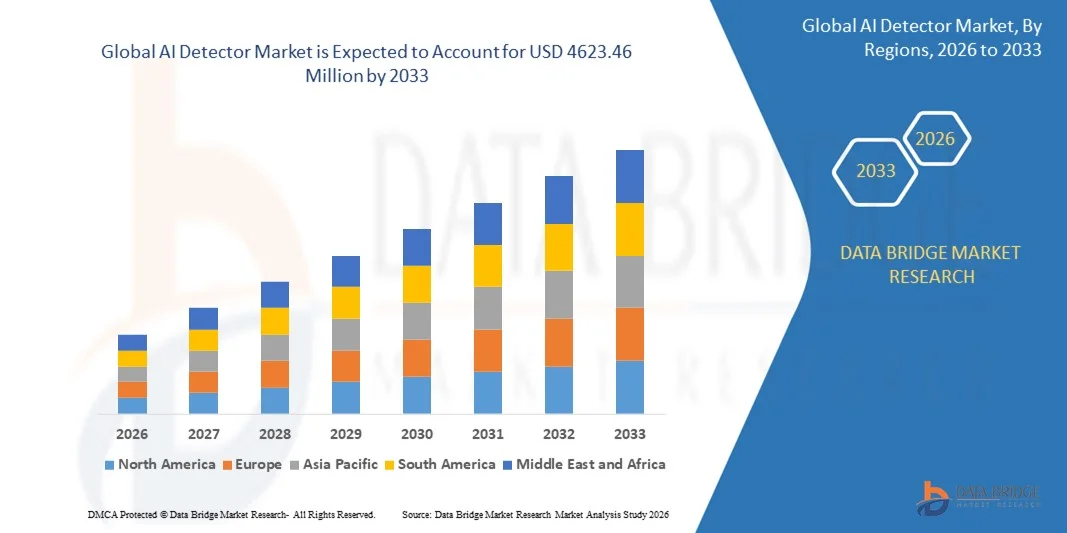
- The global AI detector market size was valued at USD 559.86 million in 2025 and is expected to reach USD 4623.46 million by 2033, at a CAGR of 30.20% during the forecast period
- The market growth is largely fueled by the rising adoption of AI-generated content across education, media, and corporate sectors, coupled with technological advancements in detection algorithms and natural language processing. These developments are driving digitalization of content verification, academic integrity enforcement, and misinformation monitoring across multiple industries
- Furthermore, increasing demand from institutions, enterprises, and content creators for reliable, real-time, and automated AI detection solutions is establishing AI detectors as essential tools for maintaining content authenticity and integrity. These converging factors are accelerating the uptake of AI detection technologies, thereby significantly boosting the market’s growth
AI Detector Market Analysis
- AI detectors, designed to identify AI-generated text, code, images, audio, and multimedia content, are becoming critical tools in academic, corporate, and media workflows due to their ability to ensure originality, detect deepfakes, and verify content authenticity across platforms
- The escalating demand for AI detectors is primarily driven by the growing prevalence of AI-generated content, increasing concerns over plagiarism and misinformation, and the need for automated, accurate, and scalable detection solutions that can be integrated into existing digital ecosystems
- North America dominated the AI detector market with a share of 33.5% in 2025, due to increasing adoption of AI-generated content across education, media, and corporate sectors, as well as heightened concerns about plagiarism, misinformation, and deepfakes
- Asia-Pacific is expected to be the fastest growing region in the AI detector market during the forecast period due to rapid digitalization, increasing adoption of AI content generation tools, and rising awareness of plagiarism and misinformation in countries such as China, Japan, and India
- Platform segment dominated the market with a market share of 67.5% in 2025, due to its comprehensive capabilities for deploying, managing, and analyzing AI-generated content detection across multiple applications. Platforms often provide centralized dashboards, advanced analytics, and integration with enterprise systems, making them the preferred choice for large organizations and academic institutions. These solutions offer robust support for diverse detection needs, including plagiarism detection, deepfake identification, and content verification, which enhances operational efficiency and decision-making accuracy
Report Scope and AI Detector Market Segmentation
|
Attributes |
AI Detector Key Market Insights |
|
Segments Covered |
|
|
Countries Covered |
North America
Europe
Asia-Pacific
Middle East and Africa
South America
|
|
Key Market Players |
|
|
Market Opportunities |
|
|
Value Added Data Infosets |
In addition to the market insights such as market value, growth rate, market segments, geographical coverage, market players, and market scenario, the market report curated by the Data Bridge Market Research team includes in-depth expert analysis, import/export analysis, pricing analysis, production consumption analysis, and pestle analysis. |
AI Detector Market Trends
Growing Use of AI Detection in Education and Media
- A significant trend in the AI detector market is the increasing adoption of detection solutions across educational institutions, media organizations, and corporate content platforms, driven by the rising prevalence of AI-generated text, code, and multimedia. This trend is reinforcing the role of AI detectors as essential tools for ensuring content authenticity, academic integrity, and mitigation of misinformation across digital ecosystems
- For instance, Turnitin has expanded its AI writing detection capabilities to identify content modified by AI “humanizer” tools, enabling educators to maintain academic integrity across student submissions. Such implementations strengthen institutional trust and highlight the critical need for automated detection solutions
- The adoption of AI detection tools is also growing rapidly in media and entertainment, where platforms require verification of digital content to prevent the spread of deepfakes and manipulated media. Companies such as Sensity and Reality Defender provide AI-driven platforms to monitor and flag synthetic media, ensuring content credibility and protecting brand reputation
- Corporate and enterprise sectors are integrating AI detectors into workflows for content verification, plagiarism monitoring, and quality assurance. Solutions from GPTZero and AI Detector Pro are increasingly used to validate internal and external communications, reinforcing compliance and maintaining stakeholder confidence
- In the academic sector, there is a rising demand for seamless integration of AI detection solutions with learning management systems and educational platforms. Copyleaks’ AI Logic, for instance, provides transparent reporting and real-time detection within platforms such as Canvas and Moodle, enhancing instructor-student engagement while ensuring originality
- The market is witnessing growth in solutions capable of multimodal detection, addressing AI-generated text, code, audio, and visual content. This capability is expanding the relevance of AI detectors beyond traditional text verification and establishing them as comprehensive tools for digital authenticity across industries
AI Detector Market Dynamics
Driver
Rising Demand for Real-Time Content Verification
- The growing reliance on AI-generated content in education, media, and corporate communication is driving demand for real-time, automated detection solutions. These tools enable institutions and organizations to identify and address plagiarism, misinformation, and synthetic media efficiently, maintaining credibility and compliance
- For instance, Grammarly’s AI-native “Docs” platform integrates specialized AI agents for evidence sourcing, content evaluation, and audience analysis, providing real-time verification and productivity enhancements. This reduces manual oversight and accelerates adoption of AI detection tools across professional and academic environments
- The rising penetration of online learning, digital publications, and remote corporate operations further fuels the need for instantaneous content verification. Organizations such as Turnitin and Copyleaks offer API-based and platform solutions that integrate seamlessly with existing systems, enabling continuous monitoring and automated enforcement of content authenticity
- AI detection is increasingly applied to deepfake and synthetic media verification, where the speed and accuracy of automated tools are critical. Sensity and Reality Defender provide platforms capable of analyzing images and videos in real time, addressing evolving threats in social media and news distribution channels
- The proliferation of AI-assisted writing tools and content generators has also heightened the requirement for scalable verification solutions. Platforms that provide cloud-based, real-time detection services are particularly gaining traction, enabling broad adoption across institutions and enterprises with high volumes of digital content
Restraint/Challenge
AI Content Tools Evolving Faster than Detection
- The AI detector market faces challenges as AI content generation tools continuously evolve, producing outputs that increasingly evade traditional detection algorithms. This rapid evolution demands constant updates to detection models, creating complexity and resource intensity for providers
- For instance, Turnitin’s updates to identify AI-altered text highlight the ongoing arms race between AI generation and detection, requiring sophisticated algorithmic solutions and continuous model training. The dynamic nature of AI-assisted writing and synthetic media creation increases operational demands on detection platforms
- Developing models capable of accurately detecting AI-generated code, text, and multimodal content across languages and formats adds further technical complexity. Solutions must balance precision, speed, and scalability to meet growing enterprise and educational needs
- The market also encounters constraints related to model transparency, explainability, and ethical considerations. Institutions and organizations demand clear reasoning behind flagged content to ensure fair use and prevent misclassification, adding additional layers of development and deployment challenges
- Supply-side pressures, including talent scarcity in AI research, high computational requirements, and ongoing maintenance costs, further impact the pace at which detection solutions can keep up with emerging AI content tools. Collectively, these factors limit the ability of providers to fully address rapidly evolving AI content threats while maintaining reliable, accurate, and scalable solutions
AI Detector Market Scope
The market is segmented on the basis of solution type, application type, detection modality, and end-user.
- By Solution Type
On the basis of solution type, the AI detector market is segmented into Platform and API/SDKs. The Platform segment dominated the market with the largest revenue share of 67.5% in 2025, driven by its comprehensive capabilities for deploying, managing, and analyzing AI-generated content detection across multiple applications. Platforms often provide centralized dashboards, advanced analytics, and integration with enterprise systems, making them the preferred choice for large organizations and academic institutions. These solutions offer robust support for diverse detection needs, including plagiarism detection, deepfake identification, and content verification, which enhances operational efficiency and decision-making accuracy. The market also sees strong demand for platforms due to their scalability and ability to support multimodal detection, catering to both small-scale deployments and enterprise-level requirements. Advanced machine learning models and continuous updates further reinforce their dominance.
The API/SDKs segment is expected to witness the fastest growth rate from 2026 to 2033, fueled by the increasing adoption among software developers and technology providers seeking to integrate detection capabilities into their applications. API/SDK solutions provide flexible and cost-effective options for embedding AI detection into third-party platforms, mobile apps, and web services. Their ease of integration, minimal infrastructure requirements, and ability to support real-time detection make them attractive for startups and SaaS companies. Growing demand for customized and specialized solutions across industries also contributes to this rapid growth.
- By Application Type
On the basis of application type, the AI detector market is segmented into Academic Integrity, Content Verification, Plagiarism Detection, Deepfake and Synthetic Media Detection, Code Authenticity Checking, Misinformation and Disinformation Detection, and Others. The Plagiarism Detection segment dominated the market with the largest revenue share in 2025, driven by increasing adoption across educational institutions and publishing platforms. Academic institutions heavily rely on plagiarism detection solutions to ensure originality in student submissions and research publications, reinforcing integrity and compliance. Plagiarism detection tools often integrate advanced AI models capable of scanning vast online databases and cross-referencing content, which enhances accuracy and reliability. In addition, the growing number of digital publications and online learning platforms fuels consistent demand. Ease of deployment and integration with learning management systems also strengthens the segment’s position.
The Deepfake and Synthetic Media Detection segment is projected to witness the fastest growth from 2026 to 2033, fueled by rising concerns over synthetic media manipulation and misinformation. Industries such as media, entertainment, and government increasingly require automated solutions to detect manipulated videos, images, and audio content. Advanced detection algorithms capable of analyzing facial cues, voice patterns, and image artifacts drive adoption in real-time scenarios. The rapid proliferation of AI-generated media and increasing social media circulation further accelerates market demand for this application. Organizations also prioritize deepfake detection to safeguard reputations, ensure compliance, and maintain trust.
- By Detection Modality
On the basis of detection modality, the AI detector market is segmented into AI Generated Text, AI Generated Image & Video, AI Generated Audio & Voice, AI Generated Code, and Multimodal. The AI Generated Text segment dominated the market with the largest revenue share in 2025, driven by the rising volume of AI-assisted writing and content generation. Educational institutions, publishing platforms, and corporate organizations rely heavily on text detection solutions to maintain content authenticity, prevent plagiarism, and verify originality. Advanced natural language processing (NLP) algorithms enable accurate identification of AI-generated content, enhancing trust in academic and professional outputs. The integration of these detection tools into document workflows and content management systems further strengthens adoption.
The Multimodal segment is expected to witness the fastest growth from 2026 to 2033, fueled by the increasing demand for comprehensive detection of AI-generated content across multiple modalities. Organizations handling text, images, videos, and audio simultaneously require solutions capable of analyzing combined content streams. Multimodal detection leverages deep learning models to cross-reference signals across formats, improving accuracy and robustness. Rising adoption in media, entertainment, and government sectors for monitoring synthetic content and combating misinformation supports this rapid growth. Flexibility, scalability, and real-time detection capabilities further contribute to the market expansion.
- By End-User
On the basis of end-user, the AI detector market is segmented into Education, Media & Entertainment, Government & Defense, BFSI, Software & Technology Providers, Healthcare & Life Sciences, Legal, and Others. The Education segment dominated the market with the largest revenue share in 2025, driven by the growing emphasis on academic integrity and prevention of plagiarism in schools, universities, and online learning platforms. Educational institutions leverage AI detection tools to maintain content authenticity, improve assessment standards, and ensure compliance with institutional policies. The integration of detection solutions with learning management systems and digital submission platforms further enhances adoption.
The Media & Entertainment segment is expected to witness the fastest growth from 2026 to 2033, fueled by the rising need to verify the authenticity of digital content, including news, videos, and social media posts. Organizations increasingly deploy AI detectors to combat deepfakes, synthetic media, and misinformation that can damage reputations and mislead audiences. The segment benefits from technological advancements in real-time content monitoring and detection, enabling broadcasters, streaming services, and production houses to safeguard intellectual property. Expanding digital content consumption and regulatory pressure on content verification further drive adoption.
AI Detector Market Regional Analysis
- North America dominated the AI detector market with the largest revenue share of 33.5% in 2025, driven by increasing adoption of AI-generated content across education, media, and corporate sectors, as well as heightened concerns about plagiarism, misinformation, and deepfakes
- Consumers and organizations in the region highly value advanced detection capabilities, seamless integration with existing systems, and real-time analysis provided by AI detection platforms and APIs/SDKs
- This widespread adoption is further supported by high technological literacy, strong R&D infrastructure, and growing regulatory emphasis on content authenticity, establishing AI detectors as a critical tool for academic, media, and corporate users
U.S. AI Detector Market Insight
The U.S. AI detector market captured the largest revenue share in 2025 within North America, fueled by the rapid integration of AI tools in education, media, and enterprise applications. Institutions and organizations are increasingly prioritizing solutions to detect AI-generated text, code, and multimedia content, ensuring compliance, academic integrity, and content authenticity. The growing demand for API-based solutions that allow easy integration with learning management systems, publishing platforms, and content verification workflows is further propelling market growth. Moreover, rising awareness of AI-generated misinformation and the need for automated monitoring tools in government and corporate sectors significantly contribute to market expansion.
Europe AI Detector Market Insight
The Europe AI detector market is projected to expand at a substantial CAGR during the forecast period, driven by rising regulatory requirements around content authenticity and increasing digitalization across education, media, and enterprise sectors. The growing need to mitigate plagiarism, fake news, and synthetic media in academic and professional settings is fostering the adoption of AI detection solutions. European users are also drawn to cloud-based and platform solutions offering scalable detection and integration with institutional workflows. The region is witnessing growth across academic institutions, media houses, and government initiatives aimed at curbing misinformation.
U.K. AI Detector Market Insight
The U.K. AI detector market is anticipated to grow at a noteworthy CAGR during the forecast period, driven by the rising adoption of digital education platforms and media verification tools. Academic institutions, publishers, and content creators are increasingly adopting AI detection tools to uphold integrity and credibility. Furthermore, the country’s focus on combating misinformation and deepfakes across news media and social platforms is driving demand for advanced AI detectors. The presence of robust digital infrastructure and cloud adoption further supports the expansion of AI detection solutions in both academic and commercial applications.
Germany AI Detector Market Insight
The Germany AI detector market is expected to expand at a considerable CAGR during the forecast period, fueled by growing awareness of AI-generated misinformation and the importance of content authenticity in academic and professional sectors. Germany’s emphasis on innovation, digital security, and sustainable technological solutions promotes the adoption of AI detection platforms and APIs/SDKs. Adoption is particularly strong among educational institutions, media organizations, and government agencies seeking reliable solutions for plagiarism detection, content verification, and deepfake monitoring. The integration of AI detection tools into enterprise and academic workflows is becoming increasingly prevalent, reflecting local consumer expectations for secure, accurate, and compliant solutions.
Asia-Pacific AI Detector Market Insight
The Asia-Pacific AI detector market is poised to grow at the fastest CAGR of 23% during the forecast period of 2026 to 2033, driven by rapid digitalization, increasing adoption of AI content generation tools, and rising awareness of plagiarism and misinformation in countries such as China, Japan, and India. The region’s growing e-learning, media, and corporate sectors are supporting the adoption of AI detection solutions, while government initiatives promoting digital literacy and content integrity further stimulate growth. In addition, the emergence of domestic AI technology providers and affordable cloud-based detection solutions is expanding accessibility to a broader user base.
Japan AI Detector Market Insight
The Japan AI detector market is gaining momentum due to the country’s high-tech culture, increasing e-learning adoption, and strong focus on content integrity in education and media. Japanese institutions and enterprises are adopting AI detection solutions to ensure plagiarism-free academic submissions, validate digital media, and monitor synthetic content. Integration with cloud platforms, APIs, and existing IT infrastructures enhances the adoption of these solutions. Moreover, growing awareness of misinformation and the need for automated, real-time detection tools are driving market growth across educational, media, and corporate sectors.
China AI Detector Market Insight
The China AI detector market accounted for the largest market revenue share in Asia-Pacific in 2025, driven by rapid digital transformation, widespread AI adoption, and the growing prevalence of online education and media content. Chinese institutions, corporations, and government agencies are increasingly deploying AI detection platforms and APIs/SDKs to combat plagiarism, misinformation, and deepfake content. The push for smart education, content verification initiatives, and strong domestic AI technology providers contribute to the market’s growth. Affordable and scalable AI detection solutions further support adoption across a diverse range of users, from educational institutions to corporate enterprises.
AI Detector Market Share
The AI detector industry is primarily led by well-established companies, including:
- GPTZero (U.S.)
- Sensity (U.K.)
- Truepic (U.S.)
- Crossplag (Germany)
- Reality Defender (U.S.)
- Neuralwriter (U.S.)
- AI Detector Pro (U.S.)
- Writer.com (U.S.)
- Originality.AI (U.S.)
- Hive Moderation (U.S.)
- Turnitin (U.S.)
- Sightengine (U.S.)
- Copyleaks (U.S.)
Latest Developments in Global AI Detector Market
- In October 2025, BrowserStack launched its Accessibility Issue Detection AI Agent, designed to bring human-like intelligence to accessibility testing. The tool leverages context-aware analysis of web and mobile interfaces to identify issues such as missing alt text, poor color contrast, and broken keyboard navigation. By integrating seamlessly into the development lifecycle, it allows development teams to detect and resolve accessibility problems early, improving compliance with WCAG standards and reducing reliance on time-consuming manual audits. This innovation strengthens the AI detection market by expanding its application beyond content verification to interface accessibility, creating demand among web and app developers seeking automated, intelligent solutions
- In August 2025, Turnitin enhanced its AI writing detection capabilities by introducing an advanced feature to detect content altered by AI bypasser or “humanizer” tools. This update allows educators to identify AI-generated text and also submissions intentionally modified to evade detection systems. Integrated directly into Turnitin Originality, the solution ensures comprehensive academic integrity checks without requiring additional tools. This launch reinforces Turnitin’s market leadership in educational AI detection, addressing evolving plagiarism challenges and driving adoption among schools, universities, and academic institutions worldwide
- In August 2025, Grammarly unveiled a suite of specialized AI agents integrated into its AI-native “Docs” platform to boost productivity. The agents, including Citation Finder, AI Grader, Reader Reactions, and Expert Review, assist users with evidence sourcing, content evaluation, audience analysis, and expert-level feedback. By providing context-aware, task-specific support, the platform eliminates the need for complex prompting and enhances workflow efficiency across academic and professional use cases. This development expands the AI detector market by positioning AI-powered writing assistance as a productivity tool, attracting both enterprise and individual users seeking intelligent content verification and improvement
- In July 2025, Copyleaks introduced AI Logic, a transparency-focused AI detection feature integrated with major learning management systems such as Canvas, Moodle, and Blackboard. The solution uses AI Phrases and AI Source Match technologies to identify and explain AI-generated content in student submissions, emphasizing transparency and promoting constructive educator-student discussions. By transforming detection into a learning-driven process, Copyleaks strengthens the AI detector market in the academic sector, encouraging adoption of solutions that balance compliance with educational engagement
- In June 2025, Microsoft launched its AI Content Verification Suite within the Microsoft 365 ecosystem, integrating advanced AI detection capabilities for documents, emails, and Teams communications. The suite leverages machine learning algorithms to detect AI-generated text, deepfake media, and manipulated content in real-time, providing alerts and contextual explanations to end-users. By embedding detection tools directly into widely used productivity software, Microsoft lowers the barrier for enterprise adoption and sets a new standard for workplace content authenticity. This development significantly impacts the AI detector market by accelerating enterprise uptake and driving demand for integrated, seamless detection solutions across professional and corporate environments

- Interactive Data Analysis Dashboard
- Company Analysis Dashboard for high growth potential opportunities
- Research Analyst Access for customization & queries
- Competitor Analysis with Interactive dashboard
- Latest News, Updates & Trend analysis
- Harness the Power of Benchmark Analysis for Comprehensive Competitor Tracking
Data collection and base year analysis are done using data collection modules with large sample sizes. The stage includes obtaining market information or related data through various sources and strategies. It includes examining and planning all the data acquired from the past in advance. It likewise envelops the examination of information inconsistencies seen across different information sources. The market data is analysed and estimated using market statistical and coherent models. Also, market share analysis and key trend analysis are the major success factors in the market report. To know more, please request an analyst call or drop down your inquiry.
The key research methodology used by DBMR research team is data triangulation which involves data mining, analysis of the impact of data variables on the market and primary (industry expert) validation. Data models include Vendor Positioning Grid, Market Time Line Analysis, Market Overview and Guide, Company Positioning Grid, Patent Analysis, Pricing Analysis, Company Market Share Analysis, Standards of Measurement, Global versus Regional and Vendor Share Analysis. To know more about the research methodology, drop in an inquiry to speak to our industry experts.
Data Bridge Market Research is a leader in advanced formative research. We take pride in servicing our existing and new customers with data and analysis that match and suits their goal. The report can be customized to include price trend analysis of target brands understanding the market for additional countries (ask for the list of countries), clinical trial results data, literature review, refurbished market and product base analysis. Market analysis of target competitors can be analyzed from technology-based analysis to market portfolio strategies. We can add as many competitors that you require data about in the format and data style you are looking for. Our team of analysts can also provide you data in crude raw excel files pivot tables (Fact book) or can assist you in creating presentations from the data sets available in the report.













