


AI-Driven Clinical Decision Support Systems Market Size
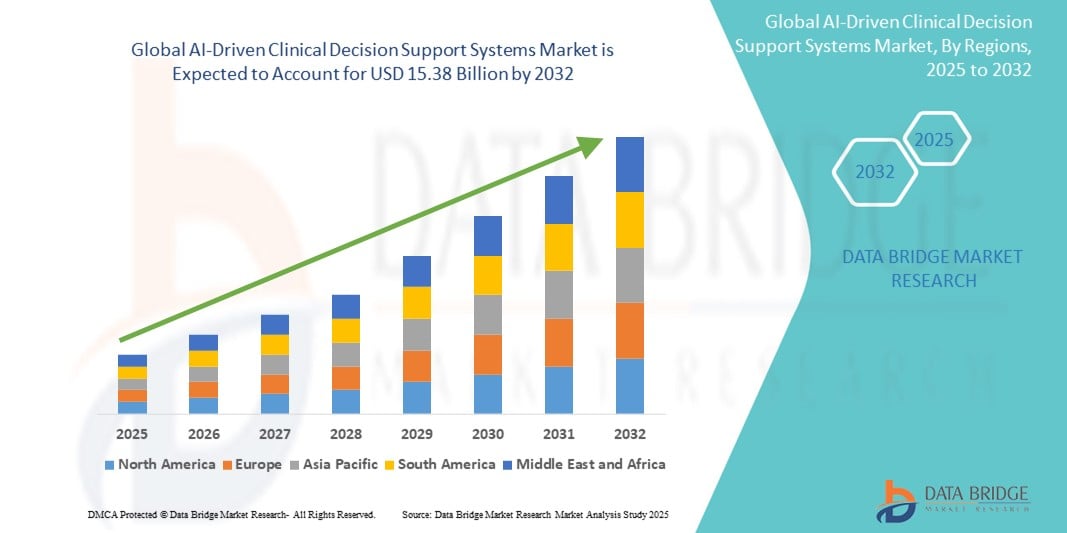
- The global AI-driven clinical decision support systems market size was valued at USD 2.77 billion in 2024 and is expected to reach USD 15.38 billion by 2032, at a CAGR of 23.90% during the forecast period
- This growth is driven by factors such as the increasing adoption of artificial intelligence in healthcare, rising demand for advanced diagnostic tools, and the need to improve patient outcomes and clinical efficiency in the AI-driven clinical decision support systems market
AI-Driven Clinical Decision Support Systems Market Analysis
- The AI-Driven Clinical Decision Support Systems (CDSS) market is experiencing significant growth, propelled by technological advancements, increasing healthcare demands, and a global shift toward value-based care
- The widespread adoption of EHRs enhances the functionality of CDSS by providing real-time access to patient data, leading to improved clinical decisions. AI technologies, including machine learning and natural language processing, enable CDSS to analyze vast datasets, offering personalized and evidence-based recommendations
- North America is expected to dominate the AI-driven clinical decision support systems market with largest market share of 43.6%, due to rising demand for IT solutions in healthcare and the emphasis on delivering quality healthcare services
- Asia-Pacific is expected to be the fastest growing region in the AI-driven clinical decision support systems market during the forecast period due to the increasing healthcare sector investments in countries such as China, Japan, India, and Australia
- On-premise segment is expected to dominate the market with a largest market share of 42.4% due to flexibility for customization and integration with existing healthcare systems and workflows, catering to specific organizational needs
Report Scope and AI-Driven Clinical Decision Support Systems Market Segmentation
|
Attributes |
AI-Driven Clinical Decision Support Systems Key Market Insights |
|
Segments Covered |
|
|
Countries Covered |
North America
Europe
Asia-Pacific
Middle East and Africa
South America
|
|
Key Market Players |
|
|
Market Opportunities |
|
|
Value Added Data Infosets |
In addition to the insights on market scenarios such as market value, growth rate, segmentation, geographical coverage, and major players, the market reports curated by the Data Bridge Market Research also include in-depth expert analysis, geographically represented company-wise production and capacity, network layouts of distributors and partners, detailed and updated price trend analysis and deficit analysis of supply chain and demand. |
AI-Driven Clinical Decision Support Systems Market Trends
“Integration of AI with Electronic Health Records (EHRs)”
- Integrating AI-driven CDSS with EHRs allows healthcare professionals to access comprehensive patient data in real-time, enhancing decision-making capabilities
- This integration streamlines clinical workflows, reducing manual data entry and minimizing errors, leading to more efficient patient care
- AI algorithms analyze EHR data to provide evidence-based recommendations, supporting clinicians in making informed decisions
- By evaluating individual patient data, AI-driven CDSS can suggest personalized treatment options, improving patient outcomes
- Integrating AI with EHRs helps ensure compliance with healthcare regulations by maintaining accurate and up-to-date patient records
AI-Driven Clinical Decision Support Systems Market Dynamics
Driver
“Advancements in AI Technologies”
- Continuous advancements in machine learning enable AI systems to learn from vast datasets, improving diagnostic accuracy and predictive capabilities
- NLP allows AI systems to interpret and analyze unstructured clinical notes, enhancing the richness of decision support
- AI-driven CDSS utilizes computer vision to analyze medical imaging, aiding in early detection of conditions such as cancer
- AI systems can predict patient outcomes by analyzing historical data, assisting in proactive care planning
- AI automates administrative tasks, allowing healthcare professionals to focus more on patient care
Opportunity
“Expansion in Emerging Markets”
- Countries such as India and China are implementing policies to support the adoption of healthcare IT solutions, including CDSS
- Increased government spending on healthcare infrastructure in emerging markets creates opportunities for CDSS adoption
- The availability of skilled IT professionals in emerging markets facilitates the implementation and maintenance of AI-driven CDSS
- dvancements in AI and machine learning technologies are being leveraged to develop cost-effective CDSS solutions for emerging markets
- AI-driven CDSS can enhance healthcare delivery in underserved areas by providing decision support to remote healthcare providers
Restraint/Challenge
“Data Privacy and Security Concerns”
- AI-driven CDSS systems handle vast amounts of sensitive patient information, raising concerns about data breaches and unauthorized access
- Ensuring compliance with regulations such as HIPAA in the U.S. and GDPR in Europe is challenging, especially with cloud-based systems
- Sharing patient data across platforms and institutions increases the risk of exposure and misuse
- Healthcare systems are prime targets for cyberattacks, and AI-driven CDSS are vulnerable to such threats if not adequately protected
- Data privacy concerns can erode public trust in AI-driven healthcare solutions, hindering adoption and utilization
AI-Driven Clinical Decision Support Systems Market Scope
The market is segmented on the basis of component, deployment mode, application, and end user.
|
Segmentation |
Sub-Segmentation |
|
By Component |
|
|
By Deployment Mode |
|
|
By Application |
|
|
By End User |
|
In 2025, the on-premise is projected to dominate the market with a largest share in deployment mode segment
The on-premise segment is expected to dominate the AI-driven clinical decision support systems market with the largest share of 42.4% due to flexibility for customization and integration with existing healthcare systems and workflows, catering to specific organizational needs. Multispecialty hospitals and large healthcare organizations prefer this system for greater data control within their infrastructure. Integrating existing systems such as EHRs enables smoother data flow and interoperability, enhancing efficiency in decision support.
The drug allergy alerts is expected to account for the largest share during the forecast period in application segment
In 2025, the drug allergy alerts segment is expected to dominate the market with the largest market share of 26.2% due to widely utilized in clinical decision support systems (CDSSs) to enhance patient safety and prevent adverse drug reactions (ADRs). CDSSs allow customization of alerts based on individual patient profiles and specific allergy information. Healthcare providers can tailor alert thresholds and preferences to ensure relevance and actionability for each patient. The rising burden of drug allergies is driving CDSS adoption, fueling segment growth.
AI-Driven Clinical Decision Support Systems Market Regional Analysis
“North America Holds the Largest Share in the AI-Driven Clinical Decision Support Systems Market”
- North America dominates the AI-driven clinical decision support systems market with largest market share of 43.6%, due to rising demand for IT solutions in healthcare and the emphasis on delivering quality healthcare services. Rapid technological advancements further drive market growth
- The U.S. held the largest market share of approximately 43.76% due to the robust healthcare IT infrastructure in the U.S. supports the widespread deployment of these systems, enabling their effective use in various medical settings
- The region boasts well-established healthcare systems and a high adoption rate of AI technologies, facilitating the integration of CDSS into clinical practices
- Policies and funding from governments, particularly in the United States, support the development and implementation of AI-driven healthcare solutions
- Major companies in the healthcare IT sector, such as IBM Watson Health and Cerner Corporation, are headquartered in North America, driving innovation and market growth
- The increasing prevalence of chronic diseases and a focus on personalized care are propelling the demand for advanced decision support systems in the region
“Asia-Pacific is Projected to Register the Highest CAGR in the AI-Driven Clinical Decision Support Systems Market”
- The Asia-Pacific region is experiencing the highest growth rate in the AI-powered clinical decision support market due to increasing healthcare sector investments in countries such as China, Japan, India, and Australia. Asia Pacific’s market is showing high potential due to growing R&D expenses by governments of key regional economies for improving information technology penetration in the healthcare sector
- Countries such as China, India, and Japan are investing heavily in healthcare infrastructure and digital health technologies, driving the adoption of CDSS
- Initiatives such as China's Healthy China 2030 plan and India's National Digital Health Mission aim to enhance healthcare delivery through digital solutions, including AI-powered systems
- The region's large and aging population, coupled with a rise in chronic diseases, necessitates efficient clinical decision-making tools
- The proliferation of mobile health applications and cloud computing in healthcare is facilitating the integration of AI-driven CDSS in clinical settings
AI-Driven Clinical Decision Support Systems Market Share
The market competitive landscape provides details by competitor. Details included are company overview, company financials, revenue generated, market potential, investment in research and development, new market initiatives, global presence, production sites and facilities, production capacities, company strengths and weaknesses, product launch, product width and breadth, application dominance. The above data points provided are only related to the companies' focus related to market.
The Major Market Leaders Operating in the Market Are:
- Wolters Kluwer N.V. (Netherlands)
- Oraclev (U.S.)
- Merative (U.S.)
- Change Healthcare (U.S.)
- Veradigm Incv. (U.S.)
- athenahealth (U.S.)
- Epic Systems Corporation (U.S.)
- Elsevier B.V. (Netherlands)
- Zynx Health (U.S.)
- Koninklijke Philips N.V. (Netherlands)
- Medical Information Technology, Inc. (U.S.)
- NextGen Healthcare, Inc. (U.S.)
- CureMD Healthcare (U.S.)
- Siemens Healthineers (Germany)
- EBSCO Information Services (U.S.)
- GE HealthCare (U.S.)
- eClinicalWorks (U.S.)
- The Medical Algorithms Company (U.K.)
- RAMPmedical (Germany)
Latest Developments in Global AI-Driven Clinical Decision Support Systems Market
- In May 2024, WELL Health Technologies Corp. launched HEALWELL AI, a second-generation WELL AI Decision Support (WAIDS). The upgraded WAIDS includes screening capabilities for numerous chronic diseases such as chronic kidney disease, hypertension, and diabetes, enabling risk stratification of patients into high-, medium-, or low-risk categories. This expansion broadens WAIDS's utility in detecting more than 100 rare and chronic diseases, providing clinically validated insights that identify care gaps and equip clinicians with actionable information at the point of care
- In February 2024, Elsevier Health, in partnership with OpenEvidence, launched ClinicalKey AI, the first and most advanced clinical decision support tool in the United States that combines the latest and most trusted medical content with generative artificial intelligence (AI) to help clinicians at the point of care
- In April 2023, Microsoft (US) and Epic Systems Corporation (US) expanded their long-standing strategic collaboration to develop and integrate generative AI into healthcare by combining the scale and power of Azure OpenAI Service with Epic’s industry-leading electronic health record (EHR) software. This co-innovation is focused on delivering a comprehensive array of generative AI- powered solutions integrated with Epic’s EHR to increase productivity, enhance patient care, and improve financial integrity of health systems globall
- In April 2023, Elsevier B.V. (UK) announced the launch of an upgraded version of its clinical decision support solution, ClinicalKey. This enhanced platform incorporates a comprehensive drug compendium, a cutting-edge mobile application, and seamless integration into Electronic Health Records (EHR). These new features have been strategically designed to offer physicians in the United States and international markets convenient access to reliable and extensive medical content directly at the point of care, speeding up diagnosis and treatment for their patients
- In February 2023, The province of Nova Scotia, in collaboration with Nova Scotia Health Authority (NSHA) and IWK Health (IWK) entered into a new 10-year agreement has been signed with Oracle (US) to implement an integrated electronic care record across the province for the more than one million Nova Scotians. This technology can help improve the way health professionals use and share patient information

- Interactive Data Analysis Dashboard
- Company Analysis Dashboard for high growth potential opportunities
- Research Analyst Access for customization & queries
- Competitor Analysis with Interactive dashboard
- Latest News, Updates & Trend analysis
- Harness the Power of Benchmark Analysis for Comprehensive Competitor Tracking
Data collection and base year analysis are done using data collection modules with large sample sizes. The stage includes obtaining market information or related data through various sources and strategies. It includes examining and planning all the data acquired from the past in advance. It likewise envelops the examination of information inconsistencies seen across different information sources. The market data is analysed and estimated using market statistical and coherent models. Also, market share analysis and key trend analysis are the major success factors in the market report. To know more, please request an analyst call or drop down your inquiry.
The key research methodology used by DBMR research team is data triangulation which involves data mining, analysis of the impact of data variables on the market and primary (industry expert) validation. Data models include Vendor Positioning Grid, Market Time Line Analysis, Market Overview and Guide, Company Positioning Grid, Patent Analysis, Pricing Analysis, Company Market Share Analysis, Standards of Measurement, Global versus Regional and Vendor Share Analysis. To know more about the research methodology, drop in an inquiry to speak to our industry experts.
Data Bridge Market Research is a leader in advanced formative research. We take pride in servicing our existing and new customers with data and analysis that match and suits their goal. The report can be customized to include price trend analysis of target brands understanding the market for additional countries (ask for the list of countries), clinical trial results data, literature review, refurbished market and product base analysis. Market analysis of target competitors can be analyzed from technology-based analysis to market portfolio strategies. We can add as many competitors that you require data about in the format and data style you are looking for. Our team of analysts can also provide you data in crude raw excel files pivot tables (Fact book) or can assist you in creating presentations from the data sets available in the report.













