


What is the AI-Driven Clinical Trial Recruitment Market size and Overview ?
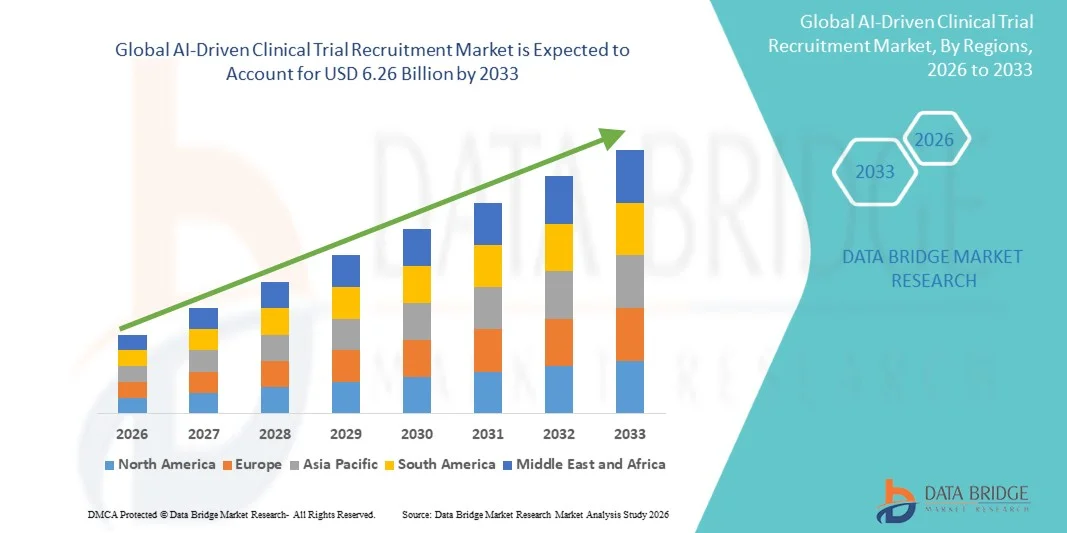
- As per Data Bridge Market Research analysis, the AI-driven clinical trial recruitment market was valued at USD 2.18 billion in 2025 and is projected to reach USD 6.26 billion by 2033, growing at a CAGR of 14.10% from 2026 to 2033. The market is experiencing consistent growth driven by increasing adoption of artificial intelligence technologies in clinical research, rising demand for faster patient enrollment, and growing need to reduce clinical trial timelines and costs. The market is expanding as pharmaceutical companies, biotechnology firms, and contract research organizations (CROs) increasingly utilize AI-powered platforms for patient identification, eligibility screening, recruitment optimization, and trial matching.
- The increasing complexity of clinical trials, rising number of drug development programs, and challenges associated with patient recruitment are driving the adoption of AI-based recruitment solutions. Advanced technologies such as artificial intelligence, machine learning, and natural language processing enable analysis of large healthcare datasets, electronic health records (EHRs), and real-world data to identify suitable clinical trial participants efficiently. AI-driven recruitment platforms are improving enrollment accuracy, enhancing patient engagement, and supporting decentralized clinical trial models by providing faster and more targeted recruitment approaches.
Market Size & Forecast
- Global Market Value (2025): USD 2.18 Billion
- Expected Market Value (2033): USD 6.26 Billion
- Forecast CAGR (2026–2033): 14.10%
- Leading Region in 2025: North America
- Fastest Growing Region: Asia-Pacific
Key Market Trends & Insights
- North America dominated the AI-driven clinical trial recruitment market with the largest revenue share of 42.80% in 2025, supported by advanced healthcare infrastructure, strong presence of pharmaceutical and biotechnology companies, increasing adoption of artificial intelligence technologies, and growing clinical trial activities across the region
- The software segment led the market with a 70.20% share in 2025, driven by increasing adoption of AI-powered patient matching platforms, automated eligibility screening tools, predictive analytics, and machine learning-based recruitment solutions across clinical research organizations
- Asia-Pacific is expected to be the fastest-growing region at a CAGR of 24.3% from 2026 to 2033, fueled by rising clinical trial outsourcing, expanding digital healthcare infrastructure, increasing artificial intelligence investments, and growing adoption of AI-based recruitment solutions in China, India, and Japan
- Services are the fastest-growing component type, projected to register a CAGR of 20.82%, reflecting the surge in demand for AI implementation, consulting, integration, and managed services required for deploying clinical trial recruitment platforms
- The cloud-based segment dominated the deployment mode category with a 55.40% revenue share in 2025, led by increasing demand for scalable, flexible, and cost-efficient AI recruitment platforms among pharmaceutical companies, biotechnology firms, and CROs
- Oncology trials accounted for 38.60% of the market, preferred by the increasing number of cancer clinical trials, complex eligibility requirements, and growing need for advanced patient identification solutions
- The rare disease trials segment is the fastest-growing application category, with a CAGR of 24.10%, driven by increasing adoption of AI technologies to overcome patient identification challenges in rare disease research
Report Scope and AI-Driven Clinical Trial Recruitment Market Segmentation
|
Attributes |
AI-Driven Clinical Trial Recruitment Key Market Insights |
|
Segments Covered |
|
|
Countries Covered |
North America
Europe
Asia-Pacific
Middle East and Africa
South America
|
|
Key Market Players |
|
|
Market Opportunities |
|
|
Value Added Data Infosets |
In addition to the insights on market scenarios such as market value, growth rate, segmentation, geographical coverage, and major players, the market reports curated by the Data Bridge Market Research also include in-depth expert analysis, patient epidemiology, pipeline analysis, pricing analysis, and regulatory framework. |
What is the Key Trend in AI-Driven Clinical Trial Recruitment Market ?
Trend: Growth in AI-Powered Patient Identification & Precision Recruitment
Pharmaceutical companies and clinical research organizations are increasingly adopting AI-driven recruitment platforms to identify eligible patients, optimize screening processes, and improve enrollment efficiency. The integration of machine learning, natural language processing, and real-world data analytics enables automated analysis of electronic health records (EHRs), clinical notes, and patient databases for faster trial matching. AI-powered recruitment solutions are also supporting decentralized clinical trials by expanding access to diverse patient populations and reducing recruitment timelines through data-driven approaches. For instance, in January 2025, Celéri Health launched PatientFinder, an AI-powered large language model (LLM)-based platform designed for clinical trial patient matching and eligibility identification. The platform analyzes patient medical histories and clinical trial eligibility criteria to automate patient-to-trial matching, helping research organizations improve recruitment efficiency, reduce manual screening efforts, and accelerate enrollment.
The launch and validation of AI-enabled trial matching platforms demonstrate the growing role of artificial intelligence in accelerating patient recruitment, improving trial accessibility, and reducing enrollment challenges in clinical research
AI-Driven Clinical Trial Recruitment Market Dynamics
Key Market Driver: Rising Demand to Accelerate Clinical Trial Enrollment and Reduce Development Timelines
The increasing complexity of clinical trials and rising drug development activities are creating substantial demand for AI-driven recruitment solutions that can identify suitable participants, predict enrollment outcomes, and improve trial efficiency. AI technologies analyze healthcare datasets, patient histories, and eligibility criteria to automate recruitment workflows, helping pharmaceutical companies and CROs overcome traditional enrollment challenges. AI-based platforms are becoming an important component of modern clinical research strategies by reducing delays, improving patient matching, and supporting faster clinical trial execution. For instance, in February 2024, Unlearn.AI raised USD 50 million in Series C funding to expand its AI-powered Digital Twin platform for clinical trials. The platform uses machine learning and historical clinical data to create AI-generated digital twins of trial participants, helping sponsors design more efficient studies, reduce reliance on traditional control groups, and accelerate clinical development processes.
The development and expansion of AI-powered digital twin technologies demonstrate the growing opportunity for artificial intelligence to improve clinical trial efficiency, optimize study design, and reduce recruitment and enrollment challenges.
Key Restraint/Challenge: Data Privacy, Regulatory Compliance, and Healthcare Data Integration Barriers
A significant restraint in the AI-driven clinical trial recruitment market is the complexity associated with managing sensitive patient information while maintaining regulatory compliance. AI recruitment platforms require access to large healthcare datasets, including electronic health records, medical histories, and real-world evidence, creating challenges related to data security, interoperability, and standardized data access. Differences in healthcare regulations across countries and concerns regarding patient confidentiality can slow the implementation of AI-based recruitment systems in clinical research environments. For instance, in December 2023, The U.S. Food and Drug Administration (FDA) issued draft guidance on “Digital Health Technologies for Remote Data Acquisition in Clinical Investigations,” emphasizing the importance of data quality, reliability, security, and regulatory considerations when using digital technologies and real-world data approaches in clinical trials.
Addressing data governance, cybersecurity, and regulatory challenges will be critical for ensuring broader adoption of AI-driven recruitment platforms across global clinical trials
Key Market Opportunity: Integration of AI with Decentralized Clinical Trials and Real-World Evidence Platforms
The integration of artificial intelligence with decentralized clinical trials, real-world evidence platforms, and precision medicine approaches presents significant growth opportunities for AI-driven recruitment solutions. AI-enabled systems can analyze diverse healthcare datasets, improve patient outreach, support remote recruitment, and identify difficult-to-reach populations in oncology and rare disease trials. The combination of AI, genomic information, wearable data, and digital health technologies is creating new opportunities to enhance patient engagement and improve clinical trial efficiency globally. For instance, in June 2024, Medidata launched Clinical Data Studio, an AI-enabled clinical trial data management solution designed to modernize clinical research workflows. The platform integrates data from multiple sources and uses artificial intelligence to improve data review, identify potential data issues and safety signals, enhance data quality, and support faster, more efficient clinical trial decision-making.
The convergence of AI, decentralized research models, and advanced healthcare data platforms is expected to expand opportunities for faster, more efficient, and patient-focused clinical trial recruitment.
AI-Driven Clinical Trial Recruitment Market Scope
The AI-driven clinical trial recruitment market is segmented on the basis of component, deployment mode, application, and end user.
- By Component
On the basis of component, the AI-driven clinical trial recruitment market is segmented into software and services. The software segment dominated the market with a 70.20% share in 2025, owing to increasing adoption of AI-powered patient matching platforms, automated eligibility screening tools, predictive analytics, and machine learning-based recruitment solutions across clinical research organizations. AI software platforms enable faster identification of suitable trial participants by analyzing electronic health records (EHRs), real-world data, and clinical databases. These solutions reduce manual screening efforts and improve recruitment accuracy by matching patients with complex trial eligibility criteria. Pharmaceutical companies and CROs are increasingly investing in AI-based software to overcome patient enrollment challenges and reduce clinical trial timelines. Integration with healthcare information systems and real-world evidence platforms is further strengthening software adoption. Continuous advancements in natural language processing (NLP) and machine learning algorithms are expected to maintain the segment’s leading position.
The services segment is projected to register the fastest growth at a CAGR of 20.82% from 2026 to 2033, driven by rising demand for AI implementation, consulting, integration, and managed services required for deploying clinical trial recruitment platforms. Organizations increasingly require specialized expertise to integrate AI technologies with existing clinical research workflows and healthcare databases. Service providers assist pharmaceutical companies and CROs in customizing AI models, improving recruitment strategies, and managing data complexities. Growing adoption of outsourced clinical research activities is further increasing demand for AI-related support services. The need for continuous platform optimization, regulatory compliance support, and technical assistance is accelerating service adoption. Increasing complexity of AI-driven clinical trial ecosystems is expected to create significant growth opportunities for this segment.
- By Deployment Mode
On the basis of deployment mode, the AI-driven clinical trial recruitment market is segmented into cloud-based, on-premises, hybrid, and software-as-a-service (SaaS). The cloud-based segment dominated the market with a 55.40% share in 2025, supported by increasing demand for scalable, flexible, and cost-efficient AI recruitment platforms among pharmaceutical companies, biotechnology firms, and CROs. Cloud-based systems enable real-time access to clinical trial data, remote collaboration, and seamless integration with healthcare databases. These platforms reduce infrastructure costs by eliminating the need for extensive hardware investments and maintenance. Cloud deployment also supports large-scale data processing required for AI algorithms, including patient matching and predictive analytics. Growing adoption of decentralized clinical trials is further increasing demand for cloud-based solutions. Enhanced accessibility, scalability, and faster implementation continue to drive dominance of cloud deployment in AI-driven recruitment.
The software-as-a-service (SaaS) segment is expected to witness the fastest growth at a CAGR of 23.10% from 2026 to 2033, driven by increasing preference for subscription-based AI clinical trial recruitment platforms. SaaS solutions provide pharmaceutical companies and research organizations with flexible access to advanced AI capabilities without significant upfront investment. These platforms enable rapid deployment, automatic updates, and simplified maintenance compared with traditional deployment models. Small and mid-sized biotechnology companies are increasingly adopting SaaS-based solutions due to affordability and operational flexibility. Growing demand for remote clinical trial management and digital research platforms is further supporting SaaS expansion. The increasing shift toward cloud-native healthcare technologies is expected to accelerate growth of this segment.
- By Application
On the basis of application, the AI-driven clinical trial recruitment market is segmented into oncology trials, rare disease trials, cardiovascular trials, neurology trials, infectious disease trials, general clinical studies, and others. The oncology trials segment dominated the market with a 38.60% share in 2025, driven by the increasing number of cancer clinical trials, complex eligibility requirements, and growing need for advanced patient identification solutions. Oncology studies often involve highly specific patient characteristics, biomarkers, and treatment histories, making AI-based matching technologies valuable for improving recruitment efficiency. AI platforms help researchers analyze large volumes of clinical and genomic data to identify suitable cancer patients faster. Rising global cancer burden and expansion of precision medicine approaches are further increasing demand for AI-driven recruitment solutions. Pharmaceutical companies are increasingly using AI tools to accelerate enrollment in targeted oncology studies. Growing investment in cancer drug development continues to support segment dominance.
The rare disease trials segment is projected to register the fastest growth at a CAGR of 24.10% from 2026 to 2033, supported by increasing adoption of AI technologies to overcome patient identification challenges in rare disease research. Rare disease trials often face difficulties due to limited patient populations, fragmented healthcare data, and complex diagnostic requirements. AI-powered platforms help identify potential participants by analyzing medical records, genetic information, and real-world evidence. Growing investment in orphan drug development and precision medicine is increasing demand for advanced recruitment solutions. AI enables researchers to locate geographically dispersed patient populations and improve trial accessibility. Increasing focus on rare disease therapies is expected to accelerate growth of this segment.
- By End User
On the basis of end user, the AI-driven clinical trial recruitment market is segmented into pharmaceutical & biotechnology companies, contract research organizations (CROs), hospitals & clinics, and others. The pharmaceutical & biotechnology companies segment dominated the market with a 46.50% share in 2025, owing to increasing investment in drug discovery, clinical development programs, and AI-powered research technologies. These companies are adopting AI recruitment platforms to reduce trial delays, optimize patient enrollment, and improve clinical development efficiency. Large pharmaceutical organizations manage complex global trials requiring advanced patient matching and data analytics capabilities. AI solutions help these companies reduce recruitment costs and accelerate time-to-market for new therapies. Growing adoption of precision medicine and personalized therapies is further increasing demand among pharmaceutical and biotechnology firms. Strong investment capacity and expanding clinical trial pipelines continue to support segment leadership.
The contract research organizations (CROs) segment is expected to witness the fastest growth at a CAGR of 22.50% from 2026 to 2033, driven by increasing outsourcing of clinical trial activities by pharmaceutical and biotechnology companies. CROs are adopting AI-based recruitment technologies to provide faster enrollment solutions, improve trial performance, and enhance operational efficiency for sponsors. AI platforms allow CROs to manage multiple trials simultaneously by automating patient identification and screening processes. Rising complexity of global clinical studies is increasing demand for technology-enabled CRO services. Expansion of decentralized clinical trials is further supporting AI adoption among CROs. Growing need for cost-effective and efficient trial management solutions is expected to accelerate segment growth.
AI-Driven Clinical Trial Recruitment Market Regional Analysis
North America dominated the AI-driven clinical trial recruitment market with the largest revenue share of 42.80% in 2025, supported by advanced healthcare infrastructure, strong presence of pharmaceutical and biotechnology companies, increasing adoption of artificial intelligence technologies, and growing clinical trial activities across the region. The region benefits from extensive availability of electronic health records (EHRs), real-world data platforms, and advanced clinical research networks that enable AI-based patient identification and recruitment. Growing adoption of machine learning, natural language processing (NLP), and predictive analytics solutions is accelerating market development. Increasing investment in precision medicine, decentralized clinical trials, and digital health technologies continues to strengthen North America's leadership position in the global AI-driven clinical trial recruitment market.
U.S. AI-Driven Clinical Trial Recruitment Market Insight
The U.S. AI-driven clinical trial recruitment market is witnessing strong growth due to rising adoption of artificial intelligence in healthcare research, increasing clinical trial activity, and growing demand for faster patient enrollment solutions. The country’s advanced healthcare data ecosystem, extensive electronic health record (EHR) availability, and strong presence of pharmaceutical companies and CROs are driving demand for AI-powered recruitment platforms. According to ClinicalTrials.gov, the U.S. remains the largest contributor to registered clinical studies globally, with more than 180,000 registered studies, creating significant demand for AI-based patient matching and recruitment technologies. In addition, increasing investments in precision medicine, decentralized clinical trials, and real-world evidence solutions are accelerating AI adoption across clinical research organizations.
Europe AI-Driven Clinical Trial Recruitment Market Insight
The Europe AI-driven clinical trial recruitment market remains a major contributor to global revenue, driven by strong pharmaceutical research capabilities, increasing digital health adoption, and growing investments in artificial intelligence-enabled clinical research. The region benefits from established clinical trial networks, advanced healthcare systems, and increasing use of real-world data platforms for patient identification and enrollment optimization. The European Medicines Agency (EMA) adopted its reflection paper on the use of artificial intelligence (AI) and machine learning (ML) across the medicinal product lifecycle, highlighting the growing role of AI in clinical research, medicines development, regulatory decision-making, and data-driven healthcare innovation. The guidance emphasizes the need for safe, effective, and responsible use of AI technologies in areas including clinical trials and evidence generation.
U.K. AI-Driven Clinical Trial Recruitment Market Insight
The U.K. AI-driven clinical trial recruitment market is experiencing steady growth, supported by increasing adoption of AI technologies in healthcare research, strong clinical trial infrastructure, and government initiatives promoting digital innovation. Increasing collaboration between academic institutions, healthcare providers, and technology companies is supporting development of AI-based patient identification and recruitment solutions. The U.K. government announced the AI Life Sciences Accelerator Mission, supported by NHS data and artificial intelligence technologies, to accelerate healthcare innovation and improve clinical research capabilities. Furthermore, integration of AI, real-world evidence, and healthcare analytics is improving trial efficiency and positioning the U.K. as a key innovation hub in AI-enabled clinical development.
Germany AI-Driven Clinical Trial Recruitment Market Insight
The Germany AI-driven clinical trial recruitment market is expanding steadily due to the country’s strong pharmaceutical research base, advanced healthcare infrastructure, and increasing adoption of digital clinical research technologies. Pharmaceutical companies, research institutes, and CROs are increasingly utilizing AI solutions for patient identification, trial optimization, and data-driven clinical development. Germany’s Federal Ministry of Health launched the Medical Research Data Infrastructure initiative to improve access to health data for research purposes, supporting AI applications in healthcare and clinical research. Continuous advancements in healthcare digitization, data platforms, and precision medicine approaches are further driving AI-based recruitment adoption in Germany.
Asia-Pacific AI-Driven Clinical Trial Recruitment Market Insight
The Asia-Pacific AI-driven clinical trial recruitment market is expected to witness rapid growth, driven by increasing clinical trial outsourcing, expanding healthcare digitization, and rising investments in artificial intelligence technologies across countries such as China, India, and Japan. Growing availability of healthcare data, increasing pharmaceutical research activities, and adoption of decentralized clinical trials are supporting regional market expansion. According to ClinicalTrials.gov, China, India, and Japan are among the leading countries in registered clinical studies outside North America and Europe, creating strong demand for AI-enabled recruitment solutions. In addition, increasing government support for healthcare AI development and digital transformation is accelerating adoption across pharmaceutical, biotechnology, and research sectors.
Japan AI-Driven Clinical Trial Recruitment Market Insight
The Japan AI-driven clinical trial recruitment market is witnessing consistent growth due to rising investments in healthcare artificial intelligence, advanced pharmaceutical research capabilities, and increasing demand for efficient clinical trial enrollment solutions. Pharmaceutical manufacturers and research institutions are adopting AI-powered technologies to improve patient matching, optimize clinical workflows, and support precision medicine initiatives. In 2024, Japan’s Ministry of Health, Labour and Welfare promoted the use of digital technologies and data utilization in healthcare research, supporting AI adoption in clinical development. Moreover, Japan’s aging population and focus on innovative therapies are increasing demand for advanced clinical research technologies.
China AI-Driven Clinical Trial Recruitment Market Insight
The China AI-driven clinical trial recruitment market is growing rapidly, driven by increasing clinical research activity, expanding pharmaceutical innovation, and government support for artificial intelligence in healthcare. Growing adoption of AI-enabled patient screening, healthcare data analytics, and digital trial platforms is significantly boosting market demand. China’s National Health Commission highlighted the importance of accelerating healthcare digitalization, strengthening health data utilization, and promoting the integration of big data, artificial intelligence, and other digital technologies into healthcare services and medical research. The initiative supports the development of healthcare data platforms and encourages AI applications to improve medical innovation, precision healthcare, and research capabilities.
AI-Driven Clinical Trial Recruitment Market Share
The AI-driven clinical trial recruitment industry is primarily led by well-established companies, including:
- IQVIA (U.S.)
- Medidata (U.S.)
- Unlearn.ai, Inc. (U.S.)
- Belonglife Inc (U.S.)
- Saama. (U.S.)
- Veeva Systems Inc. (U.S.)
- Oracle (U.S.)
- Clario, Inc. (U.S.)
- Medable, Inc. (U.S.)
- Science 37, Inc. (U.S.)
- Antidote Technologies, Inc. (U.S.)
- TriNetX, LLC (U.S.)
- Owkin, Inc. (U.S.)
- ConcertAI. (U.S.)
- Phesi Inc. (U.K.)
- ClinOne, Inc. (U.S.)
- Castor. (Netherlands)
- Trialbee AB (Sweden)
Latest Developments in AI-Driven Clinical Trial Recruitment Market
- In January 2025, Celéri Health launched PatientFinder, an AI-powered large language model (LLM)-based patient matching platform designed to improve clinical trial recruitment and patient eligibility identification. The platform analyzes patient medical histories and clinical trial criteria to automate patient-to-trial matching, helping research organizations reduce manual screening efforts, improve recruitment efficiency, and accelerate clinical trial enrollment. This launch highlights the growing adoption of generative AI and large language models for solving patient recruitment challenges in clinical research
- In July 2024, Eisai selected Medidata Clinical Data Studio, an AI-enhanced clinical trial data platform, to improve clinical trial efficiency and patient experience. The technology enables integration of clinical data sources, accelerates data review processes, and supports large-scale clinical studies by providing AI-driven insights for research teams. This adoption demonstrates increasing demand for AI-powered platforms that improve clinical trial management and support faster patient-focused research
- In June 2024, Medidata launched Clinical Data Studio, an AI-enabled clinical trial data management platform designed to modernize clinical research workflows. The platform integrates data from multiple sources and uses embedded artificial intelligence to support data review, anomaly detection, risk identification, and faster decision-making across clinical trials. The launch strengthens AI adoption in clinical development by enabling sponsors and research teams to improve data quality, operational efficiency, and trial execution
- In September 2023, Belong.Life launched Tara, a conversational AI-based clinical trial matching platform designed to improve cancer patient recruitment. The SaaS-based platform uses artificial intelligence, machine learning, and natural language processing (NLP) to collect patient information, analyze eligibility criteria, and match patients with suitable clinical trials. Tara enables hospitals, healthcare systems, and contract research organizations (CROs) to accelerate patient identification and improve enrollment efficiency in oncology studies
- In September 2023, Deep 6 AI launched its AI-powered Genomics Module to accelerate enrollment in precision medicine and oncology clinical trials. The module uses artificial intelligence to analyze genomic reports, electronic medical records (EMRs), and unstructured clinical data to identify patients with specific genetic markers who may qualify for clinical studies. The solution enables healthcare organizations and life sciences companies to improve patient-trial matching, enhance trial feasibility assessment, and accelerate recruitment for complex precision medicine research

- Interactive Data Analysis Dashboard
- Company Analysis Dashboard for high growth potential opportunities
- Research Analyst Access for customization & queries
- Competitor Analysis with Interactive dashboard
- Latest News, Updates & Trend analysis
- Harness the Power of Benchmark Analysis for Comprehensive Competitor Tracking
Data collection and base year analysis are done using data collection modules with large sample sizes. The stage includes obtaining market information or related data through various sources and strategies. It includes examining and planning all the data acquired from the past in advance. It likewise envelops the examination of information inconsistencies seen across different information sources. The market data is analysed and estimated using market statistical and coherent models. Also, market share analysis and key trend analysis are the major success factors in the market report. To know more, please request an analyst call or drop down your inquiry.
The key research methodology used by DBMR research team is data triangulation which involves data mining, analysis of the impact of data variables on the market and primary (industry expert) validation. Data models include Vendor Positioning Grid, Market Time Line Analysis, Market Overview and Guide, Company Positioning Grid, Patent Analysis, Pricing Analysis, Company Market Share Analysis, Standards of Measurement, Global versus Regional and Vendor Share Analysis. To know more about the research methodology, drop in an inquiry to speak to our industry experts.
Data Bridge Market Research is a leader in advanced formative research. We take pride in servicing our existing and new customers with data and analysis that match and suits their goal. The report can be customized to include price trend analysis of target brands understanding the market for additional countries (ask for the list of countries), clinical trial results data, literature review, refurbished market and product base analysis. Market analysis of target competitors can be analyzed from technology-based analysis to market portfolio strategies. We can add as many competitors that you require data about in the format and data style you are looking for. Our team of analysts can also provide you data in crude raw excel files pivot tables (Fact book) or can assist you in creating presentations from the data sets available in the report.












