


What is the AI-Driven Revenue Cycle Management (RCM) Services Market Size and Growth Rate?
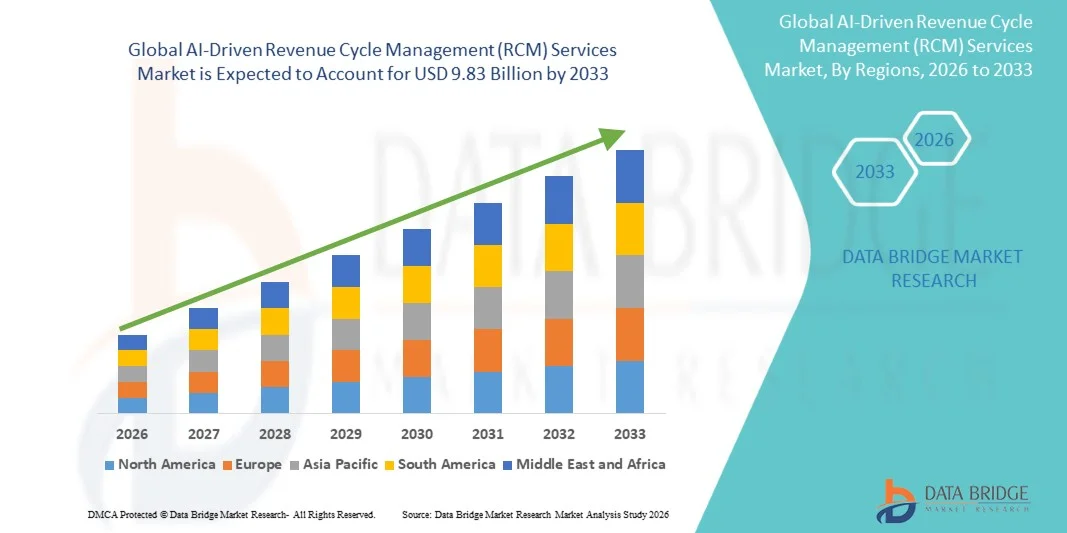
As per Data Bridge Market Research Analysis the AI-Driven Revenue Cycle Management (RCM) Services Market was valued at USD 2.43 billion in 2025 and is projected to reach USD 9.83 billion by 2033, growing at a CAGR of 19.10% from 2026 to 2033. The AI-Driven Revenue Cycle Management (RCM) Services Market is experiencing consistent growth driven by rising demand for efficient healthcare revenue optimization, increasing administrative burden on healthcare providers, and rapid adoption of AI-powered automation in billing, coding, and claims processing workflows. Growing healthcare expenditure, coupled with the need to reduce claim denials and improve reimbursement accuracy, is further accelerating the adoption of AI-driven RCM solutions across hospitals, diagnostic laboratories, and ambulatory care centers.
The increasing complexity of healthcare reimbursement systems, along with stricter regulatory compliance requirements and rising pressure on healthcare organizations to improve financial performance, is compelling providers to adopt advanced AI-enabled RCM platforms. Cloud-based and integrated AI RCM solutions are replacing traditional manual billing systems in many markets, offering automated claims management, predictive analytics, fraud detection, and real-time revenue cycle visibility, thereby improving operational efficiency and financial outcomes across the healthcare ecosystem.
Market Size & Forecast
- Global Market Value (2025): USD 2.43 Billion
- Expected Market Value (2033): USD 9.83 Billion
- Forecast CAGR (2026–2033): 19.10%
- Leading Region in 2025: North America
- Fastest Growing Region: Asia-Pacific
What are the Major Takeaways of AI-Driven Revenue Cycle Management (RCM) Services Market?
- North America dominated the AI-Driven Revenue Cycle Management (RCM) Services Market with the largest revenue share of 38.62% in 2025, supported by advanced healthcare infrastructure, strong presence of leading healthcare IT and RCM solution providers, and high adoption of AI-driven automation in claims processing, medical coding, billing, and denial management. The region also benefits from well-established hospital networks, favorable reimbursement frameworks, and increasing pressure to reduce administrative costs and improve revenue cycle efficiency, which is driving adoption across hospitals, diagnostic laboratories, and ambulatory care centers in the U.S. and Canada.
- The Cloud-Based segment dominated the market with a 59.68% share in 2025, driven by strong demand for scalable, flexible, and cost-efficient healthcare IT infrastructure
- Asia-Pacific is expected to be the fastest-growing region at a CAGR of 8.1% from 2026 to 2033, fueled by rising healthcare expenditure, rapid digital transformation of healthcare systems, and increasing adoption of AI-based revenue cycle automation solutions. Expanding hospital infrastructure, growing insurance penetration, and increasing demand for efficient billing and claims management systems across China, India, and Japan are further accelerating market growth in the region.
- The Software segment dominated the market with a 42.36% share in 2025, driven by strong adoption of AI-powered claims management systems, medical coding solutions, billing automation platforms, and predictive revenue analytics tools. Increasing deployment of cloud-based software solutions and integration with hospital information systems is further strengthening segment dominance across healthcare organizations globally.
- The AI & Machine Learning Modules segment is expected to be the fastest-growing with a CAGR of 6.8% from 2026 to 2033, driven by rising demand for intelligent automation in revenue cycle operations, predictive analytics for claim approvals, fraud detection systems, and real-time revenue optimization tools. Increasing use of AI-driven decision support systems in hospitals and healthcare providers is further accelerating adoption.
- The Cloud-Based segment is expected to be the fastest-growing with a CAGR of 6.6% from 2026 to 2033, driven by increasing digital transformation initiatives in healthcare, rising demand for flexible subscription-based RCM solutions, and growing need for centralized data management and real-time financial analytics across hospitals and healthcare networks.
Report Scope and AI-Driven Revenue Cycle Management (RCM) Services Market Segmentation
|
Attributes |
AI-Driven Revenue Cycle Management (RCM) Services Key Market Insights |
|
Segments Covered |
|
|
Countries Covered |
North America
Europe
Asia-Pacific
Middle East and Africa
South America
|
|
Key Market Players |
|
|
Market Opportunities |
|
|
Value Added Data Infosets |
In addition to the insights on market scenarios such as market value, growth rate, segmentation, geographical coverage, and major players, the market reports curated by the Data Bridge Market Research also include in-depth expert analysis, geographically represented company-wise production and capacity, network layouts of distributors and partners, detailed and updated price trend analysis and deficit analysis of supply chain and demand. |
How is the AI-Driven Revenue Cycle Management (RCM) Services Market Segmented?
Trend: Growth in AI-Driven Automation in Healthcare Revenue Cycle Operations
Healthcare providers are increasingly adopting AI-Driven Revenue Cycle Management (RCM) Services to improve billing accuracy, reduce claim denials, and enhance financial efficiency across hospitals and diagnostic networks. AI-powered automation is being widely used for medical coding, claims submission, payment reconciliation, and denial prediction. For instance, large U.S.-based hospital systems such as Mayo Clinic and Cleveland Clinic have integrated AI-enabled RCM modules to streamline billing workflows and reduce administrative burden. Studies from healthcare IT reports (2023–2025) indicate that AI-based RCM solutions can reduce claim denial rates by up to 30–40% and shorten reimbursement cycles by nearly 20–25%, significantly improving hospital cash flow performance.
AI-Driven Revenue Cycle Management (RCM) Services Market Dynamics
Key Market Driver: Rising Healthcare Cost Pressure and Demand for Revenue Optimization
The increasing global healthcare expenditure, which surpassed USD 9–10 trillion annually (2024 estimates), is driving strong demand for efficient revenue cycle management systems. Hospitals, insurance providers, and healthcare networks are adopting AI-driven RCM platforms to minimize revenue leakage, improve coding accuracy, and optimize reimbursement workflows. For example, U.S. healthcare providers have reported that nearly 5–10% of total hospital revenue is lost due to billing inefficiencies and claim rejections, creating strong demand for AI-based automation solutions. Major RCM providers such as Optum, R1 RCM, and Change Healthcare are actively deploying machine learning models to improve claims processing accuracy and accelerate payment cycles across large-scale hospital networks.
Key Restraint/Challenge: High Implementation Cost and Integration Complexity
A major restraint in the AI-Driven Revenue Cycle Management (RCM) Services market is the high initial cost of implementation and integration complexity with legacy healthcare IT systems. Advanced AI-based RCM platforms require significant investment in software licensing, cloud infrastructure, cybersecurity, and system customization. Smaller hospitals and independent clinics often face difficulties in adopting these systems due to limited IT budgets and lack of technical expertise. In addition, integration with electronic health records (EHR) systems and compliance with regulatory frameworks such as HIPAA (U.S.) and GDPR (Europe) further increases deployment complexity. Industry estimates suggest that full-scale AI-RCM implementation in large hospitals can require multi-million-dollar investments, making adoption slower in cost-sensitive regions.
Key Market Opportunity: Expansion of Cloud-Based AI RCM and Predictive Healthcare Analytics
The rapid shift toward cloud-based healthcare infrastructure presents a major opportunity for AI-Driven Revenue Cycle Management (RCM) Services. Cloud platforms enable scalable deployment, real-time financial analytics, and seamless integration with hospital information systems. Increasing adoption of predictive analytics is enabling healthcare providers to forecast claim denials, optimize reimbursement strategies, and improve patient billing transparency. For example, healthcare analytics studies (2024–2025) show that predictive RCM systems can improve revenue recovery rates by 15–20% in large hospital networks. Additionally, expanding healthcare digitization in emerging markets such as India, China, and Brazil is creating new growth avenues for cost-efficient, AI-powered RCM solutions, supported by government-led healthcare modernization programs and rising insurance penetration.
How is the AI-Driven Revenue Cycle Management (RCM) Services Market Segmented?
The AI-Driven Revenue Cycle Management (RCM) Services market is segmented on the basis of component, deployment mode, function, end user, and application.
- By Component
On the basis of component, the AI-Driven Revenue Cycle Management (RCM) Services Market is segmented into software, services, and platforms. The Software segment dominated the market with a 46.82% share in 2025, driven by increasing adoption of AI-enabled billing systems, automated medical coding solutions, claims management tools, and predictive revenue analytics platforms across hospitals and healthcare networks. Growing pressure to reduce administrative burden and improve revenue cycle efficiency is further strengthening software adoption. Integration of AI with electronic health records (EHR) systems and hospital management systems is enhancing operational accuracy. Rising digital transformation in healthcare institutions is accelerating deployment of intelligent software solutions. Cloud-based software adoption is expanding rapidly due to scalability and cost efficiency. Increasing demand for real-time claim tracking and automation is supporting market dominance. Large hospital networks and diagnostic centers are major adopters. Regulatory compliance requirements are also boosting software integration.
The Platforms segment is expected to be the fastest-growing with a CAGR of 9.1% from 2026 to 2033, driven by rising demand for unified, interoperable RCM ecosystems. Healthcare providers are increasingly shifting toward integrated platforms that combine billing, coding, analytics, and compliance management. API-driven architecture and cloud-native deployment are accelerating adoption. Increasing need for real-time financial visibility is boosting platform demand. Hospitals are adopting centralized systems for multi-department coordination. Growing outsourcing of revenue cycle functions is further supporting platform expansion. Interoperability with EHR and insurance systems is a key growth driver. AI-powered decision support tools embedded in platforms are improving efficiency. Rising healthcare digitization in emerging economies is expanding adoption. Large healthcare enterprises prefer scalable platform-based solutions.
- By Deployment Mode
On the basis of deployment mode, the AI-Driven Revenue Cycle Management (RCM) Services Market is segmented into cloud-based, on-premise, and hybrid models. The Cloud-Based segment dominated the market with a 59.68% share in 2025, driven by strong demand for scalable, flexible, and cost-efficient healthcare IT infrastructure. Cloud-based RCM solutions enable real-time access to financial and clinical data across multiple healthcare facilities. Hospitals are increasingly adopting cloud systems to reduce IT infrastructure costs. Seamless integration with EHR and HIS systems is improving workflow efficiency. Automatic software updates and remote accessibility are major advantages. Growing adoption of SaaS-based healthcare solutions is boosting demand. Enhanced data security and compliance features are improving trust. Multi-location hospital networks prefer centralized cloud platforms. Rising digital transformation initiatives in healthcare are supporting growth.
The Hybrid segment is expected to be the fastest-growing with a CAGR of 9.4% from 2026 to 2033, driven by increasing need for balanced infrastructure combining cloud scalability and on-premise data security. Large hospital systems prefer hybrid models for sensitive patient data management. Integration flexibility with legacy systems is a major driver. Hybrid deployment allows phased digital transformation. Rising cybersecurity concerns in healthcare are supporting adoption. Hospitals are shifting toward flexible IT architectures. AI-enabled hybrid systems improve operational efficiency. Growing regulatory compliance requirements are influencing deployment choices. Healthcare enterprises prefer optimized cost-performance balance. Expansion of multi-cloud strategies is further accelerating growth.
- By Function
On the basis of function, the AI-Driven Revenue Cycle Management (RCM) Services Market is segmented into claims management, medical coding, billing & payment processing, fraud detection & compliance, and revenue analytics. The Claims Management segment dominated the market with a 38.27% share in 2025, driven by increasing automation of insurance claim submission, validation, and reimbursement processes. Hospitals are focusing on reducing claim denials and improving approval rates using AI-based systems. Machine learning models are widely used for error detection in claims. Integration with payer systems is improving processing speed. Rising healthcare administrative burden is accelerating automation adoption. Hospitals are using predictive tools for claim approval forecasting. AI-based workflows are reducing manual intervention. Revenue leakage prevention is a key driver. Large healthcare providers are investing in advanced claims platforms.
The Fraud Detection & Compliance segment is expected to be the fastest-growing with a CAGR of 10.2% from 2026 to 2033, driven by increasing healthcare fraud cases and regulatory enforcement pressures. AI systems are being used to detect abnormal billing patterns and suspicious claims. Real-time monitoring tools are improving compliance efficiency. Strict regulations such as HIPAA and GDPR are supporting adoption. Healthcare payers are investing in AI-driven fraud analytics. Machine learning algorithms are enhancing anomaly detection accuracy. Rising financial losses due to fraud are pushing adoption. Insurance companies are deploying predictive fraud detection systems. Hospitals are integrating compliance automation tools. Demand for transparent billing systems is accelerating growth.
- By End User
On the basis of end user, the AI-Driven Revenue Cycle Management (RCM) Services Market is segmented into hospitals, diagnostic laboratories, ambulatory care centers, and healthcare IT service providers. The Hospitals segment dominated the market with a 52.14% share in 2025, driven by high patient volumes, complex billing structures, and increasing adoption of AI-based revenue cycle automation systems. Large hospital chains are implementing AI tools for billing accuracy and reimbursement optimization. Integration with EHR systems is improving operational efficiency. Rising pressure to reduce administrative costs is a key driver. Hospitals are using predictive analytics for revenue optimization. AI adoption is improving financial transparency. Demand for real-time claim processing is increasing. Government healthcare reforms are supporting digitization. Large healthcare institutions are early adopters of RCM automation.
The Healthcare IT Service Providers segment is expected to be the fastest-growing with a CAGR of 9.6% from 2026 to 2033, driven by rising outsourcing of revenue cycle management operations. Healthcare organizations are partnering with IT service providers for AI integration. Demand for specialized analytics services is increasing. Cloud-based outsourcing models are expanding rapidly. IT providers are offering end-to-end RCM solutions. Rising complexity of healthcare billing systems is supporting growth. Small and mid-sized hospitals rely heavily on external service providers. AI-enabled consulting services are gaining traction. Global expansion of healthcare IT firms is accelerating adoption. Cost efficiency and scalability are key growth factors.
- By Application
On the basis of application, the AI-Driven Revenue Cycle Management (RCM) Services Market is segmented into patient registration & eligibility verification, claims processing, payment reconciliation, denial management, and revenue reporting & analytics. The Claims Processing segment dominated the market with a 34.89% share in 2025, driven by automation of claim validation, submission, and reimbursement workflows across healthcare institutions. Hospitals are increasingly using AI tools to improve accuracy and reduce processing time. Integration with payer systems is enhancing efficiency. Rising healthcare administrative workload is boosting adoption. Predictive analytics is improving approval rates. Automation is reducing manual intervention in billing processes. AI-driven workflows are enhancing financial outcomes. Real-time claim tracking is improving transparency. Large hospital networks are major adopters.
The Denial Management segment is expected to be the fastest-growing with a CAGR of 10.5% from 2026 to 2033, driven by increasing claim rejection rates and rising financial pressure on healthcare providers. AI systems are being deployed to analyze denial patterns and prevent future rejections. Machine learning models are improving prediction accuracy. Healthcare providers are focusing on revenue recovery optimization. Insurance complexity is increasing demand for automated solutions. Real-time denial analysis tools are gaining traction. Hospitals are integrating predictive denial prevention systems. Regulatory compliance requirements are supporting growth. Revenue leakage reduction is a major driver. Adoption is rising across both developed and emerging markets.
AI-Driven Revenue Cycle Management (RCM) Services Market Regional Analysis
North America dominated the AI-Driven Revenue Cycle Management (RCM) Services market and accounted for the largest revenue share of 38.62% in 2025, supported by advanced healthcare infrastructure, strong presence of leading healthcare IT and RCM solution providers, and high adoption of AI-driven automation in claims processing, medical coding, billing, and denial management. The region also benefits from well-established hospital networks, favorable reimbursement frameworks, and increasing pressure to reduce administrative costs and improve revenue cycle efficiency, which is driving adoption across hospitals, diagnostic laboratories, and ambulatory care centers in the U.S. and Canada. Increasing integration of AI with electronic health records (EHR) systems and cloud-based healthcare platforms continues to strengthen operational efficiency and financial performance across healthcare organizations.
U.S. AI-Driven Revenue Cycle Management (RCM) Services Market Insight
The U.S. AI-Driven Revenue Cycle Management (RCM) Services market is witnessing strong growth due to rising adoption of AI-based healthcare automation systems, increasing claim denial management needs, and expanding digital transformation across hospital networks. The country’s advanced healthcare ecosystem, along with strong penetration of private and public insurance systems, is driving demand for efficient billing and reimbursement solutions. Large healthcare providers such as hospital chains and integrated delivery networks are increasingly deploying AI-driven RCM platforms to reduce administrative burden and improve cash flow efficiency. In addition, regulatory pressure to improve billing transparency and reduce fraud is accelerating adoption across healthcare institutions.
Europe AI-Driven Revenue Cycle Management (RCM) Services Market Insight
The Europe AI-Driven Revenue Cycle Management (RCM) Services market remains a major contributor to global revenue, driven by strong healthcare digitization initiatives, strict regulatory frameworks, and increasing demand for cost-efficient revenue cycle optimization. Countries across the region are investing in AI-enabled healthcare IT systems to improve billing accuracy and reimbursement efficiency. Growing adoption of electronic health records (EHR) integration and cloud-based RCM platforms is enhancing operational workflows in hospitals and diagnostic centers. In addition, rising healthcare expenditure and aging population trends are increasing demand for efficient healthcare financial management systems across Europe.
U.K. AI-Driven Revenue Cycle Management (RCM) Services Market Insight
The U.K. AI-Driven Revenue Cycle Management (RCM) Services market is experiencing steady growth, supported by increasing adoption of digital healthcare systems, rising pressure on NHS efficiency, and growing use of AI-powered administrative automation tools. Healthcare providers are focusing on reducing operational costs and improving billing accuracy through advanced RCM platforms. Integration of AI and analytics into healthcare financial systems is improving revenue forecasting and claim management efficiency. In addition, government-led digital health initiatives and modernization of healthcare infrastructure are supporting market expansion across the country.
Germany AI-Driven Revenue Cycle Management (RCM) Services Market Insight
The Germany AI-Driven Revenue Cycle Management (RCM) Services market is expanding steadily due to strong healthcare infrastructure, advanced hospital systems, and increasing adoption of digital healthcare technologies. Hospitals and healthcare providers are leveraging AI-driven solutions for claims processing, billing automation, and compliance management. Germany’s focus on healthcare efficiency and data-driven decision-making is accelerating the adoption of RCM platforms. In addition, rising healthcare costs and increasing patient volumes are driving demand for optimized revenue cycle solutions across medical institutions.
Asia-Pacific AI-Driven Revenue Cycle Management (RCM) Services Market Insight
The Asia-Pacific AI-Driven Revenue Cycle Management (RCM) Services market is expected to witness rapid growth, driven by rising healthcare expenditure, expanding hospital infrastructure, and accelerating digital transformation across healthcare systems. Increasing adoption of AI-based billing and claims management solutions is improving operational efficiency in hospitals across China, India, and Japan. Growing insurance penetration and government-led healthcare modernization initiatives are further supporting market expansion. In addition, increasing demand for cost-effective and scalable healthcare IT solutions is accelerating regional adoption.
Japan AI-Driven Revenue Cycle Management (RCM) Services Market Insight
The Japan AI-Driven Revenue Cycle Management (RCM) Services market is witnessing consistent growth due to advanced healthcare infrastructure, strong focus on automation, and increasing adoption of AI-enabled healthcare IT systems. Hospitals and medical institutions are integrating AI-based RCM solutions to improve billing accuracy, reduce administrative workload, and enhance financial performance. Japan’s aging population is increasing healthcare service demand, further strengthening the need for efficient revenue cycle systems. In addition, strong technological innovation is supporting continuous adoption of advanced healthcare analytics platforms.
China AI-Driven Revenue Cycle Management (RCM) Services Market Insight
The China AI-Driven Revenue Cycle Management (RCM) Services market is growing rapidly, driven by large-scale healthcare digitalization, expanding hospital networks, and rising adoption of AI-enabled healthcare management systems. Increasing government investment in healthcare modernization and insurance expansion is boosting demand for efficient billing and claims processing solutions. Hospitals are increasingly adopting AI-driven platforms to improve revenue cycle efficiency and reduce administrative costs. In addition, rapid growth in healthcare data analytics and cloud adoption is positioning China as a key high-growth market in the global RCM services industry.
AI-Driven Revenue Cycle Management (RCM) Services Market Share
The AI-Driven Revenue Cycle Management (RCM) Services industry is primarily led by well-established companies, including:
- Athenahealth (U.S.)
- Change Healthcare (U.S.)
- R1 RCM Inc. (U.S.)
- Optum (U.S.)
- Cognizant Technology Solutions (U.S.)
- Epic Systems Corporation (U.S.)
- McKesson Corporation (U.S.)
- Conifer Health Solutions (U.S.)
- GE Healthcare (U.S.)
- Veradigm Inc. (U.S.)
- Cotiviti Inc. (U.S.)
- Allscripts Healthcare Solutions (U.S.)
- Siemens Healthineers (Germany)
- Philips Healthcare (Netherlands)
- WNS (Holdings) Ltd. (India)
- EXL Service Holdings Inc. (U.S.)
- TCS (Tata Consultancy Services) (India)
- Infosys Limited (India)
- Tech Mahindra (India)
- NTT DATA Corporation (Japan)
- Fujitsu Limited (Japan)
- Agfa HealthCare (Belgium)
- Deloitte (U.K./Global)
- IBM Watson Health (U.S.)
- Oracle Corporation (U.S.)
- Microsoft Corporation (U.S.)
- SAP SE (Germany)
- HCLTech (India)
- Genpact (Bermuda/U.S.)
- Sutherland Global Services (U.S.)
- MedAssist (U.S.)
- Waystar (U.S.)
What are Latest Developments in AI-Driven Revenue Cycle Management (RCM) Services Market Scope Market?
- In August 2024, R1 RCM announced its agreement to be acquired by private equity firms TowerBrook Capital Partners and Clayton, Dubilier & Rice in a transaction valued at approximately USD 8.9 billion. The deal reflected increasing investor confidence in AI-driven revenue cycle platforms, particularly those focused on automation of claims management, billing optimization, and denial prevention. The acquisition aimed to scale R1 RCM’s intelligent automation capabilities across healthcare systems globally, reinforcing the strategic importance of AI-based RCM solutions in improving financial performance and operational efficiency
- In April 2025, Zinnov released a major industry report highlighting that AI is transforming revenue cycle management by enabling automation of claims processing, denial management, and medical coding, resulting in up to 90% faster onboarding and over 92% improvement in claims efficiency. The report emphasized that healthcare organizations are rapidly shifting toward AI-native RCM platforms, integrating generative AI and agentic AI to reduce administrative burden and improve reimbursement accuracy. This development underscored the growing role of advanced AI technologies in reshaping global healthcare financial workflows
- In March 2026, AI-powered RCM platform providers such as RapidClaims reported widespread industry adoption of intelligent revenue cycle automation tools, with healthcare organizations increasingly deploying AI for denial prediction, eligibility verification, and automated medical coding. The report highlighted that AI-driven systems are now capable of processing a significant share of revenue cycle tasks autonomously, reducing operational costs and improving cash flow performance across hospitals and diagnostic centers. This reflects the rapid commercialization and scaling of AI-native RCM platforms in real-world healthcare environments
- In May 2026, Commure, a healthcare AI company specializing in revenue cycle automation, achieved a post-money valuation of USD 7 billion after raising USD 70 million in funding. The company reported that its agentic AI platform already automates more than 85% of revenue cycle tasks, including billing and payment tracking, across over 500 healthcare organizations and 3,000 sites. This development demonstrates the increasing investor interest and real-world deployment of autonomous AI systems in revenue cycle management operations globally

- Interactive Data Analysis Dashboard
- Company Analysis Dashboard for high growth potential opportunities
- Research Analyst Access for customization & queries
- Competitor Analysis with Interactive dashboard
- Latest News, Updates & Trend analysis
- Harness the Power of Benchmark Analysis for Comprehensive Competitor Tracking
Data collection and base year analysis are done using data collection modules with large sample sizes. The stage includes obtaining market information or related data through various sources and strategies. It includes examining and planning all the data acquired from the past in advance. It likewise envelops the examination of information inconsistencies seen across different information sources. The market data is analysed and estimated using market statistical and coherent models. Also, market share analysis and key trend analysis are the major success factors in the market report. To know more, please request an analyst call or drop down your inquiry.
The key research methodology used by DBMR research team is data triangulation which involves data mining, analysis of the impact of data variables on the market and primary (industry expert) validation. Data models include Vendor Positioning Grid, Market Time Line Analysis, Market Overview and Guide, Company Positioning Grid, Patent Analysis, Pricing Analysis, Company Market Share Analysis, Standards of Measurement, Global versus Regional and Vendor Share Analysis. To know more about the research methodology, drop in an inquiry to speak to our industry experts.
Data Bridge Market Research is a leader in advanced formative research. We take pride in servicing our existing and new customers with data and analysis that match and suits their goal. The report can be customized to include price trend analysis of target brands understanding the market for additional countries (ask for the list of countries), clinical trial results data, literature review, refurbished market and product base analysis. Market analysis of target competitors can be analyzed from technology-based analysis to market portfolio strategies. We can add as many competitors that you require data about in the format and data style you are looking for. Our team of analysts can also provide you data in crude raw excel files pivot tables (Fact book) or can assist you in creating presentations from the data sets available in the report.













