


What is the AI-Driven Revenue Cycle Optimization Services Market Size and Growth Rate?
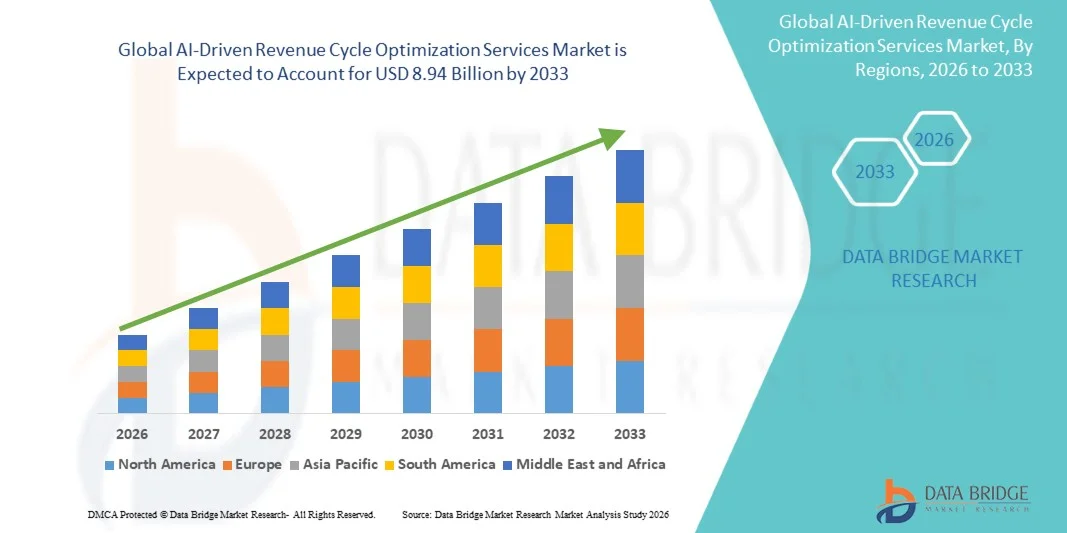
As per Data Bridge Market Research Analysis the AI-Driven Revenue Cycle Optimization Services Market was valued at USD 2.18 billion in 2025 and is projected to reach USD 8.94 billion by 2033, growing at a CAGR of 19.30% from 2026 to 2033. The market is experiencing robust growth driven by increasing adoption of artificial intelligence across healthcare revenue cycle management, rising pressure to reduce claim denials and administrative costs, and growing demand for data-driven financial performance optimization among healthcare providers.
The growing complexity of healthcare reimbursement systems, coupled with increasing volumes of patient data and evolving regulatory requirements, is encouraging hospitals, physician groups, and healthcare organizations to deploy AI-powered revenue cycle optimization solutions. Advanced technologies such as machine learning, predictive analytics, natural language processing, and robotic process automation are transforming billing, coding, claims management, and payment collection processes, enabling faster reimbursements, improved revenue capture, and enhanced operational efficiency while minimizing manual errors and compliance risks.
Market Size & Forecast
- Global Market Value (2025): USD 2.18 Billion
- Expected Market Value (2033): USD 8.94 Billion
- Forecast CAGR (2026–2033): 19.30%
- Leading Region in 2025: North America
- Fastest Growing Region: Asia Pacific
Key Market Trends & Insights
- North America dominated the AI-Driven Revenue Cycle Optimization Services Market with the largest revenue share of 41.32% in 2025, supported by advanced healthcare IT infrastructure, high adoption of AI-powered revenue cycle management solutions, and increasing focus on financial efficiency across healthcare organizations.
- The Services segment led the market with a 46.83% share in 2025, driven by the growing need for implementation, consulting, managed services, and continuous optimization of AI-enabled revenue cycle workflows.
- Asia-Pacific is expected to be the fastest-growing region at a CAGR of 15.1% from 2026 to 2033, fueled by rapid healthcare digitalization, growing investments in healthcare analytics, and increasing adoption of AI-enabled financial management platforms across emerging economies.
- Platforms are the fastest-growing component type, projected to register a CAGR of 15.9%, reflecting the surge adoption of integrated AI-powered revenue cycle ecosystems.
- The Cloud-Based segment dominated the deployment mode category with a 63.41% revenue share in 2025, led by its scalability, cost efficiency, and ease of deployment across healthcare organizations of all sizes
- Claims Management & Denial Prevention accounted for 40.18% of the market, preferred by the increasing financial impact of denied claims and reimbursement delays across healthcare systems.
- The Medical Coding & Charge Capture segment is the fastest-growing application category, with a CAGR of 14.8%, driven by the rising adoption of artificial intelligence and natural language processing technologies
Report Scope and AI-Driven Revenue Cycle Optimization Services Market Segmentation
|
Attributes |
AI-Driven Revenue Cycle Optimization Services Key Market Insights |
|
Segments Covered |
|
|
Countries Covered |
North America
Europe
Asia-Pacific
Middle East and Africa
South America
|
|
Key Market Players |
|
|
Market Opportunities |
|
|
Value Added Data Infosets |
|
What is the Key Trend in the AI-Driven Revenue Cycle Optimization Services Market?
Trend: Growing Adoption of Generative AI for Revenue Cycle Automation
Healthcare providers are increasingly adopting generative AI-powered revenue cycle optimization services to automate medical coding, claims processing, denial management, and patient billing workflows while reducing administrative burdens. The integration of advanced natural language processing and machine learning algorithms enables real-time extraction of clinical information, identification of reimbursement opportunities, and prediction of payment outcomes. Hospitals, physician groups, and revenue cycle service providers are similarly leveraging AI-driven platforms to improve operational efficiency through standardized, data-driven financial processes, while cloud-based technologies create intelligent environments that continuously optimize revenue performance and reimbursement accuracy.
For instance, in March 2025, Waystar expanded its AI-enabled revenue cycle capabilities with advanced automation tools designed to improve claims accuracy, streamline reimbursement workflows, and enhance healthcare financial performance.
AI-Driven Revenue Cycle Optimization Services Market Dynamics
Key Market Driver: Rising Need to Reduce Claim Denials and Revenue Leakage
The growing complexity of healthcare reimbursement systems and increasing volumes of insurance claims have created substantial demand for AI-driven revenue cycle optimization services that can identify billing errors, predict denial risks, and improve payment collection efficiency across healthcare organizations. Hospitals, physician networks, and revenue cycle service providers are deploying AI-powered platforms as a core component of their financial management strategy, reducing administrative costs, accelerating reimbursement cycles, and improving revenue realization. The ability of artificial intelligence to automate repetitive tasks and provide actionable financial insights is further strengthening adoption across both public and private healthcare systems globally.
For instance, in 2025, R1 RCM continued expanding AI-based revenue cycle solutions focused on denial prevention, automated claims management, and reimbursement optimization for healthcare providers.
Key Restraint/Challenge: Data Privacy Concerns and Integration Complexity
A significant restraint in the AI-Driven Revenue Cycle Optimization Services Market is the complexity of integrating artificial intelligence solutions with existing healthcare information systems while maintaining compliance with evolving data privacy regulations. Modern AI platforms require access to large volumes of clinical, financial, and patient information, creating concerns related to data security, interoperability, and regulatory compliance. The implementation process often extends to workflow redesign, staff training, and continuous system monitoring, making adoption challenging for smaller healthcare providers and organizations with limited digital infrastructure. The need to ensure accuracy, transparency, and regulatory adherence further increases deployment complexity and operational risk.
For instance, healthcare organizations implementing AI-powered revenue cycle platforms frequently face challenges associated with integrating legacy electronic health record systems while meeting strict patient data protection and compliance requirements.
Key Market Opportunity: Expansion of Predictive Analytics and Value-Based Care Solutions
The integration of predictive analytics and value-based care management capabilities in revenue cycle optimization services presents a significant market opportunity. AI-enabled platforms can forecast reimbursement trends, identify financial risks, automate contract performance analysis, and support proactive decision-making across healthcare organizations. The development of cloud-based delivery models and advanced analytics solutions is further expanding access to intelligent revenue optimization capabilities, opening growth opportunities across emerging healthcare markets in Asia-Pacific, Latin America, and the Middle East.
For instance, in February 2025, Veradigm enhanced its healthcare analytics portfolio with AI-driven solutions designed to improve financial forecasting, value-based care performance, and revenue cycle optimization outcomes.
AI-Driven Revenue Cycle Optimization Services Market Scope
The AI-driven revenue cycle optimization services market is segmented on the basis of component, deployment mode, application, and end user.
- By Component
On the basis of component, the AI-Driven Revenue Cycle Optimization Services Market is segmented into software, services, and platforms. The Services segment dominated the market with a 46.83% share in 2025, driven by the growing need for implementation, consulting, managed services, and continuous optimization of AI-enabled revenue cycle workflows. Healthcare organizations increasingly rely on specialized service providers to integrate AI solutions with existing clinical and financial systems. The complexity of reimbursement processes and regulatory requirements is further increasing demand for expert support services. Service providers help healthcare institutions reduce claim denials, improve coding accuracy, and enhance reimbursement efficiency. Continuous monitoring, analytics, and workflow optimization are strengthening the value proposition of service offerings. The segment continues to lead due to the critical role of human expertise in maximizing AI-driven financial outcomes.
The Platforms segment is projected to register the fastest growth at a CAGR of 15.9% from 2026 to 2033, driven by increasing adoption of integrated AI-powered revenue cycle ecosystems. These platforms provide centralized capabilities for claims processing, coding automation, payment management, and financial analytics. Healthcare providers are increasingly seeking unified solutions that eliminate data silos and improve operational visibility. Advancements in cloud computing and interoperability technologies are supporting rapid platform adoption. The ability to deliver real-time insights and predictive revenue forecasting is making these platforms highly attractive. Growing investments in digital transformation initiatives are expected to further accelerate segment growth during the forecast period.
- By Deployment Mode
On the basis of deployment mode, the AI-Driven Revenue Cycle Optimization Services Market is segmented into cloud-based, on-premise, and hybrid. The Cloud-Based segment dominated the market with a 63.41% share in 2025, owing to its scalability, cost efficiency, and ease of deployment across healthcare organizations of all sizes. Cloud solutions enable real-time access to financial data, streamlined collaboration, and faster software updates. Healthcare providers increasingly prefer cloud deployment to reduce infrastructure costs and improve operational flexibility. The growing adoption of Software-as-a-Service (SaaS) models is further supporting segment growth. Enhanced cybersecurity capabilities and regulatory compliance features are improving confidence in cloud-based systems. The segment remains the preferred deployment model as healthcare organizations continue their digital modernization efforts.
The Hybrid segment is expected to witness the fastest growth at a CAGR of 15.6% from 2026 to 2033, driven by increasing demand for flexible deployment environments that combine cloud scalability with on-premise control. Healthcare organizations are adopting hybrid models to balance data security requirements with the need for advanced analytics capabilities. These solutions enable seamless integration with legacy systems while supporting AI-driven automation. Hybrid deployments are particularly attractive for large healthcare networks managing sensitive patient and financial information. Growing regulatory scrutiny and data governance requirements are further encouraging adoption. The segment is benefiting from increasing investments in interoperable healthcare IT infrastructure.
- By Application
On the basis of application, the AI-Driven Revenue Cycle Optimization Services Market is segmented into claims management & denial prevention, medical coding & charge capture, patient access & eligibility verification, payment processing & collections, revenue analytics & reporting, and fraud detection & compliance. The Claims Management & Denial Prevention segment led the market with a 40.18% share in 2025, driven by the increasing financial impact of denied claims and reimbursement delays across healthcare systems. AI-powered solutions help identify denial risks before submission, improving claim acceptance rates and revenue realization. Healthcare providers are increasingly leveraging predictive analytics to reduce administrative inefficiencies and accelerate payments. Automated workflows improve accuracy while minimizing manual intervention. The ability to optimize reimbursement performance is making this application a top investment priority. Growing pressure to improve financial sustainability is further reinforcing segment dominance.
The Medical Coding & Charge Capture segment is projected to register the fastest growth at a CAGR of 14.8% from 2026 to 2033, driven by rising adoption of artificial intelligence and natural language processing technologies. These solutions automate coding processes, reduce human error, and improve billing accuracy. Increasing complexity of clinical documentation requirements is creating strong demand for advanced coding automation tools. Healthcare organizations are adopting AI-based systems to enhance productivity and reduce administrative workloads. Improved coding accuracy directly contributes to higher reimbursement rates and reduced revenue leakage. Continuous advancements in generative AI capabilities are expected to further accelerate market expansion.
- By End User
On the basis of end user, the AI-Driven Revenue Cycle Optimization Services Market is segmented into hospitals, physician practices/clinics, ambulatory surgery centers, diagnostic laboratories, and healthcare IT service providers. The Hospitals segment dominated the market with a 44.28% share in 2025, driven by high patient volumes, complex reimbursement structures, and significant administrative workloads. Hospitals generate vast amounts of clinical and financial data, making them ideal environments for AI-driven revenue cycle optimization. These institutions increasingly invest in automation technologies to improve billing accuracy and operational efficiency. AI solutions help hospitals reduce claim denials, enhance revenue capture, and improve cash flow management. Growing pressure to control costs while maintaining quality care is further supporting adoption. The segment continues to account for the largest share due to its extensive revenue cycle management requirements.
The Healthcare IT Service Providers segment is anticipated to be the fastest-growing end-user category at a CAGR of 15.7% from 2026 to 2033, driven by increasing demand for outsourced revenue cycle optimization and AI-enabled financial management solutions. These providers are expanding their service portfolios to include advanced analytics, coding automation, and predictive reimbursement tools. Healthcare organizations are increasingly partnering with specialized IT firms to accelerate digital transformation initiatives. The growing complexity of reimbursement regulations is creating opportunities for third-party expertise. AI technologies enable service providers to deliver scalable and cost-effective solutions across multiple healthcare settings. Rising demand for managed revenue cycle services is expected to drive strong growth throughout the forecast period.
AI-Driven Revenue Cycle Optimization Services Market Regional Analysis
North America dominated the AI-Driven Revenue Cycle Optimization Services Market with the largest revenue share of 41.32% in 2025, supported by advanced healthcare IT infrastructure, high adoption of AI-powered revenue cycle management solutions, and increasing focus on financial efficiency across healthcare organizations. The region also benefits from complex reimbursement frameworks, strong investments in healthcare digital transformation, and widespread implementation of AI-powered analytics across hospitals, physician networks, and healthcare organizations. Increasing focus on reducing claim denials, improving reimbursement efficiency, and automating administrative workflows continues to strengthen North America's leadership position in the global market
U.S. AI-Driven Revenue Cycle Optimization Services Market Insight
The U.S. AI-driven revenue cycle optimization services market is witnessing strong growth due to rising investments in healthcare digital transformation initiatives, revenue cycle automation technologies, and advanced financial analytics solutions. The country's mature healthcare ecosystem, along with increasing adoption of AI-powered, cloud-based, and predictive analytics platforms, is driving demand across hospitals, physician groups, and healthcare service providers. In addition, growing emphasis on reducing claim denials, improving reimbursement efficiency, and minimizing administrative costs is accelerating adoption of AI-driven revenue cycle optimization services across the healthcare sector.
Europe AI-Driven Revenue Cycle Optimization Services Market Insight
The Europe AI-driven revenue cycle optimization services market remains a major contributor to global revenue, driven by strong healthcare modernization efforts, technological innovation, and increasing demand for financial workflow automation solutions. The widespread use of AI-powered platforms in hospitals, healthcare networks, and reimbursement management programs is supporting market expansion across the region. Increasing investments in healthcare analytics technologies, coupled with stringent regulatory requirements and a highly developed healthcare infrastructure, continue to enhance the adoption of AI-driven revenue cycle optimization services throughout Europe.
U.K. AI-Driven Revenue Cycle Optimization Services Market Insight
The U.K. AI-driven revenue cycle optimization services market is experiencing steady growth, supported by rising adoption of artificial intelligence technologies in healthcare administration, claims management, and reimbursement optimization applications. Increasing investments in advanced healthcare IT infrastructure and growing demand for cost-effective, data-driven financial management solutions are contributing to market growth. Furthermore, integration of machine learning, predictive analytics, and automation technologies is improving operational efficiency and revenue performance, positioning the U.K. as a key innovation hub in the AI-driven healthcare services industry.
Germany AI-Driven Revenue Cycle Optimization Services Market Insight
The Germany AI-driven revenue cycle optimization services market is expanding steadily due to the country's advanced healthcare infrastructure, strong digital health initiatives, and increasing adoption of next-generation financial management technologies. Healthcare providers, hospital networks, and insurance organizations are increasingly utilizing AI-powered solutions for claims processing, reimbursement optimization, and revenue analytics activities. Continuous advancements in machine learning, automation, and predictive analytics technologies, along with strong government support for healthcare innovation and efficiency, are further driving market growth in Germany.
Asia-Pacific AI-Driven Revenue Cycle Optimization Services Market Insight
The Asia-Pacific AI-driven revenue cycle optimization services market is expected to witness rapid growth, driven by increasing healthcare digitalization, expanding healthcare infrastructure, and rising investments in financial management technologies across countries such as China, India, and Japan. Growing awareness regarding revenue optimization, rising adoption of artificial intelligence solutions, and increasing demand for scalable and cost-effective healthcare administration platforms are supporting regional market expansion. Additionally, the growing presence of private healthcare providers and digital health initiatives is accelerating adoption of AI-driven revenue cycle optimization services across healthcare organizations.
Japan AI-Driven Revenue Cycle Optimization Services Market Insight
The Japan AI-driven revenue cycle optimization services market is witnessing consistent growth due to rising investments in healthcare automation technologies, digital transformation initiatives, and healthcare efficiency improvement programs. Healthcare providers, hospital systems, and technology companies are increasingly adopting AI-powered solutions for claims management, coding automation, and financial performance optimization purposes. Moreover, increasing integration of machine learning and predictive analytics technologies and the country's focus on efficient and sustainable healthcare delivery models are further contributing to market growth.
China AI-Driven Revenue Cycle Optimization Services Market Insight
The China AI-driven revenue cycle optimization services market is growing rapidly, driven by increasing healthcare digitalization, expanding healthcare infrastructure, and rising government focus on healthcare efficiency and financial sustainability. Growing adoption of AI-enabled automation and predictive analytics platforms across hospitals, healthcare networks, and insurance organizations is significantly boosting market demand. In addition, rising investments in healthcare IT modernization, increasing awareness regarding revenue cycle efficiency, and rapid technological advancements are positioning China as one of the fastest-growing markets for AI-driven revenue cycle optimization services globally.
Which are the Top Companies in AI-Driven Revenue Cycle Optimization Services Market?
The AI-driven revenue cycle optimization services industry is primarily led by well-established companies, including:
- R1 RCM Inc. (U.S.)
- Waystar, Inc. (U.S.)
- athenahealth, Inc. (U.S.)
- Veradigm LLC (U.S.)
- Experian Information Solutions, Inc. (U.S.)
- Oracle (U.S.)
- Epic Systems Corporation (U.S.)
- eClinicalWorks (U.S.)
- NextGen Healthcare, Inc. (U.S.)
- Infinx Healthcare (U.S.)
- XiFin, Inc. (U.S.)
- FinThrive, Inc. (U.S.)
- Cognizant Technology Solutions U.S. Corporation (U.S.)
- Optum, Inc. (U.S.)
- TELUS Health (Canada)
- AKASA, Inc. (U.S.)
- CureMD Healthcare (U.S.)
- GeBBS Healthcare Solutions, Inc. (U.S.)
- MDaudit (U.S.)
- EnableComp, LLC (U.S.)
Latest Developments in AI-Driven Revenue Cycle Optimization Services Market
- In October 2025, R1 RCM announced the launch of Phare, healthcare’s first AI-powered Revenue Operating System. The platform leverages enterprise-grade AI and agentic applications to automate and optimize the entire revenue cycle, from patient access to claims and reimbursement management. The launch highlights the growing adoption of AI-driven automation to improve healthcare financial performance and operational efficiency
- In October 2025, R1 RCM announced a strategic partnership with Sierra to enhance AI-driven experiences across the healthcare revenue management ecosystem. The collaboration aims to deploy advanced AI agents capable of automating stakeholder interactions, improving operational workflows, and supporting comprehensive revenue cycle automation. This development reflects the increasing integration of conversational and agentic AI technologies in revenue cycle optimization services
- In May 2025, R1 RCM announced a strategic investment from Khosla Ventures to accelerate AI-driven healthcare transformation. The investment supports expansion of R1’s R37 AI lab, developed in partnership with Palantir, to create agentic AI applications focused on reducing administrative complexity and improving revenue cycle performance. The initiative underscores growing investor confidence in AI-enabled healthcare financial management solutions
- In February 2025, XiFin unveiled new embedded AI capabilities within its XiFin Empower RCM platform at HIMSS25. The enhanced solution incorporates AI-powered payer response intelligence and workflow automation tools designed to improve reimbursement outcomes, increase operational productivity, and streamline revenue cycle processes for healthcare organizations. The launch demonstrates the growing role of embedded AI in next-generation RCM platforms
- In December 2024, athenahealth announced new AI and automation innovations designed to reduce revenue cycle management workloads for physician practices by up to 50%. The company introduced AI-enabled claims processing and administrative workflow automation capabilities across its cloud platform to improve speed, accuracy, and efficiency in healthcare billing and reimbursement operations. This development highlights the accelerating adoption of AI-based automation across healthcare revenue cycle functions

- Interactive Data Analysis Dashboard
- Company Analysis Dashboard for high growth potential opportunities
- Research Analyst Access for customization & queries
- Competitor Analysis with Interactive dashboard
- Latest News, Updates & Trend analysis
- Harness the Power of Benchmark Analysis for Comprehensive Competitor Tracking
Data collection and base year analysis are done using data collection modules with large sample sizes. The stage includes obtaining market information or related data through various sources and strategies. It includes examining and planning all the data acquired from the past in advance. It likewise envelops the examination of information inconsistencies seen across different information sources. The market data is analysed and estimated using market statistical and coherent models. Also, market share analysis and key trend analysis are the major success factors in the market report. To know more, please request an analyst call or drop down your inquiry.
The key research methodology used by DBMR research team is data triangulation which involves data mining, analysis of the impact of data variables on the market and primary (industry expert) validation. Data models include Vendor Positioning Grid, Market Time Line Analysis, Market Overview and Guide, Company Positioning Grid, Patent Analysis, Pricing Analysis, Company Market Share Analysis, Standards of Measurement, Global versus Regional and Vendor Share Analysis. To know more about the research methodology, drop in an inquiry to speak to our industry experts.
Data Bridge Market Research is a leader in advanced formative research. We take pride in servicing our existing and new customers with data and analysis that match and suits their goal. The report can be customized to include price trend analysis of target brands understanding the market for additional countries (ask for the list of countries), clinical trial results data, literature review, refurbished market and product base analysis. Market analysis of target competitors can be analyzed from technology-based analysis to market portfolio strategies. We can add as many competitors that you require data about in the format and data style you are looking for. Our team of analysts can also provide you data in crude raw excel files pivot tables (Fact book) or can assist you in creating presentations from the data sets available in the report.













