


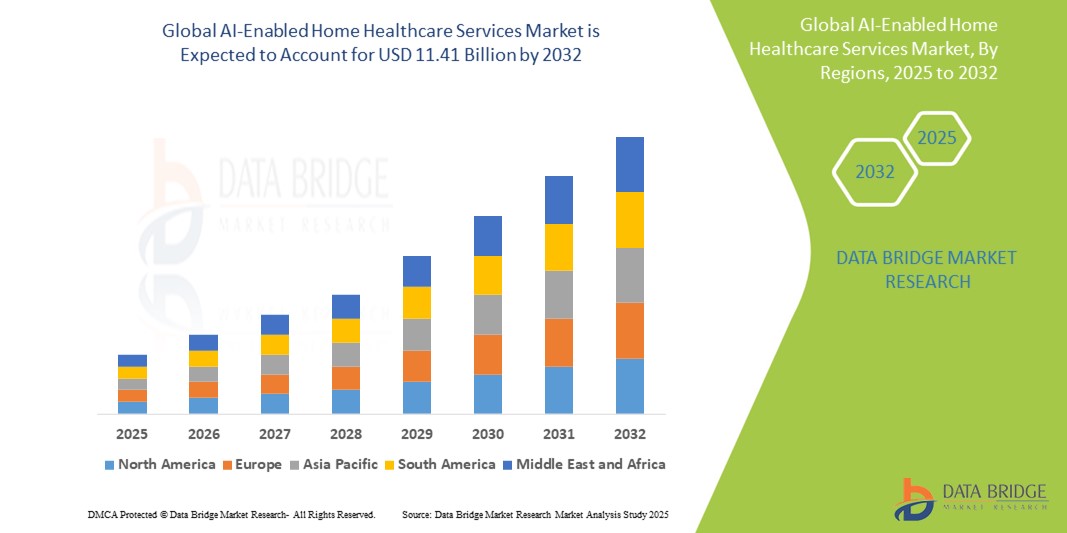
AI-Enabled Home Healthcare Services Market Size
- The global AI-enabled home healthcare services market size was valued at USD 1.83 billion in 2024 and is expected to reach USD 11.41 billion by 2032, at a CAGR of 25.70% during the forecast period
- The market growth is largely fueled by the increasing geriatric population, the rising prevalence of chronic diseases, and the growing need for remote patient monitoring and personalized care within the home setting.
- Furthermore, the escalating demand for cost-effective, convenient, and accessible healthcare solutions, coupled with advancements in artificial intelligence and connected devices, is establishing AI-enabled home healthcare services as a crucial component of modern healthcare delivery. These converging factors are accelerating the adoption of AI-Enabled Home Healthcare Services, thereby significantly boosting the industry's growth
AI-Enabled Home Healthcare Services Market Analysis
- AI-enabled home healthcare services, offering remote monitoring, personalized care plans, and virtual assistance, are increasingly vital components of modern healthcare delivery and aging-in-place strategies in both residential and assisted living settings due to their enhanced convenience, remote management capabilities, and seamless integration with connected health ecosystems
- The escalating demand for AI-enabled home healthcare services is primarily fueled by the growing geriatric population, rising prevalence of chronic diseases, increasing strain on traditional healthcare systems, and a growing preference for the comfort and independence of receiving care at home
- North America dominates the AI-enabled home healthcare services market with the largest revenue share of 49.6%, characterized by advanced healthcare infrastructure, high adoption of remote patient monitoring technologies, and a strong presence of key technology and healthcare providers, with the U.S. experiencing substantial growth in AI-Enabled Home Healthcare Services adoption, particularly for chronic disease management and elderly care, driven by innovations from both established medical device companies and startups focusing on AI-powered health solutions
- Asia-Pacific is expected to be the fastest growing region in the AI-enabled home healthcare services market with a CAGR of 35.6%, during the forecast period due to increasing healthcare expenditure, rising awareness of remote monitoring benefits, and a growing aging population with a preference for home-based care
- The remote patient monitoring segment is anticipated to hold the largest revenue share in the AI-Enabled Home Healthcare Services market with a market share of 35.4%. This dominance is fuelled by the factors previously mentioned: the increasing prevalence of chronic diseases, the growing geriatric population, and the advancements in remote monitoring technologies
Report Scope and AI-Enabled Home Healthcare Services Market Segmentation
|
Attributes |
AI-Enabled Home Healthcare Services Key Market Insights |
|
Segments Covered |
|
|
Countries Covered |
North America
Europe
Asia-Pacific
Middle East and Africa
South America
|
|
Key Market Players |
|
|
Market Opportunities |
|
|
Value Added Data Infosets |
In addition to the insights on market scenarios such as market value, growth rate, segmentation, geographical coverage, and major players, the market reports curated by the Data Bridge Market Research also include import export analysis, production capacity overview, production consumption analysis, price trend analysis, climate change scenario, supply chain analysis, value chain analysis, raw material/consumables overview, vendor selection criteria, PESTLE Analysis, Porter Analysis, and regulatory framework. |
AI-Enabled Home Healthcare Services Market Trends
“Enhanced Convenience Through AI and Voice Integration”
- A significant and accelerating trend in the global AI-enabled home healthcare services market is the deepening integration with artificial intelligence (AI) and popular voice-controlled ecosystems such as Amazon Alexa, Google Assistant, and Apple HomeKit. This fusion of technologies is significantly enhancing user convenience and control over their healthcare management
- For instance, AI-powered medication reminder apps seamlessly integrate with voice assistants, allowing users to set and receive verbal reminders for their prescriptions. Similarly, smart health monitoring devices can relay real-time vital signs and alerts through voice commands via these ecosystems, offering a hands-free approach to health tracking
- AI integration in home healthcare enables features such as learning patient routines to potentially suggest optimal medication times or predict potential health risks based on subtle changes in voice patterns or activity levels detected by smart speakers. For instance, some AI-enabled virtual assistants utilize NLP to understand and respond to patient queries about their health conditions or medication, providing more intelligent and personalized support
- This trend towards more intelligent, intuitive, and interconnected healthcare solutions is fundamentally reshaping user expectations for home-based care. Consequently, companies are developing AI-enabled platforms with features such as voice-activated emergency alerts, hands-free control of medical devices, and seamless data sharing with healthcare providers through voice commands
- The demand for AI-enabled home healthcare services that offer seamless AI and voice control integration is growing rapidly across both residential and assisted living sectors, as consumers increasingly prioritize convenience, accessibility, and comprehensive smart home functionality that supports their health and independence
AI-Enabled Home Healthcare Services Market Dynamics
Driver
“Growing Need Due to Rising Healthcare Costs and Aging Population”
- The increasing burden of healthcare costs for managing chronic diseases and the growing global aging population are significant drivers for the heightened demand for AI-enabled home healthcare services
- For instance, in May 2024, several healthcare providers announced pilot programs leveraging AI-powered remote monitoring to reduce hospital readmissions for elderly patients with heart conditions. Such strategies by healthcare organizations are expected to drive the AI-enabled home healthcare services industry growth in the forecast period
- As individuals and healthcare systems become more aware of the financial strain associated with traditional in-patient care and long-term care facilities, AI-enabled solutions offer a cost-effective alternative for continuous monitoring and personalized support at home
- Furthermore, the growing desire among older adults to maintain independence and age in place is making AI-enabled home healthcare services an integral component of their care plans, offering seamless integration with telehealth platforms and remote support systems
- The convenience of receiving care at home, the ability for family members to remotely monitor well-being, and the potential for early detection of health issues through AI-driven analytics are key factors propelling the adoption of these services in both individual residences and assisted living facilities. The trend towards patient-centric care and the increasing availability of user-friendly AI-enabled home healthcare services options further contribute to market growth
Restraint/Challenge
“Concerns Regarding Data Privacy and Interoperability Issues”
- Concerns surrounding the privacy and security of sensitive health data collected by connected devices and AI algorithms pose a significant challenge to broader market penetration. As AI-enabled home healthcare services rely on the collection and analysis of personal health information, anxieties among potential users about data breaches and misuse are significant
- For instance, reports of data breaches in healthcare systems have made some consumers hesitant to adopt AI-powered home health monitoring solutions, fearing unauthorized access to their medical information
- Addressing these data privacy concerns through robust data encryption, compliance with healthcare regulations (such as HIPAA), and transparent data usage policies is crucial for building consumer trust. Companies offering AI-enabled home healthcare services emphasize their data security measures and privacy safeguards in their marketing to reassure potential users. In addition, the lack of seamless interoperability between different AI-enabled devices and healthcare platforms can be a barrier to adoption, as users may find it difficult to integrate various devices and services into a cohesive system
- While efforts are being made to improve data exchange standards, the current fragmentation can hinder the effective use of AI-enabled home healthcare services, especially for individuals managing multiple health conditions with different devices
- Overcoming these challenges through enhanced data security measures, clear communication about data privacy practices, and the development of standardized interoperability protocols will be vital for sustained market growth
AI-Enabled Home Healthcare Services Market Scope
The market is segmented on the basis of offering, technology, application, and end user.
By Offering
On the basis of offering, the AI-enabled home healthcare services market is segmented into software, hardware, and services. The services segment held the largest market revenue share of 45% in 2025, driven by the increasing need for personalized care, remote assistance, and professional support facilitated by AI-enabled platforms in home settings. The demand for skilled professionals leveraging AI tools for patient monitoring and care delivery is a key driver.
The software segment is anticipated to witness the fastest growth rate from 2025 to 2032, fueled by the continuous development of sophisticated AI algorithms, data analytics platforms, and user-friendly interfaces that enable efficient remote patient monitoring, data analysis, and virtual assistance in home healthcare
By Technology
On the basis of technology, the AI-enabled home healthcare services market is segmented into machine learning, natural language processing, context-aware computing, and computer vision. The Machine Learning segment held the largest market revenue share in 2025, driven by its crucial role in predictive analytics for patient risk assessment, personalized treatment recommendations, and efficient data analysis in remote monitoring applications.
The natural language processing segment is anticipated to witness the fastest CAGR from 2025 to 2032, fueled by the increasing adoption of virtual assistants and chatbots that provide seamless communication, medication reminders, and patient support through natural language interactions in home healthcare
By Application
On the basis of application, the AI-enabled home healthcare Services market is segmented into lifestyle management, remote patient monitoring, patient data & risk analysis, virtual assistants, wearables, mental health, and others. The remote patient monitoring segment held the largest market revenue share in 2025 with 35.4%, driven by the growing need for continuous health tracking, early detection of health issues, and proactive intervention for patients in their homes, facilitated by AI-powered devices and platforms.
The mental health segment is anticipated to witness the fastest CAGR from 2025 to 2032, fueled by the increasing awareness of mental well-being and the development of AI-driven virtual therapists, mood monitoring tools, and personalized mental health support accessible in the comfort of patients' homes
By End User
On the basis of end user, the AI-enabled home healthcare services market is segmented into Healthcare Providers, Healthcare Payers, Patients, and Others. The Healthcare Providers segment accounted for the largest market revenue share in 2025, driven by the increasing adoption of AI tools to enhance the efficiency of remote patient management, improve care coordination, and reduce operational costs in delivering home healthcare services.
The Patients segment is anticipated to witness the fastest CAGR from 2025 to 2032, fueled by the growing preference for convenient, personalized, and accessible healthcare solutions at home, with AI-enabled devices and platforms empowering individuals to actively manage their health and well-being
AI-Enabled Home Healthcare Services Market Regional Analysis
- North America dominates the AI-enabled home healthcare services market with the largest revenue share of 49.6% in 2024, driven by a growing demand for remote healthcare solutions, an increasing geriatric population, and a strong emphasis on independent living and chronic disease management
- Consumers in the region highly value the convenience, personalized care capabilities, and seamless integration offered by AI-enabled devices and platforms with other smart home and health monitoring systems
- This widespread adoption is further supported by advanced healthcare infrastructure, high healthcare expenditure, a technologically receptive population, and the growing preference for continuous health monitoring and virtual care, establishing AI-enabled home healthcare services as a favored solution for both individual homes and assisted living facilities
U.S. AI-Enabled Home Healthcare Services Market Insight
U.S. market dominated North America in 2025 with 72.4% revenue share, fueled by the swift uptake of connected health devices and the expanding trend of remote patient monitoring. Consumers increasingly prioritize proactive health management through intelligent, AI-driven systems. The growing preference for DIY health tech setups, combined with robust demand for voice-controlled health assistants and mobile application integration, further propels the AI-enabled home healthcare services industry. Moreover, the increasing integration of smart home technologies for health monitoring, such as ambient sensors and virtual assistants, is significantly contributing to the market's expansion.
Europe AI-Enabled Home Healthcare Services Market Insight
The European market is projected to expand at a substantial CAGR, primarily driven by stringent healthcare regulations and the escalating need for enhanced remote care in homes and assisted living facilities. The increase in urbanization, coupled with the demand for connected health devices, is fostering the adoption of AI-enabled monitoring. European consumers are also drawn to the convenience and efficiency these services offer for managing chronic conditions and supporting independent living. The region is experiencing significant growth across individual residences, assisted living facilities, and home healthcare agencies, with AI-enabled services being incorporated into both new care models and existing healthcare frameworks.
U.K. AI-Enabled Home Healthcare Services Market Insight
U.K. market is anticipated to grow at a noteworthy CAGR, driven by the escalating trend of remote healthcare and a desire for heightened convenience and proactive health management. Additionally, concerns regarding hospital capacity and the need for efficient community care are encouraging both individuals and healthcare providers to choose AI-enabled home healthcare solutions. The UK’s embrace of digital health technologies, alongside its robust healthcare infrastructure and technology adoption, is expected to continue to stimulate market growth.
Germany AI-Enabled Home Healthcare Services Market Insight
The German market is expected to expand at a considerable CAGR, fueled by increasing awareness of digital health solutions and the demand for technologically advanced, patient-centric care. Germany’s well-developed healthcare system, combined with its emphasis on innovation and data privacy, promotes the adoption of secure AI-enabled home healthcare, particularly for chronic disease management and elderly care. The integration of AI-enabled services with existing healthcare infrastructure is also becoming increasingly prevalent, with a strong preference for secure, privacy-focused solutions aligning with local patient expectations.
Asia-Pacific AI-Enabled Home Healthcare Services Market Insight
The Asia-Pacific market is poised to grow at the fastest CAGR of over 35.6% in 2025, driven by increasing urbanization, rising disposable incomes, and technological advancements in countries such as China, Japan, and India. The region's growing inclination towards digital health, supported by government initiatives promoting telehealth and remote monitoring, is driving the adoption of AI-enabled home healthcare. Furthermore, as APAC emerges as a manufacturing hub for AI-enabled healthcare devices and platforms, the affordability and accessibility of these services are expanding to a wider patient base.
India AI-Enabled Home Healthcare Services Market Insight
India is expected to witness the highest compound annual growth rate (CAGR) in the AI-enabled home healthcare services market due to a confluence of factors including a large and growing population with increasing healthcare needs, rising awareness and adoption of digital health solutions, supportive government initiatives for digital healthcare infrastructure, increasing disposable incomes and healthcare expenditure, a shortage of healthcare professionals necessitating remote solutions, and growing investments in healthcare technology and the emergence of health-tech startups focused on AI-driven home care.
China AI-Enabled Home Healthcare Services Market Insight
The China market accounted for the largest market revenue share in Asia Pacific in 2025, attributed to the country's expanding middle class, rapid urbanization, and high rates of technological adoption. China stands as one of the largest markets for digital health solutions, and AI-enabled home healthcare services are becoming increasingly popular for chronic disease management, elderly care, and remote consultations. The push towards smart healthcare and the availability of affordable AI-enabled options, alongside strong domestic technology companies, are key factors propelling the market in China.
AI-Enabled Home Healthcare Services Market Share
The AI-Enabled Home Healthcare Services industry is primarily led by well-established companies, including:
- Medtronic (Ireland)
- Koninklijke Philips N.V. (Netherlands)
- Microsoft (U.S.)
- IBM (U.S.)
- NVIDIA Corporation (U.S.)
- GE Healthcare (U.S.)
- Oracle (U.S.)
- Amazon Web Services, Inc. (U.S.)
- Teladoc Health (U.S.)
- Siemens Healthineers AG (Germany)
- Enlitic, Inc. (U.S.)
- Johnson & Johnson Services, Inc. (U.S.)
- Tempus AI, Inc. (U.S.)
Latest Developments in Global AI-Enabled Home Healthcare Services Market
- In April 2025, Diag-Nose.io, an Australian company, secured seed funding to advance its AI-driven precision management for chronic pulmonary disorders, showcasing AI's growing role in specialized home-based care. This initiative highlights the increasing investment in AI to personalize and enhance remote management of complex conditions
- In March 2025, Researchers at the University of Cambridge unveiled an AI tool for rapid coeliac disease diagnosis using image analysis, demonstrating AI's potential to expedite diagnostics within home or point-of-care settings, improving accessibility and reducing wait times for patients needing timely results
- In March 2025, Akido Labs launched ScopeAI in collaboration with the Independent Drivers Guild and Workers Benefit Fund, providing AI-powered medical care to New York City's ride-share drivers. This initiative indicates a trend towards leveraging AI to extend healthcare access to underserved populations in their everyday environments
- In February 2025, UnitedHealth acquired LHC Group, a major in-home healthcare service provider, signaling a growing consolidation and investment by large healthcare organizations in expanding their home-based care capabilities, likely integrating AI for enhanced efficiency and patient management
- In January 2025 DUOS launched Chat 2.0, an advanced AI platform designed for the geriatric population, featuring at HLTH 2024. This platform aims to make healthcare more accessible, actionable, and personalized for seniors at home, addressing the increasing need for AI-driven support for aging in place

- Interactive Data Analysis Dashboard
- Company Analysis Dashboard for high growth potential opportunities
- Research Analyst Access for customization & queries
- Competitor Analysis with Interactive dashboard
- Latest News, Updates & Trend analysis
- Harness the Power of Benchmark Analysis for Comprehensive Competitor Tracking
Data collection and base year analysis are done using data collection modules with large sample sizes. The stage includes obtaining market information or related data through various sources and strategies. It includes examining and planning all the data acquired from the past in advance. It likewise envelops the examination of information inconsistencies seen across different information sources. The market data is analysed and estimated using market statistical and coherent models. Also, market share analysis and key trend analysis are the major success factors in the market report. To know more, please request an analyst call or drop down your inquiry.
The key research methodology used by DBMR research team is data triangulation which involves data mining, analysis of the impact of data variables on the market and primary (industry expert) validation. Data models include Vendor Positioning Grid, Market Time Line Analysis, Market Overview and Guide, Company Positioning Grid, Patent Analysis, Pricing Analysis, Company Market Share Analysis, Standards of Measurement, Global versus Regional and Vendor Share Analysis. To know more about the research methodology, drop in an inquiry to speak to our industry experts.
Data Bridge Market Research is a leader in advanced formative research. We take pride in servicing our existing and new customers with data and analysis that match and suits their goal. The report can be customized to include price trend analysis of target brands understanding the market for additional countries (ask for the list of countries), clinical trial results data, literature review, refurbished market and product base analysis. Market analysis of target competitors can be analyzed from technology-based analysis to market portfolio strategies. We can add as many competitors that you require data about in the format and data style you are looking for. Our team of analysts can also provide you data in crude raw excel files pivot tables (Fact book) or can assist you in creating presentations from the data sets available in the report.













