


AI-Enhanced Ultrasound Imaging Devices Market Overview
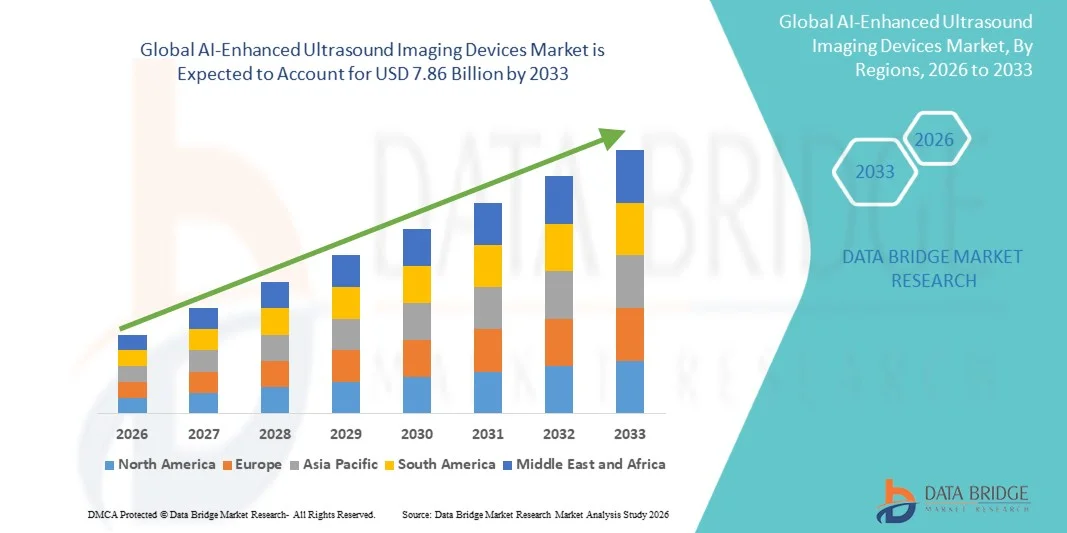
The AI-Enhanced Ultrasound Imaging Devices Market was valued at USD 2.18 billion in 2025 and is projected to reach USD 7.86 billion by 2033, growing at a CAGR of 17.40% from 2026 to 2033. The market is witnessing steady growth driven by increasing demand for early and accurate disease diagnosis, rapid integration of artificial intelligence into medical imaging workflows, and continuous advancements in portable and handheld ultrasound systems.
The rising global burden of chronic diseases such as cardiovascular disorders, cancer, and obstetric complications, combined with the need for faster and more precise imaging solutions, is encouraging healthcare providers to adopt AI-powered ultrasound devices. These systems enhance image quality, enable real-time diagnostic support, and reduce operator dependency, making them increasingly valuable in hospitals, diagnostic centers, and point-of-care settings. Growing investments in healthcare digitalization, expansion of telemedicine, and the shift toward minimally invasive diagnostics are further accelerating the adoption of AI-enabled ultrasound technologies across developed and emerging markets.
Key Market Trends & Insights
- North America dominated the AI-Enhanced Ultrasound Imaging Devices Market with the largest revenue share of 38.42% in 2025, supported by strong healthcare infrastructure, early adoption of AI-based diagnostic imaging, and high investment in medical imaging R&D.
- The Portable Ultrasound Devices segment led the market with a 44.16% share in 2025, driven by increasing demand for point-of-care diagnostics and rapid bedside imaging.
- Asia-Pacific is expected to be the fastest-growing region from 2026 to 2033, expanding at a CAGR of 8.1%, fueled by rising healthcare expenditure, expanding hospital networks, and increasing adoption of AI-enabled diagnostic tools in China, India, and Japan.
- Handheld Ultrasound Devices are the fastest-growing product type, projected to register a CAGR of 9.5%, reflecting the surge in rapid advancements in mobile health technology and AI-powered imaging applications.
- The Automated Image Interpretation segment dominated the technology category with a 31.82% revenue share in 2025, led by its ability to significantly reduce diagnostic time and operator dependency.
- Cardiology accounted for 29.67% of the market, preferred by the rising global burden of cardiovascular diseases and increasing use of echocardiography.
- The Emergency Medicine segment is the fastest-growing application category, with a CAGR of 8.8%, driven by increasing use of point-of-care ultrasound in trauma and critical care settings.
Market Size & Forecast
- Global Market Value (2025): USD 2.18 Billion
- Expected Market Value (2033): USD 7.86 Billion
- Forecast CAGR (2026–2033): 17.40%
- Leading Region in 2025: North America
- Fastest Growing Region: Asia Pacific
Report Scope and AI-Enhanced Ultrasound Imaging Devices Market Segmentation
|
Attributes |
AI-Enhanced Ultrasound Imaging Devices Key Market Insights |
|
Segments Covered |
|
|
Countries Covered |
North America · U.S. · Canada · Mexico Europe · Germany · France · U.K. · Netherlands · Switzerland · Belgium · Russia · Italy · Spain · Turkey · Rest of Europe Asia-Pacific · China · Japan · India · South Korea · Singapore · Malaysia · Australia · Thailand · Indonesia · Philippines · Rest of Asia-Pacific Middle East and Africa · Saudi Arabia · U.A.E. · South Africa · Egypt · Israel · Rest of Middle East and Africa South America · Brazil · Argentina · Rest of South America |
|
Key Market Players |
· GE HealthCare (U.S.) · Siemens Healthineers AG (Germany) · Koninklijke Philips N.V. (Netherlands) · CANON MEDICAL SYSTEMS CORPORATION (Japan) · Samsung Medison Co., Ltd. (South Korea) · FUJIFILM Healthcare (Japan) · Mindray Medical International Limited (China) · Shenzhen Landwind Industry Co., Ltd. (China) · Chison Medical Imaging Co., Ltd. (China) · Butterfly Network, Inc. (U.S.) · Esaote S.p.A. (Italy) · Teratech Corporation (U.S.) · Clarius Mobile Health (Canada) · Shenzhen Kaier Technology Co., Ltd. (China) · Sonoscape Medical Corp. (China) · Healcerion Co., Ltd. (South Korea) · Hologic, Inc. (U.S.) · Samsung Electronics (South Korea) · BK Medical (Denmark) |
|
Market Opportunities |
· Expansion of AI-powered point-of-care ultrasound in emergency and rural healthcare settings · Integration of AI ultrasound systems with cloud-based imaging platforms · Growing use of AI-enhanced ultrasound in early disease screening programs |
|
Value Added Data Infosets |
In addition to the insights on market scenarios such as market value, growth rate, segmentation, geographical coverage, and major players, the market reports curated by the Data Bridge Market Research also include in-depth expert analysis, patient epidemiology, pipeline analysis, pricing analysis, and regulatory framework. |
AI-Enhanced Ultrasound Imaging Devices Market Trends
Trend: Rapid Adoption of AI-Driven Point-of-Care Ultrasound Systems
Professional Healthcare systems globally are rapidly shifting toward decentralized and point-of-care imaging, where AI-enabled ultrasound devices play a central role in enabling fast, bedside diagnostics without reliance on large radiology infrastructure. These systems combine machine learning-based image enhancement, automated organ identification, and real-time diagnostic suggestions, allowing even non-specialist healthcare workers to perform reliable scans. This is especially important in emergency medicine, ambulances, ICUs, and rural clinics where time-sensitive decisions are critical. The growing integration of portable handheld ultrasound devices with cloud platforms and mobile applications is further strengthening remote consultation capabilities, enabling clinicians to instantly share scans with specialists for faster interpretation. AI also helps reduce variability caused by operator skill differences, making ultrasound imaging more standardized and scalable across healthcare systems.
For instance, AI-assisted handheld ultrasound devices used in emergency trauma assessment are helping clinicians quickly identify internal bleeding or organ damage, significantly improving patient triage and survival outcomes in critical cases.
AI-Enhanced Ultrasound Imaging Devices Market Dynamics
Key Market Driver: Rising Demand for AI-Based Diagnostic Accuracy and Workflow Efficiency
The demand for faster, more accurate, and reproducible diagnostic imaging is a major force driving the adoption of AI-enhanced ultrasound systems across global healthcare institutions. Traditional ultrasound imaging heavily depends on operator expertise, but AI algorithms now assist in automated measurements, lesion detection, image segmentation, and organ classification, significantly reducing human error and inter-operator variability. This improvement in consistency is particularly valuable in high-volume departments such as cardiology, obstetrics, and oncology, where early and precise diagnosis directly impacts treatment outcomes. AI also helps streamline clinical workflows by reducing scan time, automating report generation, and supporting clinicians with decision-support tools integrated into imaging systems.
For instance, AI-enabled cardiac ultrasound platforms are improving the accuracy and repeatability of ejection fraction measurements across large hospital networks, ensuring more consistent diagnosis of heart failure patients.
Key Restraint/Challenge: High Cost and Limited Access to Advanced AI Ultrasound Systems
Despite strong technological progress, the market faces a significant barrier in the form of high acquisition and operational costs associated with AI-integrated ultrasound systems. These include not only advanced imaging hardware but also AI software subscriptions, cloud storage infrastructure, and periodic algorithm updates required to maintain diagnostic accuracy. Smaller healthcare facilities, especially in rural and emerging economies, often struggle with limited budgets, lack of trained sonographers, and insufficient IT infrastructure to fully utilize AI-enabled imaging systems. In addition, integration into existing hospital information systems (HIS) and electronic medical records (EMR) can be complex and time-consuming, slowing down large-scale adoption. Regulatory approvals for AI-based diagnostic tools also add another layer of delay and compliance cost.
For instance, advanced AI-powered 3D and 4D ultrasound platforms are still largely concentrated in well-funded tertiary hospitals and academic medical centers due to their high deployment and maintenance cost
Key Market Opportunity: Expansion of AI-Enabled Tele-Ultrasound and Cloud Imaging Platforms
A major growth opportunity in the market lies in the rapid expansion of AI-powered tele-ultrasound systems integrated with cloud-based imaging platforms. These technologies allow real-time transmission of ultrasound scans from remote or low-resource settings to specialists located in urban hospitals, enabling faster diagnosis and expert consultation regardless of geographic barriers. AI further enhances this ecosystem by assisting in automated image quality checks, guided scanning instructions, and preliminary diagnostic suggestions, reducing dependence on highly trained sonographers in underserved areas. This is particularly impactful in maternal health, emergency care, and infectious disease screening programs where early detection is critical.
For instance, AI-enabled tele-ultrasound systems used in rural maternal screening programs are significantly improving early detection of fetal complications and reducing delays in prenatal care access.
AI-Enhanced Ultrasound Imaging Devices Market Scope
The AI-enhanced ultrasound imaging devices market is segmented on the basis of product type, technology, application, and end user.
- By Product Type
On the basis of product type, the AI-Enhanced Ultrasound Imaging Devices Market is segmented into trolley-based ultrasound systems, portable ultrasound devices, handheld ultrasound devices, and 3D/4D ultrasound systems. The Portable Ultrasound Devices segment dominated the market with a 44.16% share in 2025, driven by increasing demand for point-of-care diagnostics and rapid bedside imaging. These systems are widely used in emergency rooms, ICUs, and outpatient care due to their mobility and ease of use. Integration of AI enables real-time image enhancement and automated interpretation, reducing dependency on expert operators. Hospitals are increasingly adopting portable systems to improve workflow efficiency and reduce patient waiting times. Their lower cost compared to full-sized systems also supports widespread adoption across developed and emerging markets. Growing use in ambulances and rural healthcare settings further strengthens their dominance.
The Handheld Ultrasound Devices segment is projected to register the fastest growth at a CAGR of 9.5% from 2026 to 2033, driven by rapid advancements in mobile health technology and AI-powered imaging applications. These devices are compact, smartphone-connected, and highly accessible, making them ideal for decentralized healthcare delivery. AI integration allows even non-specialists to perform accurate scans with guided imaging assistance. Increasing use in telemedicine and home healthcare is significantly boosting demand. Declining hardware costs and improved imaging quality are expanding adoption in primary care and emergency response. Rising demand for instant diagnostics in remote and resource-limited areas is further accelerating growth.
- By Technology
On the basis of technology, the market is segmented into image enhancement & noise reduction AI, automated image interpretation, real-time diagnostic assistance, workflow automation AI, and deep learning models. The Automated Image Interpretation segment dominated the market with a 31.82% share in 2025, driven by its ability to significantly reduce diagnostic time and operator dependency. This technology helps automatically detect anatomical structures, lesions, and abnormalities with high accuracy. It is widely used in cardiology and radiology where precision and speed are critical. Hospitals prefer this technology due to its ability to standardize reporting across multiple operators. Continuous improvements in AI algorithms are enhancing diagnostic reliability. Integration with hospital PACS systems is further strengthening adoption across large healthcare networks.
The Deep Learning segment is expected to be the fastest growing technology at a CAGR of 9.02% from 2026 to 2033, driven by advancements in neural networks and large medical imaging datasets. Deep learning enables more accurate pattern recognition, predictive diagnostics, and adaptive learning capabilities. These systems continuously improve performance through exposure to new clinical data. Increasing use in complex disease detection such as cancer and cardiovascular disorders is driving adoption. Cloud-based AI model training is further enhancing scalability and accuracy. Rising investment in AI-driven healthcare innovation is accelerating the shift toward deep learning-based ultrasound systems.
- By Application
On the basis of application, the market is segmented into radiology, cardiology, obstetrics & gynecology, emergency medicine, musculoskeletal imaging, and urology. The Cardiology segment dominated the market with a 29.67% share in 2025, driven by the rising global burden of cardiovascular diseases and increasing use of echocardiography. AI-enhanced ultrasound enables precise measurement of cardiac function, valve assessment, and early detection of heart failure. Hospitals rely heavily on AI tools to reduce variability in cardiac imaging interpretation. Growing elderly population and lifestyle-related heart diseases are further strengthening demand. Continuous innovation in AI-based echocardiographic analysis is improving diagnostic speed and accuracy. Integration with hospital workflows is making cardiology one of the most AI-dependent ultrasound applications.
The Emergency Medicine segment is projected to be the fastest growing at a CAGR of 8.8% from 2026 to 2033, driven by increasing use of point-of-care ultrasound in trauma and critical care settings. AI enables rapid detection of internal injuries, bleeding, and organ damage during emergency assessments. Portable ultrasound devices are widely used in ambulances and emergency rooms for immediate diagnosis. Rising global trauma cases and accident rates are increasing demand for fast imaging solutions. AI-assisted scanning reduces dependence on highly trained radiologists in urgent situations. Expanding emergency healthcare infrastructure in emerging economies is further accelerating growth.
- By End User
On the basis of end user, the market is segmented into hospitals, diagnostic imaging centers, ambulatory surgical centers (ASCs), point-of-care settings, and research & academic institutes. The Hospitals segment dominated the market with a 52.38% share in 2025, driven by high patient inflow and advanced imaging infrastructure. Hospitals are the primary users of AI-enhanced ultrasound systems due to their need for accurate, fast, and scalable diagnostic solutions. Integration of AI into radiology departments is improving workflow efficiency and reducing diagnostic errors. Large hospital networks are increasingly deploying AI ultrasound systems across multiple departments. Continuous investment in digital healthcare transformation is strengthening adoption. Hospitals also benefit from access to trained specialists who can fully utilize AI capabilities.
The Point-of-Care Settings segment is expected to be the fastest growing at a CAGR of 9.1% from 2026 to 2033, driven by the shift toward decentralized healthcare delivery. AI-enabled portable and handheld ultrasound devices are enabling diagnostics outside traditional hospital environments. These settings include emergency sites, rural clinics, ambulances, and home healthcare services. AI support allows non-specialist users to perform reliable scans with minimal training. Rising demand for immediate diagnosis and treatment is boosting adoption. Expanding telemedicine networks and remote healthcare programs are further accelerating growth in this segment.
AI-Enhanced Ultrasound Imaging Devices Market Regional Analysis
North America dominated the AI-Enhanced Ultrasound Imaging Devices Market with the largest revenue share of 38.42% in 2025, supported by strong healthcare infrastructure, early adoption of AI-based diagnostic imaging, and high investment in medical imaging R&D. The region also benefits from the presence of leading medical device manufacturers, high healthcare expenditure, and widespread integration of AI into hospital imaging workflows. Increasing prevalence of chronic diseases, strong regulatory support for digital health innovation, and rapid deployment of point-of-care ultrasound systems continue to strengthen North America’s leadership position in the global market.
U.S. AI-Enhanced Ultrasound Imaging Devices Market Insight
The U.S. AI-enhanced ultrasound imaging devices market is witnessing strong growth due to rising adoption of AI-driven diagnostic imaging, increasing prevalence of chronic diseases, and continuous investments in healthcare digitalization. The country’s advanced hospital infrastructure, strong presence of leading medical device companies, and early integration of AI into radiology workflows are driving demand across hospitals, diagnostic centers, and point-of-care settings. In addition, growing focus on improving diagnostic accuracy, reducing clinician workload, and expanding portable ultrasound adoption in emergency and outpatient care is accelerating market expansion.
Europe AI-Enhanced Ultrasound Imaging Devices Market Insight
The Europe AI-enhanced ultrasound imaging devices market remains a significant contributor to global revenue, driven by strong regulatory support for medical imaging innovation, increasing healthcare modernization programs, and high demand for efficient diagnostic solutions. The widespread adoption of AI-based imaging tools in cardiology, radiology, and obstetrics is supporting market expansion across the region. Increasing investments in hospital digital infrastructure, combined with rising focus on early disease detection and workflow automation, continue to enhance the adoption of AI-enabled ultrasound systems throughout Europe.
U.K. AI-Enhanced Ultrasound Imaging Devices Market Insight
The U.K. AI-enhanced ultrasound imaging devices market is experiencing steady growth, supported by growing integration of AI in public healthcare systems, rising demand for rapid diagnostic tools, and increasing focus on improving clinical efficiency. Hospitals and diagnostic centers are increasingly adopting AI-powered ultrasound systems to reduce waiting times and enhance imaging accuracy. Furthermore, government support for digital health transformation, along with growing use of portable and handheld ultrasound devices in emergency care, is strengthening market development in the country.
Germany AI-Enhanced Ultrasound Imaging Devices Market Insight
The Germany AI-enhanced ultrasound imaging devices market is expanding steadily due to strong healthcare infrastructure, advanced medical research capabilities, and increasing adoption of AI-based imaging technologies. Hospitals and research institutions are increasingly using AI-powered ultrasound systems for cardiology, oncology, and musculoskeletal imaging applications. Continuous innovation in medical imaging technologies, combined with Germany’s strong focus on precision medicine and digital health integration, is further driving market growth across the country.
Asia-Pacific AI-Enhanced Ultrasound Imaging Devices Market Insight
The Asia-Pacific AI-enhanced ultrasound imaging devices market is expected to witness rapid growth, driven by rising healthcare expenditure, expanding hospital infrastructure, and increasing adoption of AI-based diagnostic tools in countries such as China, India, and Japan. Growing awareness of early disease detection, along with increasing demand for cost-effective and portable imaging solutions, is supporting regional market expansion. In addition, the rapid development of telemedicine networks and increasing investments in healthcare AI technologies are accelerating adoption across both urban and rural healthcare systems.
Japan AI-Enhanced Ultrasound Imaging Devices Market Insight
The Japan AI-enhanced ultrasound imaging devices market is witnessing consistent growth due to advanced healthcare systems, strong emphasis on technological innovation, and increasing adoption of AI-driven diagnostic imaging. Hospitals and research institutions are increasingly integrating AI-enabled ultrasound systems for cardiology, oncology, and emergency medicine applications. Moreover, Japan’s aging population and rising demand for early disease detection are further driving the need for accurate and efficient imaging solutions across the healthcare sector.
China AI-Enhanced Ultrasound Imaging Devices Market Insight
The China AI-enhanced ultrasound imaging devices market is growing rapidly, driven by expanding healthcare infrastructure, increasing government support for medical AI adoption, and rising demand for advanced diagnostic imaging solutions. The country’s large patient population, growing burden of chronic diseases, and rapid digital transformation of hospitals are significantly boosting demand for AI-enabled ultrasound systems. In addition, strong investments in domestic medical device innovation and increasing adoption of portable ultrasound technologies are positioning China as one of the fastest-growing markets globally.
AI-Enhanced Ultrasound Imaging Devices Market Share
The AI-enhanced ultrasound imaging devices industry is primarily led by well-established companies, including:
- GE HealthCare (U.S.)
- Siemens Healthineers AG (Germany)
- Koninklijke Philips N.V. (Netherlands)
- CANON MEDICAL SYSTEMS CORPORATION (Japan)
- Samsung Medison Co., Ltd. (South Korea)
- FUJIFILM Healthcare (Japan)
- Mindray Medical International Limited (China)
- Shenzhen Landwind Industry Co., Ltd. (China)
- Chison Medical Imaging Co., Ltd. (China)
- Butterfly Network, Inc. (U.S.)
- Esaote S.p.A. (Italy)
- Teratech Corporation (U.S.)
- Clarius Mobile Health (Canada)
- Shenzhen Kaier Technology Co., Ltd. (China)
- Sonoscape Medical Corp. (China)
- Healcerion Co., Ltd. (South Korea)
- Hologic, Inc. (U.S.)
- Samsung Electronics (South Korea)
- BK Medical (Denmark)
Latest Developments in AI-Enhanced Ultrasound Imaging Devices Market
- In April 2025, Philips introduced its Elevate Platform upgrade for the EPIQ Elite ultrasound imaging system, integrating advanced AI capabilities to enhance workflow automation, improve image quality, and support faster clinical decision-making. The upgrade focuses on reducing scan time, increasing diagnostic confidence, and enabling remote system support for high-volume healthcare environments. This development highlights Philips’ continued expansion of AI-driven ultrasound innovation in hospital imaging workflows
- In March 2025, Butterfly Network received U.S. FDA clearance for an AI-powered ultrasound tool designed to estimate gestational age in pregnancy without requiring manual biometric measurements. The solution leverages deep learning trained on millions of ultrasound images to deliver rapid results, improving access to maternal care in emergency and resource-limited settings. This approval marks a major step toward autonomous AI-assisted ultrasound diagnostics in obstetrics
- In March 2025, Wipro GE Healthcare launched the Versana Premier R3 AI-enabled ultrasound system in India, designed to improve imaging workflow efficiency and diagnostic accuracy across clinical settings. The system integrates AI-based productivity tools that assist clinicians in faster image acquisition and interpretation. This launch supports the expansion of locally manufactured AI-driven medical imaging technologies in emerging healthcare markets
- In April 2024, GE HealthCare introduced the Voluson Signature 20 and 18 ultrasound systems equipped with AI-enabled imaging tools for women’s health applications. These systems enhance automation in image processing, improve examination speed, and increase diagnostic precision in obstetrics and gynecology workflows. The launch reflects GE HealthCare’s continued focus on AI integration in specialized ultrasound imaging solutions
- In February 2024, Butterfly Network launched its FDA-cleared handheld ultrasound device iQ3, featuring advanced AI-powered imaging capabilities and improved semiconductor-based ultrasound technology. The device enhances image clarity, processing speed, and portability for point-of-care diagnostics across hospitals and remote healthcare environments. This innovation further accelerates the adoption of AI-enabled handheld ultrasound systems globally

- Interactive Data Analysis Dashboard
- Company Analysis Dashboard for high growth potential opportunities
- Research Analyst Access for customization & queries
- Competitor Analysis with Interactive dashboard
- Latest News, Updates & Trend analysis
- Harness the Power of Benchmark Analysis for Comprehensive Competitor Tracking
Data collection and base year analysis are done using data collection modules with large sample sizes. The stage includes obtaining market information or related data through various sources and strategies. It includes examining and planning all the data acquired from the past in advance. It likewise envelops the examination of information inconsistencies seen across different information sources. The market data is analysed and estimated using market statistical and coherent models. Also, market share analysis and key trend analysis are the major success factors in the market report. To know more, please request an analyst call or drop down your inquiry.
The key research methodology used by DBMR research team is data triangulation which involves data mining, analysis of the impact of data variables on the market and primary (industry expert) validation. Data models include Vendor Positioning Grid, Market Time Line Analysis, Market Overview and Guide, Company Positioning Grid, Patent Analysis, Pricing Analysis, Company Market Share Analysis, Standards of Measurement, Global versus Regional and Vendor Share Analysis. To know more about the research methodology, drop in an inquiry to speak to our industry experts.
Data Bridge Market Research is a leader in advanced formative research. We take pride in servicing our existing and new customers with data and analysis that match and suits their goal. The report can be customized to include price trend analysis of target brands understanding the market for additional countries (ask for the list of countries), clinical trial results data, literature review, refurbished market and product base analysis. Market analysis of target competitors can be analyzed from technology-based analysis to market portfolio strategies. We can add as many competitors that you require data about in the format and data style you are looking for. Our team of analysts can also provide you data in crude raw excel files pivot tables (Fact book) or can assist you in creating presentations from the data sets available in the report.













