


AI for Public Sector Digital Transformation Market Size
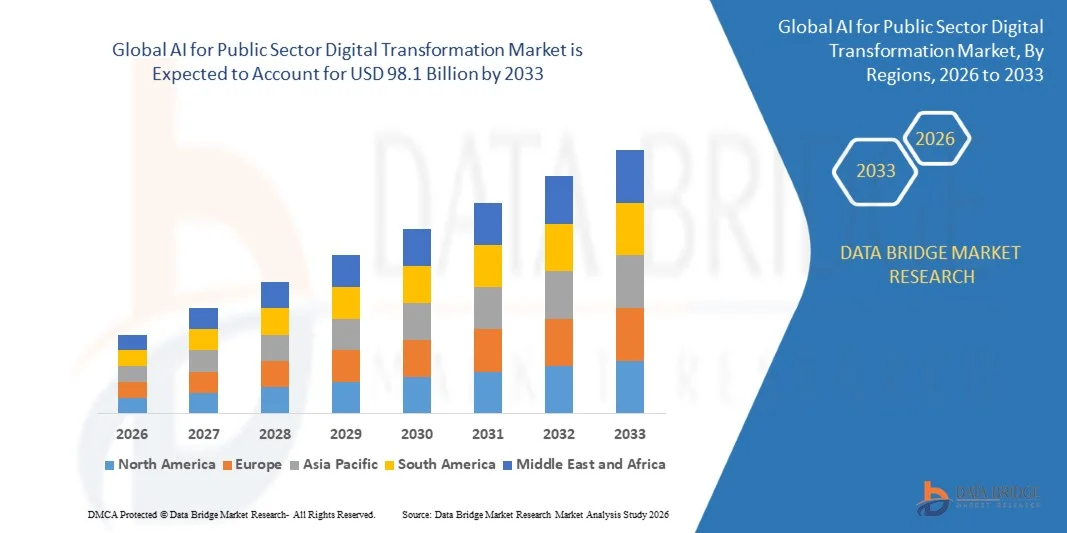
- The global AI for public sector digital transformation market size was valued at USD 26.4 billion in 2025and is expected to reach USD 98.1 billion by 2033, at a CAGR of 17.8% during the forecast period
- The market growth is primarily driven by increasing government investments in digital governance, rising demand for automation in public services, and growing adoption of AI-driven decision-making systems across administrative and security functions
- In addition, rapid advancements in generative AI, predictive analytics, and intelligent automation are enabling governments to improve citizen engagement, optimize resource allocation, and enhance transparency, thereby accelerating large-scale digital transformation initiatives globally
AI for Public Sector Digital Transformation Market Analysis
- AI technologies such as ML, NLP, and computer vision are increasingly being integrated into public sector operations to improve efficiency, reduce operational costs, and enhance service delivery quality across government agencies
- The rising demand for real-time data-driven governance, fraud detection, and predictive public safety systems is significantly accelerating AI adoption in both developed and emerging economies
- North America dominated the market with the largest revenue share of 38.6% in 2025, supported by strong federal digital transformation programs, high defense spending, and advanced AI ecosystem maturity across government institutions
- Asia-Pacific is expected to be the fastest growing region with a CAGR of 19.4% during the forecast period (2026–2033) due to large-scale smart city initiatives, expanding e-governance frameworks, and increasing investments in AI infrastructure in countries such as India and China
- The Machine Learning (ML) segment dominated the market with the largest revenue share of 34.8% in 2025, driven by its extensive use in predictive analytics, fraud detection, risk assessment, and policy optimization across government operations. ML algorithms are widely deployed in tax compliance systems, social welfare targeting, and public safety analytics due to their ability to process large-scale structured and unstructured data.
Report Scope and AI for Public Sector Digital Transformation Market Segmentation
|
Attributes |
AI for Public Sector Digital Transformation Key Market Insights |
|
Segments Covered |
|
|
Countries Covered |
North America · U.S. · Canada · Mexico Europe · Germany · France · U.K. · Netherlands · Switzerland · Belgium · Russia · Italy · Spain · Turkey · Rest of Europe Asia-Pacific · China · Japan · India · South Korea · Singapore · Malaysia · Australia · Thailand · Indonesia · Philippines · Rest of Asia-Pacific Middle East and Africa · Saudi Arabia · U.A.E. · South Africa · Egypt · Israel · Rest of Middle East and Africa South America · Brazil · Argentina · Rest of South America |
|
Key Market Players |
|
|
Market Opportunities |
· Expansion of AI-powered smart governance and digital citizen service platforms · Increasing adoption of generative AI for policy analysis, documentation automation, and public communication systems |
|
Value Added Data Infosets |
In addition to the market insights such as market value, growth rate, market segments, geographical coverage, market players, and market scenario, the market report curated by the Data Bridge Market Research team includes in-depth expert analysis, import/export analysis, pricing analysis, production consumption analysis, and pestle analysis. |
AI for Public Sector Digital Transformation Market Trends
“Rise of Generative AI and Intelligent Governance Platforms in Public Administration”
- A major trend shaping the market is the rapid integration of generative AI and advanced analytics into government workflows for automating documentation, citizen interaction, and policy assistance
- AI-powered chatbots and virtual assistants are increasingly being deployed in public service portals to improve citizen engagement and reduce response time for government queries
- Governments are adopting predictive analytics and machine learning models for proactive decision-making in areas such as taxation, fraud detection, and public safety management
- Cloud-based AI platforms are enabling scalable and cost-efficient deployment of digital government services across multiple departments and agencies
- The rise of smart cities is driving AI adoption in traffic management, surveillance systems, and urban infrastructure optimization
- Increasing focus on AI governance frameworks and ethical AI deployment is shaping procurement and deployment strategies across public sector organizations
AI for Public Sector Digital Transformation Market Dynamics
Driver
“Rising Government Push for Digital Governance and AI-Enabled Public Services”
- Governments worldwide are investing heavily in digital transformation programs to improve efficiency, transparency, and accessibility of public services
- For instance, AI-based systems are being deployed to automate citizen service delivery, streamline administrative processes, and improve decision-making accuracy
- Growing demand for real-time data analytics in areas such as public safety, defense intelligence, and healthcare services is accelerating AI adoption in government operations
- Increasing pressure to reduce operational costs while improving service quality is driving automation across taxation, welfare distribution, and municipal services
- Expansion of smart city initiatives is further boosting demand for integrated AI platforms in urban management and infrastructure planning
- Rising public expectations for faster, digital-first government services is pushing agencies to adopt AI-driven engagement tools
Restraint/Challenge
“Data Privacy Concerns, Legacy Infrastructure, and Regulatory Complexity”
- Concerns related to data privacy, security, and ethical use of AI remain significant barriers to large-scale adoption in the public sector
- Many government agencies still operate on legacy IT infrastructure, limiting seamless integration of advanced AI solutions
- For instance, fragmented data systems across departments often hinder the development of unified AI-driven governance platforms
- Regulatory uncertainty around AI governance and accountability can slow down procurement and deployment cycles
- High implementation costs for advanced AI systems and shortage of skilled AI talent in government organizations further restrain market growth
- Resistance to organizational change and lack of digital readiness in certain regions also limit adoption speed
- Ensuring transparency, fairness, and explainability in AI decision-making remains a critical challenge for public sector deployment
AI for Public Sector Digital Transformation Market Scope
The market is segmented on the basis of technology, component, deployment mode, application, and end user.
- By Technology
On the basis of technology, the global AI for public sector digital transformation market is segmented into Machine Learning (ML), Natural Language Processing (NLP), Computer Vision, Generative AI, and Robotic Process Automation (RPA) integrated with AI. The Machine Learning (ML) segment dominated the market with the largest revenue share of 34.8% in 2025, driven by its extensive use in predictive analytics, fraud detection, risk assessment, and policy optimization across government operations. ML algorithms are widely deployed in tax compliance systems, social welfare targeting, and public safety analytics due to their ability to process large-scale structured and unstructured data. Governments increasingly rely on ML-powered decision-support systems to improve operational efficiency and reduce manual workload in administrative processes. Continuous advancements in data infrastructure and cloud computing further strengthen ML adoption across public sector institutions.
The Generative AI segment is expected to witness the fastest growth during the forecast period, fueled by its transformative applications in citizen engagement, automated documentation, policy drafting, and virtual assistance. Governments are increasingly deploying generative AI-powered chatbots and assistants to enhance public service delivery and reduce response times for citizen queries. Its ability to generate contextual responses, summarize legal and administrative documents, and support multilingual communication is significantly improving accessibility in e-governance systems. Rising investment in AI copilots for government employees and integration of generative AI in digital portals are accelerating segment growth globally.
- By Component
On the basis of component, the market is segmented into Solutions and Services. The Solutions segment dominated the market in 2025, driven by widespread deployment of AI platforms for citizen services, defense intelligence, public safety analytics, and automated administrative workflows. Governments are increasingly adopting end-to-end AI solutions that integrate data management, analytics, and decision-making capabilities into unified platforms. Strong demand for scalable AI systems in smart governance and digital identity management further supports segment leadership.
The Services segment is expected to witness the fastest growth during the forecast period, supported by rising demand for AI implementation, system integration, consulting, and managed services. Public sector organizations often require specialized expertise to deploy and maintain AI systems, particularly in legacy infrastructure environments. Increasing outsourcing of AI operations and growing reliance on third-party technology providers are accelerating service adoption globally.
- By Deployment Mode
On the basis of deployment mode, the market is segmented into Cloud-based, On-premises, and Hybrid. The Cloud-based segment dominated the market in 2025, supported by its scalability, cost efficiency, and ability to support large-scale digital government initiatives. Cloud platforms enable seamless data sharing across departments and enhance real-time analytics capabilities for public services. Governments are increasingly adopting cloud-first strategies to modernize IT infrastructure and accelerate AI deployment.
The Hybrid segment is expected to witness the fastest growth during the forecast period, driven by increasing demand for data sovereignty, security compliance, and flexible integration of legacy systems with modern AI platforms. Hybrid deployment allows governments to balance sensitive data protection with scalable cloud capabilities, making it highly suitable for defense, intelligence, and critical public services.
- By Application
On the basis of application, the market is segmented into Citizen Services & Engagement, Public Safety & Security, Healthcare & Social Services, Transportation & Mobility, Taxation & Revenue Management, and Defense & Intelligence. The Citizen Services & Engagement segment dominated the market in 2025, driven by rapid adoption of AI-powered chatbots, virtual assistants, and digital service portals aimed at improving citizen interaction and reducing administrative burden. Governments are increasingly prioritizing digital-first service delivery models to enhance accessibility and transparency.
The Public Safety & Security segment is expected to witness the fastest growth during the forecast period, fueled by rising adoption of AI-based surveillance systems, predictive policing, fraud detection, and emergency response optimization. Increasing concerns over urban crime, terrorism threats, and disaster management are accelerating investment in intelligent security infrastructure.
- By End User
On the basis of end user, the market is segmented into Central/Federal Government Agencies, State Government Agencies, Local/Municipal Governments, Defense & Homeland Security Departments, Public Service Organizations, and Smart City Authorities. The Central/Federal Government Agencies segment dominated the market in 2025, supported by large-scale national digital transformation programs, high defense spending, and centralized AI adoption initiatives.
The Smart City Authorities segment is expected to witness the fastest growth during the forecast period, driven by expanding smart infrastructure projects, AI-enabled urban mobility systems, intelligent traffic management, and real-time environmental monitoring solutions. Increasing urbanization and government investments in smart governance frameworks are further accelerating adoption.
AI for Public Sector Digital Transformation Market Regional Analysis
- North America dominated the AI for public sector digital transformation market with the largest revenue share of 38.6% in 2025, supported by strong federal digital transformation initiatives, high defense spending, advanced AI ecosystem maturity, and early adoption of cloud-based government platforms.
- Governments and public institutions in the region prioritize data-driven governance, cybersecurity integration, and automation of administrative processes, leading to widespread deployment of AI across public services and defense operations.
- This strong market position is further supported by robust public-private partnerships, high technology spending, and the presence of leading AI and cloud service providers, making North America a global hub for government AI innovation.
U.S. AI for Public Sector Digital Transformation Market Insight
The U.S. AI for public sector digital transformation market captured the largest revenue share in North America in 2025, driven by large-scale federal AI initiatives, strong defense modernization programs, and widespread adoption of AI-powered citizen service platforms. Government agencies increasingly deploy AI for fraud detection, national security intelligence, and healthcare administration. Strong funding from federal programs, advanced cloud infrastructure, and active participation from major technology providers continue to drive sustained market expansion.
Europe AI for Public Sector Digital Transformation Market Insight
The Europe AI for public sector digital transformation market is projected to expand at a steady CAGR during the forecast period, driven by strong regulatory frameworks supporting digital governance, increasing investment in AI ethics and compliance systems, and rising demand for efficient public service delivery. Governments across the region are focusing on data protection, transparent AI usage, and cross-border digital collaboration, which is accelerating structured AI adoption across public institutions.
U.K. AI for Public Sector Digital Transformation Market Insight
The U.K. AI for public sector digital transformation market is expected to grow at a notable CAGR during the forecast period, supported by national digital government programs, strong adoption of AI-powered public service platforms, and increasing use of automation in healthcare and administrative services. The country’s focus on digital identity systems and smart governance initiatives further strengthens AI adoption across public sector organizations.
Germany AI for Public Sector Digital Transformation Market Insight
The Germany AI for public sector digital transformation market is expected to expand at a considerable CAGR during the forecast period, driven by strong emphasis on industrial-grade AI applications, data security compliance, and structured digital transformation programs. Government institutions in Germany are increasingly integrating AI into public administration, taxation systems, and transportation management to improve efficiency and accuracy.
Asia-Pacific AI for Public Sector Digital Transformation Market Insight
The Asia-Pacific AI for public sector digital transformation market is poised to grow at the fastest CAGR during 2026–2033, driven by rapid urbanization, large-scale smart city initiatives, increasing government investments in digital infrastructure, and expanding e-governance frameworks across emerging economies. Rising adoption of AI in public safety, citizen services, and transportation management is significantly accelerating regional growth.
Japan AI for Public Sector Digital Transformation Market Insight
The Japan AI for public sector digital transformation market is gaining momentum due to an aging population, strong focus on automation in public services, and high adoption of advanced AI technologies in healthcare and administrative governance. The government’s emphasis on robotics, AI integration, and smart city development further supports market expansion.
India AI for Public Sector Digital Transformation Market Insight
The India AI for public sector digital transformation market accounted for the largest revenue share in Asia-Pacific in 2025, driven by rapid digitalization initiatives, strong government-led e-governance programs, expanding smart city projects, and increasing AI adoption across taxation, citizen services, and public safety systems. Growing investments in digital infrastructure and domestic AI development capabilities continue to support strong long-term growth.
AI for Public Sector Digital Transformation Market Share
The AI for public sector digital transformation industry is primarily led by well-established companies, including:
- Microsoft Corporation (U.S.)
- International Business Machines Corporation (IBM) (U.S.)
- Google LLC (U.S.)
- Amazon Web Services (AWS) (U.S.)
- Oracle Corporation (U.S.)
- SAP SE (Germany)
- Accenture (Ireland)
- Deloitte (U.K.)
- Capgemini (France)
- Palantir Technologies (U.S.)
- C3.ai (U.S.)
- NVIDIA Corporation (U.S.)
What are the Recent Developments in Global AI for Public Sector Digital Transformation Market?
- In October 2025, Amazon Web Services (AWS) expanded its collaboration with public sector and defense organizations by launching AI-powered cloud modernization solutions in partnership with Accenture, aimed at improving citizen service delivery, optimizing government workflows, and strengthening national security operations through secure generative AI and cloud infrastructure capabilities
- In November 2025, Amazon Web Services (AWS) announced a major investment of up to USD 50 billion to expand AI and supercomputing infrastructure for U.S. government customers, enhancing access to advanced generative AI tools such as Amazon Bedrock and SageMaker for federal agencies and public sector workloads
- In December 2025, Microsoft Corporation expanded its AI-driven public sector transformation initiatives by scaling deployment of Microsoft Copilot and Azure AI solutions across government agencies, enabling automation of administrative workflows, improved citizen engagement, and enhanced productivity in public services
- In July 2025, Google LLC strengthened its public sector AI presence through a partnership with the UK government to modernize legacy systems and upskill civil servants in AI and digital technologies, supporting large-scale adoption of AI in public administration and e-governance frameworks
- In June 2025, Palantir Technologies expanded its federal AI footprint through a strategic partnership with Accenture Federal Services to deploy AI-powered operational platforms for U.S. government agencies, focusing on mission-critical workflows, defense modernization, and intelligence analytics

- Interactive Data Analysis Dashboard
- Company Analysis Dashboard for high growth potential opportunities
- Research Analyst Access for customization & queries
- Competitor Analysis with Interactive dashboard
- Latest News, Updates & Trend analysis
- Harness the Power of Benchmark Analysis for Comprehensive Competitor Tracking
Data collection and base year analysis are done using data collection modules with large sample sizes. The stage includes obtaining market information or related data through various sources and strategies. It includes examining and planning all the data acquired from the past in advance. It likewise envelops the examination of information inconsistencies seen across different information sources. The market data is analysed and estimated using market statistical and coherent models. Also, market share analysis and key trend analysis are the major success factors in the market report. To know more, please request an analyst call or drop down your inquiry.
The key research methodology used by DBMR research team is data triangulation which involves data mining, analysis of the impact of data variables on the market and primary (industry expert) validation. Data models include Vendor Positioning Grid, Market Time Line Analysis, Market Overview and Guide, Company Positioning Grid, Patent Analysis, Pricing Analysis, Company Market Share Analysis, Standards of Measurement, Global versus Regional and Vendor Share Analysis. To know more about the research methodology, drop in an inquiry to speak to our industry experts.
Data Bridge Market Research is a leader in advanced formative research. We take pride in servicing our existing and new customers with data and analysis that match and suits their goal. The report can be customized to include price trend analysis of target brands understanding the market for additional countries (ask for the list of countries), clinical trial results data, literature review, refurbished market and product base analysis. Market analysis of target competitors can be analyzed from technology-based analysis to market portfolio strategies. We can add as many competitors that you require data about in the format and data style you are looking for. Our team of analysts can also provide you data in crude raw excel files pivot tables (Fact book) or can assist you in creating presentations from the data sets available in the report.













