


What is the AI in Chemicals Market Size and Growth Rate?
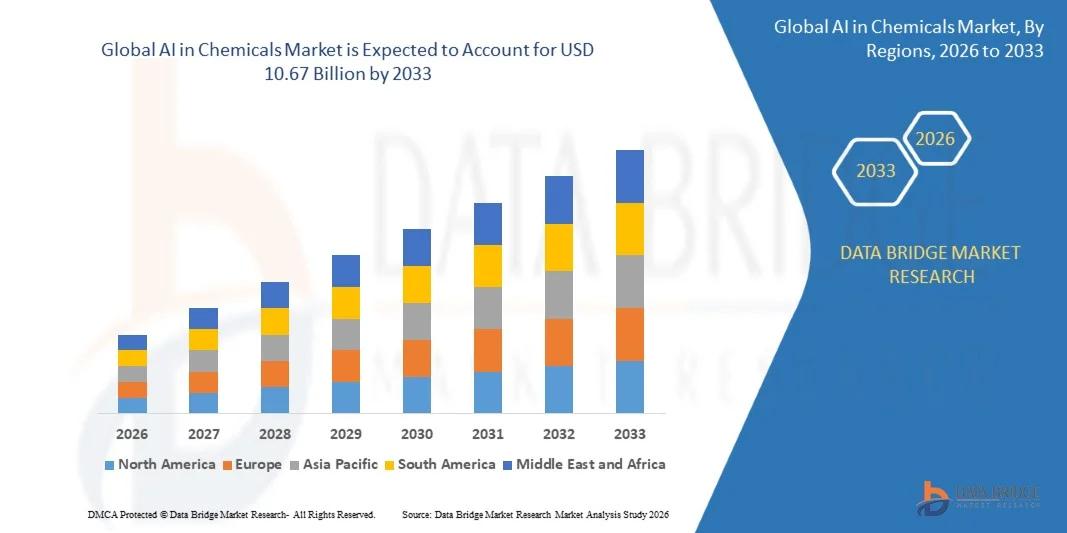
- As per Data Bridge Market Research analysis, the AI in chemicals market was valued at USD 1.50 billion in 2025 and is projected to reach USD 10.67 billion by 2033, growing at a CAGR of 27.80% from 2026 to 2033.
- The market is experiencing consistent growth driven by the increasing adoption of artificial intelligence for chemical research and development, production optimization, predictive maintenance, material discovery, and supply-chain management, alongside rapid advancements in machine learning, generative AI, and data analytics.
- The growing need to accelerate chemical discovery, improve production efficiency, reduce operational costs, and develop sustainable materials is compelling chemical manufacturers to adopt AI-enabled technologies. Machine learning, generative AI, and AI-powered process optimization are increasingly being integrated into research, manufacturing, quality management, and supply-chain operations, enabling faster decision-making and more efficient chemical development.
Market Size & Forecast
- Global Market Value (2025): USD 1.50 Billion
- Expected Market Value (2033): USD 10.67 Billion
- Forecast CAGR (2026–2033): 27.80%
- Leading Region in 2025: North America
- Fastest Growing Region: Asia Pacific
What are the Major Takeaways of the AI in Chemicals Market?
- North America dominated the AI in chemicals market with the largest revenue share of 40.2% in 2025, supported by advanced AI infrastructure, substantial R&D investments, and the presence of major technology and chemical companies
- Asia-Pacific is expected to be the fastest-growing region at a CAGR of 28.0% from 2026 to 2033, fueled by expanding chemical manufacturing, increasing digitalization, rising AI investments, and growing adoption of AI for production optimization, predictive maintenance, and new material innovation.
- The AI software segment led the market with a 50.4% share in 2025, driven by widespread adoption of AI platforms, predictive analytics tools, process optimization software, and data-driven decision-support systems across chemical operations.
- AI services are the fastest-growing offering type, projected to register a CAGR of 25.4%, reflecting the surge in demand for consulting, implementation, system integration, customization, training, maintenance, and ongoing optimization of AI platforms
- The machine learning segment dominated the technology category with a 34% revenue share in 2025, led by its extensive application across production optimization, predictive maintenance, quality control, demand forecasting, and chemical property prediction.
- Production optimization accounted for 38.2% of the market share in 2025, preferred by growing adoption of AI to improve production efficiency, reduce waste, optimize energy consumption, and enhance process control.
- The new material innovation segment is the fastest-growing application category, with a CAGR of 20.8%, driven by increasing use of AI for molecular design, material discovery, property prediction, and formulation development.
Report Scope and AI in Chemicals Market Segmentation
|
Attributes |
AI in Chemicals Key Market Insights |
|
Segments Covered |
|
|
Countries Covered |
North America
Europe
Asia-Pacific
Middle East and Africa
South America
|
|
Key Market Players |
|
|
Market Opportunities |
|
|
Value Added Data Infosets |
In addition to the market insights such as market value, growth rate, market segments, geographical coverage, market players, and market scenario, the market report curated by the Data Bridge Market Research team includes in-depth expert analysis, import/export analysis, pricing analysis, production consumption analysis, and pestle analysis. |
What is the Key Trend in the AI in Chemicals Market?
- Chemical companies are increasingly adopting generative AI and large language models to accelerate molecule discovery, formulation development, technical knowledge retrieval, and research workflows, shifting chemical innovation from traditional experimentation toward AI-assisted design and decision-making.
- For instance, in August 2025, Clariant highlighted Clarita, its generative AI tool, which uses large language models across laboratories, offices, and production sites to improve processes and support innovation throughout its specialty chemicals operations.
- AI platforms are increasingly integrating scientific literature, patents, reaction databases, experimental results, and process information to provide researchers with faster access to actionable chemical knowledge and improve productivity across research and development workflows globally.
- Chemical manufacturers are increasingly combining AI with real-time industrial data to optimize production, predict equipment performance, reduce energy consumption, and improve process stability across complex and increasingly automated manufacturing environments and facilities worldwide globally.
- For instance, in March 2024, Clariant launched CLARITY Prime, an AI-powered digital service using real-time plant performance data and machine learning to project catalyst performance and provide health alerts for ammonia production operations globally.
- As chemical companies continue integrating generative AI, molecular foundation models, and real-time industrial analytics into R&D and manufacturing, AI is becoming increasingly central to chemical discovery, process optimization, and operational decision-making.
What are the Key Drivers of the AI in Chemicals Market?
- The rising pressure to improve energy efficiency and reduce emissions is accelerating AI adoption because chemical and petrochemical operations require energy use, while AI can optimize process conditions, improve yields, and identify operational inefficiencies across facilities.
- For instance, in August 2024, ADNOC deployed Neuron 5 across hundreds of equipment units, with pilot results indicating potential to reduce unplanned shutdowns by 50% and increase planned maintenance intervals by 20% across operations.
- Growing demand for faster chemical and material discovery is driving AI adoption as machine learning can screen molecular structures, predict properties, and prioritize promising candidates before costly laboratory synthesis and testing at scale globally.
- For instance, in June 2025, Taiho Pharmaceutical and SyntheticGestalt initiated validation of an AI foundation model trained on 10 billion compound data points to improve molecular profile predictions for new compounds and accelerate discovery.
- Chemical producers are increasingly investing in AI to strengthen predictive maintenance, process control, demand forecasting, quality management, and supply-chain decisions, helping companies improve productivity while responding faster to volatile markets and operational disruptions worldwide.
- With chemical manufacturers facing increasing pressure to improve efficiency, accelerate innovation, and reduce environmental impact, AI adoption is expected to expand across R&D, production, maintenance, and supply-chain functions.
Which Factors are Challenging the Growth of the AI in Chemicals Market?
- Poor data quality, fragmented datasets, and incompatible legacy systems remain major barriers because AI models require reliable, standardized, and accessible information from laboratories, plants, sensors, and enterprise systems to deliver dependable results.
- For instance, in February 2026, an ECETOC workshop publication identified limited machine-readability, inconsistent metadata, proprietary data, and organizational data silos as key barriers to implementing AI in chemical risk assessment, highlighting the difficulty of creating reliable datasets for AI models.
- Limited interpretability and explainability can also slow AI deployment because chemical companies and regulators need confidence that model predictions are scientifically defensible, reproducible, transparent, and suitable for safety-critical decisions and regulatory use
- For instance, in September 2026, the U.K. Committee on Toxicity highlighted the complexity of data ecosystems required for AI integration into chemical risk assessment, underscoring data availability, quality, and interoperability challenges in regulatory applications
- The challenges associated with fragmented data, limited explainability, and regulatory confidence continue to restrict large-scale AI implementation, particularly where chemical companies require highly reliable and auditable outputs for operational and safety-critical applications.
How is the AI in Chemicals Market Segmented?
The AI in chemicals market is segmented on the basis of offering, technology, application, and end user.
- By Offering
On the basis of offering, the AI in chemicals market is segmented into AI software, AI services, and hardware. The AI software segment dominated the market with a 50.4% share in 2025, owing to widespread adoption of AI platforms, predictive analytics tools, process optimization software, and data-driven decision-support systems across chemical operations. AI software enables chemical manufacturers to analyze large volumes of production, laboratory, and operational data efficiently. These solutions support real-time monitoring, predictive modeling, process control, quality management, and optimization of resource utilization. Their scalability allows companies to deploy AI capabilities across multiple facilities without proportionately increasing physical infrastructure requirements. Growing integration of cloud computing, advanced analytics, and machine learning is further strengthening software adoption.
The AI services segment is projected to witness the fastest growth at a CAGR of 25.4% during forecast period, driven by increasing demand for consulting, implementation, system integration, customization, training, maintenance, and ongoing optimization of AI platforms. Chemical companies often require specialized expertise to integrate AI models with existing enterprise, laboratory, manufacturing, and process-control systems. The growing complexity of AI deployments is increasing demand for external technical support and customized implementation services. Service providers also help companies address data integration, model development, cybersecurity, and workforce training requirements. Increasing adoption among companies that lack extensive internal AI capabilities is further supporting this segment. Continued expansion of AI applications across chemical R&D and manufacturing is expected to create sustained demand for specialized implementation and support services.
- By Technology
On the basis of technology, the AI in chemicals market is segmented into machine learning, deep learning, generative AI, natural language processing, computer vision, and advanced analytics. The machine learning segment dominated the technology category with 34% share in 2025, supported by its extensive application across production optimization, predictive maintenance, quality control, demand forecasting, and chemical property prediction. Machine learning models can identify complex relationships within large industrial and scientific datasets and generate predictive insights for chemical operations. Chemical manufacturers use these models to optimize process conditions, detect anomalies, improve product consistency, and forecast equipment performance. The maturity and broad applicability of machine learning make it easier to integrate into existing industrial analytics environments. Its ability to support both real-time and historical data analysis further strengthens its adoption across chemical facilities.
The generative AI segment is expected to witness the fastest growth at 30% CAGR during forecast period, supported by increasing use of large language models, molecular generation platforms, and AI-based design systems in chemical research. Generative AI can create and evaluate potential molecular structures, formulations, materials, and synthesis pathways, significantly expanding the scope of computational chemical discovery. Chemical companies are increasingly applying these technologies to accelerate R&D and reduce the number of physical experiments required to identify promising candidates. The technology is also being used to search scientific literature, analyze patents, generate technical knowledge, and support formulation development. Rapid improvements in foundation models and chemical-specific datasets are further increasing the practical value of generative AI.
- By Application
On the basis of application, the AI in chemicals market is segmented into production optimization, new material innovation, operational process management, pricing optimization, raw material demand forecasting, and others. The production optimization segment dominated the market with a 38.2% share in 2025, driven by growing adoption of AI to improve production efficiency, reduce waste, optimize energy consumption, and enhance process control. AI-based systems can continuously analyze operating conditions and identify deviations that may affect productivity or product quality. These capabilities are particularly valuable in large-scale chemical plants where small improvements in yield and resource efficiency can generate significant financial benefits. Manufacturers are increasingly using AI to optimize reaction conditions, improve throughput, and minimize operational losses. Integration with sensors, industrial control systems, and digital twins is further increasing the effectiveness of AI-based production optimization.
The new material innovation segment is projected to register the fastest growth at a CAGR of 20.8% during forecast period, driven by increasing use of AI for molecular design, material discovery, property prediction, and formulation development. AI allows researchers to evaluate large numbers of potential compounds and materials more rapidly than conventional trial-and-error approaches. Machine learning and generative models can predict chemical properties and identify promising material candidates before laboratory synthesis. These technologies are increasingly being applied to advanced materials, sustainable chemicals, catalysts, coatings, polymers, and performance-enhancing formulations. The ability to shorten discovery cycles and reduce experimental costs is encouraging chemical companies to increase investment in AI-enabled R&D. Growing demand for high-performance and environmentally sustainable materials is further strengthening the segment.
- By End User
On the basis of end user, the AI in chemicals market is segmented into base chemicals & petrochemicals, agricultural chemicals, and specialty chemicals. The base chemicals & petrochemicals segment dominated the market with 41% share in 2025, supported by the large-scale and highly complex nature of production processes within these industries. AI technologies are widely used to optimize plant operations, monitor process conditions, improve asset performance, and reduce production costs. Petrochemical facilities generate large volumes of operational data that can be analyzed by AI systems to identify inefficiencies and predict potential equipment failures. AI also supports feedstock optimization, energy management, demand forecasting, and supply-chain planning across large industrial networks. The substantial economic impact of efficiency improvements creates strong incentives for AI adoption in these sectors.
The specialty chemicals segment is projected to witness the fastest growth at a CAGR of 27.51% during forecast period, driven by increasing demand for advanced formulations, customized products, and high-value materials. Specialty chemical manufacturers are increasingly using AI to optimize formulation design, accelerate product development, improve quality control, and enhance manufacturing consistency. AI can help researchers identify relationships between formulation variables and final product performance, reducing development cycles and experimental requirements. The segment also benefits from growing demand for advanced coatings, catalysts, adhesives, electronic chemicals, and performance materials. Increasing competition and the need to develop differentiated products are encouraging specialty chemical companies to invest in AI-enabled R&D and production systems. Greater use of AI for customized formulations and sustainable material development is expected to further accelerate adoption.
Which Region Holds the Largest Share of the AI in Chemicals Market?
- North America dominated the AI in chemicals market with the largest revenue share of 40.2% in 2025, supported by advanced AI infrastructure, substantial R&D investments, and the presence of major technology and chemical companies
- The region also benefits from rapid adoption of machine learning and generative AI, strong digitalization across chemical production, and growing use of AI for molecular discovery, process optimization, predictive maintenance, and supply-chain management. Increasing investment in AI-enabled innovation and advanced manufacturing technologies continues to strengthen North America’s leadership position in the global market.
U.S. AI in Chemicals Market Insight
The U.S. AI in chemicals market is witnessing strong growth due to rising investments in artificial intelligence, chemical research, and advanced manufacturing technologies. The country’s mature chemical industry, strong technology ecosystem, and extensive R&D capabilities are driving adoption of AI across molecular discovery, process optimization, predictive maintenance, and supply-chain management. In addition, increasing focus on improving production efficiency, accelerating material innovation, and reducing operational costs is accelerating AI adoption across chemical manufacturers and research organizations.
Asia-Pacific AI in Chemicals Market Insight
The Asia-Pacific AI in chemicals market is expected to witness rapid growth, driven by expanding chemical manufacturing, increasing digitalization, and rising investments in artificial intelligence across countries such as China, India, Japan, and South Korea. Growing demand for advanced manufacturing technologies, sustainable chemical production, and faster product development is supporting regional market expansion. In addition, increasing adoption of machine learning, generative AI, and predictive analytics across chemical R&D and production activities is accelerating AI integration across the region.
Japan AI in Chemicals Market Insight
The Japan AI in chemicals market is witnessing consistent growth due to rising investments in artificial intelligence, advanced materials, and chemical research and development. Chemical manufacturers and research institutions are increasingly adopting AI for molecular discovery, formulation optimization, production management, and predictive maintenance. Moreover, Japan’s strong technological capabilities, emphasis on automation, and focus on developing high-performance and sustainable materials are further contributing to AI adoption across the chemical industry.
China AI in Chemicals Market Insight
The China AI in chemicals market is growing rapidly, driven by the country’s large chemical manufacturing base, increasing industrial digitalization, and rising investments in artificial intelligence technologies. Growing adoption of AI-enabled production optimization, predictive maintenance, molecular discovery, and supply-chain management is significantly boosting market demand. In addition, increasing government emphasis on advanced manufacturing, technological innovation, and sustainable industrial development is positioning China as one of the fastest-growing markets for AI applications in the chemicals industry.
U.K. AI in Chemicals Market Insight
The U.K. AI in chemicals market is experiencing steady growth, supported by increasing adoption of AI technologies across chemical research, manufacturing, and process optimization applications. Growing investments in advanced analytics, machine learning, and generative AI are contributing to the development of faster and more efficient chemical discovery and production processes. Furthermore, the country’s strong research ecosystem, focus on sustainable manufacturing, and increasing collaboration between technology companies and chemical organizations are supporting AI adoption across the U.K. chemicals industry.
Germany AI in Chemicals Market Insight
The Germany AI in chemicals market is expanding steadily due to the country’s strong chemical manufacturing base, advanced industrial capabilities, and increasing adoption of digital technologies. Chemical companies are increasingly utilizing AI for production optimization, predictive maintenance, molecular research, quality management, and supply-chain planning. Continuous advancements in machine learning and industrial AI, along with Germany’s strong focus on energy efficiency, sustainable manufacturing, and Industry 4.0 technologies, are further driving AI adoption across the chemicals sector.
Which are the Top Companies in AI in Chemicals Market?
The AI in chemicals industry is primarily led by well-established companies, including:
- BASF SE (Germany)
- The Dow Chemical Company (U.S.)
- DuPont (U.S.)
- Evonik Industries AG (Germany)
- Clariant (Switzerland)
- Covestro AG (Germany)
- Saudi Basic Industries Corporation (Saudi Arabia)
- Solvay (Belgium)
- Mitsubishi Chemical Group Corporation (Japan)
- Wacker Chemie AG (Germany)
- Schrödinger, Inc. (U.S.)
- Citrine Informatics Inc. (U.S.)
- Kebotix, Inc. (U.S.)
- IBM Corporation (U.S.)
- Microsoft Corporation (U.S.)
- NVIDIA Corporation (U.S.)
- Siemens AG (Germany)
- Honeywell International Inc. (U.S.)
- Dassault Systèmes SE (France)
What are Latest Developments in AI in Chemicals Market?
- In December 2025, BASF reported the development of an AI-supported tool for predicting groundwater leaching risks of chemical compounds during the early stages of research. The tool uses an AI model developed from approximately one million simulations to identify compounds with favorable environmental characteristics earlier in the development process. The development illustrates the use of AI in chemical R&D and sustainability assessment, helping researchers prioritize promising compounds while incorporating environmental considerations earlier in product development.
- In May 2025, PPG launched PPG DELTRON NXT Premium Glamour Speed Clearcoat, its first product developed using artificial intelligence and machine learning to meet full commercial specifications. The AI-supported development process was used to identify a novel coating formulation that provides a premium appearance while enabling significantly faster curing. The product demonstrates how AI can be applied directly to chemical formulation and coatings development to improve product performance, accelerate innovation, and reduce energy requirements during industrial use.
- In April 2025, BASF announced the establishment of its AI Innovation Center in collaboration with the University of Waterloo to accelerate the development and application of AI solutions across its businesses and product lines. The center is designed to serve as BASF's dedicated innovation hub for AI, supporting research and development, operational improvements, and new AI-enabled solutions across the chemical value chain. The initiative strengthens BASF's use of AI for chemical innovation and demonstrates the industry's shift toward dedicated AI development capabilities.
- In March 2024, Clariant launched CLARITY Prime, an AI-powered digital service designed to optimize catalyst operation in chemical production. The service analyzes real-time plant performance data using machine learning to provide catalyst performance projections and health alerts. CLARITY Prime was developed to help chemical producers improve catalyst utilization, increase operational efficiency, and support more effective plant management. The launch demonstrates the increasing integration of AI and real-time industrial data into chemical manufacturing processes.
- In February 2022, BASF launched Emollient Maestro, an AI-enabled digital product designer developed to support the formulation of sustainable cosmetics. The platform uses artificial intelligence modeling to identify suitable emollient combinations based on specific formulation requirements, enabling cosmetic developers to evaluate formulations more efficiently and conduct faster, more targeted prototyping. The solution represents the application of AI directly to chemical formulation and product development, helping researchers identify suitable ingredient combinations while reducing reliance on conventional trial-and-error approaches.

- Interactive Data Analysis Dashboard
- Company Analysis Dashboard for high growth potential opportunities
- Research Analyst Access for customization & queries
- Competitor Analysis with Interactive dashboard
- Latest News, Updates & Trend analysis
- Harness the Power of Benchmark Analysis for Comprehensive Competitor Tracking
Data collection and base year analysis are done using data collection modules with large sample sizes. The stage includes obtaining market information or related data through various sources and strategies. It includes examining and planning all the data acquired from the past in advance. It likewise envelops the examination of information inconsistencies seen across different information sources. The market data is analysed and estimated using market statistical and coherent models. Also, market share analysis and key trend analysis are the major success factors in the market report. To know more, please request an analyst call or drop down your inquiry.
The key research methodology used by DBMR research team is data triangulation which involves data mining, analysis of the impact of data variables on the market and primary (industry expert) validation. Data models include Vendor Positioning Grid, Market Time Line Analysis, Market Overview and Guide, Company Positioning Grid, Patent Analysis, Pricing Analysis, Company Market Share Analysis, Standards of Measurement, Global versus Regional and Vendor Share Analysis. To know more about the research methodology, drop in an inquiry to speak to our industry experts.
Data Bridge Market Research is a leader in advanced formative research. We take pride in servicing our existing and new customers with data and analysis that match and suits their goal. The report can be customized to include price trend analysis of target brands understanding the market for additional countries (ask for the list of countries), clinical trial results data, literature review, refurbished market and product base analysis. Market analysis of target competitors can be analyzed from technology-based analysis to market portfolio strategies. We can add as many competitors that you require data about in the format and data style you are looking for. Our team of analysts can also provide you data in crude raw excel files pivot tables (Fact book) or can assist you in creating presentations from the data sets available in the report.













