


AI in Diagnostics Market Size
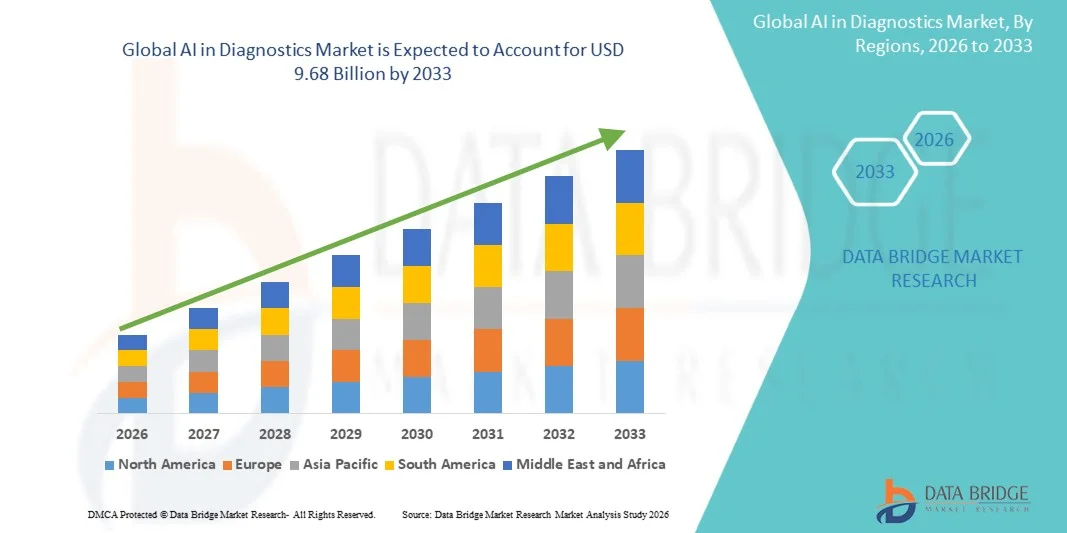
- The global AI in Diagnostics market size was valued at USD 5.64 billion in 2025and is expected to reach USD 9.68 billion by 2033, at a CAGR of 6.97% during the forecast period
- Market growth is primarily driven by the increasing demand for early and accurate disease detection, rising diagnostic workload in healthcare systems, and growing integration of artificial intelligence into medical imaging and laboratory workflows.
- In addition, advancements in machine learning algorithms, expansion of digital health infrastructure, and rising adoption of AI-enabled decision-support tools in hospitals and diagnostic laboratories are significantly accelerating market expansion.
AI in Diagnostics Market Analysis
- AI in diagnostics refers to the use of advanced algorithms and intelligent systems to assist healthcare professionals in interpreting medical data, identifying disease patterns, and improving diagnostic accuracy and speed across imaging and laboratory medicine.
- The increasing complexity of medical data, shortage of skilled radiologists and pathologists, and rising global disease burden are key factors driving adoption of AI-based diagnostic solutions.
- AI technologies are improving diagnostic efficiency by reducing human error, enabling early detection of diseases such as cancer and cardiovascular disorders, and supporting personalized treatment planning.
- North America dominated the market in 2025 with a market share of 42.8%, driven by strong healthcare digitization, early adoption of AI technologies, and the presence of leading technology and medical device companies.
- Asia-Pacific is expected to be the fastest-growing region during the forecast period, registering a CAGR of 23.6%, driven by rapid healthcare modernization, increasing patient population, and government initiatives promoting digital health adoption.
- The software segment dominated the market with the largest revenue share of 68.6% in 2025, driven by the rapid adoption of AI algorithms, cloud-based diagnostic platforms, and clinical decision-support systems across healthcare facilities. Software solutions enable real-time analysis of medical imaging, pathology slides, and patient data, significantly improving diagnostic speed and accuracy. Increasing integration of machine learning and deep learning models into hospital information systems further strengthens this segment’s dominance.
Report Scope and AI in Diagnostics Market Segmentation
|
Attributes |
AI in Diagnostics Key Market Insights |
|
Segments Covered |
|
|
Countries Covered |
North America · U.S. · Canada · Mexico Europe · Germany · France · U.K. · Netherlands · Switzerland · Belgium · Russia · Italy · Spain · Turkey · Rest of Europe Asia-Pacific · China · Japan · India · South Korea · Singapore · Malaysia · Australia · Thailand · Indonesia · Philippines · Rest of Asia-Pacific Middle East and Africa · Saudi Arabia · U.A.E. · South Africa · Egypt · Israel · Rest of Middle East and Africa South America · Brazil · Argentina · Rest of South America |
|
Key Market Players |
|
|
Market Opportunities |
· Expansion of AI-powered early disease screening programs · Rising integration of AI with medical imaging systems |
|
Value Added Data Infosets |
In addition to the insights on market scenarios such as market value, growth rate, segmentation, geographical coverage, and major players, the market reports curated by the Data Bridge Market Research also include in-depth expert analysis, patient epidemiology, pipeline analysis, pricing analysis, and regulatory framework |
AI in Diagnostics Market Trends
“Rapid Shift Toward Intelligent, Automated, and Data-Driven Diagnostics”
- A key trend in the global AI in diagnostics market is the growing integration of AI-powered tools into clinical workflows to support faster, more consistent, and more accurate diagnosis across both imaging and laboratory-based healthcare settings.
- AI-based imaging solutions are increasingly being used in radiology for detecting abnormalities in X-rays, CT scans, and MRI images with higher precision and reduced turnaround time, improving diagnostic efficiency and supporting early disease detection.
- In pathology, digital slide analysis powered by deep learning is improving cancer detection accuracy and enabling remote diagnostics through telepathology platforms, enhancing access to specialist interpretation even in underserved regions.
- The adoption of natural language processing (NLP) is expanding in clinical documentation, enabling automated extraction of relevant diagnostic insights from unstructured medical records, radiology reports, and physician notes.
- Cloud-based AI diagnostic platforms are gaining traction, allowing real-time data sharing, remote collaboration, and centralized analysis across healthcare institutions, which improves scalability and interoperability of diagnostic systems.
- Increasing use of predictive analytics is enabling early disease risk identification, particularly in oncology, cardiology, and chronic disease management, supporting proactive healthcare interventions and personalized treatment planning.
AI in Diagnostics Market Dynamics
Driver
“Rising Demand for Early Disease Detection and Diagnostic Efficiency”
- The increasing global burden of chronic and infectious diseases is driving strong demand for faster, more accurate diagnostic systems that can support timely clinical decision-making and improve patient outcomes across healthcare settings.
- AI enables early detection of conditions such as cancer, stroke, and cardiovascular diseases, significantly improving patient outcomes by allowing earlier intervention, better treatment planning, and reduced disease progression.
- Healthcare systems are increasingly adopting AI tools to reduce diagnostic workload and address shortages of radiologists and pathologists, thereby improving operational efficiency and reducing reporting delays.
- Growing investment in digital health infrastructure and government support for AI integration in healthcare is further accelerating market growth by enabling large-scale deployment of intelligent diagnostic systems and improving data interoperability.
- The shift toward value-based healthcare is encouraging the adoption of AI-based diagnostics to improve efficiency, enhance diagnostic accuracy, and reduce overall healthcare costs while maintaining or improving patient care quality.
Restraint/Challenge
“Data Privacy Concerns and Regulatory Complexity”
- Concerns related to patient data privacy and security remain a major barrier to widespread AI adoption in diagnostics, as the use of sensitive medical data in AI model training and cloud-based platforms raises risks of data breaches and compliance challenges.
- Integration of AI systems with existing healthcare infrastructure can be complex and costly, particularly in developing regions where legacy systems, limited IT capabilities, and budget constraints slow down digital transformation.
- Lack of standardized regulatory frameworks for AI-based diagnostic tools can delay approvals and commercialization, as different regions apply varying guidelines for clinical validation, safety, and performance benchmarking.
- Limited availability of high-quality, labeled medical data can affect algorithm accuracy and performance, making it difficult to train robust AI models that generalize well across diverse patient populations and clinical settings.
- Resistance from healthcare professionals due to trust issues and lack of training in AI tools also restricts adoption, as clinicians may be hesitant to rely on algorithm-based recommendations without sufficient transparency, validation, and interpretability.
AI in Diagnostics Market Scope
The market is segmented on the basis of component, diagnostic type, technology, application, and end user.
- By Component
On the basis of component, the global AI in Diagnostics market is segmented into Software, Hardware, and Services. The software segment dominated the market with the largest revenue share of 68.6% in 2025, driven by the rapid adoption of AI algorithms, cloud-based diagnostic platforms, and clinical decision-support systems across healthcare facilities. Software solutions enable real-time analysis of medical imaging, pathology slides, and patient data, significantly improving diagnostic speed and accuracy. Increasing integration of machine learning and deep learning models into hospital information systems further strengthens this segment’s dominance.
The services segment is expected to witness the fastest growth during the forecast period, fueled by rising demand for AI implementation, system integration, training, and maintenance services. Healthcare providers are increasingly relying on external expertise to deploy and optimize AI diagnostic tools effectively, especially in developing healthcare systems.
- By Diagnostic Type
On the basis of diagnostic type, the market is segmented into Diagnostic Imaging and In Vitro Diagnostics (IVD). The diagnostic imaging segment dominated the market in 2025, driven by extensive use of AI in radiology for interpreting X-rays, CT scans, MRI, and ultrasound images. AI-based imaging tools enhance detection accuracy, reduce radiologist workload, and enable early identification of diseases such as cancer and cardiovascular disorders.
The in vitro diagnostics (IVD) segment is expected to witness the fastest growth during the forecast period, supported by increasing adoption of AI in laboratory testing, genomics, biomarker analysis, and pathology workflows. Automation and AI-driven analytics are improving test accuracy and reducing turnaround times in diagnostic laboratories globally.
- By Technology
On the basis of technology, the market is segmented into Machine Learning, Deep Learning, Computer Vision, Natural Language Processing (NLP), Predictive Analytics, and Neural Networks. The machine learning segment dominated the market in 2025, driven by its widespread application in disease prediction, pattern recognition, and diagnostic decision support across multiple healthcare domains.
The deep learning segment is expected to witness the fastest growth during the forecast period, owing to its high accuracy in image recognition and its strong application in radiology, pathology, and oncology diagnostics. Increasing use of computer vision in medical imaging and NLP in clinical documentation is further enhancing AI adoption in diagnostics.
- By Application
On the basis of application, the market is segmented into Radiology, Pathology, Cardiology, Oncology, Neurology, Chest & Lung Diseases, Ophthalmology, Dermatology, and Genomics. The radiology segment dominated the market in 2025, supported by extensive AI deployment in medical imaging analysis for detecting fractures, tumors, and organ abnormalities with high precision.
The oncology segment is expected to witness the fastest growth during the forecast period, driven by increasing demand for early cancer detection, tumor classification, and precision oncology solutions. Growing integration of AI in genomic analysis and biomarker identification is further accelerating advancements in cancer diagnostics.
- By End User
On the basis of end user, the market is segmented into Hospitals, Diagnostic Laboratories, Imaging Centers, Research & Academic Institutes, and Pharmaceutical & Biotech Companies. The hospitals segment dominated the market in 2025, due to high patient inflow, strong adoption of AI-based imaging systems, and increasing use of clinical decision-support tools in routine diagnostics.
The diagnostic laboratories segment is expected to witness the fastest growth during the forecast period, driven by rising automation in pathology workflows and increasing adoption of AI-powered laboratory information systems. Imaging centers and research institutions are also expanding AI usage to enhance diagnostic accuracy and accelerate medical research outcomes.
AI in Diagnostics Market Regional Analysis
- North America dominated the market in 2025 with a market share of 42.8%, driven by strong healthcare digitization, early adoption of AI technologies, and the presence of leading technology and medical device companies.
- The region benefits from widespread integration of AI-based diagnostic tools in hospitals and imaging centers, enabling improved accuracy and faster clinical decision-making across radiology and pathology workflows.
- Strong reimbursement frameworks and high healthcare expenditure further support the adoption of advanced AI diagnostic solutions across both public and private healthcare systems in North America.
U.S. AI in Diagnostics Market Insight
The U.S. AI in Diagnostics market is witnessing strong growth, driven by high adoption of advanced healthcare technologies, robust digital health infrastructure, and increasing demand for early and accurate disease detection. The country benefits from widespread deployment of AI-powered imaging systems in radiology and oncology, supported by leading healthcare providers and technology firms. Rising prevalence of chronic diseases such as cancer and cardiovascular disorders is further accelerating demand for AI-enabled diagnostic solutions. In addition, strong venture capital investment and regulatory support for AI-based medical devices are encouraging continuous innovation and commercialization across the U.S. healthcare ecosystem.
Europe AI in Diagnostics Market Insight
The Europe AI in Diagnostics market is expanding steadily, supported by strong regulatory frameworks, increasing healthcare digitization, and growing emphasis on early disease detection. Countries across the region are integrating AI into public healthcare systems to improve diagnostic accuracy and reduce clinical workload. Rising adoption of AI in medical imaging, pathology, and laboratory diagnostics is being driven by aging populations and increasing chronic disease burden. In addition, supportive government initiatives and collaborations between healthcare providers and AI technology companies are fostering market growth across Europe.
U.K. AI in Diagnostics Market Insight
The U.K. AI in Diagnostics market is growing at a notable pace, driven by strong government support for digital healthcare transformation and increasing adoption of AI in the National Health Service (NHS). The country is actively integrating AI-based imaging and diagnostic tools to improve early disease detection and reduce waiting times in hospitals. Rising cases of cancer and respiratory diseases are further fueling demand for advanced diagnostic solutions. In addition, increasing investment in health tech startups and partnerships between healthcare institutions and AI firms are strengthening market expansion in the U.K.
Germany AI in Diagnostics Market Insight
The Germany AI in Diagnostics market is witnessing significant growth due to strong emphasis on healthcare innovation, precision medicine, and advanced medical technologies. The country’s well-developed healthcare infrastructure supports the adoption of AI-powered diagnostic imaging and laboratory systems. Increasing focus on early diagnosis and efficient disease management is driving the use of AI in radiology, oncology, and pathology. In addition, government initiatives promoting digital health solutions and strong collaboration between research institutes and medical technology companies are supporting market development in Germany.
Asia-Pacific AI in Diagnostics Market Insight
The Asia-Pacific AI in Diagnostics market is expected to grow at the fastest rate globally, driven by rapid healthcare modernization, increasing population burden, and rising prevalence of chronic diseases. Countries such as China, India, and Japan are investing heavily in AI-based healthcare infrastructure and digital diagnostic platforms. Expanding access to healthcare services, growing medical imaging demand, and government initiatives promoting AI adoption are further accelerating market growth. In addition, increasing presence of regional AI startups and cost-effective diagnostic solutions is enhancing accessibility across emerging economies in the region.
Japan AI in Diagnostics Market Insight
The Japan AI in Diagnostics market is expanding steadily due to its advanced healthcare system, aging population, and strong focus on precision medicine. The country is increasingly adopting AI-powered imaging and diagnostic tools to improve efficiency in radiology and oncology workflows. Rising demand for early disease detection and personalized healthcare solutions is further driving market growth. In addition, Japan’s strong technological ecosystem and integration of AI into hospital systems are supporting continuous innovation in diagnostic applications.
India AI in Diagnostics Market Insight
The India AI in Diagnostics market is growing rapidly, supported by increasing healthcare digitization, rising disease burden, and expanding access to advanced diagnostic services. The country is witnessing strong adoption of AI in radiology and pathology, particularly in urban hospitals and diagnostic centers. Growing awareness of early disease detection, coupled with government initiatives promoting digital health and telemedicine, is accelerating market penetration. In addition, the presence of a strong domestic healthcare IT and startup ecosystem is driving affordable and scalable AI diagnostic solutions across India.
AI in Diagnostics Market Share
The AI in Diagnostics industry is primarily led by well-established companies, including:
- IBM Corporation (U.S.)
- GE HealthCare (U.S.)
- Siemens Healthineers (Germany)
- Philips Healthcare (Netherlands)
- Microsoft Corporation (U.S.)
- Google Health (U.S.)
- NVIDIA Corporation (U.S.)
- Aidoc (Israel)
- PathAI (U.S.)
- Tempus Labs (U.S.)
- Qure.ai (India)
- Zebra Medical Vision (Israel)
- Siemens Healthineers AI Division (Germany)
- Fujifilm Holdings Corporation (Japan)
- Canon Medical Systems (Japan)
What are the Recent Developments in Global AI in Diagnostics Market?
- In May 2026, Roche announced its agreement to acquire PathAI for up to USD 1.05 billion, strengthening its AI-powered diagnostics and digital pathology capabilities. The acquisition builds on an existing partnership and is aimed at integrating PathAI’s AI platform into Roche’s global diagnostics division to enhance cancer diagnosis and laboratory automation.
- In November 2025, Aidoc completed a pivotal FDA submission for its CARE™ foundation model–powered multi-triage AI system, designed to detect and prioritize multiple acute conditions in diagnostic imaging workflows. The solution is deployed through its aiOS™ platform, which has already processed over 100 million real-world patient cases, marking a major milestone in scalable clinical AI deployment.
- In October 2025, GE HealthCare advanced its AI innovation program by launching new imaging AI models under its AI Innovation Lab, collaborating with Mass General Brigham and the University of Wisconsin–Madison to refine MRI-based foundational AI models using real-world hospital data. The initiative aims to improve adaptability of AI systems across clinical workflows and imaging applications.
- In September 2025, Siemens Healthineers introduced Syngo.CT Coronary Cockpit, an AI-powered diagnostic imaging software for coronary CT angiography (CCTA). The solution uses AI algorithms to automate plaque detection and segmentation, helping clinicians improve diagnosis and treatment planning for coronary artery disease.
- In July 2025, Aidoc raised USD 150 million to expand its CARE™ clinical foundation model and AI operating system, with participation from major U.S. healthcare systems and NVIDIA’s venture arm. The funding is being used to scale AI-driven diagnostic decision support across radiology, oncology, and cardiovascular care.

- Interactive Data Analysis Dashboard
- Company Analysis Dashboard for high growth potential opportunities
- Research Analyst Access for customization & queries
- Competitor Analysis with Interactive dashboard
- Latest News, Updates & Trend analysis
- Harness the Power of Benchmark Analysis for Comprehensive Competitor Tracking
Data collection and base year analysis are done using data collection modules with large sample sizes. The stage includes obtaining market information or related data through various sources and strategies. It includes examining and planning all the data acquired from the past in advance. It likewise envelops the examination of information inconsistencies seen across different information sources. The market data is analysed and estimated using market statistical and coherent models. Also, market share analysis and key trend analysis are the major success factors in the market report. To know more, please request an analyst call or drop down your inquiry.
The key research methodology used by DBMR research team is data triangulation which involves data mining, analysis of the impact of data variables on the market and primary (industry expert) validation. Data models include Vendor Positioning Grid, Market Time Line Analysis, Market Overview and Guide, Company Positioning Grid, Patent Analysis, Pricing Analysis, Company Market Share Analysis, Standards of Measurement, Global versus Regional and Vendor Share Analysis. To know more about the research methodology, drop in an inquiry to speak to our industry experts.
Data Bridge Market Research is a leader in advanced formative research. We take pride in servicing our existing and new customers with data and analysis that match and suits their goal. The report can be customized to include price trend analysis of target brands understanding the market for additional countries (ask for the list of countries), clinical trial results data, literature review, refurbished market and product base analysis. Market analysis of target competitors can be analyzed from technology-based analysis to market portfolio strategies. We can add as many competitors that you require data about in the format and data style you are looking for. Our team of analysts can also provide you data in crude raw excel files pivot tables (Fact book) or can assist you in creating presentations from the data sets available in the report.













