


AI in Fashion Market Size
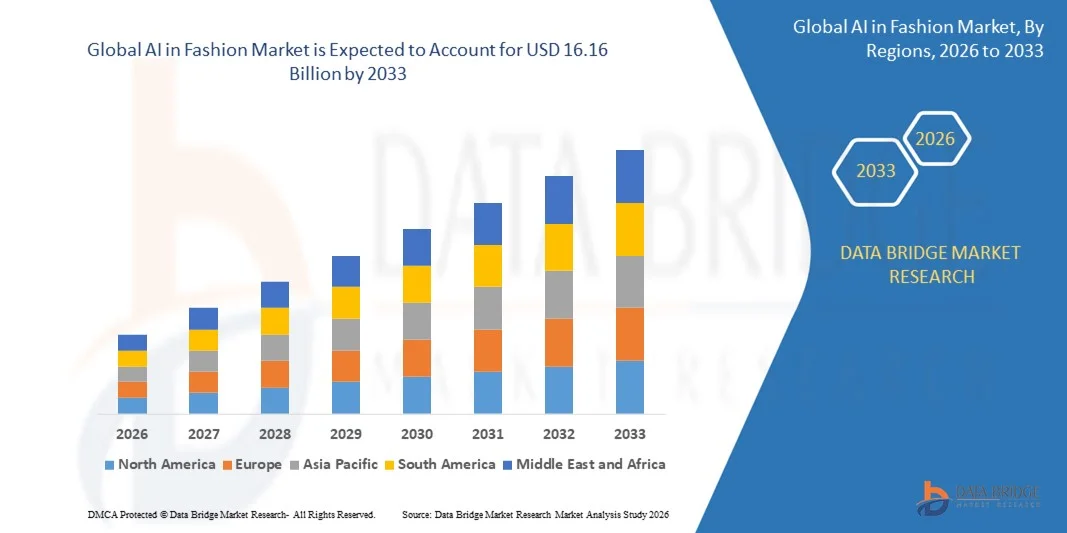
- The global AI in fashion market size was valued at USD 1.17 billion in 2025 and is expected to reach USD 16.16 billion by 2033, at a CAGR of 38.85% during the forecast period
- The market growth is largely fueled by the growing integration of artificial intelligence across fashion retail and design processes, enabling automation in product development, trend forecasting, and personalized shopping experiences. Increasing demand for data-driven insights to improve customer engagement and inventory efficiency is driving fashion brands to adopt AI-based tools and analytics platforms
- Furthermore, the rising consumer preference for personalized fashion recommendations and virtual try-on experiences is accelerating AI adoption among online retailers and designers. These converging factors are reshaping the global fashion ecosystem through enhanced operational efficiency, predictive analytics, and customer-centric innovation, thereby propelling market expansion
AI in Fashion Market Analysis
- AI in fashion leverages machine learning, computer vision, and predictive analytics to transform key operations such as product design, manufacturing, marketing, and retailing. By analyzing vast amounts of consumer and trend data, AI enables brands to forecast demand accurately, optimize supply chains, and deliver customized fashion experiences
- The increasing reliance on digital channels, rapid e-commerce growth, and a competitive focus on personalization are key drivers elevating AI adoption in the fashion sector. As brands prioritize innovation and sustainability, AI technologies continue to play a crucial role in driving intelligent automation, creative efficiency, and strategic decision-making within the industry
- North America dominated the AI in fashion market with a share of over 40% in 2025, due to the strong presence of major fashion brands and advanced technology infrastructure supporting AI integration
- Asia-Pacific is expected to be the fastest growing region in the AI in fashion market during the forecast period due to rising internet penetration, expanding e-commerce platforms, and digitalization across emerging economies such as China, Japan, and India
- Solutions segment dominated the market with a market share of 61.9% in 2025, due to the growing adoption of AI-powered tools across product design, inventory management, and trend forecasting. Fashion retailers and brands increasingly rely on AI solutions for personalized recommendations, visual search, and predictive analytics to enhance customer engagement and reduce operational inefficiencies. The ability of AI solutions to process vast data sets for real-time insights into consumer preferences and market trends further strengthens their dominance
Report Scope and AI in Fashion Market Segmentation
|
Attributes |
AI in Fashion Key Market Insights |
|
Segments Covered |
|
|
Countries Covered |
North America
Europe
Asia-Pacific
Middle East and Africa
South America
|
|
Key Market Players |
|
|
Market Opportunities |
|
|
Value Added Data Infosets |
In addition to the market insights such as market value, growth rate, market segments, geographical coverage, market players, and market scenario, the market report curated by the Data Bridge Market Research team includes in-depth expert analysis, import/export analysis, pricing analysis, production consumption analysis, and pestle analysis. |
AI in Fashion Market Trends
Growing Adoption of Generative AI for Fashion Design
- The AI in fashion market is experiencing rapid growth due to the increasing use of generative AI technologies that assist in creative and design processes. These AI models enable designers to generate innovative patterns, styles, and virtual samples more efficiently, reducing time-to-market and expanding creative possibilities
- For instance, brands such as The Fabricant and Adidas have integrated generative AI tools into their design workflows to create unique digital garments and customize apparel collections. These initiatives demonstrate how AI supports both creative experimentation and sustainable design by minimizing physical prototyping needs
- Generative AI also facilitates trend forecasting by analyzing vast datasets including social media, runway shows, and consumer behavior, providing designers with insights to tailor collections to emerging consumer preferences. This predictive capability enhances agility and market responsiveness for fashion companies
- In addition, AI-driven 3D modeling and virtual try-on platforms improve customer engagement by offering immersive and interactive shopping experiences. This technology allows customers to visualize clothing fits and styles digitally, enhancing purchase confidence and reducing return rates
- The increasing collaboration between AI startups, fashion brands, and technology providers is accelerating the development of specialized AI applications tailored to the fashion industry’s unique needs. These partnerships are driving innovation that integrates AI seamlessly into design, manufacturing, and retail operations
- Overall, the growing adoption of generative AI in fashion signals a broader digital transformation that is reshaping creativity, sustainability, and customer experience in the sector. This trend underscores the strategic role of AI as a catalyst for innovation and competitive differentiation
AI in Fashion Market Dynamics
Driver
Rising Demand for Personalized Shopping Experiences
- Consumer demand for customized and personalized fashion products is a significant driver behind the increasing adoption of AI technologies in the industry. AI enables brands to analyze individual preferences and purchase histories to offer tailored recommendations and exclusive designs that resonate with diverse customer segments
- For instance, Stitch Fix uses advanced AI algorithms combined with human stylists to deliver highly personalized clothing selections to customers, improving engagement and satisfaction. Such AI-powered personalization models are shaping new standards in fashion retail by blending technology with expert insights
- The expansion of e-commerce and mobile shopping platforms has heightened expectations for seamless and intuitive personalized experiences. AI helps brands optimize inventory management, pricing, and promotions based on real-time consumer data, thereby enhancing conversion rates and loyalty
- In addition, personalization is increasingly influencing sustainable consumption patterns by allowing customers to make informed choices that match their style and size, reducing overproduction and waste. AI’s ability to provide precise fit and style recommendations supports this shift toward mindful fashion
- The growing importance of data analytics and AI-generated insights in shaping product development and marketing strategies further reinforces industry-wide investment in personalization capabilities. This evolving landscape is fostering more consumer-centric business models and competitive advantage
Restraint/Challenge
High Implementation Costs and Data Privacy Concerns
- The cost-intensive nature of developing and integrating advanced AI systems presents a notable challenge for fashion companies, particularly small and medium-sized enterprises. High expenses related to software development, infrastructure, and specialized talent acquisition can limit widespread adoption
- For instance, boutique brands and emerging designers may struggle to finance AI initiatives comparable to those of large global fashion houses, creating disparities in technological adoption and market positioning. Overcoming these financial barriers is critical for democratizing AI benefits across industry segments
- Data privacy and security concerns pose additional challenges as AI systems require vast amounts of consumer data to function effectively. Compliance with regulations such as GDPR and CCPA necessitates rigorous data handling practices to protect user information and maintain customer trust
- In addition, the complexity of managing and integrating heterogeneous data sources while ensuring ethical AI usage complicates implementation. Transparency in AI decision-making processes and mitigation of algorithmic biases are ongoing concerns that require continual attention
- Addressing these financial and regulatory challenges through scalable AI solutions, strategic partnerships, and robust data governance frameworks will be essential to unlocking AI’s full potential in the fashion sector. Sustained investment and collaboration are key to balancing innovation with privacy and inclusivity
AI in Fashion Market Scope
The market is segmented on the basis of component, deployment mode, application, category, and end users.
- By Component
On the basis of component, the AI in fashion market is segmented into solutions and services. The solutions segment dominated the market with the largest market revenue share of 61.9% in 2025, driven by the growing adoption of AI-powered tools across product design, inventory management, and trend forecasting. Fashion retailers and brands increasingly rely on AI solutions for personalized recommendations, visual search, and predictive analytics to enhance customer engagement and reduce operational inefficiencies. The ability of AI solutions to process vast data sets for real-time insights into consumer preferences and market trends further strengthens their dominance.
The services segment is projected to witness the fastest growth rate from 2026 to 2033, propelled by the rising demand for consulting, integration, and maintenance support for AI systems. Fashion brands are increasingly seeking professional services to deploy and customize AI tools according to their unique design workflows and retail objectives. In addition, the complexity of AI implementation, coupled with continuous advancements in machine learning algorithms, drives the need for long-term service partnerships for optimization and scalability.
- By Deployment Mode
On the basis of deployment mode, the AI in fashion market is segmented into cloud and on-premises. The cloud segment dominated the market in 2025 owing to its scalability, lower infrastructure cost, and easy integration with e-commerce and retail platforms. Cloud-based AI solutions allow fashion companies to leverage real-time data analytics and automate design-to-delivery processes efficiently. The widespread adoption of online retail and omnichannel models has further reinforced cloud deployment as the preferred mode for AI-driven applications.
The on-premises segment is expected to grow at the fastest CAGR from 2026 to 2033, driven by the demand for enhanced data security and control among premium fashion brands. Enterprises handling proprietary designs and confidential consumer data prefer on-premises solutions for greater customization and privacy assurance. The ability to maintain AI models internally while complying with regulatory and data protection norms strengthens the appeal of on-premises deployment for high-end fashion players.
- By Application
On the basis of application, the AI in fashion market is segmented into product recommendation, product search & discovery, creative designing & trend forecasting, supply chain management & demand planning, customer relationship management, virtual assistant, and others. The product recommendation segment dominated the market in 2025, driven by the widespread integration of AI algorithms in online fashion retail platforms. These systems analyze consumer behavior, purchase history, and browsing patterns to deliver personalized recommendations that boost sales conversion rates. E-commerce giants increasingly depend on recommendation engines to improve user engagement and customer retention.
The creative designing & trend forecasting segment is anticipated to register the fastest growth rate from 2026 to 2033, as AI enables designers to predict future styles and color trends with precision. AI-driven design tools analyze social media insights, historical data, and fashion archives to inspire innovative collections and reduce design cycles. This capability enhances creativity while aligning with market demand, helping brands remain agile and competitive in fast-evolving fashion landscapes.
- By Category
On the basis of category, the AI in fashion market is segmented into apparel, footwear, beauty & cosmetics, accessories, watches, jewellery, and others. The apparel segment dominated the market in 2025, attributed to the high volume of data generated from online clothing sales and the growing focus on AI-powered virtual fitting and size recommendation systems. Fashion retailers utilize AI to personalize apparel collections and manage inventory efficiently across multiple sales channels. The wide product variety and consumer base within the apparel sector make it a primary area of AI investment.
The beauty & cosmetics segment is expected to grow at the fastest rate from 2026 to 2033, fueled by the use of AI in personalized skincare analysis, virtual try-on tools, and product formulation. Beauty brands are leveraging AI to understand consumer preferences and offer customized product recommendations through augmented reality applications. The integration of AI in virtual shopping experiences enhances user satisfaction and drives innovation in the beauty tech ecosystem.
- By End Users
On the basis of end users, the AI in fashion market is segmented into fashion stores and fashion designers. The fashion stores segment held the largest market revenue share in 2025 due to the rapid adoption of AI-driven analytics for sales forecasting, customer engagement, and inventory optimization. Retail chains and online stores utilize AI for visual merchandising and predictive demand analysis to align product offerings with evolving consumer tastes. The integration of AI into omnichannel retail strategies further boosts the efficiency of fashion outlets.
The fashion designers segment is projected to witness the fastest growth from 2026 to 2033, driven by the adoption of AI tools that assist in creative design, pattern generation, and trend prediction. Designers are using AI-powered platforms to streamline concept development and gain insights from global fashion data. The technology enables faster prototyping and innovative design experimentation, fostering a new era of data-informed creativity within the fashion industry.
AI in Fashion Market Regional Analysis
- North America dominated the AI in fashion market with the largest revenue share of over 40% in 2025, driven by the strong presence of major fashion brands and advanced technology infrastructure supporting AI integration
- The region’s high investment in digital transformation, coupled with the demand for personalized fashion experiences, fosters rapid adoption of AI solutions across e-commerce and retail platforms
- In addition, robust consumer spending and a focus on sustainability through predictive analytics and smart inventory management reinforce market growth in the region
U.S. AI in Fashion Market Insight
The U.S. AI in fashion market captured the largest revenue share in 2025 within North America, propelled by widespread adoption of AI-driven design tools, virtual stylists, and recommendation systems. Fashion retailers increasingly use AI to enhance consumer engagement and optimize supply chain operations. The presence of leading AI solution providers and fashion-tech startups, combined with rising consumer inclination toward personalized online shopping, continues to accelerate market growth across the U.S. fashion landscape.
Europe AI in Fashion Market Insight
The Europe AI in fashion market is projected to grow at a significant CAGR during the forecast period, driven by the rapid digitalization of the retail industry and the focus on ethical and sustainable fashion. European brands are embracing AI for trend forecasting, virtual fitting rooms, and production optimization to reduce waste and improve customization. The region’s strong regulatory support for digital innovation and the integration of AI into omnichannel retail strategies strengthen its position in the global market.
U.K. AI in Fashion Market Insight
The U.K. AI in fashion market is anticipated to register notable growth throughout the forecast period, supported by the country’s thriving e-commerce sector and early adoption of fashion-tech innovations. Retailers and designers in the U.K. are leveraging AI to enhance customer experiences through virtual try-on solutions and predictive analytics for fashion trends. The growing emphasis on sustainability, coupled with AI’s role in reducing overproduction, is further stimulating market expansion.
Germany AI in Fashion Market Insight
The Germany AI in fashion market is expected to grow at a substantial rate, fueled by the adoption of AI technologies for smart manufacturing, supply chain transparency, and product personalization. German fashion brands are utilizing AI to enhance design efficiency and implement sustainable production practices. The nation’s strong technological infrastructure and emphasis on data-driven innovation make it a key contributor to AI adoption across Europe’s fashion industry.
Asia-Pacific AI in Fashion Market Insight
The Asia-Pacific AI in fashion market is poised to grow at the fastest CAGR from 2026 to 2033, driven by rising internet penetration, expanding e-commerce platforms, and digitalization across emerging economies such as China, Japan, and India. The region’s large youth population, coupled with growing disposable incomes and interest in online fashion shopping, accelerates AI adoption for product recommendations and virtual try-on tools. Furthermore, the region’s strong manufacturing base and rapid technological advancements foster a vibrant ecosystem for AI-driven fashion innovation.
Japan AI in Fashion Market Insight
The Japan AI in fashion market is witnessing strong growth due to its advanced technological ecosystem and high consumer demand for smart fashion experiences. Japanese retailers and designers are integrating AI into creative design, trend analysis, and customer service applications. The country’s emphasis on innovation and automation in fashion manufacturing is also propelling the use of AI in improving design precision and operational efficiency.
China AI in Fashion Market Insight
The China AI in fashion market accounted for the largest market revenue share in Asia-Pacific in 2025, driven by rapid urbanization, a booming e-commerce sector, and strong investments in AI infrastructure. Chinese fashion brands are extensively adopting AI for predictive analytics, virtual fashion shows, and consumer behavior analysis. The nation’s leading role in digital retail ecosystems and the presence of AI-driven fashion startups significantly contribute to market expansion across the region.
AI in Fashion Market Share
The AI in fashion industry is primarily led by well-established companies, including:
- Microsoft Corporation (U.S.)
- IBM Corporation (U.S.)
- Google LLC (U.S.)
- Amazon.com, Inc. (U.S.)
- SAP SE (Germany)
- Adobe Inc. (U.S.)
- Oracle Corporation (U.S.)
- Catchoom Technologies, S.L (Spain)
- Huawei Technologies Co., Ltd. (China)
- Heuritech (France)
- WIDE EYES TECHNOLOGIES (Spain)
- FindMine, Inc. (U.S.)
- Intelistyle Ltd (U.K.)
- Lily AI (U.S.)
- Syte (Israel)
Latest Developments in Global AI in Fashion Market
- In September 2025, Vivrelle partnered with Revolve and FWRD to launch Ella, an AI-powered personal styling tool designed to unify rental, resale, and retail experiences on a single platform. This collaboration marks a major advancement in AI-driven fashion personalization, allowing consumers to receive curated outfit suggestions based on data-driven insights. The move strengthens the role of AI in enhancing omnichannel retail strategies and boosting customer engagement in the luxury fashion segment
- In January 2025, Raspberry AI secured US$24 million in Series A funding led by Andreessen Horowitz to accelerate the development of its text-to-image generative AI platform for fashion design. The company’s technology enables brands such as Under Armour and MCM Worldwide to generate design prototypes rapidly, reducing creative cycle times and improving cost efficiency. This investment highlights the growing importance of generative AI in revolutionizing product development processes within the fashion industry
- In December 2024, Browzwear announced the acquisition of Lalaland.ai, an Amsterdam-based startup specializing in ultra-realistic AI-generated fashion models. This acquisition expands Browzwear’s capabilities in digital fashion design and virtual sampling by enhancing model diversity and visual accuracy. The integration of Lalaland.ai’s technology supports more inclusive and efficient fashion visualization, reinforcing AI’s role in reshaping digital fashion representation and e-commerce presentation
- In October 2024, Kridha Inc., a Stanford-backed startup, launched the world’s first universal fashion AI agent capable of operating across millions of fashion websites without direct brand integration. Covering nearly 90% of the U.S. fashion e-commerce market, this innovation provides consumers with seamless product discovery and personalized recommendations. The launch signifies a pivotal moment in AI adoption, bridging data silos and transforming user shopping experiences through advanced cross-platform intelligence
- In August 2024, Indian fashion-tech startup Shoppin raised US$1 million from InfoEdge Ventures to advance its AI-powered discovery engine that enables users to search apparel using prompts, images, and style cues. The funding underscores the increasing adoption of AI in emerging markets to improve product search accuracy and user personalization. This development enhances India’s growing position as a key contributor to AI innovation in the global fashion retail ecosystem

- Interactive Data Analysis Dashboard
- Company Analysis Dashboard for high growth potential opportunities
- Research Analyst Access for customization & queries
- Competitor Analysis with Interactive dashboard
- Latest News, Updates & Trend analysis
- Harness the Power of Benchmark Analysis for Comprehensive Competitor Tracking
Data collection and base year analysis are done using data collection modules with large sample sizes. The stage includes obtaining market information or related data through various sources and strategies. It includes examining and planning all the data acquired from the past in advance. It likewise envelops the examination of information inconsistencies seen across different information sources. The market data is analysed and estimated using market statistical and coherent models. Also, market share analysis and key trend analysis are the major success factors in the market report. To know more, please request an analyst call or drop down your inquiry.
The key research methodology used by DBMR research team is data triangulation which involves data mining, analysis of the impact of data variables on the market and primary (industry expert) validation. Data models include Vendor Positioning Grid, Market Time Line Analysis, Market Overview and Guide, Company Positioning Grid, Patent Analysis, Pricing Analysis, Company Market Share Analysis, Standards of Measurement, Global versus Regional and Vendor Share Analysis. To know more about the research methodology, drop in an inquiry to speak to our industry experts.
Data Bridge Market Research is a leader in advanced formative research. We take pride in servicing our existing and new customers with data and analysis that match and suits their goal. The report can be customized to include price trend analysis of target brands understanding the market for additional countries (ask for the list of countries), clinical trial results data, literature review, refurbished market and product base analysis. Market analysis of target competitors can be analyzed from technology-based analysis to market portfolio strategies. We can add as many competitors that you require data about in the format and data style you are looking for. Our team of analysts can also provide you data in crude raw excel files pivot tables (Fact book) or can assist you in creating presentations from the data sets available in the report.













