What is the AI in Material Discovery Market Size and Growth Rate?
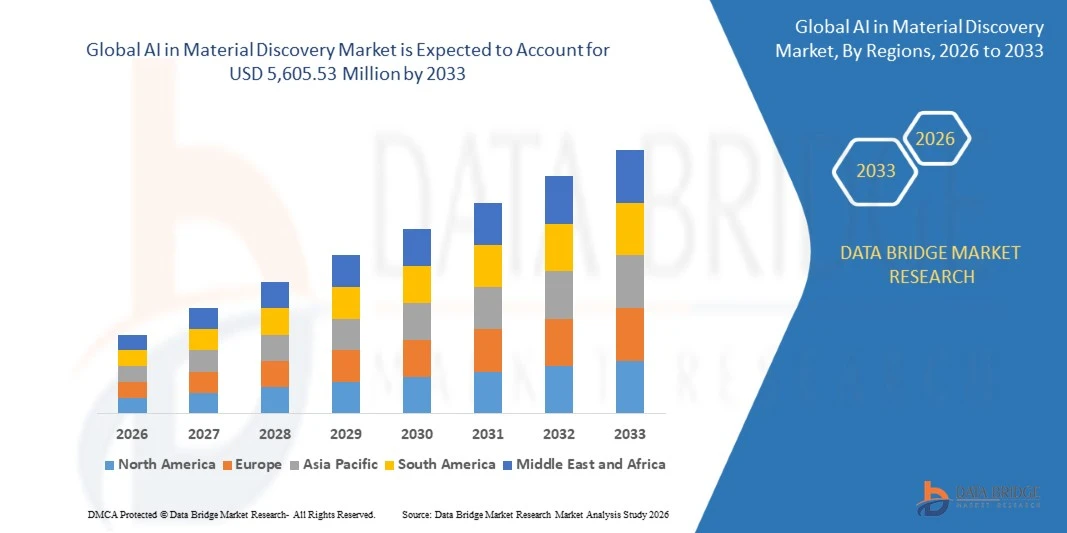
- As per Data Bridge Market Research analysis, the AI in material discovery market was valued at USD 740.10 million in 2025 and is projected to reach USD 5,605.53 million by 2033, growing at a CAGR of 28.80% from 2026 to 2033.
- The market is experiencing rapid growth driven by rising demand for advanced materials, breakthroughs in artificial intelligence and machine learning, and expanding applications across battery technology, semiconductors, chemicals, aerospace, and pharmaceutical research.
- The increasing need to accelerate material development, reduce research costs, and improve material performance is compelling manufacturers, research institutions, and technology companies to adopt AI-powered discovery platforms. Machine learning, generative AI, and predictive modeling are transforming traditional trial-and-error experimentation by enabling faster material screening, property prediction, and the identification of innovative materials for energy storage, electronics, and industrial applications.
Market Size & Forecast
- Global Market Value (2025): USD 740.10 Million
- Expected Market Value (2033): USD 5,605.53 Million
- Forecast CAGR (2026–2033): 28.80%
- Leading Region in 2025: North America
- Fastest Growing Region: Asia Pacific
What are the Major Takeaways of the AI in Material Discovery Market?
- North America dominated the AI in material discovery market with the largest revenue share of 41.6% in 2025, supported by advanced AI research infrastructure, strong technology investments, and collaboration among universities, research institutions, and material science companies.
- Asia-Pacific is expected to be the fastest-growing region at a CAGR of 31.0% from 2026 to 2033, fueled by expanding semiconductor manufacturing, increasing battery production, and rising investments in AI-powered materials research
- The software segment led the market with a 55.0% share in 2025, driven by increasing adoption of AI-powered materials informatics platforms, predictive modeling tools, and computational simulation software.
- Services are the fastest-growing component type, projected to register a CAGR of 30.2%, reflecting the surge in demand for specialized implementation and technical expertise.
- The chemicals segment dominated the material type category with a 30.0% revenue share in 2025, led by increasing adoption of AI for chemical formulation optimization, catalyst development, and specialty material discovery.
- Machine learning accounted for 36.0% of the market share in 2025, preferred by its widespread use in material property prediction, composition optimization, and candidate screening.
- The battery and energy storage material discovery segment is the fastest-growing application category, with a CAGR of 32.2%, driven by increasing demand for improved battery performance, energy density, charging speed, and safety
Report Scope and AI in Material Discovery Market Segmentation
|
Attributes |
AI in Material Discovery Key Market Insights |
|
Segments Covered |
|
|
Countries Covered |
North America
Europe
Asia-Pacific
Middle East and Africa
South America
|
|
Key Market Players |
|
|
Market Opportunities |
|
|
Value Added Data Infosets |
In addition to the market insights such as market value, growth rate, market segments, geographical coverage, market players, and market scenario, the market report curated by the Data Bridge Market Research team includes in-depth expert analysis, import/export analysis, pricing analysis, production consumption analysis, and pestle analysis. |
What is the Key Trend in the AI in Material Discovery Market?
- Generative AI and foundation models are increasingly being adopted in material discovery to design novel compounds, predict material properties, and identify materials with specific chemical, mechanical, and electronic characteristics, reducing dependence on conventional trial-and-error research.
- For instance, in January 2025, Nature published research on MatterGen, a generative AI model developed to design inorganic materials with targeted chemical, structural, mechanical, electronic, and magnetic properties. The study demonstrated the potential of generative AI to accelerate the discovery of novel functional materials.
- AI-powered platforms are enabling researchers to explore a broader range of material compositions and accelerate the identification of candidates for batteries, semiconductors, solar cells, and advanced industrial applications.
- Integration of machine learning with computational simulations is improving the screening of potential materials before laboratory synthesis, helping researchers prioritize promising candidates and optimize research workflows.
- Autonomous laboratories are increasingly combining AI algorithms, robotics, and real-time experimental feedback to automate material synthesis, characterize results, and refine subsequent experiments.
- For instance, in October 2025, Nature Materials published research on SCIGEN, a generative AI framework that incorporates structural constraints to discover candidate quantum materials. The study generated more than 10 million inorganic compounds and used computational screening to identify promising structures, highlighting advances in AI-driven materials design
- As researchers increasingly prioritize faster material development, customized material properties, and automated experimentation, the adoption of generative AI and autonomous discovery platforms is expected to expand, strengthening the role of AI across the materials research and development lifecycle.
What are the Key Drivers of the AI in Material Discovery Market?
- The growing demand for advanced materials in batteries, semiconductors, renewable energy, and aerospace has significantly increased the need for AI-powered platforms capable of predicting material properties and identifying promising compounds more efficiently.
- For instance, in November 2023, Nature published research on Google DeepMind’s GNoME deep-learning system, which identified 2.2 million potential crystal structures, including 381,000 predicted stable materials, expanding the pool of candidates for applications in batteries, semiconductors, and other advanced technologies.
- Manufacturers, technology companies, and research institutions are integrating AI into material development to reduce computational screening time, improve research productivity, and accelerate the development of materials with application-specific performance characteristics.
- Increasing access to computational materials databases, machine-learning algorithms, and high-performance computing is further enabling researchers to analyze complex material structures and evaluate potential compounds before committing resources to physical experiments.
- For instance, in March 2024, Chemical Science, published by the Royal Society of Chemistry, reported research using AI-guided computational screening and laboratory synthesis to discover two novel calcium ruthenate phases, demonstrating the potential of AI to accelerate inorganic materials research and experimental validation
- With industries increasingly relying on advanced materials to improve energy efficiency, electronic performance, and manufacturing capabilities, AI-driven discovery platforms are expected to remain important tools for accelerating innovation and reducing development bottlenecks.
What Factors are Challenging the Growth of the AI in Material Discovery Market?
- AI-based material discovery requires access to large, reliable, and standardized datasets, significant computational resources, and specialized scientific expertise to develop accurate predictive models and validate proposed materials.
- For instance, in March 2023, npj Computational Materials published a review titled Small Data Machine Learning in Materials Science, highlighting how limited training datasets can restrict model accuracy and increase the risk of overfitting, creating challenges for reliable AI-driven material discovery.
- Inconsistent experimental data, limited information about unsuccessful synthesis attempts, and differences between computational predictions and real-world laboratory outcomes can reduce model reliability and restrict commercial adoption.
- The need for experimental verification, model interpretability, specialized infrastructure, and integration with existing laboratory workflows continues to increase implementation complexity, particularly for smaller research organizations and manufacturers with limited technical resources.
- For instance, in February 2024, Digital Discovery, published by the Royal Society of Chemistry, reported challenges in reproducing results from a materials informatics machine-learning framework, identifying issues involving software dependencies, version tracking, code organization, and documentation that can hinder reproducibility and trust in AI-based research
- These technical and operational challenges can slow the commercialization of AI-generated materials, as predicted compounds must still demonstrate practical synthesizability, reproducibility, safety, and performance under real-world conditions before widespread industrial adoption.
How is the AI in Material Discovery Market Segmented?
The AI in material discovery market is segmented on the basis of component, material type, technology, and application.
- By Component
On the basis of component, the AI in material discovery market is segmented into software, hardware, and services. The software segment dominated the market with an estimated 55.0% share in 2025, owing to increasing adoption of AI-powered materials informatics platforms, predictive modeling tools, and computational simulation software. These solutions enable researchers to analyze scientific datasets, predict material properties, and screen potential compounds before laboratory experiments. Integration with molecular modeling systems and high-performance computing infrastructure is further enhancing their capabilities. Software platforms also support material design, data visualization, and research workflow automation. Growing adoption of machine learning and generative AI is strengthening software demand across chemical manufacturing, electronics, and energy storage.
The services segment is expected to witness the fastest growth at CAGR of 30.2% during forecast period, driven by increasing demand for specialized implementation and technical expertise. These services include AI model development, scientific data preparation, platform integration, and computational research consulting. Materials companies often require expert assistance to incorporate AI tools into existing research and development workflows. Service providers also help organizations validate predictions and interpret complex computational results. Growing demand for customized AI applications is supporting consulting and integration activities. Collaboration between software vendors, materials scientists, and industrial manufacturers is expanding service requirements.
- By Material Type
On the basis of material type, the AI in material discovery market is segmented into polymers, metals and alloys, ceramics, composites, nanomaterials, semiconductors, chemicals, biomaterials, and others. The chemicals segment dominated the market with an estimated 30.0% share in 2025, supported by increasing adoption of AI for chemical formulation optimization, catalyst development, and specialty material discovery. Chemical manufacturers use machine learning models to analyze molecular structures and predict chemical properties before experimental testing. AI-powered screening also helps identify promising compounds for coatings, adhesives, industrial chemicals, and high-performance polymers. Integration of computational chemistry and predictive analytics is improving research efficiency and reducing unnecessary laboratory experiments. Growing demand for advanced chemical formulations across manufacturing, energy, and electronics is further supporting adoption.
The semiconductors segment is expected to witness the fastest growth at CAGR of 30.1% during forecast period, driven by increasing demand for advanced electronic materials and next-generation chip technologies. AI-powered discovery platforms enable researchers to evaluate semiconductor compositions, predict electrical properties, and identify materials suitable for electronic applications. Growing complexity in chip manufacturing is increasing the need for materials that provide improved conductivity, thermal stability, and energy efficiency. AI-based computational screening helps researchers investigate candidate materials before committing to costly fabrication processes. Increasing investments in artificial intelligence infrastructure, power electronics, and advanced semiconductor manufacturing are creating additional demand. Integration of machine learning with atomistic simulations is expanding the range of material properties that can be evaluated
- By Technology
On the basis of technology, the AI in material discovery market is segmented into machine learning, deep learning, generative artificial intelligence, natural language processing, predictive analytics, graph neural networks, and others. The machine learning segment dominated the market with an estimated 36.0% share in 2025, owing to its widespread use in material property prediction, composition optimization, and candidate screening. Machine learning algorithms identify relationships between material structures, compositions, and performance characteristics using experimental and computational data. These capabilities enable researchers to prioritize promising materials and reduce repetitive testing. Supervised and unsupervised learning techniques also support material classification and pattern identification in complex datasets. Integration with simulation software and scientific databases is further improving model utility.
The generative artificial intelligence segment is expected to register the fastest growth at an CAGR of 37.1% during forecast period, driven by increasing demand for AI systems capable of designing materials with targeted properties. Generative models can propose novel molecular structures and material compositions that may not be readily identified through conventional screening. Researchers can use these systems to explore candidate materials with specific mechanical, chemical, thermal, or electronic characteristics. Advances in foundation models and generative algorithms are expanding their application in battery materials, catalysts, polymers, and semiconductor research. Integration with computational simulations enables proposed materials to be evaluated before physical synthesis. Increasing interest in accelerated materials innovation is encouraging research institutions and manufacturers to adopt these technologies.
- By Application
On the basis of application, the AI in material discovery market is segmented into material property prediction, molecular modeling and simulation, battery and energy storage material discovery, semiconductor and electronics material discovery, drug and pharmaceutical material discovery, catalyst discovery and optimization, polymer design and development, materials synthesis route prediction, and others. The material property prediction segment dominated the market with an estimated 38.0% share in 2025, driven by increasing demand for accurate predictions of material characteristics before laboratory validation. AI models help researchers estimate mechanical strength, thermal stability, electrical conductivity, and chemical reactivity. These predictions enable research teams to screen candidate materials more efficiently and prioritize promising compositions. Integration with computational materials science tools improves the analysis of complex structure-property relationships. Manufacturers also use predictive models to guide product development and optimize material performance.
The battery and energy storage material discovery segment is expected to witness the fastest growth at CAGR of 32.2% during forecast period, driven by increasing demand for improved battery performance, energy density, charging speed, and safety. AI-based platforms help researchers identify and evaluate electrode materials, electrolytes, and other battery components with promising electrochemical properties. Machine learning models analyze experimental datasets to predict battery behavior and identify candidate compositions for further testing. Growing electric vehicle adoption and investments in renewable energy storage are increasing the need for advanced battery technologies. AI-guided screening can also help researchers investigate alternatives to expensive or supply-constrained raw materials. Integration with automated laboratories and computational simulations is accelerating battery research workflows.
Which Region Holds the Largest Share of the AI in Material Discovery Market?
- North America dominated the AI in material discovery market with the largest revenue share of 41.6% in 2025, supported by advanced AI research infrastructure, strong technology investments, and collaboration among universities, research institutions, and material science companies.
- The region also benefits from strong collaboration among universities, government laboratories, and industrial manufacturers, alongside growing adoption of AI-powered research platforms across pharmaceuticals, semiconductors, chemicals, and energy storage. Increasing investments in high-performance computing, generative AI, and computational materials science continue to strengthen North America's leadership position in the global market.
U.S. AI in Material Discovery Market Insight
The U.S. AI in material discovery market is witnessing strong growth due to rising investments in artificial intelligence research, advanced materials development, and computational chemistry technologies. The country’s mature technology ecosystem, along with increasing adoption of machine learning, generative AI, and predictive modeling systems, is driving demand across semiconductor, pharmaceutical, chemical, and energy storage applications. In addition, growing emphasis on accelerating research and development, reducing material discovery costs, and improving material performance is accelerating the adoption of AI-driven discovery platforms.
Asia-Pacific AI in Material Discovery Market Insight
The Asia-Pacific AI in material discovery market is expected to witness rapid growth, driven by expanding electronics manufacturing, increasing investments in artificial intelligence, and rising demand for advanced materials across countries such as China, Japan, and India. Growing adoption of machine learning, deep learning, and simulation technologies, along with increasing demand for innovative battery, semiconductor, and chemical materials, is supporting regional market expansion. In addition, rising investments in research infrastructure and collaborations between technology companies, universities, and materials science institutes are accelerating AI adoption across industrial and academic sectors.
Japan AI in Material Discovery Market Insight
The Japan AI in material discovery market is witnessing consistent growth due to rising investments in advanced materials research, semiconductor innovation, and artificial intelligence technologies. Electronics manufacturers, automotive companies, and research institutes are increasingly adopting AI-powered platforms to accelerate material screening, predict material properties, and improve research and development efficiency. Moreover, increasing demand for high-performance battery materials, advanced polymers, and next-generation electronic components is further contributing to market growth in Japan.
China AI in Material Discovery Market Insight
The China AI in material discovery market is growing rapidly, driven by expanding semiconductor production, increasing investments in artificial intelligence, and rising government focus on technological self-reliance. Growing adoption of AI-enabled material modeling and predictive analytics across battery manufacturing, electronics, chemicals, and advanced materials research is significantly boosting market demand. In addition, rising investments in domestic research capabilities, energy storage technologies, and high-performance materials are positioning China as a key growth market for AI-driven material discovery.
U.K. AI in Material Discovery Market Insight
The U.K. AI in material discovery market is experiencing steady growth, supported by rising adoption of artificial intelligence in scientific research, pharmaceutical development, and advanced materials engineering. Increasing investments in AI research infrastructure and growing demand for efficient, data-driven material screening solutions are contributing to market growth. Furthermore, integration of machine learning, generative AI, and computational modeling is improving material prediction and research efficiency, positioning the U.K. as an important innovation hub in the AI in material discovery industry.
Germany AI in Material Discovery Market Insight
The Germany AI in material discovery market is expanding steadily due to the country’s strong industrial manufacturing base, advanced engineering capabilities, and increasing adoption of next-generation AI technologies. Automotive manufacturers, chemical companies, semiconductor developers, and research institutes are increasingly utilizing AI platforms for material design, property prediction, and research and development activities. Continuous advancements in machine learning, computational simulation, and data-driven materials engineering, along with strong industry focus on innovation and manufacturing efficiency, are further driving market growth in Germany.
Which are the Top Companies in AI in Material Discovery Market?
The AI in material discovery industry is primarily led by well-established companies, including:
- Citrine Informatics, Inc. (U.S.)
- Schrödinger, Inc. (U.S.)
- Materials.Zone Technologies Ltd. (Israel)
- Kebotix, Inc. (U.S.)
- Aionics, Inc. (U.S.)
- CuspAI Ltd. (U.K.)
- Preferred Computational Chemistry, Inc. (Japan)
- Enthought, Inc. (U.S.)
- UL Research Institutes (U.S.)
- Discovered Materials (U.S.)
- Yonder Materials (U.S.)
- Doublet Labs (U.S.)
- Thetic (U.K.)
- XtalPi Holdings Limited (China)
- SES AI Corporation (U.S.)
- QuantumScape Corporation (U.S.)
- Schrödinger Materials Science (U.S.)
- NVIDIA Corporation (U.S.)
- International Business Machines Corporation (U.S.)
- Microsoft Corporation (U.S.)
What are Latest Developments in AI in Material Discovery Market?
- In June 2025, Aionics launched its Artificial Molecular Intelligence (AMI) platform, designed to accelerate formulation development for battery electrolytes and other chemical applications. The platform uses AI to screen complex chemical formulations while accounting for molecular interactions and practical formulation constraints, helping researchers evaluate potential materials more efficiently. This launch highlights the growing role of specialized AI systems in accelerating materials research and battery innovation.
- In April 2025, SES AI announced its Molecular Universe MU-0 material discovery platform, combining physics-based methods and artificial intelligence to support the discovery of battery materials. The company planned to demonstrate the software and services platform to showcase how AI-enabled molecular analysis could support the development of advanced lithium-metal and lithium-ion battery technologies. This development reflects the increasing use of AI-driven tools to accelerate materials discovery for energy storage.
- In July 2024, researchers at SLAC National Accelerator Laboratory and Stanford University introduced an AI-based approach to targeted materials discovery. The method was designed to improve the efficiency of collecting and analyzing data while searching for materials with specific properties. The research could help scientists identify promising candidates for applications ranging from climate technologies to quantum computing, while supporting the development of more automated experimental workflows.
- In November 2023, Google DeepMind announced that its GNoME deep-learning tool had predicted 2.2 million new crystal structures, including approximately 380,000 predicted to be stable and potentially useful for future technologies. The team made the promising predicted structures available to the research community through the Materials Project, supporting further investigation into materials for batteries, electronics, and other applications. The development demonstrated how AI could expand the range of candidate materials available for scientific testing.
- In July 2021, Preferred Computational Chemistry launched Matlantis as a cloud-based atomistic simulation service. Developed with Preferred Networks and ENEOS, the platform integrated deep learning with conventional physical simulation to accelerate the analysis of atomic-scale material behavior. Its approach was designed to help industrial and academic researchers explore a wider range of potential materials more efficiently, marking an important early commercial development in AI-powered materials discovery.

- Interactive Data Analysis Dashboard
- Company Analysis Dashboard for high growth potential opportunities
- Research Analyst Access for customization & queries
- Competitor Analysis with Interactive dashboard
- Latest News, Updates & Trend analysis
- Harness the Power of Benchmark Analysis for Comprehensive Competitor Tracking
Data collection and base year analysis are done using data collection modules with large sample sizes. The stage includes obtaining market information or related data through various sources and strategies. It includes examining and planning all the data acquired from the past in advance. It likewise envelops the examination of information inconsistencies seen across different information sources. The market data is analysed and estimated using market statistical and coherent models. Also, market share analysis and key trend analysis are the major success factors in the market report. To know more, please request an analyst call or drop down your inquiry.
The key research methodology used by DBMR research team is data triangulation which involves data mining, analysis of the impact of data variables on the market and primary (industry expert) validation. Data models include Vendor Positioning Grid, Market Time Line Analysis, Market Overview and Guide, Company Positioning Grid, Patent Analysis, Pricing Analysis, Company Market Share Analysis, Standards of Measurement, Global versus Regional and Vendor Share Analysis. To know more about the research methodology, drop in an inquiry to speak to our industry experts.
Data Bridge Market Research is a leader in advanced formative research. We take pride in servicing our existing and new customers with data and analysis that match and suits their goal. The report can be customized to include price trend analysis of target brands understanding the market for additional countries (ask for the list of countries), clinical trial results data, literature review, refurbished market and product base analysis. Market analysis of target competitors can be analyzed from technology-based analysis to market portfolio strategies. We can add as many competitors that you require data about in the format and data style you are looking for. Our team of analysts can also provide you data in crude raw excel files pivot tables (Fact book) or can assist you in creating presentations from the data sets available in the report.