


AI in Neurology Market Size
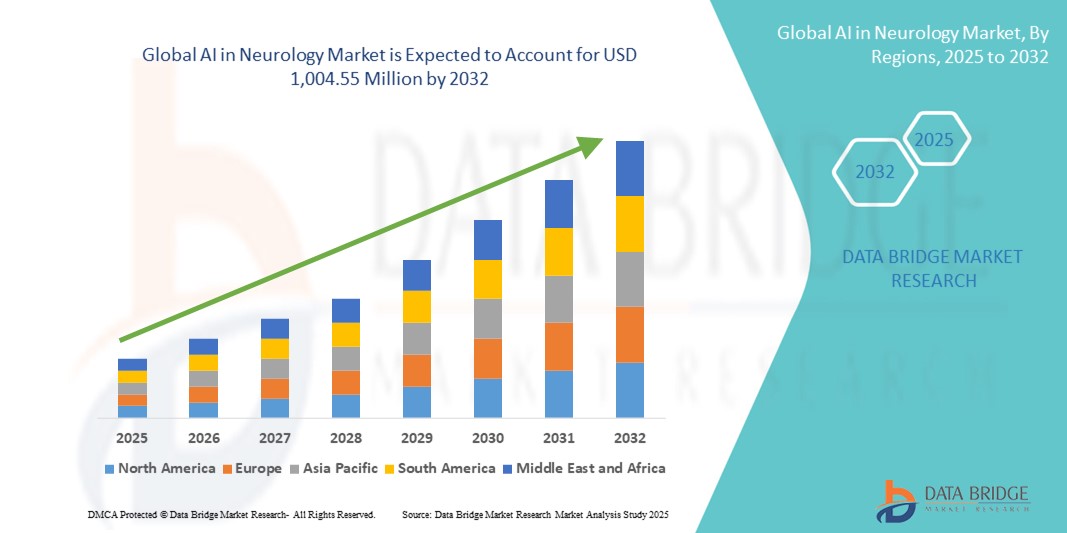
- The global AI in neurology market size was valued at USD 67.29 million in 2024 and is expected to reach USD 1,004.55 million by 2032, at a CAGR of 40.20% during the forecast period
- The market growth is largely fueled by the growing adoption of AI technologies and advancements in medical imaging, diagnostics, and data analytics across neurology. The integration of artificial intelligence into neurological applications is revolutionizing the way disorders such as epilepsy, Alzheimer’s disease, Parkinson’s disease, multiple sclerosis, and brain tumors are diagnosed, monitored, and treated
- Furthermore, the rising demand for secure, accurate, and real-time neurological data processing is establishing AI-powered tools as the go-to solution for neurologists and healthcare providers. These converging factors are accelerating the uptake of AI in neurology solutions, thereby significantly boosting the industry's growth
AI in Neurology Market Analysis
- AI technologies, offering data-driven support in diagnosis, treatment planning, and patient monitoring, are becoming increasingly vital in neurology due to their ability to analyze complex datasets, improve diagnostic accuracy, and facilitate personalized care across both clinical and research settings
- The accelerating demand for AI in neurology is primarily fueled by the growing prevalence of neurological disorders, the need for faster and more precise diagnostics, and technological advancements in imaging, machine learning, and real-time data processing
- North America dominated the AI in Neurology market with the largest revenue share of 41.2% in 2024, characterized by robust healthcare infrastructure, high R&D investments, and early adoption of AI technologies in medical imaging and neurosurgical applications. The U.S. leads the region with rapid integration of AI in brain-computer interface (BCI), diagnostics, and robotic neurosurgery platforms
- Asia-Pacific is expected to be the fastest-growing region in the AI in Neurology market during the forecast period, projected to expand at a CAGR of around 37.1% from 2024 to 2030. This growth is driven by increasing healthcare digitization, supportive government initiatives, and rising investments in AI-based healthcare solutions in countries such as China, Japan, and India
- Neuro-technology dominated the segment with a mark AI in Neurology market et share of 62.3% in 2024, driven by rising adoption of AI in neuroimaging, brain-computer interface systems, and disease monitoring tools
Report Scope and AI in Neurology Market Segmentation
|
Attributes |
AI in Neurology Key Market Insights |
|
Segments Covered |
|
|
Countries Covered |
North America
Europe
Asia-Pacific
Middle East and Africa
South America
|
|
Key Market Players |
|
|
Market Opportunities |
|
|
Value Added Data Infosets |
In addition to the insights on market scenarios such as market value, growth rate, segmentation, geographical coverage, and major players, the market reports curated by the Data Bridge Market Research also include in-depth expert analysis, pricing analysis, brand share analysis, consumer survey, demography analysis, supply chain analysis, value chain analysis, raw material/consumables overview, vendor selection criteria, PESTLE Analysis, Porter Analysis, and regulatory framework. |
AI in Neurology Market Trends
“Enhanced Convenience Through AI and Intelligent Integration”
- A significant and accelerating trend in the global AI in Neurology market is the deeper integration of artificial intelligence (AI) technologies with intelligent software platforms and diagnostic tools. This evolution is reshaping how clinicians and researchers engage with neurology solutions, enabling smarter decision-making and highly efficient workflows
- For instance, Brainomix’s AI-powered software aids in faster and more accurate stroke diagnosis by integrating seamlessly with hospital imaging systems, offering instant analysis and treatment recommendations. Likewise, Medtronic’s application of AI in neurostimulators enables automatic adjustments in therapy based on patient data patterns, optimizing outcomes in real time
- AI-powered neurology tools are increasingly capable of learning from patient data over time—refining diagnoses, suggesting personalized treatment paths, and detecting early warning signs of neurological deterioration. For instance, deep learning models are now helping interpret EEGs, MRIs, and CT scans with increasing precision, supporting faster and more accurate identification of conditions such as epilepsy or Parkinson’s disease
- The seamless integration of AI with existing hospital IT infrastructure enables centralized control and automated reporting, allowing clinicians to monitor neural patterns, patient responses, and recovery progress via a single intelligent interface. This not only improves workflow efficiency but also supports better patient outcomes through proactive and predictive care
- This transition toward more intelligent, adaptive, and interconnected neurology platforms is fundamentally reshaping expectations in clinical neurology. As a result, companies like Theator and Scalpel AI are developing next-generation surgical decision-support tools that harness real-time data and AI-driven recommendations during procedures
- The rising demand for AI-powered neurology systems is being seen across hospitals, diagnostics centers, and research institutions, as stakeholders increasingly seek scalable, data-driven solutions to improve neurological care, reduce diagnostic delays, and personalize therapeutic strategies
AI in Neurology Market Dynamics
Driver
“Growing Demand Due to Increasing Neurological Disorder Prevalence and Diagnostic Needs”
- The rising global prevalence of neurological disorders such as Alzheimer's disease, Parkinson’s disease, epilepsy, and stroke is significantly driving demand in the AI in Neurology market. As these conditions require early detection and long-term management, AI technologies are increasingly being adopted to improve diagnostic accuracy, monitor disease progression, and personalize treatment approaches
- For instance, in April 2024, researchers at the Mayo Clinic launched a pilot project using AI-enhanced EEG analysis to detect early-onset epilepsy with over 90% accuracy. Such breakthroughs highlight the growing role of AI in neurological diagnostics and are expected to spur adoption across hospitals and neurology clinics
- AI tools also enable neurologists to manage and interpret large volumes of complex brain imaging data with greater precision. These solutions reduce interpretation times and help identify patterns that may be overlooked by the human eye, contributing to improved patient outcomes
- Moreover, integration with digital health platforms allows for real-time monitoring and data-driven decision-making, creating opportunities for proactive and preventive neurological care. The shift towards personalized medicine further elevates the importance of AI, as it can tailor therapies based on patient-specific data such as imaging results, genetic profiles, and symptom history
- AI adoption is especially gaining momentum in North America and Europe due to strong healthcare infrastructure, high digital literacy, and growing investment in health tech. However, emerging economies are also recognizing the value of AI-powered neurology systems, particularly in resource-limited settings where specialists are scarce
Restraint/Challenge
“Data Privacy Concerns and High Implementation Costs”
- One of the primary challenges facing the AI in Neurology market is data privacy and security. AI systems rely on access to large volumes of sensitive patient data, including imaging, biometrics, and clinical history. This raises concerns regarding data breaches, unauthorized access, and compliance with stringent regulations such as HIPAA in the U.S. and GDPR in Europe
- A notable instance includes a 2023 report by the European Data Protection Board, which warned of increasing AI-driven diagnostic tools operating without adequate data transparency, urging stricter monitoring of such systems in clinical settings
- In addition, the high implementation cost of AI solutions, including software, hardware, training, and infrastructure upgrades, can be a significant barrier for small clinics and hospitals, particularly in developing regions. While cloud-based and SaaS AI solutions are mitigating some of these costs, upfront investment remains a key concern
- Another issue is the lack of interoperability and standardization across AI platforms and hospital systems, which can complicate integration and reduce the efficiency of AI deployment in clinical workflows
- Overcoming these challenges requires continued focus on cybersecurity, the development of cost-effective AI tools, clear regulatory guidelines, and improved interoperability standards. Industry collaboration and public-private partnerships will also be crucial in expanding access and trust in AI-enabled neurology solutions
AI in Neurology Market Scope
The market is segmented on the basis of indication, application, type, technology, components, and end user:
- By Indication
On the basis of indication, the AI in Neurology market is segmented into neuro-technology and neurosurgery. Neuro-technology dominated the segment with a market share of 62.3% in 2024, driven by rising adoption of AI in neuroimaging, brain-computer interface systems, and disease monitoring tools.
Neurosurgery is projected to grow at the fastest CAGR of 22.6% from 2025 to 2032, as AI gains traction in robotic-assisted surgery and intraoperative decision-making.
- By Application
On the basis of application, the AI in neurology market is segmented into screening & diagnosis, treatment, research & development, training, surgical planning and rehabilitation, and others. Screening & diagnosis held the largest revenue share of 38.4% in 2024, owing to early AI integration into MRI/CT analysis and neurological disease detection.
Rehabilitation is expected to expand at the fastest CAGR of 23.9% from 2025 to 2032, with AI-driven tools increasingly used in neurotherapy and recovery tracking.
- By Type
On the basis of type, the AI in Neurology market is segmented into oncology, neurodegeneration, neurovascular, traumatic brain injury, and spinal cord injury. Neurodegeneration led the market with a share of 41.2% in 2024, fueled by the global burden of Alzheimer’s and Parkinson’s disease and rising AI use in early detection.
Oncology is expected to witness the highest CAGR of 24.7% during 2025–2032, driven by increasing reliance on AI for accurate tumor classification and treatment planning.
- By Technology
On the basis of technology, the AI in neurology market is segmented into machine learning and deep learning, natural language processing (NLP), and Others. Machine Learning and Deep Learning dominated with a revenue share of 66.1% in 2024, due to their widespread implementation in diagnostic algorithms and predictive analytics.
Natural Language Processing (NLP) is projected to grow at a fastest CAGR of 21.3%, as it enables real-time analysis of clinical notes, EMRs, and research databases.
- By Components
On the basis of components, the AI in neurology market is segmented into Hardware and Software-as-a-Service (SaaS). Software-as-a-Service (SaaS) accounted for 58.9% of the total market share in 2024, supported by the scalability and flexibility of cloud-based AI solutions.
Hardware is expected to grow steadily at a CAGR of 18.1%, with demand for AI-integrated imaging systems and monitoring devices increasing in neurology clinics and hospitals.
- By End User
On the basis of end user, the AI in neurology market is segmented into Hospitals, Diagnosis Centers, and Others. Hospitals held the largest share of 54.7% in 2024, driven by comprehensive deployment of AI solutions across inpatient neurology services and operating rooms.
Diagnosis Centers are forecasted to register the fastest CAGR of 22.4% from 2025 to 2032, due to the growing need for faster, AI-assisted diagnostics and remote access to neurological insights.
AI in Neurology Market Regional Analysis
- North America dominated the AI in neurology market with the largest revenue share of 41.2% in 2024, driven by significant investments in advanced neuro‑diagnostic platforms, broad adoption of AI‑enabled imaging tools, and robust healthcare infrastructure across the U.S. and Canada
- Consumers and healthcare providers in the region highly value the ability of AI systems to enhance diagnostic accuracy, speed decision‑making, and integrate seamlessly with electronic health records and clinical workflows
- This widespread adoption is further supported by high levels of healthcare digitization, strong R&D funding, and strategic collaborations between tech firms, academic institutions, and health systems
U.S. AI in Neurology Market Insight
The U.S., AI in neurology market contributing approximately 85% of North America’s AI in Neurology revenue in 2024, continues to lead the market. Fueled by early adoption of AI‑based neuroimaging solutions (e.g. machine‑learning analysis of MRI and EEG), cognitive assessment tools, and neurology‑focused digital health platforms, the United States remains the primary growth engine of the region. Regulatory support from the FDA and growing clinical interest in Alzheimer’s, stroke, and epilepsy detection are major drivers.
Europe AI in Neurology Market Insight
The Europe AI in neurology market is projected to grow at a robust CAGR through 2032, supported by national AI strategies (e.g. Germany’s “AI Made in Europe”) and expanded tele‑health infrastructure. Increasing urbanization and healthcare modernization are driving adoption of AI for diagnostic support, virtual neurology consultations, and neuro‑rehabilitation. European healthcare providers are increasingly investing in AI‑enabled systems for early detection and monitoring of neurological diseases.
U.K. AI in Neurology Market Insight
The U.K. AI in neurology market is expected to register one of Europe’s fastest growth rates in this sector. Growth is underpinned by NHS initiatives to modernize neurological diagnostics with AI tools—from dementia screening using speech analytics to movement monitoring for Parkinson’s disease. The country’s vibrant med‑tech startup ecosystem is accelerating deployment of novel AI solutions across neurology.
Germany AI in Neurology Market Insight
The Germany AI in neurology market shows promising growth potential, driven by a convergence of strong research infrastructure, healthcare digitization, and public support for health tech innovation. Providers increasingly utilize AI for image interpretation, predictive risk models, and workflow efficiency. Data privacy and ethical AI standards further reinforce patient trust, boosting adoption of neuro‑AI applications.
Asia‑Pacific AI in Neurology Market Outlook
The Asia‑Pacific AI in neurology market is forecasted to deliver the fastest regional CAGR of 37.1% from 2025 to 2032, with China, Japan, and India leading adoption. Rising neurological disease burden, expanding access to digital healthcare, and cost efficiency improvements in emerging markets support rapid deployment of AI‑based diagnostics and monitoring tools.
Japan AI in Neurology Market Insight
The Japan AI in neurology market aging demographics, high tech literacy, and national innovation programs are driving adoption of cognitive AI tools in neurologic care. Continuous-monitoring devices and predictive analytics tools for dementia and stroke rehabilitation are gaining traction in hospitals and elder‑care facilities.
China AI in Neurology Market Insight
The China AI in neurology market accounted for the largest share in Asia‑Pacific’s AI neurology sector in 2024. Rapid urbanization, government investment in digital health infrastructure (e.g. Healthy China 2030), widespread AI deployment in hospitals, and partnerships between local tech firms (e.g. Baidu, Alibaba Health) and hospital networks are fueling market expansion.
AI in Neurology Market Share
The AI in Neurology industry is primarily led by well-established companies, including:
- ActivSurgical Inc. (U.S.)
- Brainomix Limited (U.K.)
- Caresyntax Corp (U.S.)
- Neosama Inc. (Israel)
- ExplORer Surgical Corp. (U.S.)
- Surgalign Spine Technology Inc. (U.S.)
- LeanTaaS Inc. (U.S.)
- Medtronic Plc (Ireland)
- Scalpel Limited (U.K.)
- Theator Inc. (U.S.)
Latest Developments in Global AI in Neurology Market
- In July 2025, Synchron’s minimally invasive BCI (“Stentrode”) integrated with Nvidia AI and Apple Vision Pro Synchron introduced a next-generation brain-computer interface (BCI) that leverages Nvidia’s Holoscan AI platform and now features seamless integration with Apple Vision Pro, boosting accuracy and speed of decoding brain signals. Demonstrated by an ALS patient controlling home devices via thought alone, the initiative marks a significant step toward commercially viable, user-friendly AI for neurological assistive care
- In April 2025, Brainomix received FDA clearance for a new feature within its Brainomix 360 Stroke platform, enabling accurate ischemic core volume detection from non‑contrast CT scans. This AI-driven tool equips stroke care networks with faster, smarter, and more accessible tools for urgent stroke intervention

- Interactive Data Analysis Dashboard
- Company Analysis Dashboard for high growth potential opportunities
- Research Analyst Access for customization & queries
- Competitor Analysis with Interactive dashboard
- Latest News, Updates & Trend analysis
- Harness the Power of Benchmark Analysis for Comprehensive Competitor Tracking
Data collection and base year analysis are done using data collection modules with large sample sizes. The stage includes obtaining market information or related data through various sources and strategies. It includes examining and planning all the data acquired from the past in advance. It likewise envelops the examination of information inconsistencies seen across different information sources. The market data is analysed and estimated using market statistical and coherent models. Also, market share analysis and key trend analysis are the major success factors in the market report. To know more, please request an analyst call or drop down your inquiry.
The key research methodology used by DBMR research team is data triangulation which involves data mining, analysis of the impact of data variables on the market and primary (industry expert) validation. Data models include Vendor Positioning Grid, Market Time Line Analysis, Market Overview and Guide, Company Positioning Grid, Patent Analysis, Pricing Analysis, Company Market Share Analysis, Standards of Measurement, Global versus Regional and Vendor Share Analysis. To know more about the research methodology, drop in an inquiry to speak to our industry experts.
Data Bridge Market Research is a leader in advanced formative research. We take pride in servicing our existing and new customers with data and analysis that match and suits their goal. The report can be customized to include price trend analysis of target brands understanding the market for additional countries (ask for the list of countries), clinical trial results data, literature review, refurbished market and product base analysis. Market analysis of target competitors can be analyzed from technology-based analysis to market portfolio strategies. We can add as many competitors that you require data about in the format and data style you are looking for. Our team of analysts can also provide you data in crude raw excel files pivot tables (Fact book) or can assist you in creating presentations from the data sets available in the report.












