


AI in Video Surveillance Market Overview
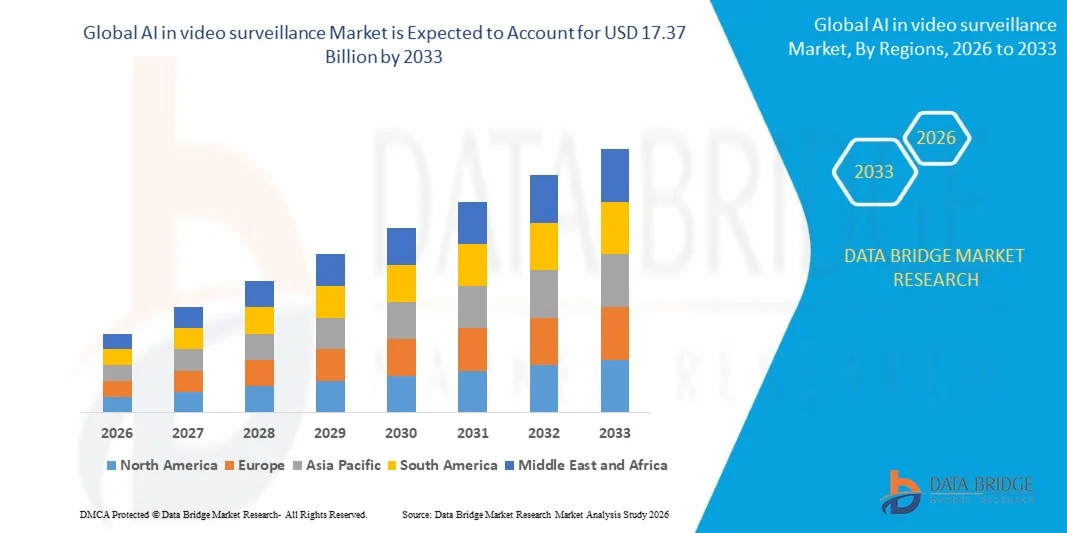
As per Data Bridge Market Research Analysis, the AI in video surveillance Market was valued at USD 5.41 billion in 2025 and is projected to reach USD 17.37 billion by 2033, growing at a CAGR of 15.70% from 2026 to 2033. The market is experiencing significant growth driven by the escalating demand for intelligent security solutions, rapid urbanization, and the proliferation of smart city initiatives worldwide. AI in video surveillance refers to the integration of artificial intelligence technologies such as machine learning, deep learning, computer vision, and generative AI into traditional surveillance systems to enable real-time threat detection, behavioral analysis, facial recognition, object identification, and predictive security capabilities. These advanced systems transform conventional cameras into intelligent sensors capable of analyzing video feeds, identifying anomalies, and alerting security personnel proactively. The market's expansion is further fueled by the growing adoption of cloud-based video management systems, advancements in edge computing, and increasing investments in public safety infrastructure. According to industry estimates, global data creation continues to rise exponentially, underscoring the critical need for AI-powered surveillance solutions that can efficiently process and analyze massive video data volumes.
Key Market Trends & Insights
- Asia Pacific dominated the AI in video surveillance Market with a share of 45–50% in 2025, driven by rapid urbanization, large-scale smart city projects, and the presence of major surveillance equipment manufacturers such as Hikvision and Dahua in China.
- North America held a significant market share in 2025, with the U.S. market estimated at USD 2.5 billion, supported by strong technological infrastructure, high adoption of advanced security solutions, and substantial investments in AI research and development.
- The Hardware segment dominated the market in 2025, driven by widespread deployment of AI-enabled cameras, storage systems, and edge surveillance infrastructure across smart city projects and commercial applications.
- The Software segment is expected to register the highest CAGR from 2026 to 2033, reflecting increasing demand for AI-driven video analytics, cloud-based platforms, and advanced video management solutions.
- The Generative AI segment is projected to record a CAGR of 25–30% during the forecast period, driven by the emergence of prompt-driven AI surveillance capabilities and zero-shot detection models.
- The Government & Public Facilities end-user segment dominated the market, supported by rising investments in public safety, law enforcement, and critical infrastructure protection.
- Growing adoption of edge-based AI processing is enhancing real-time analytics capabilities, reducing latency and bandwidth requirements for surveillance systems.
- Increasing integration of AI with IoT-enabled cameras and sensors is creating more interconnected and intelligent surveillance ecosystems.
Market Size & Forecast
- Global Market Value (2025): USD 5.41 Billion
- Expected Market Value (2033): USD 17.37 Billion
- Forecast CAGR (2026–2033): 15.70%
- Leading Region in 2025: Asia Pacific
- Fastest Growing Region: Asia Pacific
Report Scope and AI in Video Surveillance Market Segmentation
|
Attributes |
AI in video surveillance Key Market Insights |
|
Segments Covered |
|
|
Countries Covered |
North America · U.S. · Canada · Mexico Europe · Germany · France · U.K. · Netherlands · Switzerland · Belgium · Russia · Italy · Spain · Turkey · Rest of Europe Asia-Pacific · China · Japan · India · South Korea · Singapore · Malaysia · Australia · Thailand · Indonesia · Philippines · Rest of Asia-Pacific Middle East and Africa · Saudi Arabia · U.A.E. · South Africa · Egypt · Israel · Rest of Middle East and Africa South America · Brazil · Argentina · Rest of South America |
|
Key Market Players |
· Hangzhou Hikvision Digital Technology Co. Ltd. (China) · Dahua Technology Co. Ltd. (China) · Axis Communications AB (Sweden) · Motorola Solutions Inc. (USA) · Hanwha Vision Co. Ltd. (South Korea) · Bosch Sicherheitssysteme GmbH (Germany) · Honeywell International Inc. (USA) · NEC Corporation (Japan) · Verkada Inc. (USA) · Huawei Technologies Co. Ltd. (China) · Cisco Meraki (USA) · Johnson Controls International (Ireland) · Robert Bosch GmbH (Germany) · Siemens AG (Germany) · ASSA ABLOY (Sweden) · Fujitsu Limited (Japan) · AxxonSoft (Ireland) · Morphean SA (Switzerland) · Camcloud (Canada) · Simshine Intelligent Technology Co. Ltd. (China) |
|
Market Opportunities |
· Rising demand for prompt-driven and zero-shot AI surveillance capabilities enabling custom detection models through natural language instructions · Integration of generative AI and large language models for advanced video analytics and predictive security · Expansion of smart city initiatives and intelligent infrastructure projects across emerging economies · Growing adoption of cloud-based video management systems and hybrid deployment models |
|
Value Added Data Infosets |
In addition to the insights on market scenarios such as market value, growth rate, segmentation, geographical coverage, and major players, the market reports curated by the Data Bridge Market Research also include in-depth expert analysis, geographically represented company-wise production and capacity, network layouts of distributors and partners, detailed and updated price trend analysis and deficit analysis of supply chain and demand. |
AI in Video Surveillance Market Trends
Trend: Rise of Prompt-Driven and Zero-Shot AI Surveillance
The AI video surveillance industry is witnessing a paradigm shift with the emergence of prompt-driven AI surveillance capabilities. Organizations can now instantly create and deploy custom AI detection models through simple natural language prompts, eliminating the need for extensive training data and specialized data science expertise. Real-time zero-shot AI detection represents a new approach to deploying video analytics, allowing organizations to create custom surveillance capabilities using simple natural language instructions. This innovation is democratizing AI surveillance, enabling businesses of all sizes to deploy sophisticated security solutions quickly and cost-effectively. The technology significantly reduces deployment time, operational complexity, and reliance on specialized AI expertise.
AI in Video Surveillance Market Dynamics
Key Market Driver: Expansion of Smart City Initiatives
The expansion of smart city initiatives is a primary driver of the AI in video surveillance market. Smart city initiatives leverage technology, data, and innovation to improve urban living, sustainability, and efficiency, creating an ideal environment for AI-driven video surveillance systems. Investment in AI for smart cities is expected to increase from USD 37.4 billion in 2023 to USD 164 billion by 2030. These systems can harness data from interconnected infrastructures within smart cities, enabling sophisticated surveillance and analysis for enhanced security, traffic management, and public safety. Governments worldwide are investing heavily in smart city projects, with a particular focus on public safety, law enforcement, and critical infrastructure protection.
Key Restraint/Challenge: Data Privacy Regulations and Compliance Concerns
A significant challenge facing the AI in video surveillance market is the growing regulatory scrutiny and data privacy concerns surrounding AI-powered surveillance. Regulations such as the General Data Protection Regulation (GDPR) in Europe impose strict requirements on the collection, storage, and processing of personal data, including video footage. Organizations must navigate complex compliance landscapes while deploying AI surveillance systems, balancing security needs with privacy rights. Regulatory pressures are encouraging businesses and governments to adopt AI-driven surveillance technologies with privacy-conscious features, such as anonymizing sensitive information and ensuring secure data storage. However, compliance costs and legal uncertainties may slow adoption in certain regions and applications.
Key Market Opportunity: Generative AI and Advanced Analytics
The integration of generative AI and large language models into video surveillance presents a significant growth opportunity. Generative AI is enabling new capabilities such as prompt-based detection model creation, natural language querying of video archives, and predictive security analytics. The Generative AI segment is projected to record a CAGR of 25–30% during the forecast period. Organizations can now create custom surveillance capabilities using simple natural language instructions, democratizing AI access and reducing deployment complexity. As AI models continue to advance, the range of applications for AI video surveillance is expanding across retail analytics, traffic management, industrial safety, and crowd monitoring.
AI in Video Surveillance Market Scope
The AI in video surveillance market is segmented on the basis of offering, deployment, technology, application, and end user.
-
By Offering
On the basis of offering, the AI in video surveillance Market is segmented into hardware, software and services. The Hardware segment dominated the market in 2025, supported by widespread deployment of AI-enabled cameras, storage systems, monitoring equipment, and edge surveillance infrastructure across smart city projects and commercial applications. AI cameras, including PTZ, dome, bullet, panoramic, and fisheye variants, represent the largest hardware category. The Software segment is expected to register the highest CAGR from 2026 to 2033, reflecting increasing demand for AI-driven video analytics, cloud-based video management platforms, and advanced analytics solutions. Software solutions include video management systems, AI-driven analytics platforms, and cloud-based services that enable real-time threat detection, facial recognition, and behavioral analysis.
-
By Deployment:
On the basis of deployment, the AI in video surveillance Market is segmented into edge-based and cloud-based. Edge-based deployment dominated the market in 2025, driven by the need for low-latency processing, real-time threat detection, and reduced bandwidth requirements. By embedding analytics closer to the point of capture, AI allows surveillance to move from retrospective review to immediate interpretation. The Cloud-based segment is expected to register the highest CAGR from 2026 to 2033, driven by the expansion of cloud-based video management systems, integration of AI with IoT-enabled cameras, and increasing adoption of hybrid deployment models.
-
By Technology
On the basis of technology, the AI in video surveillance Market is segmented into computer vision, deep learning, machine learning, generative AI and natural language processing. Computer vision and deep learning technologies dominate the market, enabling advanced capabilities such as facial recognition, object detection, and anomaly detection. The Generative AI segment is expected to record the highest CAGR from 2026 to 2033, reflecting the emergence of prompt-driven AI surveillance capabilities and zero-shot detection models.
-
By Application
On the basis of application, the AI in video surveillance Market is segmented into security & public safety, traffic monitoring & management, intelligent transportation system, retail management, urban planning & smart cities and others. Security & Public Safety dominated the market in 2025, driven by increasing demand for real-time threat detection, crime prevention, crowd monitoring, and emergency response management. Retail Management is experiencing strong growth due to AI applications in customer behavior tracking, store layout optimization, and inventory management.
· By End User
On the basis of end user, the AI in video surveillance Market is segmented into government & public facilities, commercial, military & defense, industrial, residential and critical infrastructure. The Government & Public Facilities segment dominates the market, supported by rising investments in public safety, law enforcement, and critical infrastructure protection. The Commercial segment is experiencing significant growth, driven by increasing adoption of AI surveillance in retail, hospitality, and corporate environments.
AI in Video Surveillance Market Regional Analysis
Asia Pacific AI in Video Surveillance Market Insight
Asia Pacific dominated the AI in video surveillance market with a share of 45–50% in 2025, driven by rapid urbanization, large-scale smart city projects, and the presence of major surveillance equipment manufacturers such as Hikvision and Dahua in China. China, the world's second largest economy, is forecast to reach a projected market size of USD 8.4 billion by 2032, trailing a CAGR of 28.3%. Countries including India, Japan, South Korea, and Southeast Asian nations are witnessing significant investments in smart city infrastructure and public safety initiatives. The region's strong manufacturing base, growing technology adoption, and government support for AI innovation reinforce Asia Pacific's leadership position in the global market.
North America AI in Video Surveillance Market Insight
North America holds a significant share of the AI in video surveillance Market, with the U.S. market estimated at USD 2.5 billion in 2025. The region is expected to be a key growth market, fueled by strong technological infrastructure, high adoption of advanced security solutions, and substantial investments in AI research and development. The United States maintains its leadership position in AI innovation, with major technology companies and surveillance providers driving continuous advancements in AI-powered video analytics. The region's mature security ecosystem, robust venture capital funding for AI startups, and favorable regulatory environment for technology innovation further accelerate market growth.
Europe AI in Video Surveillance Market Insight
Europe represents a mature and technologically advanced market for AI in video surveillance, supported by strong regulatory frameworks governing data privacy, high security standards, and significant investments in public safety infrastructure. Germany is forecast to grow at approximately 20.9% CAGR, while Japan and Canada are each forecast to grow at CAGRs of 26.8% and 26.0% respectively. The region benefits from the presence of leading surveillance technology companies, established security integrators, and a strong focus on innovation and quality. Continuous investments in urban security, critical infrastructure protection, and compliance with GDPR requirements are driving market growth across Western and Eastern European countries.
AI in Video Surveillance Market Share
The AI in video surveillance industry is primarily led by well-established companies, including:
- Hangzhou Hikvision Digital Technology Co. Ltd. (China)
- Dahua Technology Co. Ltd. (China)
- Axis Communications AB (Sweden)
- Motorola Solutions Inc. (USA)
- Hanwha Vision Co. Ltd. (South Korea)
- Bosch Sicherheitssysteme GmbH (Germany)
- Honeywell International Inc. (USA)
- NEC Corporation (Japan)
- Verkada Inc. (USA)
- Huawei Technologies Co. Ltd. (China)
- Cisco Meraki (USA)
- Johnson Controls International (Ireland)
- Robert Bosch GmbH (Germany)
- Siemens AG (Germany)
- ASSA ABLOY (Sweden)
- Fujitsu Limited (Japan)
- AxxonSoft (Ireland)
- Morphean SA (Switzerland)
- Camcloud (Canada)
- Simshine Intelligent Technology Co. Ltd. (China)
Latest Developments in AI in Video Surveillance Market
- In June 2026, Iveda, a provider of AI-driven video surveillance solutions, launched prompt-driven AI surveillance technology allowing users to instantly create and deploy custom AI detection models through simple natural language prompts. The introduction of real-time zero-shot AI detection represents a new approach to deploying video analytics, allowing organizations to create custom surveillance capabilities without extensive training data or specialized data science expertise.
- In May 2026, Hanwha Vision released its Wisenet 9 System-on-Chip (SoC), utilizing two neural processing units (NPUs) for advanced noise reduction and AI analytics capabilities. The SoC enables enhanced facial recognition, automatic number plate recognition, and advanced behavioral analytics directly at the edge.
- In April 2025, Axis Communications published its inaugural report "The State of AI in Video Surveillance 2025," highlighting current developments, key opportunities, future trends, and risks for AI in video-based security. The report emphasized how the integration of AI-based analytics capabilities turns network cameras into powerful, data-generating sensors.
- In February 2025, Qualcomm Incorporated announced a strategic partnership with India's leading video security company, CP PLUS, to expand its presence in the AI video intelligence market. The collaboration leverages Qualcomm's AI processors and CP PLUS's surveillance expertise to deliver advanced AI-powered security solutions.
- In October 2024, Motorola Solutions announced the acquisition of a leading AI video analytics provider to strengthen its portfolio of intelligent public safety solutions. The acquisition enhances Motorola's capabilities in real-time video analytics, facial recognition, and predictive security for law enforcement and critical infrastructure applications.
- In September 2024, Hangzhou Hikvision Digital Technology launched the next-generation Turbo HD 8.0 series featuring two-way audio for real-time communication, compact dual-lens cameras with 180-degree stitching technology, and Smart Hybrid Light for enhanced night vision. The PowerX DVR with AcuSense technology integrates AI-driven facial recognition and motion detection, reinforcing Hikvision's commitment to cutting-edge AI security solutions.
- In May 2024, Shield AI, a U.S.-based defense technology company specializing in autonomous systems, acquired Sentient Vision Systems Pty Ltd. to strengthen its video surveillance, anomaly detection, and remote guarding capabilities. The acquisition integrates Sentient Vision Systems' ViDAR optical-radar and AI video analytics technology with Shield AI's Hivemind autonomy stack.

- Interactive Data Analysis Dashboard
- Company Analysis Dashboard for high growth potential opportunities
- Research Analyst Access for customization & queries
- Competitor Analysis with Interactive dashboard
- Latest News, Updates & Trend analysis
- Harness the Power of Benchmark Analysis for Comprehensive Competitor Tracking
Global Ai In Video Surveillance Market, Supply Chain Analysis and Ecosystem Framework
To support market growth and help clients navigate the impact of geopolitical shifts, DBMR has integrated in-depth supply chain analysis into its Global Ai In Video Surveillance Market research reports. This addition empowers clients to respond effectively to global changes affecting their industries. The supply chain analysis section includes detailed insights such as Global Ai In Video Surveillance Market consumption and production by country, price trend analysis, the impact of tariffs and geopolitical developments, and import and export trends by country and HSN code. It also highlights major suppliers with data on production capacity and company profiles, as well as key importers and exporters. In addition to research, DBMR offers specialized supply chain consulting services backed by over a decade of experience, providing solutions like supplier discovery, supplier risk assessment, price trend analysis, impact evaluation of inflation and trade route changes, and comprehensive market trend analysis.
Data collection and base year analysis are done using data collection modules with large sample sizes. The stage includes obtaining market information or related data through various sources and strategies. It includes examining and planning all the data acquired from the past in advance. It likewise envelops the examination of information inconsistencies seen across different information sources. The market data is analysed and estimated using market statistical and coherent models. Also, market share analysis and key trend analysis are the major success factors in the market report. To know more, please request an analyst call or drop down your inquiry.
The key research methodology used by DBMR research team is data triangulation which involves data mining, analysis of the impact of data variables on the market and primary (industry expert) validation. Data models include Vendor Positioning Grid, Market Time Line Analysis, Market Overview and Guide, Company Positioning Grid, Patent Analysis, Pricing Analysis, Company Market Share Analysis, Standards of Measurement, Global versus Regional and Vendor Share Analysis. To know more about the research methodology, drop in an inquiry to speak to our industry experts.
Data Bridge Market Research is a leader in advanced formative research. We take pride in servicing our existing and new customers with data and analysis that match and suits their goal. The report can be customized to include price trend analysis of target brands understanding the market for additional countries (ask for the list of countries), clinical trial results data, literature review, refurbished market and product base analysis. Market analysis of target competitors can be analyzed from technology-based analysis to market portfolio strategies. We can add as many competitors that you require data about in the format and data style you are looking for. Our team of analysts can also provide you data in crude raw excel files pivot tables (Fact book) or can assist you in creating presentations from the data sets available in the report.













