What Is The AI In Warehousing Market Size And Growth Rate?
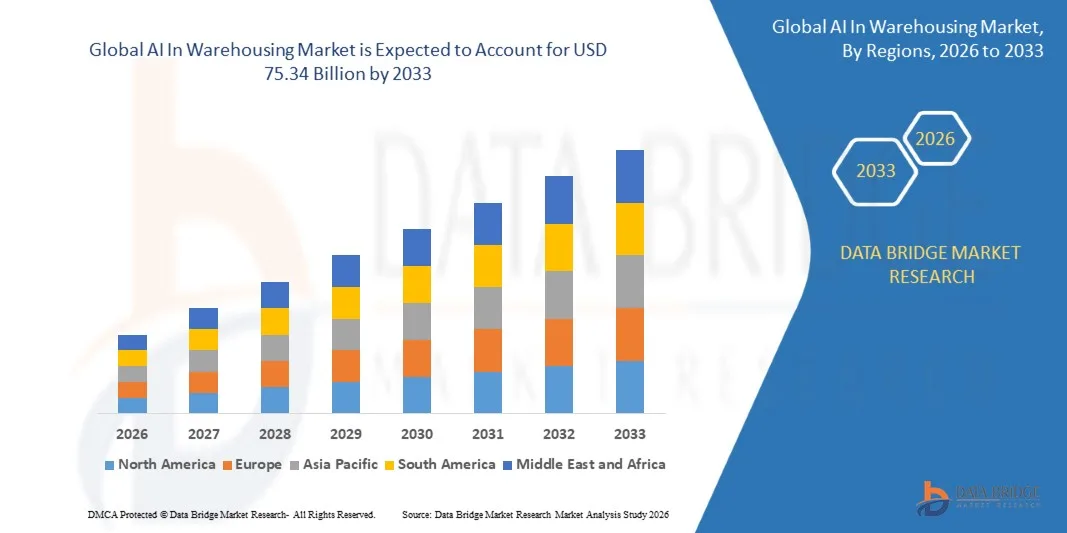
- As per Data Bridge Market Research analysis, the AI in warehousing market was valued at USD 12.40 billion in 2025 and is projected to reach USD 75.34 billion by 2033, growing at a CAGR of 25.30% from 2026 to 2033.
- The market is expanding due to rapid growth of e-commerce and faster delivery expectations, labor shortages and rising labor costs, growing adoption of robotics and sensors in warehouses, demand for accurate inventory and demand forecasting, expansion of cloud-based warehouse software, and growing investment in supply chain digitalization.
- AI is increasingly being used in warehouses for inventory tracking, order picking, slotting, labor planning, robot coordination, quality inspection, and demand forecasting, supported by machine learning, computer vision, autonomous mobile robots, Internet of Things sensors, cloud platforms, and growing supply from technology, robotics, and warehouse software companies.
Market Size & Forecast
- Global Market Value (2025): USD 12.40 billion
- Expected Market Value (2033): USD 75.34 billion
- Forecast CAGR (2026–2033): 25.30%
- Leading Region in 2025: North America
- Fastest Growing Region: Asia-Pacific
What Are The Major Takeaways Of The AI In Warehousing Market?
- North America dominated the global AI in warehousing market with a share of 41.00% in 2025, supported by a large e-commerce and retail sector, early adoption of warehouse automation, strong presence of technology and robotics providers, and high labor costs.
- Asia-Pacific is expected to be the fastest-growing regional market at a CAGR of 28.50% from 2026 to 2033, driven by rapid e-commerce growth, expansion of logistics infrastructure, manufacturing activity, government support for smart logistics, and growing adoption of automation.
- The hardware segment dominated the market by component with a share of 46.00% in 2025, supported by strong demand for robots, sensors, cameras, scanners, and automated storage and handling equipment.
- The order picking and fulfillment segment is expected to register the fastest growth among applications, at a CAGR of 28.20% from 2026 to 2033, driven by rising order volumes, same-day delivery expectations, and use of AI-guided picking and robots.
- The inventory management segment dominated the application category with a share of 30.00% in 2025, supported by the need for real-time stock visibility, accurate counts, and reduced stockouts and overstocking.
- The cloud segment dominated the deployment category with a share of 62.00% in 2025, supported by scalability, lower upfront costs, easy integration, and remote access to AI-based warehouse software.
- The e-commerce and retail segment dominated the end user category with a share of 42.00% in 2025, supported by high order volumes, fast delivery expectations, and large investment in fulfillment automation.
Report Scope And AI In Warehousing Market Segmentation
|
Attributes |
AI In Warehousing Key Market Insights |
|
Segments Covered |
|
|
Countries Covered |
North America
Europe
Asia-Pacific
Middle East and Africa
South America
|
|
Key Market Players |
|
|
Market Opportunities |
|
|
Value Added Data Infosets |
In addition to the insights on market scenarios such as market value, growth rate, segmentation, geographical coverage, and major players, the market reports curated by the Data Bridge Market Research also include in-depth expert analysis, pricing analysis, brand share analysis, consumer survey, demography analysis, supply chain analysis, value chain analysis, raw material/consumables overview, vendor selection criteria, PESTLE Analysis, Porter Analysis, and regulatory framework. |
What Is The Key Trend In The AI In Warehousing Market?
- Increasing use of AI-driven software to orchestrate robots, people, and inventory is becoming a major trend in the global AI in warehousing market, as operators look to raise throughput while labor remains constrained. Warehouse operators are moving from single-purpose automation toward platforms that coordinate picking, storage, and fulfillment in real time.
- Integration of robotics, computer vision, and cloud platforms is gaining importance as suppliers invest in autonomous mobile robots, vision-based inspection, and flexible automation that can be deployed in existing sites. Automation is also expanding into pharmaceuticals, healthcare, apparel, perishables, and third-party logistics, while partnerships and acquisitions broaden vendor portfolios.
- For instance, in April 2026, Ocado Intelligent Automation was reported to unveil Ocado IQ, a cloud-based AI software platform for warehouse picking, at the MODEX 2026 trade show.
- Overall, the AI in warehousing market is increasingly shaped by AI orchestration software, robotics, computer vision, cloud deployment, and flexible automation. AI in warehousing suppliers are therefore moving toward integrated platforms, faster deployment, and closer partnerships with logistics and retail customers.
What Are The Key Drivers Of The AI In Warehousing Market?
- Rapid growth of e-commerce and faster delivery expectations is becoming a major growth driver in the global AI in warehousing market, as rising order volumes and smaller order sizes increase pressure on picking, packing, and shipping speed. Labor shortages and rising labor costs further increase the need for automation and AI-based planning.
- Demand for inventory accuracy and cost reduction is gaining importance as operators seek to cut errors, stockouts, and handling costs. Adoption of robotics and Internet of Things sensors, scalable cloud software, and government support for smart logistics and digital transformation are further supporting market demand.
- For instance, in July 2026, Symbotic announced the acquisition of ARMS Innovations, a UK-based software company whose AI tools match tasks to available people or robots and manage problems in real time in automated warehouses.
- Overall, the AI in warehousing market is increasingly shaped by e-commerce growth, labor constraints, inventory accuracy needs, and automation investment. AI in warehousing suppliers are therefore moving toward end-to-end warehouse platforms, product innovation, and closer partnerships with retailers and logistics providers.
What Factors Are Challenging The Growth Of The AI In Warehousing Market?
- High upfront investment and integration complexity are becoming a major challenge in the global AI in warehousing market, as robots, sensors, and automated storage systems require significant capital and must connect with existing warehouse management and enterprise systems. Long implementation times and uncertain returns can delay adoption, especially for small and mid-sized operators.
- Data quality, cybersecurity concerns, skills shortages, and workforce acceptance are also restraining growth, as AI systems depend on accurate data, connected devices increase security risks, and operators need staff who can manage and maintain automation. Interoperability gaps between vendors and the disruption of retrofitting live warehouses further limit adoption.
- For instance, Ocado Intelligent Automation's Porter pallet-moving robot, shown in 2026, targets sites with tight layouts or mixed inventory and aims to modernize manual operations without major capital investment, reflecting the demand for lower-cost automation options.
- Overall, the global AI in warehousing market is increasingly shaped by capital cost, integration complexity, data and security risks, and skills requirements. AI in warehousing suppliers are therefore moving toward modular and flexible solutions, easier integration, stronger security, and training and support services.
How Is The AI In Warehousing Market Segmented?
The global AI in warehousing market is segmented on the basis of component, application, deployment, end user, and technology.
- By Component
On the basis of component, the global AI in warehousing market is segmented into hardware, software, and services. The hardware segment dominated the market with a share of 46.00% in 2025, supported by strong demand for robots, sensors, cameras, scanners, and automated storage and handling equipment.
The software segment is projected to grow at a CAGR of 27.50% from 2026 to 2033, driven by demand for AI-based warehouse management, planning, and orchestration platforms that improve the use of existing equipment and labor.
- By Application
On the basis of application, the global AI in warehousing market is segmented into inventory management, order picking and fulfillment, demand forecasting, warehouse robotics and automation, and others. The inventory management segment dominated the market with a share of 30.00% in 2025, supported by the need for real-time stock visibility, accurate counts, and reduced stockouts and overstocking.
The order picking and fulfillment segment is projected to grow at a CAGR of 28.20% from 2026 to 2033, driven by rising order volumes, same-day delivery expectations, and use of AI-guided picking and robots.
- By Deployment
On the basis of deployment, the global AI in warehousing market is segmented into cloud, on-premises, and hybrid. The cloud segment dominated the market with a share of 62.00% in 2025, supported by scalability, lower upfront costs, easy integration, and remote access to AI-based warehouse software.
The hybrid segment is projected to grow at a CAGR of 27.00% from 2026 to 2033, supported by demand for combining cloud analytics with on-site control for low-latency robot and equipment operations.
- By End User
On the basis of end user, the global AI in warehousing market is segmented into e-commerce and retail, third-party logistics, manufacturing, food and beverage, healthcare and pharmaceuticals, and others. The e-commerce and retail segment dominated the market with a share of 42.00% in 2025, supported by high order volumes, fast delivery expectations, and large investment in fulfillment automation.
The third-party logistics segment is projected to grow at a CAGR of 27.80% from 2026 to 2033, driven by outsourcing of fulfillment and demand for flexible, scalable automation that serves multiple customers.
- By Technology
On the basis of technology, the global AI in warehousing market is segmented into machine learning, computer vision, natural language processing, and others. The machine learning segment dominated the market with a share of 40.00% in 2025, supported by its wide use in demand forecasting, slotting, labor planning, and route and task optimization.
The computer vision segment is projected to grow at a CAGR of 28.40% from 2026 to 2033, supported by use of cameras and vision models for inventory counting, quality inspection, robot guidance, and safety monitoring.
Which Region Holds The Largest Share Of The AI In Warehousing Market?
- North America accounted for the largest share of the global AI in warehousing market, with a revenue share of 41.00% in 2025, supported by a large e-commerce and retail sector, early adoption of warehouse automation, strong presence of technology and robotics providers, and high labor costs. The U.S. remains the key market within the region, supported by established companies such as Amazon Web Services, Microsoft, Symbotic, Locus Robotics, and Zebra Technologies.
- Europe also represents an important market, supported by advanced logistics and manufacturing sectors, Industry 4.0 initiatives, and strong presence of warehouse automation providers. Asia-Pacific is expected to be the fastest-growing region, driven by rapid e-commerce growth, expanding logistics infrastructure, and growing adoption of automation.
North America AI In Warehousing Market Insight
North America is the largest region in the global AI in warehousing market. The regional market is supported by a large e-commerce and retail sector, high labor costs, early adoption of robotics and cloud platforms, and strong investment in supply chain technology. Growing demand for AI orchestration software and flexible robots is expected to further support regional growth.
U.S. AI In Warehousing Market Insight
The U.S. AI in warehousing market is supported by large retail and e-commerce fulfillment networks, labor constraints, and a strong base of technology and robotics companies. Suppliers such as Amazon Web Services, Microsoft, Google, Symbotic, Locus Robotics, Zebra Technologies, and Manhattan Associates are investing in AI-based warehouse platforms, while demand for faster delivery drives adoption.
Europe AI In Warehousing Market Insight
The Europe AI in warehousing market is supported by advanced manufacturing and logistics sectors, strong Industry 4.0 programs, and the presence of companies such as Siemens, SAP, Ocado, and Körber. Labor costs, sustainability goals, and data protection rules shape deployment, while demand for efficient and automated fulfillment supports market growth.
Germany AI In Warehousing Market Insight
The Germany AI in warehousing market is supported by a strong industrial and automotive base, advanced intralogistics suppliers, and the presence of companies such as Siemens, SAP, and Körber. Demand is driven by manufacturing logistics, e-commerce growth, and efficiency goals, while data protection and integration requirements remain important.
Asia-Pacific AI In Warehousing Market Insight
Asia-Pacific is projected to be the fastest-growing region in the global AI in warehousing market, at a CAGR of 28.50% from 2026 to 2033. The regional market is supported by rapid e-commerce growth, expansion of logistics infrastructure, manufacturing activity, government support for smart logistics, and growing adoption of robotics and cloud-based warehouse software.
China AI In Warehousing Market Insight
The China AI in warehousing market is supported by one of the world's largest e-commerce sectors, strong domestic robotics and logistics technology companies, and government support for smart logistics. Demand is driven by high order volumes and fast delivery expectations, while competition among local and international suppliers is intense.
India AI In Warehousing Market Insight
The India AI in warehousing market is supported by growing e-commerce, expanding organized retail, and rising investment in warehousing and logistics infrastructure. Third-party logistics providers and retailers are adopting warehouse software and automation, while cost sensitivity and availability of low-cost labor remain important considerations.
Which Are The Top Companies In The AI In Warehousing Market?
The AI in warehousing industry is primarily led by well-established companies, including:
- Darling Ingredients Inc.Amazon Web Services, Inc. (U.S.)
- Lauridsen Group, Inc.Microsoft Corporation (U.S.)
- SARIA GroupGoogle LLC (U.S.)
- Kraeber & Co GmbHInternational Business Machines Corporation (U.S.)
- Rocky Mountain BiologicalsHoneywell International Inc. (U.S.)
- Siemens AG (Germany)
- Oracle Corporation (U.S.)
- SAP SE (Germany)
- ABB Ltd (Switzerland)
- Zebra Technologies Corporation (U.S.)
- Symbotic Inc. (U.S.)
- Ocado Group plc (U.K.)
- Locus Robotics (U.S.)
- Körber Supply Chain Software (Germany)
- Manhattan Associates, Inc. (U.S.)
What Are Latest Developments In AI In Warehousing Market?
- In April 2026, Ocado Intelligent Automation was reported to unveil Ocado IQ, a cloud-based AI software platform for warehouse picking, at MODEX 2026.
- In July 2026, Symbotic announced the acquisition of ARMS Innovations, a UK-based provider of real-time operational intelligence software for automated warehouses.
- In October 2026, Jungheinrich and Automha were reported to have announced a strategic partnership.
- In October 2026, Körber was reported to have invested in NAiSE to support fleet management for warehouse robots.
- Interactive Data Analysis Dashboard
- Company Analysis Dashboard for high growth potential opportunities
- Research Analyst Access for customization & queries
- Competitor Analysis with Interactive dashboard
- Latest News, Updates & Trend analysis
- Harness the Power of Benchmark Analysis for Comprehensive Competitor Tracking
Data collection and base year analysis are done using data collection modules with large sample sizes. The stage includes obtaining market information or related data through various sources and strategies. It includes examining and planning all the data acquired from the past in advance. It likewise envelops the examination of information inconsistencies seen across different information sources. The market data is analysed and estimated using market statistical and coherent models. Also, market share analysis and key trend analysis are the major success factors in the market report. To know more, please request an analyst call or drop down your inquiry.
The key research methodology used by DBMR research team is data triangulation which involves data mining, analysis of the impact of data variables on the market and primary (industry expert) validation. Data models include Vendor Positioning Grid, Market Time Line Analysis, Market Overview and Guide, Company Positioning Grid, Patent Analysis, Pricing Analysis, Company Market Share Analysis, Standards of Measurement, Global versus Regional and Vendor Share Analysis. To know more about the research methodology, drop in an inquiry to speak to our industry experts.
Data Bridge Market Research is a leader in advanced formative research. We take pride in servicing our existing and new customers with data and analysis that match and suits their goal. The report can be customized to include price trend analysis of target brands understanding the market for additional countries (ask for the list of countries), clinical trial results data, literature review, refurbished market and product base analysis. Market analysis of target competitors can be analyzed from technology-based analysis to market portfolio strategies. We can add as many competitors that you require data about in the format and data style you are looking for. Our team of analysts can also provide you data in crude raw excel files pivot tables (Fact book) or can assist you in creating presentations from the data sets available in the report.