What Is The AI Inference Market Size And Growth Rate?
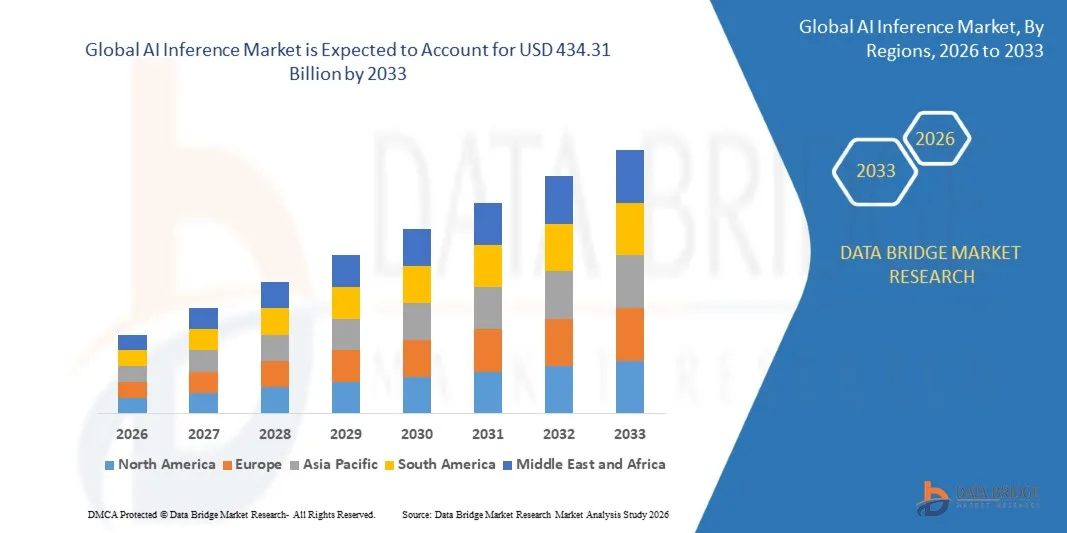
- As per Data Bridge Market Research analysis, the AI inference market was valued at USD 111.70 billion in 2025 and is projected to reach USD 434.31 billion by 2033, growing at a CAGR of 18.50% from 2026 to 2033.
- The market is expanding due to rapid adoption of generative AI and large language models, growing deployment of AI assistants and agents, rising volumes of real-time data, demand for low-latency and energy-efficient inference hardware, expansion of cloud and edge infrastructure, and growing enterprise investment in AI applications.
- AI inference is increasingly being used to run trained models in chatbots, search, recommendation, fraud detection, medical imaging, autonomous systems, and industrial automation, supported by specialized GPUs and accelerators, high-bandwidth memory, high-speed networking, optimized software stacks, and growing supply from chipmakers, hyperscalers, and AI infrastructure companies.
Market Size & Forecast
- Global Market Value (2025): USD 111.70 billion
- Expected Market Value (2033): USD 434.31 billion
- Forecast CAGR (2026–2033): 18.50%
- Leading Region in 2025: North America
- Fastest Growing Region: Asia-Pacific
What Are The Major Takeaways Of The AI Inference Market?
- North America dominated the global AI inference market with a share of 40.00% in 2025, supported by the presence of leading AI chipmakers and hyperscalers, large investment in data centers, strong enterprise AI adoption, and a mature cloud ecosystem.
- Asia-Pacific is expected to be the fastest-growing regional market at a CAGR of 21.00% from 2026 to 2033, driven by expanding data center capacity, government AI programs, growing semiconductor manufacturing, and rapid adoption of AI services by consumers and enterprises.
- The compute segment dominated the market by component with a share of 62.00% in 2025, supported by strong demand for GPUs, CPUs, and custom accelerators that run AI models in production.
- The generative AI segment is expected to register the fastest growth among applications, at a CAGR of 22.00% from 2026 to 2033, driven by large language model deployment, AI assistants, content generation, and agentic workloads.
- The machine learning segment dominated the application category with a share of 36.00% in 2025, supported by broad use of predictive and recommendation models across search, advertising, finance, and industrial operations.
- The cloud segment dominated the deployment category with a share of 58.00% in 2025, supported by access to scalable accelerators, flexible pricing, and the large AI infrastructure of hyperscale providers.
- The cloud service providers segment dominated the end user category with a share of 47.00% in 2025, supported by large-scale purchasing of accelerators, memory, and networking for AI services offered to customers.
Report Scope And AI Inference Market Segmentation
|
Attributes |
AI Inference Key Market Insights |
|
Segments Covered |
|
|
Countries Covered |
North America
Europe
Asia-Pacific
Middle East and Africa
South America
|
|
Key Market Players |
|
|
Market Opportunities |
|
|
Value Added Data Infosets |
In addition to the insights on market scenarios such as market value, growth rate, segmentation, geographical coverage, and major players, the market reports curated by the Data Bridge Market Research also include in-depth expert analysis, pricing analysis, brand share analysis, consumer survey, demography analysis, supply chain analysis, value chain analysis, raw material/consumables overview, vendor selection criteria, PESTLE Analysis, Porter Analysis, and regulatory framework. |
What Is The Key Trend In The AI Inference Market?
- Increasing demand for specialized, low-latency inference hardware is becoming a major trend in the global AI inference market, as generative AI assistants and AI agents require continuous, real-time inference at lower cost and power. Chipmakers and hyperscalers are developing inference-optimized accelerators and custom silicon as alternatives to general-purpose training GPUs.
- Integration of memory, networking, and software optimization is gaining importance as suppliers invest in high-bandwidth memory, SmartNICs, high-speed interconnects, and inference software that improve throughput and reduce cost per token. Edge inference platforms and enterprise AI deployment tools are also expanding, while consolidation and partnerships help suppliers broaden their inference portfolios.
- For instance, in March 2026, NVIDIA was reported to have released the Groq 3 LPX Rack, holding 256 Groq language processing units, aimed at low-latency agentic workloads.
- Overall, the AI inference market is increasingly shaped by generative AI, agentic workloads, custom inference silicon, high-bandwidth memory and networking, and edge deployment. AI inference suppliers are therefore moving toward lower cost per query, higher energy efficiency, and integrated hardware and software offerings.
What Are The Key Drivers Of The AI Inference Market?
- Rapid adoption of generative AI and large language models is becoming a major growth driver in the global AI inference market, as chatbots, copilots, search, and content generation require large-scale inference in real time. Growing data volumes and the shift from model training to everyday model use increase demand for inference capacity.
- Demand for cost-effective and energy-efficient processing is gaining importance as enterprises and cloud providers seek to scale AI services. Expansion of cloud and edge infrastructure, growth of 5G and connected devices, and rising enterprise investment in AI applications are further supporting market demand.
- For instance, in November 2025, AMD was reported to have acquired MK1, a company focused on high-speed inference and enterprise AI, reflecting the growing investment in inference capabilities.
- Overall, the AI inference market is increasingly shaped by generative AI adoption, data growth, efficiency demands, and infrastructure expansion. AI inference suppliers are therefore moving toward capacity expansion, product innovation, and closer partnerships with cloud providers and enterprises.
What Factors Are Challenging The Growth Of The AI Inference Market?
- High hardware cost and power consumption are becoming a major challenge in the global AI inference market, as advanced accelerators, high-bandwidth memory, and networking require significant investment and large amounts of electricity. Data center power and cooling limits can slow deployment and increase operating costs for providers and enterprises.
- Supply concentration, memory and packaging constraints, and software complexity are also restraining growth, as demand for leading accelerators can exceed supply and organizations depend on a small number of suppliers. Data privacy and security concerns, regulatory requirements, export controls, and a shortage of skilled talent further limit adoption.
- For instance, in June 2026, OpenAI was reported to have unveiled Jalapeño, its first custom inference chip co-designed with Broadcom, reflecting efforts to reduce dependence on a single supplier and control inference costs.
- Overall, the global AI inference market is increasingly shaped by hardware cost, power limits, supply concentration, and regulatory and security requirements. AI inference suppliers are therefore moving toward energy-efficient designs, diversified supply chains, custom silicon, and stronger security and compliance features.
How Is The AI Inference Market Segmented?
The global AI inference market is segmented on the basis of component, application, deployment, end user, and industry vertical.
- By Component
On the basis of component, the global AI inference market is segmented into compute, memory, and network. The compute segment dominated the market with a share of 62.00% in 2025, supported by strong demand for GPUs, CPUs, and custom accelerators that run AI models in production.
The network segment is projected to grow at a CAGR of 20.50% from 2026 to 2033, driven by demand for high-speed, low-latency interconnects and SmartNICs that move data between accelerators in large inference clusters.
- By Application
On the basis of application, the global AI inference market is segmented into generative AI, machine learning, natural language processing, computer vision, and others. The machine learning segment dominated the market with a share of 36.00% in 2025, supported by broad use of predictive and recommendation models across search, advertising, finance, and industrial operations.
The generative AI segment is projected to grow at a CAGR of 22.00% from 2026 to 2033, driven by large language model deployment, AI assistants, content generation, and agentic workloads.
- By Deployment
On the basis of deployment, the global AI inference market is segmented into cloud, on-premises, and edge. The cloud segment dominated the market with a share of 58.00% in 2025, supported by access to scalable accelerators, flexible pricing, and the large AI infrastructure of hyperscale providers.
The edge segment is projected to grow at a CAGR of 21.80% from 2026 to 2033, supported by demand for low-latency, private, and offline inference in vehicles, industrial systems, smartphones, and healthcare devices.
- By End User
On the basis of end user, the global AI inference market is segmented into cloud service providers, enterprises, consumers, and government and defense. The cloud service providers segment dominated the market with a share of 47.00% in 2025, supported by large-scale purchasing of accelerators, memory, and networking for AI services offered to customers.
The enterprises segment is projected to grow at a CAGR of 20.20% from 2026 to 2033, driven by growing deployment of AI assistants, analytics, and automation across business functions and demand for enterprise AI platforms.
- By Industry Vertical
On the basis of industry vertical, the global AI inference market is segmented into IT and telecom, BFSI, healthcare, retail and e-commerce, automotive, and others. The IT and telecom segment dominated the market with a share of 28.00% in 2025, supported by large AI-based services, network automation, and cloud platforms.
The healthcare segment is projected to grow at a CAGR of 21.00% from 2026 to 2033, supported by use of AI inference in medical imaging, diagnostics, drug discovery, and clinical documentation.
Which Region Holds The Largest Share Of The AI Inference Market?
- North America accounted for the largest share of the global AI inference market, with a revenue share of 40.00% in 2025, supported by the presence of leading AI chipmakers and hyperscalers, large investment in data centers, strong enterprise AI adoption, and a mature cloud ecosystem. The U.S. remains the key market within the region, supported by established companies such as NVIDIA, AMD, Google, Microsoft, and Amazon Web Services.
- The region driven by increasing AI infrastructure investments, expanding cloud computing capabilities, rising adoption of generative AI applications, and growing demand for real-time AI processing across manufacturing, healthcare, finance, and telecommunications.
North America AI Inference Market Insight
North America is the largest region in the global AI inference market. The regional market is supported by the presence of leading chip designers and cloud providers, large investment in AI data centers, strong venture funding, and early enterprise adoption of generative AI. Growing demand for custom inference chips and edge AI is expected to further support regional growth.
U.S. AI Inference Market Insight
The U.S. AI inference market is supported by a concentration of leading AI companies, hyperscale cloud providers, and semiconductor firms. Domestic suppliers such as NVIDIA, AMD, Intel, Google, Microsoft, and Amazon Web Services are investing in inference hardware and infrastructure, while export controls and data center power availability shape deployment.
Europe AI Inference Market Insight
The Europe AI inference market is supported by growing enterprise adoption of AI, sovereign cloud and AI infrastructure initiatives, and a strong industrial and automotive base. Data protection rules and the EU AI Act shape deployment, while demand for energy-efficient and privacy-preserving inference supports market growth.
Germany AI Inference Market Insight
The Germany AI inference market is supported by a strong industrial, automotive, and engineering base, growing investment in AI and data center capacity, and demand for edge inference in manufacturing and mobility. Data protection and regulatory requirements remain important, while enterprise adoption of generative AI is increasing.
Asia-Pacific AI Inference Market Insight
Asia-Pacific is projected to be the fastest-growing region in the global AI inference market, at a CAGR of 21.00% from 2026 to 2033. The regional market is supported by expanding data center capacity, government AI programs, a strong semiconductor and memory manufacturing base in South Korea, Taiwan, and Japan, and rapid adoption of AI services by consumers and enterprises.
China AI Inference Market Insight
The China AI inference market is supported by large domestic technology companies, rapid adoption of AI applications, and government support for AI and domestic semiconductor development. Export controls on advanced chips encourage development of local accelerators from companies such as Huawei, while demand for generative AI services continues to grow.
India AI Inference Market Insight
The India AI inference market is supported by a large digital user base, growing data center investment, expanding startup and IT services ecosystems, and government initiatives to build national AI compute capacity. Demand is driven by AI services for consumers and enterprises, while power availability and cost remain important considerations.
Which Are The Top Companies In The AI Inference Market?
The AI inference industry is primarily led by well-established companies, including:
- Darling Ingredients Inc.NVIDIA Corporation (U.S.)
- Lauridsen Group, Inc.Advanced Micro Devices, Inc. (U.S.)
- SARIA GroupIntel Corporation (U.S.)
- Kraeber & Co GmbHGoogle LLC (U.S.)
- Rocky Mountain BiologicalsAmazon Web Services, Inc. (U.S.)
- Microsoft Corporation (U.S.)
- Meta Platforms, Inc. (U.S.)
- Qualcomm Incorporated (U.S.)
- Broadcom Inc. (U.S.)
- SK hynix Inc. (South Korea)
- Samsung Electronics Co., Ltd. (South Korea)
- Micron Technology, Inc. (U.S.)
- Huawei Technologies Co., Ltd. (China)
- Cerebras Systems Inc. (U.S.)
- Graphcore Limited (U.K.)
What Are Latest Developments In AI Inference Market?
- In April 2024, Intel released the Gaudi 3 AI accelerator with integrated Ethernet networking for large-scale AI training and inference.
- In November 2025, AMD was reported to have acquired MK1, a company focused on high-speed inference and enterprise AI.
- In December 2025, NVIDIA was reported to have acquired Groq's inference technology in a deal valued at about USD 20 billion.
- In March 2026, NVIDIA was reported to have released the Groq 3 LPX Rack for low-latency agentic AI workloads.
- In June 2026, OpenAI was reported to have unveiled Jalapeño, its first custom inference chip, co-designed with Broadcom.
- Interactive Data Analysis Dashboard
- Company Analysis Dashboard for high growth potential opportunities
- Research Analyst Access for customization & queries
- Competitor Analysis with Interactive dashboard
- Latest News, Updates & Trend analysis
- Harness the Power of Benchmark Analysis for Comprehensive Competitor Tracking
Data collection and base year analysis are done using data collection modules with large sample sizes. The stage includes obtaining market information or related data through various sources and strategies. It includes examining and planning all the data acquired from the past in advance. It likewise envelops the examination of information inconsistencies seen across different information sources. The market data is analysed and estimated using market statistical and coherent models. Also, market share analysis and key trend analysis are the major success factors in the market report. To know more, please request an analyst call or drop down your inquiry.
The key research methodology used by DBMR research team is data triangulation which involves data mining, analysis of the impact of data variables on the market and primary (industry expert) validation. Data models include Vendor Positioning Grid, Market Time Line Analysis, Market Overview and Guide, Company Positioning Grid, Patent Analysis, Pricing Analysis, Company Market Share Analysis, Standards of Measurement, Global versus Regional and Vendor Share Analysis. To know more about the research methodology, drop in an inquiry to speak to our industry experts.
Data Bridge Market Research is a leader in advanced formative research. We take pride in servicing our existing and new customers with data and analysis that match and suits their goal. The report can be customized to include price trend analysis of target brands understanding the market for additional countries (ask for the list of countries), clinical trial results data, literature review, refurbished market and product base analysis. Market analysis of target competitors can be analyzed from technology-based analysis to market portfolio strategies. We can add as many competitors that you require data about in the format and data style you are looking for. Our team of analysts can also provide you data in crude raw excel files pivot tables (Fact book) or can assist you in creating presentations from the data sets available in the report.