


AI Lifecycle Management Software Market Overview
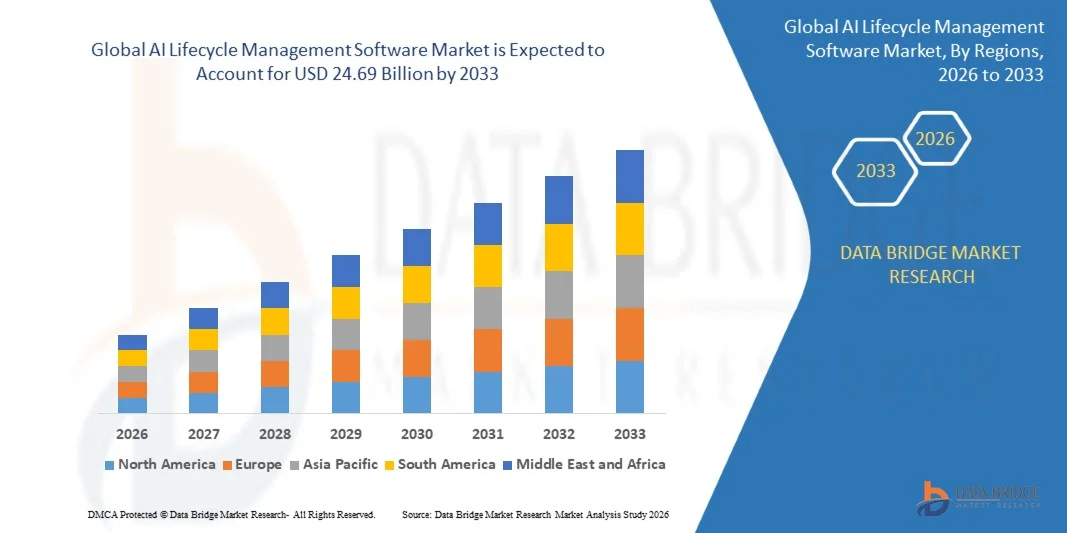
The AI Lifecycle Management Software Market was valued at USD 7.84 billion in 2025 and is projected to reach USD 24.69 billion by 2033, growing at a CAGR of 15.4% from 2026 to 2033. The market is witnessing rapid growth driven by increasing adoption of artificial intelligence across enterprises, rising demand for scalable machine learning infrastructure, and growing investments in cloud-based AI development ecosystems.
Organizations across industries are increasingly deploying AI model training and deployment platforms to accelerate machine learning workflows, automate data processing, and improve operational decision-making. The rising adoption of generative AI, large language models (LLMs), and edge AI applications is further driving demand for advanced AI lifecycle management solutions capable of supporting real-time deployment, monitoring, and optimization of AI models.
Key Market Trends & Insights
- North America dominated the AI Lifecycle Management Software Market with the largest revenue share of 39.24% in 2025, supported by advanced AI infrastructure, strong cloud ecosystem maturity, and increasing investments in enterprise AI governance frameworks.
- The Cloud-Based segment led the market with a 63.47% share in 2025, driven by increasing enterprise preference for scalable, flexible, and cost-efficient AI lifecycle management environments.
- Asia-Pacific is expected to be the fastest-growing region at a CAGR of 16.6% from 2026 to 2033, fueled by rapid digital transformation, increasing AI adoption among enterprises, and expanding cloud infrastructure investments across China, India, Japan, and South Korea.
- Automation & Orchestration Solutions are the fastest-growing component segment, projected to register a CAGR of 16.2%, reflecting rising demand for automated AI workflow management, continuous integration, and model retraining capabilities.
- Large Enterprises segment dominates the enterprise size category with a 69.81% revenue share in 2025, led by growing investments in enterprise AI operations, governance, and compliance management infrastructure.
- Hybrid deployment accounts for 27.93% of the market and is witnessing increasing adoption among enterprises requiring a combination of cloud scalability and on-premise data control capabilities.
- The Healthcare segment is the fastest-growing end-user category, with a CAGR of 16.1%, driven by increasing use of AI governance platforms for medical diagnostics, predictive analytics, and regulatory compliance management.
Market Size & Forecast
- Global Market Value (2025): USD 7.84 Billion
- Expected Market Value (2033): USD 24.69 Billion
- Forecast CAGR (2026–2033): 15.4%
- Leading Region in 2025: North America
- Fastest Growing Region: Asia-Pacific
Report Scope and AI Lifecycle Management Software Market Segmentation
|
Attributes |
AI Lifecycle Management Software Key Market Insights |
|
Segments Covered |
|
|
Countries Covered |
North America · U.S. · Canada · Mexico Europe · Germany · France · U.K. · Netherlands · Switzerland · Belgium · Russia · Italy · Spain · Turkey · Rest of Europe Asia-Pacific · China · Japan · India · South Korea · Singapore · Malaysia · Australia · Thailand · Indonesia · Philippines · Rest of Asia-Pacific Middle East and Africa · Saudi Arabia · U.A.E. · South Africa · Egypt · Israel · Rest of Middle East and Africa South America · Brazil · Argentina · Rest of South America |
|
Key Market Players |
· Microsoft Corporation (U.S.) · Amazon Web Services, Inc. (U.S.) · Google LLC (U.S.) · IBM Corporation (U.S.) · Oracle Corporation (U.S.) · NVIDIA Corporation (U.S.) · Databricks Inc. (U.S.) · DataRobot, Inc. (U.S.) · H2O.ai (U.S.) · Dataiku (U.S.) · Snowflake Inc. (U.S.) · SAP SE (Germany) · Alibaba Cloud (China) · Baidu, Inc. (China) · Tencent Cloud (China) · Hewlett Packard Enterprise (U.S.) · Dell Technologies Inc. (U.S.) · C3.ai, Inc. (U.S.) · SAS Institute Inc. (U.S.) · Palantir Technologies Inc. (U.S.) |
|
Market Opportunities |
· Rising adoption of responsible AI and AI governance frameworks · Increasing demand for automated MLOps and AI monitoring solutions · Expansion of hybrid AI infrastructure and edge AI deployment |
|
Value Added Data Infosets |
In addition to the market insights such as market value, growth rate, market segments, geographical coverage, market players, and market scenario, the market report curated by the Data Bridge Market Research team includes in-depth expert analysis, import/export analysis, pricing analysis, production consumption analysis, and pestle analysis. |
AI Lifecycle Management Software Market Trends
Trend: Rising Adoption of Responsible AI and Automated MLOps Platforms
Enterprises are increasingly adopting AI lifecycle management software to improve model transparency, automate governance workflows, and ensure responsible AI implementation across business operations. The rapid expansion of generative AI and foundation models is driving demand for advanced lifecycle management solutions capable of automating model validation, explainability, bias detection, drift monitoring, and continuous retraining processes. Organizations are also integrating AI governance platforms with cloud-native MLOps infrastructure to improve scalability, operational efficiency, and regulatory compliance across enterprise AI environments.
For instance, major enterprises across banking, healthcare, and telecom industries are increasingly implementing AI governance tools to comply with emerging global AI regulations such as the EU AI Act and responsible AI policies introduced by governments and regulatory bodies. This trend is significantly accelerating investments in AI monitoring, orchestration, and governance software solutions globally.
AI Lifecycle Management Software Market Dynamics
Key Market Driver: Growing Enterprise Adoption of AI Governance and MLOps
The increasing deployment of artificial intelligence across enterprise operations has created substantial demand for AI lifecycle management software capable of managing model development, deployment, monitoring, and governance processes. Organizations are leveraging these platforms to improve AI reliability, automate workflow management, ensure compliance, and optimize operational efficiency. The rapid growth of generative AI applications and enterprise-scale machine learning deployments is further accelerating adoption across industries including BFSI, healthcare, manufacturing, telecom, and retail.
Key Restraint/Challenge: Complexity of AI Governance and Regulatory Compliance
A significant restraint in the AI Lifecycle Management Software Market is the increasing complexity associated with AI governance, model explainability, and compliance with evolving global regulations. Enterprises often face challenges related to AI bias monitoring, interoperability between AI tools, data privacy management, and shortage of skilled AI professionals. In addition, high implementation costs and integration complexity across multi-cloud and hybrid AI environments continue to limit adoption among smaller organizations.
The increasing implementation of AI regulations such as the European Union AI Act and enterprise governance mandates is further compelling organizations to invest heavily in compliance frameworks, increasing operational complexity and deployment costs.
Key Market Opportunity: Expansion of AI Monitoring and Automation Platforms
The rapid development of AI monitoring, orchestration, and automation technologies presents a significant growth opportunity for the market. Organizations are increasingly deploying automated AI lifecycle management platforms capable of supporting continuous model monitoring, drift detection, automated retraining, and real-time governance management. The growing adoption of hybrid cloud infrastructure and edge AI deployment is also creating new opportunities for scalable AI lifecycle management solutions across industries including healthcare, finance, manufacturing, and autonomous systems.
AI Lifecycle Management Software Market Scope
The AI lifecycle management software market is segmented on the basis of component, deployment mode, enterprise size, and end user.
- By Component
On the basis of component, the AI Lifecycle Management Software Market is segmented into platform software, services, monitoring & governance tools, and automation & orchestration solutions. The platform software segment dominated the market with a 37.54% share in 2025 due to increasing enterprise demand for integrated AI lifecycle management environments capable of supporting model development, deployment, monitoring, and governance within a unified infrastructure.
The automation & orchestration solutions segment is expected to witness the fastest CAGR of 16.2% from 2026 to 2033, driven by increasing enterprise adoption of automated MLOps pipelines, continuous integration and deployment workflows, and AI model retraining systems.
- By Deployment Mode
On the basis of deployment mode, the AI Lifecycle Management Software Market is segmented into cloud-based, on-premise, and hybrid. The cloud-based segment dominated the market with a share of 63.47% in 2025 due to increasing enterprise preference for scalable AI infrastructure, lower deployment costs, and rapid accessibility to cloud-native AI lifecycle management solutions.
The hybrid segment is expected to witness the fastest CAGR of 15.8% from 2026 to 2033, driven by increasing enterprise demand for secure and flexible AI deployment architectures that combine cloud scalability with on-premise compliance and data security capabilities.
- By Enterprise Size
On the basis of enterprise size, the AI Lifecycle Management Software Market is segmented into large enterprises and small & medium enterprises. The large enterprises segment dominated the market with a share of 69.81% in 2025 due to growing investments in enterprise AI governance, large-scale automation initiatives, and advanced machine learning operations infrastructure.
The small & medium enterprises segment is expected to witness the fastest CAGR of 15.2% from 2026 to 2033, driven by rising accessibility of subscription-based AI lifecycle management solutions and increasing adoption of cloud-native AI operations platforms.
- By End User
On the basis of end user, the AI Lifecycle Management Software Market is segmented into BFSI, healthcare, retail & e-commerce, IT & telecom, manufacturing, automotive, and government & defense. The BFSI segment dominated the market with a share of 25.43% in 2025 due to increasing use of AI governance platforms for fraud detection, risk analytics, customer intelligence, and regulatory compliance management.
The healthcare segment is expected to witness the fastest CAGR of 16.1% from 2026 to 2033, driven by increasing implementation of AI governance and monitoring tools for predictive diagnostics, medical imaging, precision medicine, and healthcare workflow automation.
AI Lifecycle Management Software Market Regional Analysis
North America dominated the AI lifecycle management software market and accounted for the largest revenue share of 39.24% in 2025, supported by advanced cloud infrastructure, strong AI technology ecosystem, and increasing enterprise investments in responsible AI governance frameworks. The region also benefits from widespread adoption of generative AI technologies, advanced MLOps infrastructure, and strong regulatory focus on AI transparency and compliance management.
Asia-Pacific is expected to witness rapid growth during the forecast period, driven by increasing AI investments, rapid enterprise digital transformation, expanding cloud infrastructure, and growing government support for AI innovation across China, India, Japan, and South Korea. Rising adoption of AI-powered automation, enterprise AI governance tools, and cloud-native lifecycle management platforms continues to strengthen regional market growth.
U.S. AI Lifecycle Management Software Market Insight
The U.S. AI lifecycle management software market is witnessing strong growth due to increasing enterprise deployment of generative AI technologies, rising investments in responsible AI governance frameworks, and expanding adoption of automated MLOps platforms. The country’s advanced cloud ecosystem, strong AI startup environment, and presence of major AI technology companies are accelerating platform adoption across healthcare, finance, retail, telecom, and defense industries. In addition, increasing regulatory focus on AI transparency, security, and model explainability is driving demand for advanced lifecycle management software solutions across enterprise environments.
Europe AI Lifecycle Management Software Market Insight
The Europe AI lifecycle management software market remains a major contributor to global revenue, driven by increasing implementation of responsible AI regulations, growing enterprise adoption of AI governance platforms, and rising investments in AI compliance infrastructure. Organizations across banking, healthcare, automotive, and manufacturing industries are increasingly deploying AI lifecycle management software to improve model governance, compliance, and operational transparency. Furthermore, implementation of the EU AI Act and growing focus on ethical AI deployment continue to strengthen market growth throughout Europe.
U.K. AI Lifecycle Management Software Market Insight
The U.K. AI lifecycle management software market is experiencing steady growth, supported by rising investments in AI innovation, growing implementation of enterprise MLOps frameworks, and increasing demand for AI governance solutions across financial services and healthcare industries. Organizations are increasingly adopting AI lifecycle management platforms to improve automation efficiency, model monitoring, and compliance management capabilities. In addition, integration of generative AI technologies and hybrid cloud AI infrastructure is further supporting market expansion in the U.K.
Germany AI Lifecycle Management Software Market Insight
The Germany AI lifecycle management software market is expanding steadily due to the country’s strong industrial AI ecosystem, increasing enterprise adoption of AI automation technologies, and growing investments in AI governance infrastructure. Manufacturing enterprises, automotive companies, and industrial organizations are increasingly deploying lifecycle management platforms to support predictive analytics, intelligent automation, and compliance management. Continuous advancements in industrial AI deployment and edge AI integration are further driving market growth in Germany.
Asia-Pacific AI Lifecycle Management Software Market Insight
The Asia-Pacific AI lifecycle management software market is expected to witness rapid growth, driven by increasing enterprise digitalization, expanding AI startup ecosystems, and rising cloud infrastructure investments across China, India, Japan, and South Korea. Organizations are increasingly deploying AI governance, monitoring, and orchestration solutions to improve operational efficiency and automate machine learning workflows. Additionally, growing government AI initiatives and increasing adoption of generative AI technologies are accelerating market expansion across the region.
Japan AI Lifecycle Management Software Market Insight
The Japan AI lifecycle management software market is witnessing consistent growth due to increasing investments in enterprise AI transformation, robotics automation, and intelligent manufacturing systems. Technology companies, healthcare organizations, and manufacturing enterprises are increasingly implementing AI governance and orchestration platforms to improve operational reliability, compliance, and predictive analytics capabilities. Moreover, growing integration of AI-powered automation solutions and responsible AI frameworks is further supporting market growth in Japan.
China AI Lifecycle Management Software Market Insight
The China AI lifecycle management software market is growing rapidly, driven by increasing government-backed AI initiatives, rapid expansion of domestic cloud infrastructure, and growing enterprise investments in AI automation and generative AI technologies. Organizations across finance, manufacturing, healthcare, retail, and smart city sectors are increasingly deploying AI lifecycle management platforms to improve AI governance, model deployment, and operational scalability. In addition, advancements in AI chips, edge AI infrastructure, and foundation model development are positioning China as one of the fastest-growing AI lifecycle management software markets globally.
AI Lifecycle Management Software Market Share
The AI Lifecycle Management Software industry is primarily led by well-established companies, including:
- Microsoft Corporation (U.S.)
- Amazon Web Services, Inc. (U.S.)
- Google LLC (U.S.)
- IBM Corporation (U.S.)
- Oracle Corporation (U.S.)
- NVIDIA Corporation (U.S.)
- Databricks Inc. (U.S.)
- DataRobot, Inc. (U.S.)
- H2O.ai (U.S.)
- Dataiku (U.S.)
- Snowflake Inc. (U.S.)
- SAP SE (Germany)
- Alibaba Cloud (China)
- Baidu, Inc. (China)
- Tencent Cloud (China)
- Hewlett Packard Enterprise (U.S.)
- Dell Technologies Inc. (U.S.)
- C3.ai, Inc. (U.S.)
- SAS Institute Inc. (U.S.)
- Palantir Technologies Inc. (U.S.)
Latest Developments in AI Lifecycle Management Software Market
- In March 2025, Microsoft Corporation expanded its Azure AI governance capabilities by introducing advanced lifecycle management tools integrated with Azure AI Studio and Copilot ecosystems. The new features enable enterprises to automate AI monitoring, model validation, explainability analysis, compliance reporting, and responsible AI governance workflows across large-scale AI environments. This development strengthens Microsoft’s position in enterprise AI lifecycle management by improving operational transparency, automation efficiency, and regulatory compliance capabilities for generative AI deployments.
- In February 2025, IBM Corporation enhanced its watsonx platform with upgraded AI governance and lifecycle automation functionalities designed to support enterprise-scale AI monitoring, model risk management, and automated compliance operations. The updated platform includes improved bias detection systems, model drift monitoring tools, and explainability frameworks that help organizations maintain responsible AI practices across multi-cloud environments. This development expands IBM’s enterprise AI governance portfolio and strengthens its capabilities in regulated industries such as banking, healthcare, and government.
- In January 2025, Google LLC introduced enhanced MLOps and lifecycle orchestration capabilities within Vertex AI to support continuous AI model deployment, monitoring, and retraining across cloud-native enterprise environments. The upgraded platform enables organizations to automate AI workflows, optimize model performance, and improve operational scalability for generative AI and foundation model applications. This launch reinforces Google’s competitive position in enterprise AI lifecycle management and cloud-based AI operations infrastructure.
- In November 2024, Databricks Inc. launched new AI governance and monitoring solutions integrated with its Lakehouse AI platform, enabling enterprises to improve AI model transparency, data lineage tracking, and automated lifecycle management processes. The enhanced platform supports unified management of machine learning models, generative AI applications, and real-time analytics workflows across enterprise operations. This development strengthens Databricks’ position in AI operations and enterprise MLOps infrastructure by improving scalability, governance, and deployment efficiency.
- In October 2024, Amazon Web Services, Inc. expanded Amazon SageMaker capabilities with advanced lifecycle management, automated model retraining, and AI governance features focused on enterprise generative AI applications. The updated platform provides enhanced monitoring, security management, and operational automation tools that support scalable AI deployment across hybrid and multi-cloud environments. This development strengthens AWS’s position in AI lifecycle management infrastructure by improving enterprise AI scalability, reliability, and compliance management capabilities.

- Interactive Data Analysis Dashboard
- Company Analysis Dashboard for high growth potential opportunities
- Research Analyst Access for customization & queries
- Competitor Analysis with Interactive dashboard
- Latest News, Updates & Trend analysis
- Harness the Power of Benchmark Analysis for Comprehensive Competitor Tracking
Data collection and base year analysis are done using data collection modules with large sample sizes. The stage includes obtaining market information or related data through various sources and strategies. It includes examining and planning all the data acquired from the past in advance. It likewise envelops the examination of information inconsistencies seen across different information sources. The market data is analysed and estimated using market statistical and coherent models. Also, market share analysis and key trend analysis are the major success factors in the market report. To know more, please request an analyst call or drop down your inquiry.
The key research methodology used by DBMR research team is data triangulation which involves data mining, analysis of the impact of data variables on the market and primary (industry expert) validation. Data models include Vendor Positioning Grid, Market Time Line Analysis, Market Overview and Guide, Company Positioning Grid, Patent Analysis, Pricing Analysis, Company Market Share Analysis, Standards of Measurement, Global versus Regional and Vendor Share Analysis. To know more about the research methodology, drop in an inquiry to speak to our industry experts.
Data Bridge Market Research is a leader in advanced formative research. We take pride in servicing our existing and new customers with data and analysis that match and suits their goal. The report can be customized to include price trend analysis of target brands understanding the market for additional countries (ask for the list of countries), clinical trial results data, literature review, refurbished market and product base analysis. Market analysis of target competitors can be analyzed from technology-based analysis to market portfolio strategies. We can add as many competitors that you require data about in the format and data style you are looking for. Our team of analysts can also provide you data in crude raw excel files pivot tables (Fact book) or can assist you in creating presentations from the data sets available in the report.













