What is the AI-Personalized Skincare Market Size and Growth Rate?
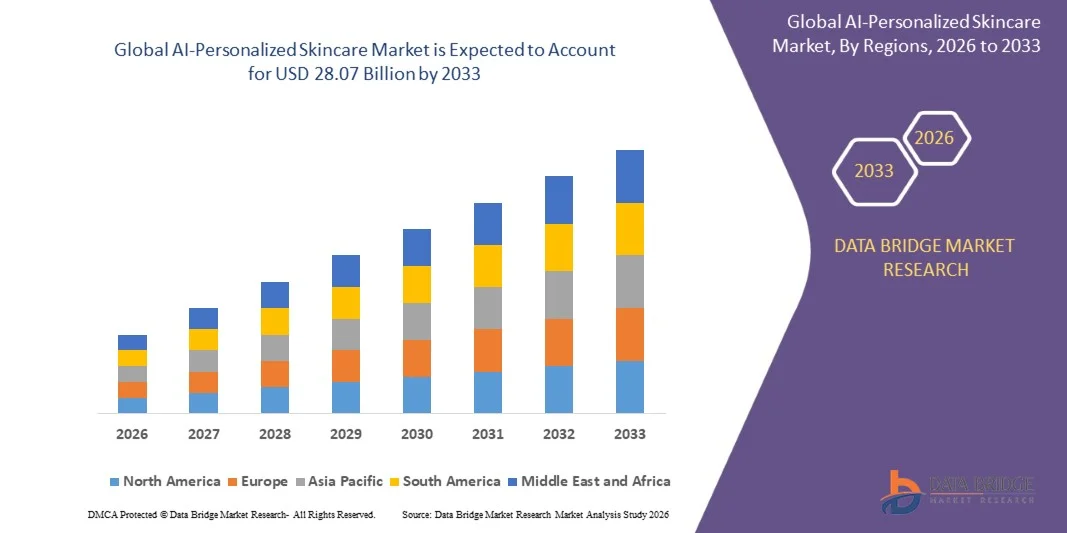
As per Data Bridge Market Research analysis, the global AI-personalized skincare market was valued at USD 6.40 billion in 2025 and is projected to reach USD 28.07 billion by 2033, growing at a CAGR of 20.30% from 2026 to 2033. The market is experiencing robust growth driven by the increasing adoption of artificial intelligence for personalized skincare recommendations, rising consumer demand for data-driven beauty solutions, and continuous advancements in AI-powered skin analysis technologies. The widespread use of computer vision, machine learning, smartphone-based facial imaging, and digital dermatology platforms enables brands to deliver customized skincare routines based on individual skin conditions, lifestyle factors, and environmental exposure, improving customer engagement and treatment effectiveness.
The growing prevalence of skin concerns such as acne, pigmentation, premature aging, sensitivity, and UV-induced skin damage, coupled with rising consumer preference for personalized beauty products, is encouraging cosmetic manufacturers, dermatology clinics, and beauty technology companies to invest in AI-enabled skincare platforms. AI-powered facial analysis applications and virtual skin consultation tools are increasingly replacing traditional trial-and-error product selection by providing real-time skin diagnostics, personalized product recommendations, continuous skin monitoring, and predictive skincare insights. The integration of cloud computing, mobile applications, augmented reality (AR), and digital health technologies is further accelerating the adoption of AI-personalized skincare solutions across both developed and emerging markets.
Market Size & Forecast
- Market Value (2025): USD 6.40 Billion
- Expected Market Value (2033): USD 28.07 Billion
- Forecast CAGR (2026–2033): 20.30%
- Leading Region in 2025: North America
- Fastest Growing Region: Asia-Pacific
Key Market Trends & Insights
- North America dominated the global AI-Personalized Skincare market with the largest revenue share of 46% in 2025, supported by advanced training infrastructure and strong government investments in simulation technology.
- The solutions segment dominated the market with an estimated 42% share in 2025 owing to the increasing adoption of AI-powered skin analysis platforms, virtual skincare assistants, personalized recommendation engines, facial imaging software, and cloud-based skincare applications by beauty brands and dermatology providers.
- Asia-Pacific is expected to be the fastest-growing region at a CAGR from 2026 to 2033, fueled by rising urbanization, increasing training infrastructure investments, and growing adoption in China, India, and Japan.
- The skin analysis and diagnostics segment dominated the market with an estimated 84% share in 2025 owing to the growing adoption of AI-powered facial analysis platforms that assess wrinkles, pigmentation, acne, pore size, hydration, redness, elasticity, and other skin conditions with high precision.
- The services segment is projected to witness the fastest CAGR of 4% from 2026 to 2033, driven by the increasing demand for AI implementation, system integration, cloud deployment, consulting, model training, software maintenance, and digital dermatology support services
Report Scope and AI-Personalized Skincare Market Segmentation
|
Attributes |
AI-Personalized Skincare Key Market Insights |
|
Segments Covered |
|
|
Countries Covered |
North America
Europe
Asia-Pacific
Middle East and Africa
South America
|
|
Key Market Players |
|
|
Market Opportunities |
|
|
Value Added Data Infosets |
In addition to the insights on market scenarios such as market value, growth rate, segmentation, geographical coverage, and major players, the market reports curated by the Data Bridge Market Research also include in-depth expert analysis, geographically represented company-wise production and capacity, network layouts of distributors and partners, detailed and updated price trend analysis and deficit analysis of supply chain and demand. |
What is the Key Trend in the AI-Personalized Skincare Market?
Trend: Growing Adoption of AI-Powered Skin Analysis and Hyper-Personalized Skincare
Beauty brands, dermatology clinics, and beauty technology companies are increasingly adopting artificial intelligence to deliver highly personalized skincare recommendations based on an individual's skin characteristics, lifestyle, age, environmental exposure, and skin concerns. AI-powered facial analysis platforms utilize computer vision, machine learning, and high-resolution imaging to detect acne, wrinkles, pigmentation, pores, hydration levels, redness, and UV damage with high accuracy. For instance, In July 2024, Perfect Corp. announced the launch of its HD AI Skin Analysis solution, an upgraded AI-powered skin diagnostic platform that leverages advanced computer vision and high-definition AI models to deliver more precise analysis of skin concerns, including wrinkles, pores, texture, redness, acne, and dark spots. The enhanced solution was developed using image datasets with twice the resolution of the previous model, enabling more accurate hyper-personalized skincare recommendations for beauty brands, dermatology clinics, and retailers. This launch reflects the growing adoption of AI-driven skin diagnostics to improve consumer engagement and deliver customized skincare experiences. The increasing availability of smartphone-based skin diagnostics, cloud-based AI platforms, and digital dermatology services is accelerating consumer adoption while improving customer engagement and treatment outcomes across the global skincare industry.
Global AI-Personalized Skincare Market Dynamics
Key Market Driver: Rising Consumer Demand for AI-Driven Personalized Skincare Solutions
The growing consumer preference for personalized skincare is a major driver of the global AI-personalized skincare market. Traditional skincare products often follow a one-size-fits-all approach, whereas AI-powered platforms analyze thousands of facial data points to recommend products tailored to an individual's skin type, age, pigmentation, wrinkles, hydration, acne severity, and environmental conditions. Continuous advancements in computer vision, deep learning, smartphone imaging, and predictive analytics are enabling brands to deliver real-time skin assessments with greater accuracy. Major companies such as L'Oréal, Estée Lauder, Shiseido, and Perfect Corp. are investing heavily in AI-powered skincare ecosystems to improve customer experience, product efficacy, and digital engagement. For instance, in March 2024, L'Oréal announced the expansion of its AI-powered beauty ecosystem by introducing Beauty Genius, a generative AI beauty assistant capable of providing personalized skincare recommendations based on users' beauty concerns and product preferences. Powered by decades of beauty science and AI technologies developed through L'Oréal's digital platforms, Beauty Genius offers customized skincare routines and product guidance, reflecting the growing consumer demand for AI-driven personalized skincare solutions and digital beauty experiences. Furthermore, increasing integration of AI with teledermatology and mobile healthcare applications is expanding access to personalized skincare solutions worldwide.
Key Restraint/Challenge: Data Privacy Concerns and Limited Diversity in AI Training Datasets
A major challenge in the global AI-personalized skincare market is ensuring data privacy while maintaining the accuracy and inclusiveness of AI algorithms. AI-powered skincare platforms require large volumes of facial images and personal health information to train machine learning models, creating concerns regarding user consent, cybersecurity, and regulatory compliance. For instance, in December 2023, the U.S. Food and Drug Administration issued guidance titled "Marketing Submission Recommendations for a Predetermined Change Control Plan for Artificial Intelligence-Enabled Device Software Functions", highlighting the importance of managing AI bias, ensuring representative training datasets, and maintaining transparency, cybersecurity, and data governance throughout the AI lifecycle. Although the guidance focuses on AI-enabled medical devices, it underscores broader challenges faced by AI-powered dermatology and skincare platforms that rely on facial images and health-related data to generate personalized recommendations. In addition, many AI algorithms have historically been trained using limited datasets that inadequately represent different skin tones, ethnicities, age groups, and dermatological conditions. This can reduce diagnostic accuracy and recommendation quality for underrepresented populations. Although companies continue expanding AI datasets and improving algorithm fairness, regulatory requirements and the need for diverse, clinically validated datasets remain significant barriers to broader commercialization.
Key Market Opportunity: Integration of AI with Genomics, Skin Microbiome Analysis, and Precision Dermatology
The integration of artificial intelligence with genomics, skin microbiome research, wearable sensors, and precision dermatology presents a significant long-term opportunity for the global AI-personalized skincare market. AI models are increasingly capable of combining genetic information, microbiome profiles, environmental exposure, and lifestyle factors to develop highly customized skincare regimens that optimize treatment outcomes. For instance, in January 2024, L'Oréal Groupe announced a strategic partnership with IBM to develop an AI Foundation Model aimed at accelerating innovation in cosmetics by leveraging formulation science and extensive research datasets. The collaboration is designed to support more sustainable and highly personalized beauty products by applying generative AI to ingredient discovery, formulation development, and consumer personalization. The initiative represents a significant step toward integrating AI with precision beauty and future personalized skincare solutions. Advances in multimodal AI, cloud computing, and digital health platforms are enabling continuous skin monitoring and predictive skincare recommendations. Growing collaborations among cosmetic manufacturers, biotechnology companies, dermatology clinics, and academic research institutions are expected to accelerate innovation and commercial adoption of next-generation precision skincare solutions.
How is the AI-Personalized Skincare Market Segmented?
The AI-personalized skincare market is segmented on the basis of component, technology and application area.
• By Component
On the basis of component, the global ai-personalized skincare market is segmented into solutions and services. The solutions segment dominated the market with an estimated 68.42% share in 2025 owing to the increasing adoption of AI-powered skin analysis platforms, virtual skincare assistants, personalized recommendation engines, facial imaging software, and cloud-based skincare applications by beauty brands and dermatology providers. These solutions enable consumers to receive customized skincare recommendations by analyzing facial images, skin texture, pigmentation, wrinkles, acne, pore size, hydration levels, and environmental exposure in real time. Beauty companies are increasingly integrating AI solutions into mobile applications, e-commerce platforms, and in-store smart beauty devices to enhance customer engagement and improve purchasing decisions. The growing commercialization of generative AI, computer vision, and predictive analytics is enabling more accurate skin assessments and highly personalized skincare regimens. Furthermore, rising investments by cosmetic manufacturers in digital beauty technologies, increasing demand for contactless skincare consultations, and the expansion of direct-to-consumer personalized beauty platforms continue to strengthen the dominance of the solutions segment. Continuous innovation in AI software and digital dermatology ecosystems is expected to sustain its leading market position throughout the forecast period.
The services segment is projected to witness the fastest CAGR of 17.4% from 2026 to 2033, driven by the increasing demand for AI implementation, system integration, cloud deployment, consulting, model training, software maintenance, and digital dermatology support services. As beauty brands and dermatology clinics continue adopting AI-powered skincare platforms, demand for professional services that ensure seamless deployment, algorithm optimization, cybersecurity, and continuous software upgrades is increasing significantly. Service providers are also supporting organizations with AI model customization, cloud migration, data management, and regulatory compliance for consumer health data. Growing collaborations between AI technology companies, cosmetic manufacturers, and dermatology clinics are accelerating the adoption of managed and consulting services globally. In addition, the rapid expansion of subscription-based AI skincare platforms and teledermatology solutions is expected to create substantial growth opportunities for service providers. Continuous advancements in cloud computing, generative AI, and digital healthcare infrastructure will further accelerate the growth of the services segment during the forecast period.
• By Technology
On the basis of technology, the global ai-personalized skincare market is segmented into computer vision & image recognition, machine learning & predictive analytics, 3D face/body scanning & AR/VR, and cloud & edge AI solutions. The computer vision & image recognition segment dominated the market with an estimated 37.26% share in 2025 owing to its widespread adoption in AI-powered skin analysis applications that accurately assess acne, wrinkles, pigmentation, pores, redness, hydration, dark spots, and skin texture through high-resolution facial imaging. Beauty brands and dermatology platforms increasingly utilize computer vision algorithms to generate real-time skin assessments and personalized product recommendations, improving customer engagement and treatment accuracy. Continuous improvements in smartphone camera technology, deep learning algorithms, and facial recognition software have significantly enhanced diagnostic precision. The technology is also being integrated into mobile applications, smart mirrors, beauty kiosks, and e-commerce platforms to deliver seamless digital skincare experiences. Increasing investments by companies such as L'Oréal, Perfect Corp., Revieve, and Haut.AI in AI-powered skin diagnostic solutions continue to strengthen market adoption. Furthermore, growing demand for virtual dermatology consultations and contactless skincare analysis is reinforcing the leadership of the computer vision & image recognition segment across the global market.
The cloud & edge AI solutions segment is anticipated to witness the fastest CAGR of 18.1% from 2026 to 2033, driven by the increasing deployment of scalable AI platforms capable of processing large volumes of skin imaging data in real time. Cloud-based AI enables beauty companies to continuously improve machine learning models, deliver personalized skincare recommendations across multiple digital channels, and provide seamless software updates without requiring on-device processing. At the same time, edge AI allows faster facial analysis directly on smartphones and smart beauty devices, improving response time while enhancing data privacy. The growing adoption of Software-as-a-Service (SaaS) platforms, connected beauty ecosystems, and AI-powered teledermatology services is further accelerating demand. In addition, increasing investments in cloud infrastructure, generative AI, and secure digital healthcare technologies are enabling beauty brands to expand personalized skincare services globally. These technological advancements are expected to drive robust growth of the cloud & edge AI solutions segment throughout the forecast period.
• By Application Area
On the basis of application area, the global ai-personalized skincare market is segmented into skin analysis and diagnostics, R&D & product innovation, personalized skincare solutions, and virtual try-on / AR. The skin analysis and diagnostics segment dominated the market with an estimated 39.84% share in 2025 owing to the growing adoption of AI-powered facial analysis platforms that assess wrinkles, pigmentation, acne, pore size, hydration, redness, elasticity, and other skin conditions with high precision. Beauty brands, dermatology clinics, and cosmetic retailers are increasingly utilizing computer vision, machine learning, and high-resolution imaging technologies to provide real-time skin diagnostics and customized skincare recommendations. The widespread availability of smartphone-based skin analysis applications and AI-enabled smart beauty devices has significantly improved consumer access to professional-grade skin assessments. In addition, rising consumer awareness regarding preventive skincare, increasing preference for science-backed beauty solutions, and the expansion of digital dermatology services are strengthening demand for AI-powered diagnostic platforms. Continuous innovation in image recognition algorithms, predictive analytics, and cloud-based AI technologies is further improving diagnostic accuracy and customer engagement, reinforcing the segment's dominant position in the global market.
The personalized skincare solutions segment is projected to witness the fastest CAGR of 18.5% from 2026 to 2033, driven by the increasing consumer demand for customized skincare regimens based on individual skin characteristics, environmental exposure, genetic factors, and lifestyle habits. AI-powered recommendation engines are enabling brands to formulate personalized skincare products and routines by integrating facial imaging, predictive analytics, and real-time consumer data. Cosmetic companies are increasingly offering customized serums, moisturizers, cleansers, and treatment kits through direct-to-consumer digital platforms and subscription-based services. Growing collaborations between AI technology providers, dermatologists, and beauty manufacturers are accelerating innovation in personalized cosmetic formulations. Furthermore, rapid advancements in generative AI, digital health technologies, and connected beauty ecosystems are enabling highly individualized skincare experiences while improving customer retention and product effectiveness. These developments are expected to significantly accelerate the adoption of personalized skincare solutions throughout the forecast period.
Which Region Holds the Largest Share of the AI-Personalized Skincare Market?
North America dominated the AI-personalized skincare market and accounted for the largest revenue share of 46.00% in 2025, supported by the widespread adoption of AI-powered skincare technologies, strong consumer spending on premium beauty products, and the presence of leading beauty technology companies across the United States and Canada. The region benefits from high penetration of digital health platforms, AI-enabled skin analysis applications, and personalized cosmetic solutions. Increasing collaborations between cosmetic brands, dermatology clinics, and artificial intelligence technology providers, along with growing consumer awareness regarding precision skincare, continue to strengthen North America's leadership position in the global market.
U.S. AI-Personalized Skincare Market Insight
The U.S. AI-personalized skincare market is witnessing robust growth owing to increasing consumer demand for personalized beauty solutions, expanding adoption of AI-based skin diagnostic platforms, and the presence of major skincare and beauty technology companies. Beauty brands are increasingly utilizing artificial intelligence, computer vision, and machine learning algorithms to analyze skin conditions and recommend customized skincare routines. Furthermore, the rapid expansion of teledermatology services, direct-to-consumer personalized skincare platforms, and growing investment in digital beauty innovation are accelerating market growth across the country.
Europe AI-Personalized Skincare Market Insight
The Europe AI-personalized skincare market is experiencing significant growth due to increasing consumer preference for sustainable and personalized cosmetic products, strong adoption of AI-driven beauty technologies, and supportive regulatory frameworks for digital healthcare innovation. The region is witnessing rising investments in skin imaging technologies, predictive skincare analytics, and virtual dermatology solutions. Growing collaborations between cosmetic manufacturers, biotechnology companies, and research institutions are further supporting market expansion throughout Europe.
U.K. AI-Personalized Skincare Market Insight
The U.K. AI-personalized skincare market is expanding steadily, supported by increasing consumer awareness regarding personalized skincare, growing adoption of AI-powered skin assessment applications, and rising investment in beauty technology startups. Consumers are increasingly utilizing smartphone-based facial analysis tools and virtual skincare consultations to obtain customized product recommendations. In addition, continuous innovation in machine learning algorithms and digital dermatology platforms is enhancing customer experience and driving market growth.
Germany AI-Personalized Skincare Market Insight
The Germany AI-personalized skincare market is witnessing steady expansion due to the country's strong biotechnology ecosystem, advanced healthcare infrastructure, and increasing investment in artificial intelligence applications within the beauty industry. Cosmetic manufacturers are integrating AI-powered diagnostics, predictive analytics, and computer vision technologies to deliver highly customized skincare solutions. Furthermore, growing consumer demand for scientifically validated skincare products and increasing research activities in digital dermatology continue to support market growth across Germany.
Asia-Pacific AI-Personalized Skincare Market Insight
The Asia-Pacific AI-personalized skincare market is expected to witness the fastest growth during the forecast period, driven by rapid digitalization, increasing disposable income, expanding beauty and personal care industries, and growing adoption of AI-powered skincare technologies across China, Japan, South Korea, and India. Rising smartphone penetration, increasing consumer awareness regarding skin health, and the rapid expansion of e-commerce beauty platforms are accelerating market demand. In addition, growing investments in artificial intelligence, beauty technology innovation, and personalized cosmetic formulations are expected to support an estimated highest CAGR from 2026 to 2033, positioning Asia-Pacific as the fastest-growing regional market.
Japan AI-Personalized Skincare Market Insight
The JapanAI-personalized skincare market is witnessing consistent growth due to the country's advanced beauty technology ecosystem, increasing adoption of AI-enabled skin diagnostic solutions, and strong consumer demand for premium personalized skincare products. Japanese cosmetic manufacturers are investing in machine learning, facial imaging technologies, and digital beauty platforms to improve product customization and customer engagement. Moreover, continuous innovation in skincare research and high consumer preference for technologically advanced beauty solutions are contributing to market expansion.
China AI-Personalized Skincare Market Insight
The China AI-personalized skincare market is growing rapidly owing to the rapid expansion of digital beauty platforms, increasing adoption of artificial intelligence in cosmetic retail, and rising consumer demand for personalized skincare products. Leading domestic beauty brands are integrating AI-powered facial analysis, virtual consultations, and customized product recommendation engines into online shopping platforms. In addition, growing investment in beauty technology, expanding e-commerce penetration, and increasing awareness regarding skin health are positioning China as one of the fastest-growing markets for AI-personalized skincare globally.
Which are the Top Companies in AI-Personalized Skincare Market?
The AI-Personalized Skincare industry is primarily led by well-established companies, including:
- L'Oréal S.A. (France)
- The Estée Lauder Companies. (U.S.)
- Shiseido Company, Limited (Japan)
- Beiersdorf AG (Germany)
- Procter & Gamble. (U.S.)
- Unilever (U.K.)
- Amorepacific (South Korea)
- Johnson & Johnson and its affiliates. (U.S.)
- Perfect Corp. (Taiwan)
- Revieve Inc. (Finland)
- Haut.AI (Estonia)
- PulpoAR (Argentina)
- Canfield Scientific, Inc.. (U.S.)
- FotoFinder Systems GmbH (Germany)
- Function Inc. (U.S.)
What are Latest Developments in Latest Developments in AI-Personalized Skincare Market?
- In January 2021, L'Oréal unveiled Perso, its AI-powered at-home skincare and cosmetic personalization device at CES 2021. The device uses artificial intelligence, environmental data, and facial analysis to formulate customized skincare products based on an individual's skin condition, weather, UV exposure, and personal preferences. This launch marked one of the earliest commercial applications of AI-driven personalized skincare for consumers
- In July 2024, Perfect Corp. announced the launch of its HD AI Skin Analysis Solution, featuring skin scans with twice the image resolution of previous models. The upgraded AI engine delivers more precise analysis of wrinkles, pores, texture, moisture, redness, and other skin concerns, enabling skincare brands, dermatologists, and aesthetic clinics to provide highly personalized skincare recommendations and treatment plans
- In January 2025, L'Oréal introduced Cell BioPrint at CES 2025, an AI-enabled tabletop skin analysis device developed in collaboration with NanoEntek. The system combines proteomics with artificial intelligence to analyze skin biomarkers from a simple facial tape sample and generate personalized skincare ingredient recommendations based on biological skin aging, responsiveness to active ingredients, and future skin health predictions
- In January 2025, AI announced the commercial availability of SkinGPT together with its Generative.Skin platform. The generative AI technology enables users to virtually visualize skincare treatment outcomes and ingredient effects before purchasing products, allowing beauty brands to deliver scientifically personalized skincare recommendations and improve consumer engagement
- In April 2025, AI launched Deep C.A.R.E. (Context-aware AI Recommendation Engine), an advanced AI recommendation platform that combines detailed skin profiling with AI-powered product intelligence to generate transparent, evidence-based, and highly personalized skincare recommendations. The platform helps brands improve recommendation accuracy while optimizing product development and customer experience

- Interactive Data Analysis Dashboard
- Company Analysis Dashboard for high growth potential opportunities
- Research Analyst Access for customization & queries
- Competitor Analysis with Interactive dashboard
- Latest News, Updates & Trend analysis
- Harness the Power of Benchmark Analysis for Comprehensive Competitor Tracking
Data collection and base year analysis are done using data collection modules with large sample sizes. The stage includes obtaining market information or related data through various sources and strategies. It includes examining and planning all the data acquired from the past in advance. It likewise envelops the examination of information inconsistencies seen across different information sources. The market data is analysed and estimated using market statistical and coherent models. Also, market share analysis and key trend analysis are the major success factors in the market report. To know more, please request an analyst call or drop down your inquiry.
The key research methodology used by DBMR research team is data triangulation which involves data mining, analysis of the impact of data variables on the market and primary (industry expert) validation. Data models include Vendor Positioning Grid, Market Time Line Analysis, Market Overview and Guide, Company Positioning Grid, Patent Analysis, Pricing Analysis, Company Market Share Analysis, Standards of Measurement, Global versus Regional and Vendor Share Analysis. To know more about the research methodology, drop in an inquiry to speak to our industry experts.
Data Bridge Market Research is a leader in advanced formative research. We take pride in servicing our existing and new customers with data and analysis that match and suits their goal. The report can be customized to include price trend analysis of target brands understanding the market for additional countries (ask for the list of countries), clinical trial results data, literature review, refurbished market and product base analysis. Market analysis of target competitors can be analyzed from technology-based analysis to market portfolio strategies. We can add as many competitors that you require data about in the format and data style you are looking for. Our team of analysts can also provide you data in crude raw excel files pivot tables (Fact book) or can assist you in creating presentations from the data sets available in the report.