


What is the AI-Powered Drug Formulation Market Size and Growth Rate?
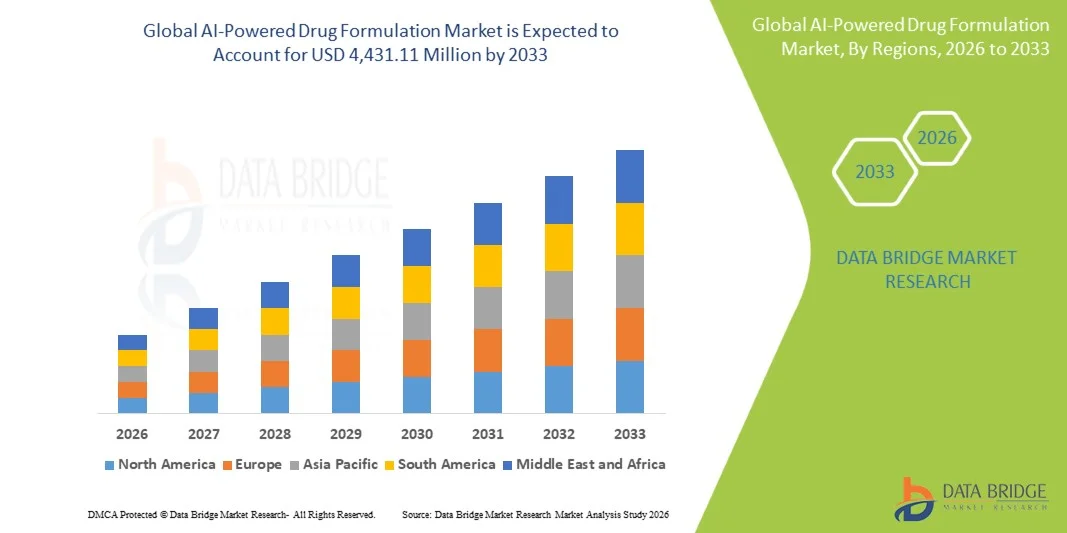
- As per Data Bridge Market Research analysis, the AI-powered drug formulation market was valued at USD 782.60 million in 2025 and is projected to reach USD 4,431.11 million by 2033, growing at a CAGR of 24.20% from 2026 to 2033.
- The market is experiencing consistent growth driven by increasing adoption of artificial intelligence and machine learning in pharmaceutical R&D, rising demand for faster and more efficient drug development, growing complexity of drug formulation, and the need to optimize drug efficacy, safety, stability, solubility, and bioavailability.
- The increasing investment in AI-driven pharmaceutical research, combined with the growing adoption of predictive modeling and data-driven formulation approaches, is compelling pharmaceutical companies, biotechnology firms, and contract research organizations to integrate AI into formulation workflows. AI-powered technologies enable rapid analysis of large datasets, formulation optimization, predictive assessment of drug properties, and more efficient development of complex and personalized therapies
Market Size & Forecast
- Global Market Value (2025): USD 782.60 Million
- Expected Market Value (2033): USD 4,431.11 Million
- Forecast CAGR (2026–2033): 24.20%
- Leading Region in 2025: North America
- Fastest Growing Region: Asia Pacific
What are the Major Takeaways of the AI-Powered Drug Formulation Market?
- North America dominated the AI-powered drug formulation market with the largest revenue share of 44.24% in 2025, supported by a strong pharmaceutical and biotechnology ecosystem, substantial AI investment, and advanced drug-development infrastructure.
- Asia-Pacific is expected to be the fastest-growing region at a CAGR of 28.31% from 2026 to 2033, fueled by pharmaceutical digitalization, expanding CRO capabilities, and increasing AI adoption across China, India, South Korea, and Japan.
- The small molecules segment led the market with a 40.14% share in 2025, driven by their extensive use across pharmaceutical development and the established availability of formulation data.
- Biologics are the fastest-growing drug type, projected to register a CAGR of 27.26%, reflecting the surge in complexity of biologic formulation development
- The software platforms segment dominated the component category with a 51% revenue share in 2025, led by increasing demand for AI-enabled tools for formulation prediction, optimization, and data analysis.
- Machine learning and deep learning accounted for 40.26% of the market share in 2025, preferred by its broad application in formulation prediction and optimization.
- The excipient compatibility prediction segment is the fastest-growing application category, with a CAGR of 26.03%, driven by the increasing need to identify suitable excipients efficiently during formulation development
Report Scope and AI-Powered Drug Formulation Market Segmentation
|
Attributes |
AI-Powered Drug Formulation Key Market Insights |
|
Segments Covered |
|
|
Countries Covered |
North America
Europe
Asia-Pacific
Middle East and Africa
South America
|
|
Key Market Players |
|
|
Market Opportunities |
|
|
Value Added Data Infosets |
In addition to the insights on market scenarios such as market value, growth rate, segmentation, geographical coverage, and major players, the market reports curated by the Data Bridge Market Research also include in-depth expert analysis, patient epidemiology, pipeline analysis, pricing analysis, and regulatory framework. |
What is the Key Trend in the AI-Powered Drug Formulation Market?
- Pharmaceutical companies are increasingly adopting AI-driven formulation design to reduce trial-and-error experimentation, accelerate formulation screening, and identify optimal combinations of active ingredients, excipients, and process parameters for improved drug-product performance.
- For instance, in February 2025, the Journal of Controlled Release published research on FormulationDT, an AI platform that uses approved-drug formulation data to make 12 formulation-strategy decisions for oral and injectable products, achieving an average ROC-AUC above 90%.
- Generative AI is increasingly being integrated with formulation development to digitally generate and evaluate drug-product structures, enabling researchers to optimize critical quality attributes before conducting extensive physical laboratory experiments.
- AI-powered formulation platforms are increasingly incorporating predictive models, automated experimentation, and data analytics to improve formulation optimization while reducing experimental material requirements and development timelines across pharmaceutical research workflows.
- For instance, in September 2025, Therapeutic Innovation & Regulatory Science published research on the use of AI in liquid dosage-form development, highlighting AI-based optimization of solvent selection, drug–excipient compatibility, crystallinity, salt formation, permeability, and stability to improve formulation development and manufacturing consistency.
- As pharmaceutical developers increasingly combine AI with automated experimentation and digital formulation tools, the adoption of intelligent formulation development is expected to accelerate, reinforcing AI as an important component of next-generation pharmaceutical R&D.
What are the Key Drivers of the AI-Powered Drug Formulation Market?
- The growing complexity of biologics, advanced drug-delivery systems, and high-concentration formulations is increasing demand for AI technologies capable of predicting formulation behavior, identifying suitable excipients, and optimizing formulation parameters more efficiently.
- For instance, in October 2025, the Computational and Structural Biotechnology Journal published research on Excipient Prediction Software (ExPreSo), a machine-learning system trained on 335 regulatory-approved peptide and protein drug products to predict suitable excipients, demonstrating how AI can reduce the time, cost, and risk associated with biopharmaceutical formulation screening.
- Pharmaceutical companies are increasingly using AI to analyze formulation datasets and predict drug-excipient compatibility, solubility, stability, dissolution, and other critical attributes that traditionally require extensive laboratory experimentation and repeated formulation trials.
- For instance, in July 2025, The AAPS Journal published research demonstrating that machine learning could predict drug-release profiles and kinetic parameters from tablet formulation compositions, addressing the traditionally laborious and time-consuming process of formulation optimization.
- With pharmaceutical R&D increasingly emphasizing faster development, lower material consumption, and data-driven decision-making, AI-powered formulation technologies are becoming increasingly important for optimizing formulation development and supporting more efficient drug-product development workflows.
Which Factors are Challenging the Growth of the AI-Powered Drug Formulation Market?
- AI-powered formulation systems require large, reliable, standardized, and representative datasets, while pharmaceutical formulation data can be fragmented, heterogeneous, proprietary, and difficult to integrate across different development environments.
- For instance, in May 2025, AAPS Open published feedback on FDA’s regulatory considerations for AI in drug manufacturing, identifying challenges involving data management, governance, third-party AI data, model development and validation, lifecycle management, and integration of AI into pharmaceutical quality systems.
- These data limitations can reduce model reliability and generalizability, particularly when AI systems are trained using small datasets or formulation experiments that do not adequately represent different APIs, excipients, manufacturing conditions, and dosage forms.
- For instance, in August 2024, Advanced Healthcare Materials published an article highlighting that AI-driven formulation development faces challenges from limited access to large, high-quality pharmaceutical datasets, inconsistent data reporting, proprietary data, and the lack of transparency of “black-box” models, which can hinder reproducibility, validation, and regulatory confidence.
- The dependence on high-quality datasets, explainable models, specialized expertise, and regulatory-compatible validation frameworks continues to restrict broader AI adoption, requiring pharmaceutical organizations to integrate AI carefully with established quality-by-design and formulation-development practices.
How is the AI-Powered Drug Formulation Market Segmented?
The AI-powered drug formulation market is segmented on the basis of drug type, component, technology, and application.
- By Drug Type
On the basis of drug type, the AI-powered drug formulation market is segmented into small molecules, biologics, nucleic acid-based drugs, cell and gene therapy payloads, and vaccines. The small molecules segment dominated the market with a 40.14% share in 2025, owing to their extensive use across pharmaceutical development and the established availability of formulation data. AI-powered formulation platforms are increasingly used to optimize solubility, stability, dissolution, and drug-excipient interactions for small-molecule compounds. These technologies can evaluate large numbers of formulation variables and identify suitable combinations more efficiently than conventional trial-and-error approaches. Pharmaceutical companies are also integrating machine learning into formulation development to improve experimental prioritization and reduce development complexity. The established manufacturing infrastructure for small-molecule drugs further supports the adoption of digital formulation technologies.
The biologics segment is projected to register the fastest growth at a CAGR of 27.26% during forecast period, driven by the increasing complexity of biologic formulation development. AI technologies can help predict protein stability, aggregation, excipient compatibility, and other critical formulation characteristics. These capabilities are particularly valuable for biologics because their sensitivity to formulation conditions can create significant development challenges. Increasing development of therapeutic proteins, antibodies, and other complex biologic products is expanding the need for advanced computational formulation tools. AI can also help researchers screen formulation variables and prioritize promising candidates before laboratory validation. Growing investment in biologics development and data-driven pharmaceutical research is further supporting adoption.
- By Component
On the basis of component, the AI-powered drug formulation market is segmented into software platforms, services, and hardware and infrastructure. The software platforms segment dominated the market with 51% share in 2025, supported by increasing demand for AI-enabled tools for formulation prediction, optimization, and data analysis. These platforms allow pharmaceutical researchers to process formulation datasets and generate data-driven recommendations. They can incorporate machine learning, predictive modeling, and other analytical capabilities into formulation workflows. Software-based solutions can also be integrated with existing research and laboratory environments, supporting broader organizational adoption. Pharmaceutical and biotechnology companies are increasingly adopting digital platforms to improve formulation development efficiency.
The services segment is projected to register the fastest growth at a CAGR of 24% during forecast period, driven by increasing demand for specialized AI expertise in pharmaceutical formulation development. Service providers can support organizations with AI model development, formulation data analysis, platform implementation, and workflow integration. This approach allows companies to access specialized capabilities without developing all AI infrastructure internally. CROs and other pharmaceutical service providers are also incorporating computational technologies into their development offerings. Increasing outsourcing of pharmaceutical research and development activities is creating additional demand for AI-enabled formulation services. Services can also help organizations address data preparation, model validation, and integration challenges during implementation.
- By Technology
On the basis of technology, the AI-powered drug formulation market is segmented into machine learning and deep learning, predictive modeling and simulation, generative AI and neural networks, hybrid AI approaches, and natural language processing (NLP). The machine learning and deep learning segment dominated the market with a 40.26% share in 2025, supported by its broad application in formulation prediction and optimization. These technologies can identify complex relationships between formulation variables and drug-performance characteristics. Machine learning models can analyze historical experimental data to support prediction of stability, compatibility, dissolution, and other formulation properties. Deep learning can In addition process complex and multidimensional datasets generated during pharmaceutical research. Their ability to learn from existing formulation data makes them valuable for reducing repetitive experimentation.
The predictive modeling and simulation segment is projected to register the fastest growth at a CAGR of 25.74% during forecast period, driven by the increasing need to evaluate formulation outcomes before extensive laboratory experimentation. Predictive models can help researchers assess formulation variables and identify potentially suitable combinations at an early stage. Simulation approaches can also support virtual assessment of drug-excipient interactions and expected formulation performance. These capabilities can reduce the number of experimental iterations required during development. Pharmaceutical organizations are increasingly combining computational predictions with laboratory validation to improve formulation workflows. The technology is particularly useful for complex development programs involving numerous formulation parameters.
- By Application
On the basis of application, the AI-powered drug formulation market is segmented into formulation design and optimization, excipient compatibility prediction, stability and shelf-life prediction, high-throughput screening optimization, personalized and precision medicine formulations, and advanced therapy formulations. The formulation design and optimization segment dominated the market with a 41.16% share in 2025, owing to the growing application of AI in identifying and optimizing formulation variables. AI platforms can analyze relationships between active pharmaceutical ingredients, excipients, processing conditions, and formulation performance. These capabilities allow researchers to evaluate multiple formulation possibilities more efficiently. AI-based optimization can also help reduce reliance on extensive trial-and-error experimentation during early development. Pharmaceutical organizations are increasingly using computational approaches to improve formulation decision-making and experimental prioritization.
The excipient compatibility prediction segment is projected to register the fastest growth at a CAGR of 26.03% during forecast period, driven by the increasing need to identify suitable excipients efficiently during formulation development. AI models can analyze interactions between active pharmaceutical ingredients and excipients to predict potential compatibility issues. This can help researchers prioritize promising excipient combinations before conducting extensive laboratory testing. The approach is particularly valuable for complex formulations where multiple excipients can influence stability, solubility, release, and other characteristics. Increasing demand for faster formulation screening is encouraging pharmaceutical companies to adopt predictive compatibility technologies. Integration of formulation databases with machine learning can further improve the speed and consistency of compatibility assessment.
Which Region Holds the Largest Share of the AI-Powered Drug Formulation Market?
- North America dominated the AI-powered drug formulation market with the largest revenue share of 44.24% in 2025, supported by a strong pharmaceutical and biotechnology ecosystem, substantial AI investment, and advanced drug-development infrastructure.
- The region also benefits from substantial investments in AI-driven drug development, growing use of computational formulation platforms, and increasing collaboration between technology providers and pharmaceutical organizations. Rising demand for faster formulation development, personalized medicine, and data-driven pharmaceutical research continues to strengthen North America’s leadership position in the global market
U.S. AI-Powered Drug Formulation Market Insight
The U.S. AI-powered drug formulation market is witnessing strong growth due to rising investments in artificial intelligence-enabled pharmaceutical R&D, advanced formulation technologies, and digital drug development platforms. The country’s mature pharmaceutical and biotechnology ecosystem, along with increasing adoption of machine learning, predictive modeling, and generative AI, is driving demand across formulation design, optimization, and drug development applications. In addition, growing emphasis on accelerating drug development timelines, improving formulation precision, and reducing experimental requirements is supporting the adoption of AI-powered formulation technologies across pharmaceutical companies, biotechnology firms, and research organizations.
Asia-Pacific AI-Powered Drug Formulation Market Insight
The Asia-Pacific AI-powered drug formulation market is expected to witness rapid growth, driven by expanding pharmaceutical manufacturing, increasing investments in artificial intelligence, and rising adoption of digital drug development technologies across countries such as China, India, and Japan. Growing pharmaceutical R&D activities, increasing demand for advanced formulation solutions, and development of biotechnology capabilities are supporting regional market expansion. In addition, the growing presence of pharmaceutical manufacturers, research institutions, and contract development organizations is accelerating the adoption of AI-powered formulation platforms across the region.
Japan AI-Powered Drug Formulation Market Insight
The Japan AI-powered drug formulation market is witnessing consistent growth due to rising investments in artificial intelligence-enabled pharmaceutical research, advanced drug development technologies, and formulation optimization. Pharmaceutical companies, biotechnology organizations, and research institutes are increasingly adopting AI-powered tools for formulation design, stability prediction, excipient compatibility assessment, and drug development activities. Moreover, increasing integration of machine learning and predictive analytics with pharmaceutical research, along with Japan’s focus on advanced healthcare innovation, is further contributing to market growth.
China AI-Powered Drug Formulation Market Insight
The China AI-powered drug formulation market is growing rapidly, driven by increasing pharmaceutical R&D activities, expanding biotechnology capabilities, and rising government and industry focus on artificial intelligence adoption. Growing use of machine learning, predictive modeling, and generative AI across pharmaceutical research is significantly boosting demand for advanced formulation solutions. In addition, rising investments in innovative drug development, increasing adoption of digital technologies, and the expansion of domestic pharmaceutical and biotechnology companies are strengthening China’s position as a major growth market for AI-powered drug formulation technologies.
U.K. AI-Powered Drug Formulation Market Insight
The U.K. AI-powered drug formulation market is experiencing steady growth, supported by rising adoption of artificial intelligence in pharmaceutical research, biotechnology development, and advanced formulation applications. Increasing investments in AI-enabled drug discovery and development infrastructure and growing demand for data-driven formulation optimization are contributing to market growth. Furthermore, integration of machine learning, predictive analytics, and generative AI technologies is improving formulation development efficiency and supporting the U.K.’s position as an important innovation hub in the AI-powered pharmaceutical industry.
Germany AI-Powered Drug Formulation Market Insight
The Germany AI-powered drug formulation market is expanding steadily due to the country’s strong pharmaceutical manufacturing base, advanced research capabilities, and increasing adoption of artificial intelligence technologies. Pharmaceutical companies, biotechnology organizations, and research institutes are increasingly utilizing AI-powered platforms for formulation design, optimization, stability assessment, and drug development activities. Continuous advancements in machine learning, predictive modeling, and digital pharmaceutical technologies, along with strong focus on research innovation and advanced healthcare solutions, are further driving market growth in Germany.
Which are the Top Companies in AI-Powered Drug Formulation Market?
The AI-powered drug formulation industry is primarily led by well-established companies, including:
- BASF SE (Germany)
- Colorcon, Inc. (U.S.)
- Persist AI, Inc. (U.S.)
- Schrödinger, Inc. (U.S.)
- Recursion (U.S.)
- Insilico Medicine (U.S.)
- Certara, Inc. (U.S.)
- Dassault Systèmes SE (France)
- Thermo Fisher Scientific Inc. (U.S.)
- Sartorius AG (Germany)
- Lonza Ltd (Switzerland)
- Evonik Industries AG (Germany)
- Merck KGaA (Germany)
- International Flavors & Fragrances Inc. (U.S.)
- Roquette Frères (France)
- The Lubrizol Corporation (U.S.)
- Ashland (U.S.)
- Croda International Plc (U.K.)
- GEA Group Aktiengesellschaft (Germany)
- Syntegon Technology GmbH (Germany)
What are Latest Developments in AI-Powered Drug Formulation Market?
- In May 2025, Persist AI launched its Cloud Lab platform, an AI-powered robotic formulation development platform designed to predict formulation recipes and performance and then automatically build and test formulations. The platform supports development of long-acting injectables, tablets, capsules, topical formulations, and injectable formulations, combining AI models with robotic laboratory systems to accelerate pharmaceutical formulation development.
- In May 2024, Sanofi, Formation Bio, and OpenAI announced a collaboration to develop AI-powered software for drug development. The initiative combines proprietary pharmaceutical data, AI models, and software engineering to create customized tools across the drug-development lifecycle. While broader than formulation alone, it is directly relevant to the AI-enabled pharmaceutical development ecosystem supporting formulation and other development activities.
- In November 2023, researchers introduced FormulationAI, a web-based AI platform for drug formulation design. Published in Briefings in Bioinformatics, the development provides AI-based prediction of formulation properties across multiple drug-delivery systems and enables formulation design using basic drug and excipient information. The platform was made freely accessible for pharmaceutical researchers and represents a direct application of AI models to formulation development
- In November 2023, BASF Pharma Solutions and IFF Pharma Solutions announced the integration of IFF pharmaceutical excipients into BASF’s ZoomLab Virtual Pharma Assistant platform. ZoomLab is a digital formulation tool that uses BASF’s proprietary algorithm to predict suitable excipients for a given active pharmaceutical ingredient, while the collaboration expanded the platform’s excipient database with IFF products.
- In June 2023, Colorcon launched HyperStart C2C, a Smart Formulation Hub designed to support formulation development for solid oral dosage forms. The digital platform provides formulation recommendations, excipient choices, film-coating options, color selection, regulatory insights, and process guidance, using algorithms to help formulators reduce formulation iterations and accelerate product development.

- Interactive Data Analysis Dashboard
- Company Analysis Dashboard for high growth potential opportunities
- Research Analyst Access for customization & queries
- Competitor Analysis with Interactive dashboard
- Latest News, Updates & Trend analysis
- Harness the Power of Benchmark Analysis for Comprehensive Competitor Tracking
Data collection and base year analysis are done using data collection modules with large sample sizes. The stage includes obtaining market information or related data through various sources and strategies. It includes examining and planning all the data acquired from the past in advance. It likewise envelops the examination of information inconsistencies seen across different information sources. The market data is analysed and estimated using market statistical and coherent models. Also, market share analysis and key trend analysis are the major success factors in the market report. To know more, please request an analyst call or drop down your inquiry.
The key research methodology used by DBMR research team is data triangulation which involves data mining, analysis of the impact of data variables on the market and primary (industry expert) validation. Data models include Vendor Positioning Grid, Market Time Line Analysis, Market Overview and Guide, Company Positioning Grid, Patent Analysis, Pricing Analysis, Company Market Share Analysis, Standards of Measurement, Global versus Regional and Vendor Share Analysis. To know more about the research methodology, drop in an inquiry to speak to our industry experts.
Data Bridge Market Research is a leader in advanced formative research. We take pride in servicing our existing and new customers with data and analysis that match and suits their goal. The report can be customized to include price trend analysis of target brands understanding the market for additional countries (ask for the list of countries), clinical trial results data, literature review, refurbished market and product base analysis. Market analysis of target competitors can be analyzed from technology-based analysis to market portfolio strategies. We can add as many competitors that you require data about in the format and data style you are looking for. Our team of analysts can also provide you data in crude raw excel files pivot tables (Fact book) or can assist you in creating presentations from the data sets available in the report.













