


AI-Powered Hospital Resource Allocation Market Size
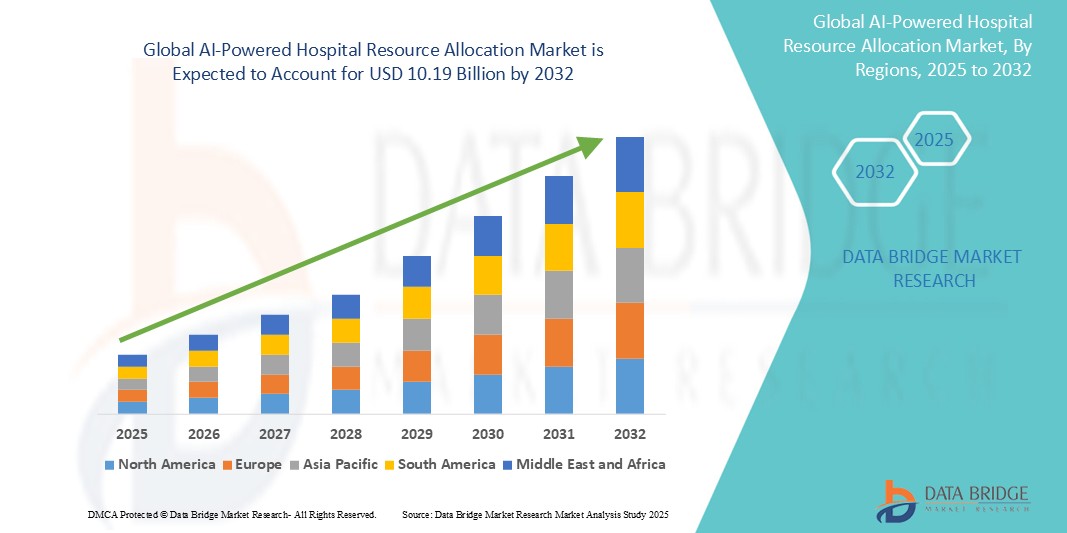
- The global AI-powered hospital resource allocation market size was valued at USD1.78 billion in 2024 and is expected to reach USD 10.19 billion by 2032, at a CAGR of 24.40% during the forecast period
- The market growth is largely fueled by the increasing demand for enhanced efficiency, accuracy, and improved patient outcomes within the healthcare sector, along with a growing recognition of AI's potential to optimize complex hospital operations.
- Furthermore, rising pressures on healthcare systems to reduce costs, manage increasing patient volumes, and transition towards value-based care models are accelerating the adoption of AI-powered solutions. These converging factors are establishing AI-powered resource allocation as a critical tool for modern hospitals, thereby significantly boosting the industry's growth
AI-Powered Hospital Resource Allocation Market Analysis
- AI-powered hospital resource allocation solutions, leveraging advanced analytics and machine learning, are becoming indispensable tools for optimizing complex healthcare operations, from patient flow and staff scheduling to supply chain management, driven by their ability to enhance efficiency, reduce costs, and significantly improve patient care quality
- The escalating demand for AI in hospital resource allocation is primarily fueled by the increasing strain on healthcare systems due to rising patient volumes, the persistent need for cost reduction, and a growing emphasis on delivering more personalized and efficient healthcare services
- North America dominates the AI-powered hospital resource allocation market with the largest revenue share of 38% in 2024, characterized by early adoption of advanced healthcare technologies, substantial investments in AI research and development, and a strong presence of leading AI solution providers
- Asia-Pacific is expected to be the fastest growing region in the AI-powered hospital resource allocation market during the forecast period due to rapidly expanding healthcare infrastructure, increasing digitalization initiatives by governments, and a growing awareness of AI's potential to address healthcare challenges in populous nations
- Cloud-based segment dominates the AI-powered hospital resource allocation market with a market share of 63.3% in 2024, driven by its superior scalability, cost-effectiveness enhanced accessibility for remote healthcare teams, and robust security features provided by major cloud vendors
Report Scope and AI-Powered Hospital Resource Allocation Market Segmentation
|
Attributes |
AI-Powered Hospital Resource Allocation Key Market Insights |
|
Segments Covered |
|
|
Countries Covered |
North America
Europe
Asia-Pacific
Middle East and Africa
South America
|
|
Key Market Players |
|
|
Market Opportunities |
|
|
Value Added Data Infosets |
In addition to the insights on market scenarios such as market value, growth rate, segmentation, geographical coverage, and major players, the market reports curated by the Data Bridge Market Research also include in-depth expert analysis, pricing analysis, brand share analysis, consumer survey, demography analysis, supply chain analysis, value chain analysis, raw material/consumables overview, vendor selection criteria, PESTLE Analysis, Porter Analysis, and regulatory framework. |
AI-Powered Hospital Resource Allocation Market Trends
“Real-Time Predictive Analytics and Ethical AI Frameworks”
- A significant and accelerating trend in the global AI-powered hospital resource allocation market is the deepening integration of real-time data analytics with sophisticated AI models, enabling predictive and prescriptive insights for immediate operational adjustments. This fusion of technologies significantly enhances hospital agility and responsiveness to dynamic patient needs
- For instance, hospitals are increasingly employing AI to forecast patient admissions and discharges hourly, allowing for dynamic adjustment of bed availability and staffing levels. Similarly, advanced AI models can predict equipment failures, enabling proactive maintenance and optimal utilization of critical medical devices, preventing costly downtime
- AI integration in hospital resource allocation also drives features such as intelligent patient routing to reduce wait times and optimize clinical pathways. For instance, some AI systems analyze patient symptoms and historical data to suggest the most appropriate department or specialist, ensuring faster and more effective care. Furthermore, real-time monitoring capabilities offer administrators continuous visibility into resource utilization, allowing for immediate reallocation based on fluctuating demand
- The seamless integration of AI-powered solutions with Electronic Health Records (EHRs) and other hospital information systems facilitates centralized control over various aspects of healthcare operations. Through a single interface, administrators can manage bed assignments, staff schedules, and inventory levels, creating a unified and highly efficient operational environment
- The demand for AI-powered solutions that offer real-time predictive capabilities and seamlessly integrate into existing hospital workflows is growing rapidly across healthcare providers, as they increasingly prioritize operational efficiency, cost reduction, and superior patient care. The growing emphasis on ethical AI, including transparency in algorithms and mitigation of biases in resource distribution, is also a key shaping trend
AI-Powered Hospital Resource Allocation Market Dynamics
Driver
“Increasing Pressure for Cost Reduction and Operational Efficiency”
- The escalating financial pressures on healthcare systems globally, coupled with the imperative to enhance operational efficiency, is a significant driver for the heightened demand for AI-powered hospital resource allocation solutions. Hospitals are continuously seeking ways to deliver high-quality care while managing rising costs
- For instance, AI-driven solutions are being adopted to automate administrative tasks such as patient scheduling, billing, and claims processing, which can significantly reduce labor costs and minimize human errors. This frees up healthcare professionals to focus more on direct patient care, improving productivity
- As healthcare organizations face increasing patient volumes and complex logistical challenges, AI offers advanced capabilities such as predictive analytics to forecast patient admissions, optimize staff scheduling, and streamline bed management. This provides a compelling solution to alleviate bottlenecks and improve patient flow
- Furthermore, the growing adoption of value-based care models, which incentivize quality and efficiency over quantity, is making AI an integral component for hospitals. AI enables better data-driven decision-making, ensuring resources are utilized effectively to achieve better patient outcomes and reduce preventable readmissions
- The ability of AI to provide real-time insights into resource utilization, identify underutilized assets, and facilitate proactive maintenance of medical equipment are key factors propelling the adoption of these solutions. The trend towards digital transformation within healthcare, supported by increased availability of patient data and robust computing power, further contributes to market growth
Restraint/Challenge
“Concerns Regarding Data Privacy, Security, and High Implementation Costs”
- Concerns surrounding the stringent requirements for data privacy and the cybersecurity vulnerabilities of highly sensitive patient information, coupled with significant initial investment costs, pose a major challenge to broader market penetration of AI-powered hospital resource allocation solutions
- For instance, high-profile reports of ransomware attacks targeting healthcare institutions and the complexities of adhering to regulations such as HIPAA and GDPR have made some healthcare organizations hesitant to adopt comprehensive AI solutions, particularly for core patient-facing operations
- Addressing these data privacy and cybersecurity concerns through robust encryption, secure data governance frameworks, explainable AI, and continuous monitoring is crucial for building trust. Leading AI solution providers for healthcare emphasize their advanced data protection protocols and compliance certifications to reassure potential buyers. In addition, the relatively high initial cost of implementing sophisticated AI platforms, including data integration, infrastructure upgrades, and workforce training, can be a significant barrier for price-sensitive hospitals, especially smaller facilities or those with limited IT budgets. While modular or cloud-based AI solutions are becoming more accessible, comprehensive enterprise-wide deployments still represent a substantial investment
- While the long-term ROI of AI in healthcare is evident, the perceived upfront financial burden can still hinder widespread adoption, especially for organizations that struggle to quantify immediate benefits or lack the necessary technical expertise
- Overcoming these challenges through enhanced data security measures, clear regulatory guidance, comprehensive training programs, and the development of more affordable and scalable AI solutions will be vital for sustained market growth
AI-Powered Hospital Resource Allocation Market Scope
The market is segmented on the basis of component, deployment, application, technology, and end-user
- By Component
On the basis of component, the AI-powered hospital resource allocation market is segmented into software, hardware, and services. The software segment dominates the largest market revenue share of 48.1% in 2024, driven by the essential role of AI algorithms, platforms, and applications in optimizing complex hospital workflows and decision-making. Hospitals prioritize software solutions for their ability to provide predictive analytics, intelligent automation, and seamless integration with existing systems, directly addressing the core needs of resource allocation.
The services segment is anticipated to witness the fastest growth rate, fueled by the increasing demand for specialized expertise in AI system implementation, integration, customization, and ongoing maintenance within diverse and complex healthcare environments. The need for training healthcare staff and ensuring smooth operation of AI tools further propels the growth of this segment.
- By Deployment
On the basis of deployment, the AI-powered hospital resource allocation market is segmented into cloud-based and on-premises. The cloud-based segment held the largest market revenue share of 63.3% in 2024, driven by its superior scalability, cost-effectiveness enhanced accessibility for remote healthcare teams, and robust security features provided by major cloud vendors. Cloud solutions enable rapid deployment and facilitate real-time data access crucial for dynamic resource management
The on-premises segment is expected to witness steady growth, primarily chosen by larger healthcare organizations with stringent data governance requirements or those that prefer full control over their IT infrastructure and sensitive patient data.
- By Application
On the basis of application, the AI-powered hospital resource allocation market is segmented into patient care management, administrative processes, diagnostic imaging and radiology, drug discovery, and others. The patient care management segment accounts for the largest market revenue share of 26.6% in 2024, driven by the critical need to optimize patient flow, bed utilization, and clinical pathways to improve patient outcomes and reduce wait times. AI directly impacts the quality and efficiency of core patient services
The administrative processes segment is expected to witness significant growth, favored for its ability to automate time-consuming tasks such as scheduling, billing, and claims management, thereby reducing operational costs and allowing human resources to focus on clinical activities. This application directly addresses the increasing administrative burden on healthcare systems
- By Technology
On the basis of technology, the AI-powered hospital resource allocation market is segmented into computer vision, context-aware computing, machine learning, and natural language processing. The machine learning (ML) segment held the largest market revenue share of 35.5% in 2024, driven by its foundational role in enabling predictive analytics for demand forecasting, optimizing complex scheduling algorithms, and learning from vast datasets to improve resource allocation accuracy over time. ML is the engine behind intelligent resource decisions
The natural language processing (NLP) segment is expected to witness rapid growth, driven by its capability to extract valuable insights from unstructured clinical notes, patient feedback, and administrative documents, facilitating automated data entry, smart search, and enhanced communication within the healthcare system
- By End User
On the basis of end user, the AI-powered hospital resource allocation market is segmented into healthcare payers, hospital & healthcare providers, patients, pharmaceuticals & biotechnology companies, and other end-users. The hospital & healthcare providers segment accounted for the largest market revenue share of 44% in 2024, driven by the direct and immediate benefits these organizations derive from AI-powered solutions in optimizing their day-to-day operations, managing resources efficiently, and ultimately enhancing patient care delivery
The healthcare payers segment is expected to witness the fastest growth, fueled by the increasing adoption of AI to combat fraud, streamline claims processing, and analyze resource utilization patterns across their networks to ensure cost-effectiveness and appropriate care
AI-Powered Hospital Resource Allocation Market Regional Analysis
- North America dominates the AI-powered hospital resource allocation market with the largest revenue share of 38% in 2024, driven by characterized by early adoption of advanced healthcare technologies, substantial investments in AI research and development, and a strong presence of leading AI solution providers
- Consumers in the region highly value the efficiency, predictive capabilities, and seamless integration offered by AI-powered solutions with existing Electronic Health Records (EHR) and other hospital information systems
- This widespread adoption is further supported by a technologically inclined healthcare workforce, increasing government initiatives and funding for digital health transformation, and the growing demand for data-driven decision-making to manage complex patient populations and resource demands effectively
U.S. AI-Powered Hospital Resource Allocation Market Insight
The U.S. AI-powered hospital resource allocation market captured largest revenue share of 37% in 2024, within the broader North American AI in healthcare market, fueled by the swift uptake of advanced healthcare technologies and the expanding trend of digital transformation in hospitals. Healthcare providers are increasingly prioritizing the enhancement of operational efficiency and patient care through intelligent, data-driven systems. The growing emphasis on value-based care and the need to manage rising healthcare costs, combined with robust demand for predictive analytics and integration with existing electronic health record (EHR) systems, further propels the AI-powered hospital resource allocation industry
Europe AI-Powered Hospital Resource Allocation Market Insight
The Europe AI-powered hospital resource allocation market is projected to expand at a substantial CAGR throughout the forecast period, primarily driven by the escalating need for enhanced efficiency in healthcare delivery, the prevalence of chronic diseases, and growing government initiatives for AI implementation in healthcare. The increase in aging populations, coupled with the demand for optimized resource utilization across national health systems, is fostering the adoption of AI-powered solutions. European healthcare providers are also drawn to the potential for cost reduction and improved patient outcomes these technologies offer
U.K. AI-Powered Hospital Resource Allocation Market Insight
The U.K. AI-powered hospital resource allocation market is anticipated to grow at a noteworthy CAGR during the forecast period, driven by the escalating trend of digital transformation within the NHS and a desire for heightened operational efficiency and cost savings. In addition, concerns regarding backlogs in patient appointments and staffing shortages are encouraging healthcare providers to choose AI-powered solutions for optimizing workflows and resource allocation. The UK’s embrace of connected healthcare devices and its robust digital health infrastructure is expected to continue to stimulate market growth
Germany AI-Powered Hospital Resource Allocation Market Insight
The Germany AI-powered hospital resource allocation market is expected to expand at a considerable CAGR during the forecast period, fueled by increasing awareness of digital health solutions and the demand for technologically advanced, efficient healthcare systems. Germany’s well-developed healthcare infrastructure, combined with its emphasis on innovation and robust government support for AI initiatives (such as German AI Strategy), promotes the adoption of AI-powered solutions, particularly in hospital management and patient flow optimization. The integration of AI with existing hospital information systems is also becoming increasingly prevalent, with a strong preference for secure, privacy-focused solutions aligning with local regulatory expectations
Asia-Pacific AI-Powered Hospital Resource Allocation Market Insight
The Asia-Pacific AI-powered hospital resource allocation market is poised to grow at the fastest CAGR, during the forecast period, driven by increasing healthcare expenditure, rising patient volumes due to urbanization and chronic diseases, and rapid technological advancements in countries such as China, Japan, and India. The region's growing inclination towards smart hospitals, supported by government initiatives promoting digitalization and accessible healthcare, is driving the adoption of AI-powered resource allocation. Furthermore, as APAC emerges as a manufacturing and innovation hub for AI components and systems, the affordability and accessibility of AI solutions are expanding to a wider range of healthcare providers
Japan AI-Powered Hospital Resource Allocation Market Insight
The Japan AI-powered hospital resource allocation market is gaining momentum due to the country’s high-tech culture, rapid aging population, and demand for efficient healthcare delivery. The Japanese market places a significant emphasis on technological innovation and operational excellence, and the adoption of AI-powered solutions is driven by the increasing number of smart hospitals and connected healthcare facilities. The integration of AI with other IoT devices and medical technologies, such as advanced imaging systems, is fueling growth. Moreover, Japan's efforts to address workforce shortages and rising healthcare costs are likely to spur demand for AI-driven, secure resource allocation solutions in both clinical and administrative sectors
China AI-Powered Hospital Resource Allocation Market Insight
The China AI-powered hospital resource allocation market accounted for the largest market revenue share in Asia Pacific in 2024, attributed to the country's expanding healthcare market, rapid urbanization, and high rates of technological adoption coupled with strong government support for AI in healthcare. China stands as one of the largest markets for digital health solutions, and AI-powered resource allocation is becoming increasingly popular in public and private hospitals. The push towards smart cities, vast available healthcare data, and the presence of strong domestic AI manufacturers are key factors propelling the market in China
AI-Powered Hospital Resource Allocation Market Share
The AI-powered hospital resource allocation industry is primarily led by well-established companies, including:
- GE HealthCare (U.S.)
- Koninklijke Philips N.V. (Netherlands)
- Siemens Healthineers AG (Germany)
- IBM (U.S.)
- Oracle (U.S.)
- Epic Systems (U.S.)
- Infor (U.S.)
- Optum Inc. (U.S.)
- Medtronic (Ireland)
- Veradigm LLC (U.S.)
- Health Catalyst (U.S.)
- Viz.ai, Inc. (U.S.)
- Tempus (U.S.)
- Komodo Health, Inc. (U.S.)
- LeanTaaS (U.S.)
- Qventus (U.S.)
- Intelligent Medical Objects, Inc (U.S.)
- athenahealth (U.S.)
- Notable (U.S.)
Latest Developments in Global AI-Powered Hospital Resource Allocation Market
- In May 2025, Smarter Technologies, a new company formed by the strategic growth investments in Access Healthcare, SmarterDx, and Thoughtful.ai, has launched the industry's first AI-powered revenue management platform. This platform aims to automate hospital and health systems' administrative workflows and strengthen financial performance by combining agentic AI agents with human-in-loop delivery capabilities and clinically driven billing algorithms
- In March 2025, A new whitepaper by global software development leader IT Medical reveals how AI-powered assistants could save hospitals millions in operational costs annually, potentially over USD 13 million. The study emphasizes AI's potential to revolutionize hospital administration by enhancing scheduling, streamlining billing, improving documentation management, and supporting data-driven decision-making, directly addressing rising costs and staffing shortages
- In March 2025, Apollo Hospitals has announced plans to introduce AI tools to automate routine tasks, such as medical documentation, and enhance diagnostic accuracy. This move aims to significantly reduce staff workload and improve overall operational efficiency, showcasing a direct investment by a major hospital group in AI for resource optimization
- In February 2025, AdventHealth, a large non-profit health system, has partnered with ParkourSC, a leader in AI-driven supply chain dynamic decision intelligence solutions, to enhance its supply chain operations. By implementing an intelligent Inventory Control Tower, AdventHealth aims to further strengthen its ability to ensure critical medical supplies are available precisely when and where they are needed. This collaboration will leverage ParkourSC's AI-powered platform to aggregate various data sources and overlay AI capabilities for insights that drive smart, data-driven decisions, improving supply chain resiliency and efficiency across their extensive network
- In January 2025, A survey conducted by Innovaccer, involving over 100 healthcare professionals, reveals key AI trends for 2025. Among these, the rise of automated clinical documentation is significantly reducing the time doctors spend on paperwork (64.76% less time), leading to a 37.1% improvement in medical decision-making. The advancement of precision medicine, driven by AI's ability to analyze complex patient data, is resulting in 41.90% greater accuracy in diagnoses and a 37.5% jump in treatment effectiveness

- Interactive Data Analysis Dashboard
- Company Analysis Dashboard for high growth potential opportunities
- Research Analyst Access for customization & queries
- Competitor Analysis with Interactive dashboard
- Latest News, Updates & Trend analysis
- Harness the Power of Benchmark Analysis for Comprehensive Competitor Tracking
Data collection and base year analysis are done using data collection modules with large sample sizes. The stage includes obtaining market information or related data through various sources and strategies. It includes examining and planning all the data acquired from the past in advance. It likewise envelops the examination of information inconsistencies seen across different information sources. The market data is analysed and estimated using market statistical and coherent models. Also, market share analysis and key trend analysis are the major success factors in the market report. To know more, please request an analyst call or drop down your inquiry.
The key research methodology used by DBMR research team is data triangulation which involves data mining, analysis of the impact of data variables on the market and primary (industry expert) validation. Data models include Vendor Positioning Grid, Market Time Line Analysis, Market Overview and Guide, Company Positioning Grid, Patent Analysis, Pricing Analysis, Company Market Share Analysis, Standards of Measurement, Global versus Regional and Vendor Share Analysis. To know more about the research methodology, drop in an inquiry to speak to our industry experts.
Data Bridge Market Research is a leader in advanced formative research. We take pride in servicing our existing and new customers with data and analysis that match and suits their goal. The report can be customized to include price trend analysis of target brands understanding the market for additional countries (ask for the list of countries), clinical trial results data, literature review, refurbished market and product base analysis. Market analysis of target competitors can be analyzed from technology-based analysis to market portfolio strategies. We can add as many competitors that you require data about in the format and data style you are looking for. Our team of analysts can also provide you data in crude raw excel files pivot tables (Fact book) or can assist you in creating presentations from the data sets available in the report.













