


What is the AI-Powered Sleep Technologies Market Size and Growth Rate?
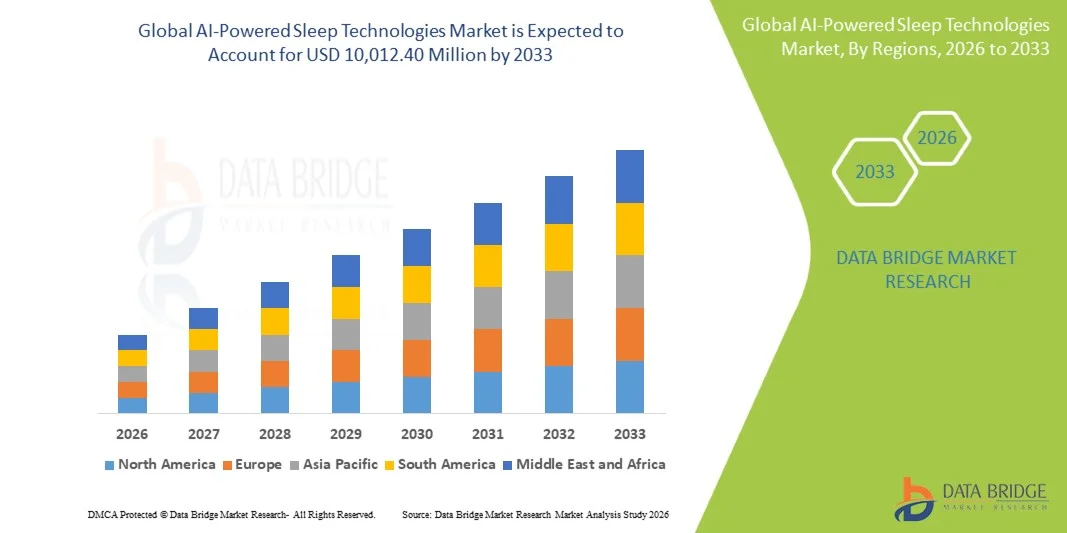
- As per market analysis, the global AI-powered sleep technologies market was valued at USD 8,065.40 Million in 2025 and is projected to reach USD 10,012.40 Million by 2033, growing at a CAGR of 20.20% from 2026 to 2033.
- The market is witnessing growth driven by the increasing prevalence of sleep disorders, rising awareness regarding sleep health, growing demand for continuous sleep monitoring, and increasing adoption of artificial intelligence and machine learning technologies for personalized sleep management. AI-powered sleep technologies are increasingly being used across sleep monitoring and tracking, sleep apnea detection and management, insomnia management, sleep quality improvement, and personalized sleep recommendations, supporting adoption across hospitals, sleep clinics, homecare settings, and wellness applications.
- Increasing healthcare expenditure related to sleep disorders, expansion of digital health infrastructure, growing adoption of wearable sleep trackers and smart sleep devices, and rising demand for personalized and preventive sleep management are creating further growth opportunities. The integration of AI with wearable sensors, smart beds, sleep monitoring systems, mobile applications, and connected healthcare platforms, along with advancements in predictive analytics and real-time sleep assessment, is supporting market development across developed and emerging healthcare markets.
Market Size & Forecast
- Market Value (2025): USD 8,065.40 Million
- Expected Market Value (2033): USD 10,012.40 Million
- Forecast CAGR (2026–2033): 20.20%
- Leading Region in 2025: North America
- Fastest Growing Region: Asia-Pacific
What are the Major Takeaways of the AI-Powered Sleep Technologies Market?
- North America dominated the global AI- powered sleep technologies market with a 41.28% market share in 2025, supported by established healthcare infrastructure, high awareness of sleep disorders, strong adoption of AI-enabled healthcare technologies, and increasing demand for continuous sleep monitoring and personalized sleep management. The region also benefits from an active regulatory environment and growing adoption of AI-enabled sleep tools across clinical and home settings.
- Asia-Pacific is expected to witness the fastest growth in the global AI- powered sleep technologies market during the forecast period, growing at a CAGR of 23.86% from 2026 to 2033, supported by increasing awareness of sleep health, expansion of healthcare infrastructure, rising adoption of wearable technologies, and growing demand for affordable and convenient sleep monitoring solutions. Increasing policy attention to sleep health and digital healthcare adoption across countries such as China, India, Japan, and South Korea is further supporting regional growth.
- AI-enabled sleep trackers represented the leading product type, accounting for a 42.83% market share in 2025, supported by widespread adoption of wearable devices, rings, and under-mattress sensing technologies for continuous sleep monitoring. Their ability to collect recurring sleep and physiological data and provide personalized insights is supporting their adoption among consumers and healthcare users.
- Machine learning and sensor fusion represented a key technology segment, accounting for a 38.57% market share in 2025, supported by their use in processing multiple physiological signals, including movement and heart-rate-related data, to generate detailed sleep profiles. Increasing integration of AI algorithms with wearable sensors, connected devices, and cloud or edge computing is further supporting the adoption of these technologies.
- Sleep monitoring and scoring represented a key application segment, accounting for a 36.92% market share in 2025, supported by the growing demand for continuous assessment of sleep duration, quality, and patterns. The increasing use of AI-powered technologies for sleep tracking, personalized recommendations, and clinical assessment is supporting adoption across consumer, homecare, and healthcare settings. Sleep apnea and snoring detection is expected to grow at a CAGR of 22.57% from 2026 to 2033, supported by increasing demand for convenient home-based screening and AI-enabled detection capabilities.
Report Scope AI-Powered Sleep Technologies Market Segmentation
|
Attributes |
AI-Powered Sleep Technologies Market Key Market Insights |
|
Segments Covered |
|
|
Countries Covered |
North America
Europe
Asia-Pacific
Middle East and Africa
South America
|
|
Key Market Players |
|
|
Market Opportunities |
|
|
Value Added Data Infosets |
In addition to the insights on market scenarios such as market value, growth rate, segmentation, geographical coverage, and major players, the market reports curated by the Data Bridge Market Research also include in-depth expert analysis, patient epidemiology, pipeline analysis, pricing analysis, and regulatory framework. |
What is the Key Trend in the AI-Powered Sleep Technologies Market?
- Increasing adoption of AI-powered personalized sleep monitoring and predictive sleep analytics is emerging as a key trend in the global AI-Powered Sleep Technologies market. Manufacturers are increasingly integrating artificial intelligence and machine learning with wearable sensors, smartwatches, smart rings, sleep trackers, and connected sleep devices to analyze sleep duration, sleep stages, heart rate, respiratory patterns, blood oxygen levels, and other physiological indicators. These technologies are increasingly being used to generate personalized sleep scores, recommendations, and behavioral insights, supporting more individualized approaches to sleep management.
- The trend is particularly relevant to sleep monitoring, sleep quality improvement, sleep apnea detection, insomnia management, and personalized sleep recommendations, where continuous data collection and AI-based analysis can provide users with actionable insights. The integration of AI with connected healthcare platforms is also supporting remote monitoring and facilitating the sharing of sleep-related information with healthcare providers. Increasing consumer interest in preventive health and growing awareness of sleep disorders are further encouraging the adoption of AI-enabled sleep technologies.
- For instance, in September 2025, Samsung showcased the Galaxy Watch8 series and its advanced sleep and wellness capabilities at World Sleep 2025. The Galaxy Watch8 series includes personalized Bedtime Guidance based on the two-process model of sleep regulation, while its Sleep Apnea feature can identify signs of moderate to severe obstructive sleep apnea through a two-night monitoring period. Samsung also highlighted the integration of advanced sensors, AI-driven insights, and the Samsung Health ecosystem for personalized health management.
- AI-enabled early detection of sleep apnea is also becoming increasingly important. In April 2025, Samsung announced a collaboration with Stanford Medicine to further research its Galaxy Watch sleep apnea technology and explore the use of AI for daily monitoring and future sleep apnea management.
What are the Key Drivers of the AI-Powered Sleep Technologies Market?
- Increasing adoption of AI-powered personalized sleep monitoring and intelligent sleep coaching is emerging as a key trend in the global AI-Powered Sleep Technologies market. Companies are increasingly integrating artificial intelligence, machine learning, multimodal data analysis, and predictive analytics into wearable devices, sleep applications, smart beds, and contactless monitoring systems. These technologies analyze sleep patterns and physiological signals to generate personalized insights, recommendations, and interventions, reducing reliance on conventional manual sleep tracking and enabling continuous, data-driven sleep management.
- The trend is particularly relevant to sleep monitoring, sleep quality improvement, insomnia management, sleep apnea detection, and personalized sleep recommendations, where AI can process large volumes of behavioral, physiological, and environmental data. The increasing integration of AI with smartphones, smart rings, wearable sensors, and connected sleep devices is supporting more convenient and continuous monitoring while expanding access to sleep-management technologies.
- For instance, in December 2025, Sleep Cycle launched Luma, an AI-powered sleep coach designed to provide personalized guidance by connecting individual sleep patterns with goals related to energy, focus, stress, performance, and long-term health. The development demonstrates the industry's movement from basic sleep tracking toward AI-enabled personalized sleep coaching and actionable recommendations.
- The integration of AI with sleep-disorder screening is also gaining importance. In June 2025, Sleep Cycle announced a clinical study for a smartphone-based AI feature designed to screen and monitor obstructive sleep apnea without additional hardware or wearables. This development highlights the growing use of AI-powered technologies for accessible, home-based sleep-disorder assessment.
Which Factors are Challenging the Growth of the AI-Powered Sleep Technologies Market?
- The increasing integration of artificial intelligence, machine learning, and predictive analytics into sleep monitoring and management solutions is emerging as a key trend in the global AI-Powered Sleep Technologies market. Manufacturers and technology companies are increasingly developing solutions that analyze sleep duration, sleep stages, breathing patterns, heart rate, movement, and other physiological signals to provide personalized sleep insights and recommendations. The growing availability of AI-enabled wearables, smartwatches, sleep trackers, connected sleep devices, and digital health applications is supporting the transition from basic sleep tracking toward personalized and predictive sleep management.
- The trend is particularly relevant to sleep monitoring, sleep apnea detection, insomnia management, personalized sleep recommendations, and remote sleep health management, where AI can process large volumes of physiological data and identify patterns that may be difficult to assess through conventional tracking methods. Increasing consumer interest in preventive health, growing awareness of sleep disorders, and the integration of sleep technologies with connected healthcare ecosystems are further encouraging companies to incorporate AI-based analytics and intelligent decision-support capabilities into sleep products.
- For instance, in December 2025, ResMed received U.S. FDA clearance for Smart Comfort, an AI-enabled digital medical device designed to recommend personalized comfort settings for people starting CPAP therapy. The technology uses machine-learning algorithms and real-world sleep data to provide individualized comfort recommendations, with a limited U.S. beta launch planned for early 2026.
How is the AI-Powered Sleep Technologies Market Segmented?
The market is segmented on the basis of technology, product type, application, end user, and distribution channel.
- By technology
On the basis of technology, the global ai-powered sleep technologies market is segmented into machine learning, deep learning, natural language processing, computer vision, predictive analytics, and other technologies. The machine learning and sensor fusion segment represented the leading technology category, accounting for a 38.57% market share in 2025, supported by the widespread use of ai algorithms to process multiple physiological signals, including movement and heart-rate-related data, for sleep analysis and monitoring.
The ai-guided behavioral therapy segment is expected to witness significant growth during the forecast period, growing at a CAGR of 21.84% from 2026 to 2033, supported by increasing adoption of digital interventions and personalized sleep-management solutions.
- By Product Type
On the basis of product type, the global ai-powered sleep technologies market is segmented into wearable sleep trackers, smart sleep devices, smart beds and mattresses, sleep monitoring systems, sleep apps and software, ai-enabled CPAP and pap devices, and other products. The ai-enabled sleep trackers segment dominated the market with a 42.83% market share in 2025, supported by increasing adoption of wearable devices, smart rings, and under-mattress sensing technologies for continuous sleep monitoring.
The sleep apps and digital sleep platforms segment is expected to witness significant growth during the forecast period, growing at a CAGR of 20.63% from 2026 to 2033, supported by increasing demand for software-based sleep analysis, personalized recommendations, and digital sleep-management solutions.
- By Application
On the basis of application, the global ai-powered sleep technologies market is segmented into sleep monitoring and tracking, sleep apnea detection and management, insomnia management, sleep quality improvement, circadian rhythm management, personalized sleep recommendations, and other applications. The sleep monitoring and scoring segment represented the leading application category, accounting for a 36.92% market share in 2025, supported by increasing demand for continuous assessment of sleep duration, sleep stages, sleep quality, and physiological patterns.
The sleep apnea detection and management segment is expected to witness significant growth during the forecast period, growing at a CAGR of 22.57% from 2026 to 2033, driven by increasing adoption of ai-enabled screening, home-based sleep testing, and automated detection technologies.
- By End User
On the basis of end user, the global ai-powered sleep technologies market is segmented into hospitals and sleep clinics, homecare settings, research and academic institutes, wellness and fitness centers, and other end users. The hospitals segment represented the leading end-user category, accounting for a 34.74% market share in 2025, supported by the use of ai-powered technologies for sleep diagnostics, polysomnography interpretation, sleep disorder assessment, and respiratory therapy support.
The homecare settings segment is expected to witness significant growth during the forecast period, growing at a CAGR of 21.26% from 2026 to 2033, supported by increasing demand for convenient home-based monitoring, remote healthcare, and personalized sleep management.
- By Distribution Channel
On the basis of distribution channel, the global ai-powered sleep technologies market is segmented into direct sales, distributor and wholesaler, online sales, retail stores, and other distribution channels. The online sales segment is expected to dominate the market with a 34.60% market share in 2025, supported by increasing consumer adoption of e-commerce platforms, direct-to-consumer digital health products, wearable sleep trackers, smart sleep devices, and ai-enabled sleep applications.
The online sales segment is also expected to be the fastest-growing distribution channel, registering a CAGR of 22.80% from 2026 to 2033, driven by increasing internet penetration, digital healthcare adoption, convenient product comparison, subscription-based sleep applications, and the expanding availability of ai-powered sleep technologies through online platforms.
Which Region Holds the Largest Share of the AI-Powered Sleep Technologies Market?
- North America dominated the global AI-powered sleep technologies market with a 41.28% market share in 2025, supported by high adoption of AI-enabled wearable sleep trackers, advanced digital healthcare infrastructure, increasing awareness of sleep disorders, and the presence of established technology and healthcare companies. The region is also supported by growing adoption of smart sleep devices, connected healthcare platforms, remote sleep monitoring, and AI-based solutions for sleep apnea detection, sleep optimization, and personalized sleep management.
- Asia-Pacific is expected to witness the fastest growth in the global AI- powered sleep technologies market during the forecast period, registering a CAGR of 23.86% from 2026 to 2031. Growth is supported by increasing adoption of wearable health technologies, expanding digital healthcare infrastructure, rising awareness of sleep health, growing smartphone and internet penetration, and increasing demand for home-based sleep monitoring and personalized sleep management solutions. Countries such as China, Japan, India, South Korea, and Australia are contributing to the regional expansion of AI-powered sleep technologies.
U.S. AI-Powered Sleep Technologies Market Insight
The U.S. Ai-powered sleep technologies market is supported by the country’s established dental care infrastructure, high utilization of professional dental services, and strong demand for precision instruments across general dentistry, restorative dentistry, periodontics, endodontics, orthodontics, and oral surgery. Increasing emphasis on preventive oral healthcare and routine dental examinations is supporting consistent instrument demand. The presence of established dental instrument manufacturers, organized dental practices, dental service organizations, and advanced sterilization infrastructure further contributes to market development. Growing preference for ergonomic, durable, and specialized hand instruments is also encouraging product innovation and replacement demand across U.S. Dental care facilities.
Europe AI-Powered Sleep Technologies Market Insight
The Europe ai-powered sleep technologies market is expanding as consumers, healthcare providers, and sleep clinics increasingly adopt ai-enabled solutions for sleep monitoring, personalized sleep management, and early identification of sleep-related conditions. Growing awareness of sleep health, rising adoption of wearable sleep trackers, smart sleep devices, connected applications, and digital healthcare platforms is supporting market development. The region is also benefiting from advancements in machine learning, sensor-based monitoring, and digital sleep therapeutics. Increasing demand for home-based monitoring and personalized sleep recommendations is further contributing to the adoption of ai-powered sleep technologies across European countries.
U.K. AI-Powered Sleep Technologies Market Insight
The U.K. Ai-powered sleep technologies market is supported by increasing adoption of digital health solutions, ai-enabled monitoring, and wearable technologies for sleep assessment and management. Growing demand for non-invasive sleep monitoring and improved diagnostic capacity is creating opportunities for ai-based sleep technologies, particularly for sleep apnea and respiratory monitoring. The U.K. Health security agency has also demonstrated the potential of passive sleep-app data for population-level respiratory surveillance. In addition, NHS initiatives are prioritizing digital health therapeutics for insomnia and wearable technologies, supporting the integration of ai-enabled sleep solutions into healthcare settings.
Germany AI-Powered Sleep Technologies Market Insight
The Germany ai-powered sleep technologies market is expanding with increasing adoption of ai-enabled sleep trackers, smart sleep devices, digital sleep applications, and connected healthcare technologies. Growing awareness of sleep disorders, rising demand for personalized sleep monitoring, and advancements in artificial intelligence are supporting market development. The country’s well-established healthcare infrastructure and strong digital health ecosystem are facilitating the integration of ai-based solutions for sleep monitoring, sleep apnea detection, sleep optimization, and personalized recommendations. Increasing consumer interest in wearable health technologies and home-based monitoring is further supporting the adoption of ai-powered sleep technologies across Germany.
Asia-Pacific AI-Powered Sleep Technologies Market Insight
The Asia-Pacific ai-powered sleep technologies market is expanding rapidly due to increasing awareness of sleep health, rising prevalence of sleep-related concerns, and growing adoption of wearable and connected healthcare technologies. Countries such as china, japan, india, south korea, and Australia are witnessing greater use of ai-enabled sleep trackers, smart sleep devices, mobile applications, and home-based monitoring solutions. Improving digital healthcare infrastructure, increasing smartphone and internet penetration, and rising consumer interest in personalized wellness are further supporting market expansion. Growing investments in artificial intelligence, remote monitoring, and digital health platforms are also creating opportunities for advanced sleep management solutions across the region.
Japan AI-Powered Sleep Technologies Market Insight
The Japan ai-powered sleep technologies market is expanding as healthcare providers, technology companies, and consumers increasingly adopt ai-enabled solutions for sleep monitoring, analysis, and personalized sleep management. Growing awareness of sleep health, an aging population, and demand for early identification of sleep-related conditions are supporting market development. Adoption of wearable sleep trackers, smart sleep devices, mobile sleep applications, and ai-based sleep analytics is increasing across homecare and clinical settings. Japan’s advanced digital infrastructure, strong technology ecosystem, and growing integration of artificial intelligence into healthcare are further supporting the adoption of personalized and continuous sleep-monitoring solutions.
China AI-Powered Sleep Technologies Market Insight
The China ai-powered sleep technologies market is expanding with increasing adoption of wearable sleep trackers, smart sleep devices, mobile health applications, and AI-enabled monitoring solutions. Rising awareness of sleep health, growing smartphone and internet penetration, and expanding digital healthcare infrastructure are supporting market development. Increasing demand for personalized sleep recommendations, sleep quality tracking, and early identification of sleep-related conditions is further encouraging adoption. The presence of technology manufacturers, expanding e-commerce channels, and investments in connected healthcare are also contributing to the integration of AI-powered sleep technologies across homecare, clinical, wellness, and research settings.
Which are the Top Companies in AI-Powered Sleep Technologies Market?
The AI-powered sleep technologies market industry is primarily led by well-established companies, including:
- ResMed Inc. (U.S.)
- Apple Inc. (U.S.)
- Google LLC (U.S.)
- Oura Health Oy (Finland)
- Samsung Electronics Co., Ltd. (South Korea)
- Philips N.V. (Netherlands)
- Sleep Number Corporation (U.S.)
- Garmin Ltd. (Switzerland)
- Withings S.A. (U.S.)
- Eight Sleep, Inc. (U.S.)
- Masimo Corporation (U.S.)
- Compumedics Limited (Australia)
- Huawei Technologies Co., Ltd. (China)
- Xiaomi Corporation (China)
- WHOOP, Inc. (U.S.)
What are Latest Developments in AI-Powered Sleep Technologies Market?
- In December 2025, ResMed received U.S. FDA clearance for Smart Comfort, an AI-enabled digital medical device designed to recommend personalized comfort settings for CPAP therapy. The technology uses machine learning and real-world sleep data. A limited U.S. beta launch was planned for early 2026, followed by broader availability later in 2026.
- In May 2026, ResMed and ŌURA announced a partnership to expand access to sleep-health education and pathways to care. The collaboration connects Oura wearable insights with ResMed educational resources and options for accessing healthcare providers when users identify potential sleep or breathing concerns.
- In June 2026, ResMed completed its acquisition of Noctrix Health. The acquisition added Noctrix's Nidra Tonic Motor Activation Therapy to ResMed's clinical sleep-health portfolio and expanded its connected-device and digital-health capabilities into restless legs syndrome management.
- In May 2026, ResMed launched AirConnect Dx in the UK as a digital service designed to increase NHS sleep-service diagnostic capacity for suspected obstructive sleep apnea. The solution is intended to support earlier diagnosis and address diagnostic backlogs through digitally enabled sleep-care workflows.
- In May 2026, Apple made sleep apnea notifications available to Apple Watch users in India. The feature uses the watch's accelerometer to identify breathing disturbances during sleep, while the notification algorithm uses machine learning and clinical-grade sleep apnea test data.

- Interactive Data Analysis Dashboard
- Company Analysis Dashboard for high growth potential opportunities
- Research Analyst Access for customization & queries
- Competitor Analysis with Interactive dashboard
- Latest News, Updates & Trend analysis
- Harness the Power of Benchmark Analysis for Comprehensive Competitor Tracking
Data collection and base year analysis are done using data collection modules with large sample sizes. The stage includes obtaining market information or related data through various sources and strategies. It includes examining and planning all the data acquired from the past in advance. It likewise envelops the examination of information inconsistencies seen across different information sources. The market data is analysed and estimated using market statistical and coherent models. Also, market share analysis and key trend analysis are the major success factors in the market report. To know more, please request an analyst call or drop down your inquiry.
The key research methodology used by DBMR research team is data triangulation which involves data mining, analysis of the impact of data variables on the market and primary (industry expert) validation. Data models include Vendor Positioning Grid, Market Time Line Analysis, Market Overview and Guide, Company Positioning Grid, Patent Analysis, Pricing Analysis, Company Market Share Analysis, Standards of Measurement, Global versus Regional and Vendor Share Analysis. To know more about the research methodology, drop in an inquiry to speak to our industry experts.
Data Bridge Market Research is a leader in advanced formative research. We take pride in servicing our existing and new customers with data and analysis that match and suits their goal. The report can be customized to include price trend analysis of target brands understanding the market for additional countries (ask for the list of countries), clinical trial results data, literature review, refurbished market and product base analysis. Market analysis of target competitors can be analyzed from technology-based analysis to market portfolio strategies. We can add as many competitors that you require data about in the format and data style you are looking for. Our team of analysts can also provide you data in crude raw excel files pivot tables (Fact book) or can assist you in creating presentations from the data sets available in the report.













