


AI Supercomputing Infrastructure For Enterprise Models Market Size
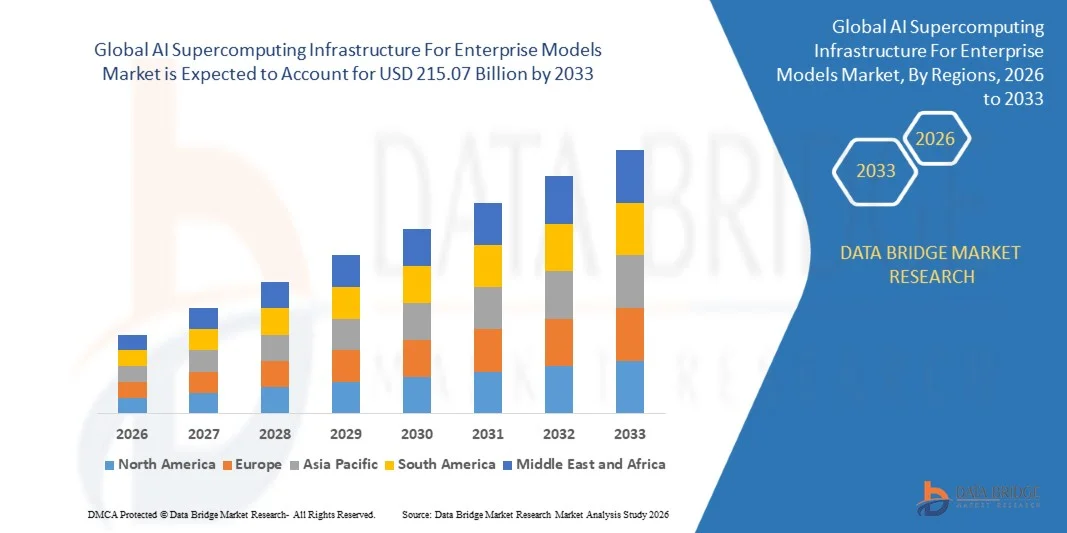
- The global AI supercomputing infrastructure for enterprise models market size was valued at USD 40 billion in 2025and is expected to reach USD 215.07billion by 2033, at a CAGR of 23.4% during the forecast period
- The market growth is primarily driven by the rapid adoption of generative AI and foundation models across enterprises, increasing demand for high-performance computing (HPC) infrastructure, and the growing need for scalable AI training and inference environments
- In addition, rising investments in AI factories, accelerated computing platforms, and energy-efficient data center architectures are transforming enterprise AI operations by enabling faster model development, real-time inference, and large-scale automation capabilities
AI Supercomputing Infrastructure For Enterprise Models Market Analysis
- AI supercomputing infrastructure for enterprise models refers to advanced computing environments optimized for training, fine-tuning, deploying, and scaling enterprise-grade AI and generative AI workloads across industries
- The increasing complexity and size of enterprise AI models, coupled with growing enterprise demand for secure, scalable, and low-latency AI computing environments, is driving strong adoption of AI supercomputers, AI cloud infrastructure, and edge AI systems
- North America dominated the global AI supercomputing infrastructure for enterprise models market with an estimated market share of 41.8% in 2025, driven by strong investments in hyperscale AI data centers, widespread adoption of generative AI technologies, and the presence of major AI infrastructure providers and cloud computing companies across the U.S. and Canada
- Asia-Pacific is expected to be the fastest growing region during the forecast period, registering a CAGR of 29.7% from 2025 to 2033, driven by rapid AI adoption across enterprises, increasing government investments in sovereign AI infrastructure, expansion of semiconductor manufacturing capabilities, and rising deployment of AI cloud and edge computing infrastructure across China, India, Japan, South Korea, and Southeast Asia
- The AI cloud infrastructure segment dominated the market in 2025 with an estimated market share of 38.6%, driven by strong enterprise demand for scalable and flexible compute resources to support large-scale AI training, inference, and generative AI workloads. Organizations increasingly prefer cloud-based GPU and AI accelerator platforms due to lower upfront infrastructure costs, faster deployment capabilities, and seamless scalability across global operations.
Report Scope and AI supercomputing infrastructure for enterprise models Market Segmentation
|
Attributes |
AI Supercomputing Infrastructure For Enterprise Models Key Market Insights |
|
Segments Covered |
|
|
Countries Covered |
North America · U.S. · Canada · Mexico Europe · Germany · France · U.K. · Netherlands · Switzerland · Belgium · Russia · Italy · Spain · Turkey · Rest of Europe Asia-Pacific · China · Japan · India · South Korea · Singapore · Malaysia · Australia · Thailand · Indonesia · Philippines · Rest of Asia-Pacific Middle East and Africa · Saudi Arabia · U.A.E. · South Africa · Egypt · Israel · Rest of Middle East and Africa South America · Brazil · Argentina · Rest of South America |
|
Key Market Players |
|
|
Market Opportunities |
· Expansion of sovereign AI infrastructure and national AI supercomputing initiatives · Increasing adoption of energy-efficient AI data centers and liquid cooling technologies |
|
Value Added Data Infosets |
In addition to the insights on market scenarios such as market value, growth rate, segmentation, geographical coverage, and major players, the market reports curated by the Data Bridge Market Research also include in-depth expert analysis, patient epidemiology, pipeline analysis, pricing analysis, and regulatory framework |
AI Supercomputing Infrastructure For Enterprise Models Market Trends
“Rapid Expansion of Generative AI Infrastructure and Accelerated Computing”
- A significant and accelerating trend in the global AI supercomputing infrastructure for enterprise models market is the growing deployment of accelerated computing platforms designed to support generative AI, large language models (LLMs), and multimodal AI applications across enterprise environments
- For instance, hyperscale cloud providers and enterprise technology vendors are heavily investing in GPU-powered AI clusters, AI factories, and advanced networking technologies to support large-scale AI model training and inference workloads
- Technological advancements in AI accelerators, high-bandwidth memory, and high-speed interconnects are enabling enterprises to train increasingly complex AI models with improved speed, scalability, and energy efficiency
- The increasing integration of AI cloud infrastructure with hybrid and edge computing architectures supports real-time analytics, autonomous systems, and enterprise AI deployment across geographically distributed environments
- This trend toward scalable, energy-efficient, and AI-optimized computing infrastructure is reshaping enterprise expectations for AI performance, deployment flexibility, and operational efficiency
- The demand for specialized AI infrastructure solutions capable of supporting trillion-parameter models and real-time inference workloads is growing rapidly across industries such as healthcare, finance, manufacturing, and telecommunications
- Increasing adoption of modular AI data centers and liquid cooling systems is gaining traction due to rising concerns related to energy consumption, thermal management, and infrastructure scalability
AI Supercomputing Infrastructure For Enterprise Models Market Dynamics
Driver
“Growing Enterprise Adoption of Generative AI and Large-Scale AI Workloads”
- The increasing prevalence of asthma, chronic obstructive pulmonary disease (COPD), and other respiratory disorders, coupled with the rising preference for home-based treatment, is a major driver fueling demand for AI supercomputing infrastructure for enterprise models globally
- For instance, pharmaceutical and medical device companies are expanding inhaler portfolios and nebulizer technologies to address the growing number of patients requiring long-term respiratory management and emergency relief therapies
- As patients and healthcare providers focus more on early intervention and continuous disease management, AI supercomputing infrastructure for enterprise models offer fast drug delivery, improved symptom control, and reduced hospitalization rates
- Furthermore, the growing shift toward homecare, supported by aging populations and pressure to reduce healthcare costs, is making portable AI supercomputing infrastructure for enterprise models essential components of respiratory treatment protocols
- The convenience of self-administration, rapid symptom relief, and compatibility with multiple drug formulations are key factors driving widespread adoption across hospitals, clinics, and homecare environments
- Expanding healthcare access in emerging economies is increasing diagnosis and treatment rates for respiratory conditions, directly supporting market expansion
- Favorable reimbursement policies for chronic respiratory disease management in developed regions are further accelerating the adoption of AI supercomputing infrastructure for enterprise models
Restraint/Challenge
“High Infrastructure Costs and Energy Consumption Challenges”
- High capital expenditure requirements associated with AI supercomputers, GPU clusters, networking systems, and advanced cooling infrastructure remain significant barriers to broader market adoption
- For instance, deploying enterprise-scale AI infrastructure requires substantial investments in accelerated computing hardware, high-performance storage systems, and energy-intensive data center environments
- Addressing these challenges through energy-efficient chip architectures, modular infrastructure models, and optimized AI workload management is critical for long-term market sustainability
- While cloud-based AI infrastructure offers scalability advantages, concerns related to data sovereignty, latency, cybersecurity, and operational costs continue to impact enterprise deployment decisions
- Overcoming these challenges through sustainable infrastructure innovation, advanced cooling technologies, and cost-effective AI-as-a-service models will be essential for sustained market growth
- Limited availability of advanced semiconductor manufacturing capacity and AI accelerator supply chain constraints can affect infrastructure deployment timelines
- Regulatory concerns surrounding AI governance, data localization, and energy consumption standards may increase operational complexity for infrastructure providers and enterprises deploying large-scale AI systems
AI Supercomputing Infrastructure For Enterprise Models Market Scope
The market is segmented on the basis of infrastructure type, component, deployment model, enterprise AI workload, and enterprise size.
- By Infrastructure Type
On the basis of infrastructure type, the global AI supercomputing infrastructure for enterprise models market is segmented into AI supercomputers, AI cloud infrastructure, enterprise AI data centers, and edge AI supercomputing. The AI cloud infrastructure segment dominated the market in 2025 with an estimated market share of 38.6%, driven by strong enterprise demand for scalable and flexible compute resources to support large-scale AI training, inference, and generative AI workloads. Organizations increasingly prefer cloud-based GPU and AI accelerator platforms due to lower upfront infrastructure costs, faster deployment capabilities, and seamless scalability across global operations. The rapid expansion of hyperscale cloud providers offering integrated AI services further strengthens the dominance of this segment across industries such as BFSI, healthcare, IT, and manufacturing.
The edge AI supercomputing segment is expected to witness the fastest growth during the forecast period, fueled by rising demand for real-time AI inference, low-latency decision-making, and on-device intelligence across industries such as autonomous systems, smart manufacturing, and telecommunications. Increasing deployment of IoT devices, 5G networks, and distributed AI applications is accelerating the need for edge-based high-performance computing infrastructure. Organizations are increasingly adopting edge AI supercomputing to reduce bandwidth dependency, enhance data security, and enable faster processing closer to data sources. Advancements in compact AI accelerators and energy-efficient edge data center architectures are further supporting segment expansion globally.
- By Component
On the basis of component, the market is segmented into hardware, software, and services. The hardware segment dominated the market in 2025, driven by strong demand for GPUs, AI accelerators, high-performance servers, and advanced networking infrastructure required for training and deploying large-scale AI models. Continuous innovation in semiconductor technologies and increasing investments in AI-optimized chips are strengthening hardware adoption across enterprise and hyperscale environments.
The services segment is expected to witness the fastest growth during the forecast period, driven by rising demand for AI infrastructure consulting, deployment, managed services, and optimization solutions. Enterprises are increasingly relying on service providers to design, scale, and maintain complex AI computing environments efficiently.
- By Deployment Model
On the basis of deployment model, the market is segmented into on-premise, cloud-based, and hybrid. The cloud-based segment dominated the market in 2025, supported by rapid adoption of AI-as-a-service models and growing reliance on hyperscale cloud infrastructure for scalable AI workloads. Cloud platforms enable enterprises to access high-performance computing resources without heavy capital investment.
The hybrid deployment segment is expected to witness the fastest growth during the forecast period, driven by increasing demand for data sovereignty, security, and workload flexibility. Enterprises are adopting hybrid architectures to balance performance, compliance, and cost efficiency across AI operations.
- By Enterprise AI Workload
On the basis of enterprise AI workload, the market is segmented into training infrastructure, inference infrastructure, and specialized AI computing. The training infrastructure segment dominated the market in 2025, driven by the growing need to train large language models (LLMs), foundation models, and generative AI systems requiring massive computational power.
The inference infrastructure segment is expected to witness the fastest growth during the forecast period, driven by increasing deployment of AI applications in real-time environments such as customer service automation, autonomous systems, and predictive analytics.
- By Enterprise Size
On the basis of enterprise size, the market is segmented into large enterprises, mid-sized enterprises, government organizations, research institutions, and AI-native startups. Large enterprises dominated the market in 2025 due to strong financial capacity and early adoption of AI supercomputing infrastructure for enterprise-scale digital transformation initiatives.
The AI-native startups segment is expected to witness the fastest growth during the forecast period, driven by rapid innovation cycles, increasing venture capital funding, and heavy reliance on cloud-based AI infrastructure to develop and deploy advanced AI models quickly and cost-effectively.
AI Supercomputing Infrastructure For Enterprise Models Market Regional Analysis
- North America dominated the AI supercomputing infrastructure for enterprise models market with the largest revenue share of 41.8% in 2025, supported by advanced hyperscale cloud infrastructure, strong presence of leading AI technology providers, and early adoption of generative AI and foundation models across enterprises.
- Enterprises and research institutions in the region are placing significant emphasis on large-scale AI training, real-time inference, and enterprise-wide AI transformation initiatives, leading to widespread adoption of GPU clusters, AI accelerators, and high-performance computing infrastructure across industries such as BFSI, healthcare, IT, and manufacturing.
- This strong market position is further supported by high R&D expenditure, rapid data center expansion, and robust semiconductor ecosystem, establishing AI supercomputing infrastructure as a critical backbone for enterprise digital transformation in both public and private sectors.
U.S. AI Supercomputing Infrastructure For Enterprise Models Market Insight
The U.S. AI supercomputing infrastructure market captured the largest revenue share in 2025 within North America, driven by strong demand for hyperscale AI data centers, rapid enterprise adoption of generative AI models, and widespread deployment of GPU-based computing platforms. Enterprises increasingly prioritize scalable cloud-based AI infrastructure to support large language model training, inference workloads, and advanced analytics applications. The strong presence of global cloud service providers and semiconductor leaders continues to significantly accelerate infrastructure development and deployment across multiple industry verticals.
Europe AI Supercomputing Infrastructure For Enterprise Models Market Insight
The Europe AI supercomputing infrastructure market is projected to expand at a steady CAGR throughout the forecast period, primarily driven by rising investments in sovereign AI infrastructure, strict data protection regulations, and increasing adoption of AI in industrial and enterprise applications. Patients and enterprises in the region place strong emphasis on secure, compliant, and energy-efficient AI computing environments, leading to growing deployment of AI cloud infrastructure and hybrid computing models across manufacturing, automotive, healthcare, and public sector organizations. This market growth is further supported by government-backed digital initiatives, increasing focus on sustainable data centers, and expanding demand for high-performance AI workloads.
U.K. AI Supercomputing Infrastructure For Enterprise Models Market Insight
The U.K. AI supercomputing infrastructure market is anticipated to grow at a notable CAGR during the forecast period, supported by strong AI research capabilities, increasing enterprise adoption of generative AI, and rapid expansion of cloud-based AI infrastructure. Financial services, healthcare, and public administration sectors are key adopters, driving demand for scalable AI computing systems and hybrid deployment models. Growing focus on AI innovation and digital transformation further strengthens market expansion.
Germany AI Supercomputing Infrastructure For Enterprise Models Market Insight
The Germany AI supercomputing infrastructure market is expected to expand at a considerable CAGR during the forecast period, driven by strong Industry 4.0 initiatives, advanced manufacturing ecosystem, and increasing integration of AI into industrial automation systems. High emphasis on precision engineering, data security, and compliance-driven infrastructure deployment is supporting strong adoption of AI supercomputing systems across automotive, manufacturing, and research institutions.
Asia-Pacific AI Supercomputing Infrastructure For Enterprise Models Market Insight
The Asia-Pacific AI supercomputing infrastructure market is poised to grow at the fastest CAGR during the forecast period of 2026 to 2033, driven by rapid urbanization, increasing enterprise AI adoption, and strong government investments in AI, cloud, and semiconductor infrastructure. Enterprises and governments in the region are focusing on building scalable AI computing ecosystems to support digital transformation, automation, and large-scale AI model deployment, resulting in rapid expansion of cloud AI platforms and edge computing infrastructure. This strong growth is further supported by expanding hyperscale data center investments, rising demand for localized AI processing, and increasing adoption of AI-driven applications across industries.
Japan AI Supercomputing Infrastructure For Enterprise Models Market Insight
The Japan AI supercomputing infrastructure market is gaining momentum due to its aging population, strong robotics ecosystem, and high adoption of advanced AI and automation technologies. Enterprises and research institutions are increasingly investing in compact, energy-efficient AI computing systems and edge AI infrastructure to support healthcare, manufacturing, and smart city applications.
India AI Supercomputing Infrastructure For Enterprise Models Market Insight
The India AI supercomputing infrastructure market accounted for a significant share in Asia-Pacific in 2025, driven by rapid digitalization, expanding AI startup ecosystem, and increasing deployment of cloud-based AI infrastructure across enterprises. Growing data center investments, rising demand for AI-powered analytics, and strong government initiatives supporting digital transformation are accelerating adoption across BFSI, IT services, and manufacturing sectors.
AI Supercomputing Infrastructure For Enterprise Models Market Share
The AI supercomputing infrastructure for enterprise models industry is primarily led by well-established companies, including:
- NVIDIA Corporation (U.S.)
- Advanced Micro Devices, Inc. (U.S.)
- Intel Corporation (U.S.)
- Microsoft Corporation (U.S.)
- Amazon Web Services, Inc. (U.S.)
- Alphabet Inc. (U.S.)
- Oracle Corporation (U.S.)
- IBM Corporation (U.S.)
- Hewlett Packard Enterprise Development LP (U.S.)
- Dell Technologies Inc. (U.S.)
- Super Micro Computer, Inc. (U.S.)
- Lenovo Group Limited (China)
- Cisco Systems, Inc. (U.S.)
- Huawei Technologies Co., Ltd. (China)
- Fujitsu Limited (Japan)
- NEC Corporation (Japan)
- SambaNova Systems (U.S.)
- Cerebras Systems (U.S.)
- Graphcore Limited (U.K.)
- Equinix, Inc. (U.S.)
What are the Recent Developments in Global AI Supercomputing Infrastructure For Enterprise Models Market?
- In October 2025, NVIDIA strengthened its leadership in AI supercomputing infrastructure through large-scale ecosystem expansion initiatives, including multi-gigawatt AI data center collaborations with partners such as IREN and major infrastructure developers. These deployments are designed to support next-generation AI factories powered by NVIDIA GPU platforms, significantly increasing global compute capacity for enterprise AI training and inference workloads.
- In 2026, Microsoft continued expanding its AI supercomputing infrastructure capabilities through deep integration of generative AI workloads into Azure cloud infrastructure, focusing on scalable GPU clusters and AI-optimized data center architectures.
- In 2026, AWS advanced its AI infrastructure strategy through large-scale data center modernization initiatives, including the “Titus” program aimed at accelerating AI-optimized data center construction and improving efficiency for high-density GPU workloads.
- In March 2026, IBM expanded its collaboration with NVIDIA to strengthen enterprise AI supercomputing infrastructure by integrating GPU-native analytics, hybrid cloud AI systems, and agentic AI capabilities across enterprise environments.

- Interactive Data Analysis Dashboard
- Company Analysis Dashboard for high growth potential opportunities
- Research Analyst Access for customization & queries
- Competitor Analysis with Interactive dashboard
- Latest News, Updates & Trend analysis
- Harness the Power of Benchmark Analysis for Comprehensive Competitor Tracking
Data collection and base year analysis are done using data collection modules with large sample sizes. The stage includes obtaining market information or related data through various sources and strategies. It includes examining and planning all the data acquired from the past in advance. It likewise envelops the examination of information inconsistencies seen across different information sources. The market data is analysed and estimated using market statistical and coherent models. Also, market share analysis and key trend analysis are the major success factors in the market report. To know more, please request an analyst call or drop down your inquiry.
The key research methodology used by DBMR research team is data triangulation which involves data mining, analysis of the impact of data variables on the market and primary (industry expert) validation. Data models include Vendor Positioning Grid, Market Time Line Analysis, Market Overview and Guide, Company Positioning Grid, Patent Analysis, Pricing Analysis, Company Market Share Analysis, Standards of Measurement, Global versus Regional and Vendor Share Analysis. To know more about the research methodology, drop in an inquiry to speak to our industry experts.
Data Bridge Market Research is a leader in advanced formative research. We take pride in servicing our existing and new customers with data and analysis that match and suits their goal. The report can be customized to include price trend analysis of target brands understanding the market for additional countries (ask for the list of countries), clinical trial results data, literature review, refurbished market and product base analysis. Market analysis of target competitors can be analyzed from technology-based analysis to market portfolio strategies. We can add as many competitors that you require data about in the format and data style you are looking for. Our team of analysts can also provide you data in crude raw excel files pivot tables (Fact book) or can assist you in creating presentations from the data sets available in the report.













