What is the AI Trust, Risk, and Security Management (AI TRiSM) Market Size and Growth Rate?
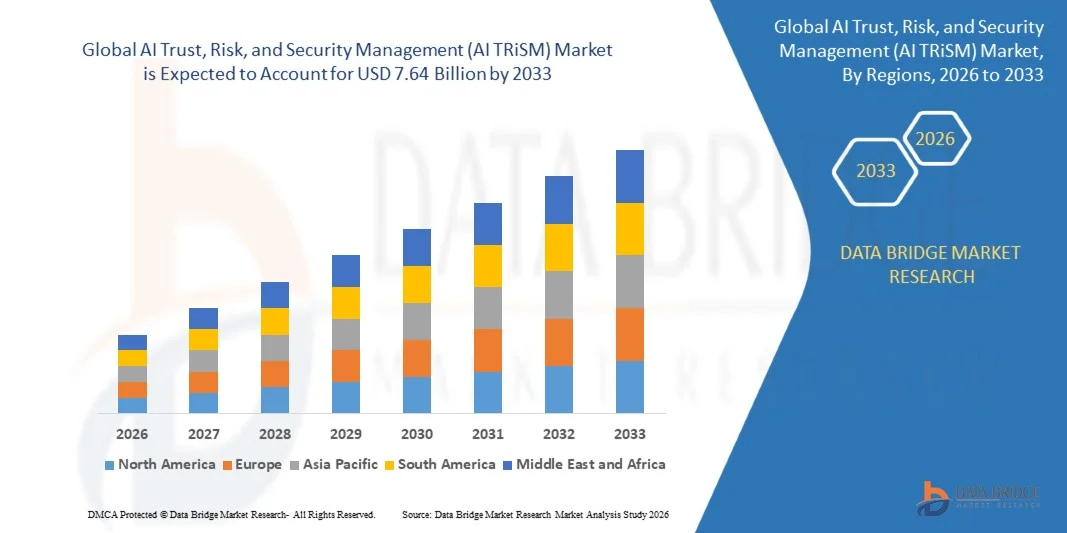
- As per Data Bridge Market Research analysis, the AI trust, risk, and security management (AI TRiSM) market was valued at USD 2.70 billion in 2025 and is projected to reach USD 7.64 billion by 2033, growing at a CAGR of 13.90% from 2026 to 2033.
- The market is experiencing consistent growth driven by rising demand for trustworthy and responsible AI deployment, increasing regulatory requirements, growing cybersecurity risks, and expanding adoption of AI governance, model monitoring, privacy, and risk management solutions across enterprises.
- The increasing complexity and widespread deployment of AI models, combined with stricter requirements for AI transparency, security, and compliance, are compelling organizations to adopt advanced AI TRiSM solutions. Explainability, ModelOps, data protection, and AI application security technologies are increasingly being integrated into enterprise AI environments, enabling organizations to manage model risks, protect sensitive data, and maintain trustworthy AI operations.
Market Size & Forecast
- Global Market Value (2025): USD 2.70 Billion
- Expected Market Value (2033): USD 7.64 Billion
- Forecast CAGR (2026–2033): 13.90%
- Leading Region in 2025: North America
- Fastest Growing Region: Asia Pacific
What are the Major Takeaways of the AI Trust, Risk, and Security Management (AI TRiSM) Market?
- North America dominated the AI trust, risk, and security management (AI TRiSM) market with the largest revenue share of 31.3% in 2025, supported by the presence of leading technology companies, advanced AI infrastructure, and growing adoption of AI governance and security solutions.
- Asia-Pacific is expected to be the fastest-growing region at a CAGR of 25.6% from 2026 to 2033, fueled by rapid AI adoption, expanding digital infrastructure, increasing regulatory focus, and growing investments in trustworthy and secure AI technologies.
- The solutions segment led the market with a 69.5% share in 2025, driven by increasing enterprise demand for integrated AI governance, model monitoring, security, privacy, explainability, and risk-management capabilities
- Services are the fastest-growing component type, projected to register a CAGR of 24%, reflecting the surge in demand for consulting, implementation, integration, managed services, and continuous AI risk monitoring.
- The explainability segment dominated the type category with a 36.9% revenue share in 2025, led by increasing demand for transparent and interpretable AI decision-making.
- On-Premise accounted for 55% of the market share in 2025, preferred by organizations' requirements for greater control over sensitive AI models, proprietary data, and security infrastructure.
- The bias detection & mitigation segment is the fastest-growing application category, with a CAGR of 24.5%, driven by increasing concerns regarding fairness and discriminatory outcomes generated by AI systems.
Report Scope and AI Trust, Risk, and Security Management (AI TRiSM) Market Segmentation
|
Attributes |
AI Trust, Risk, and Security Management (AI TRiSM) Key Market Insights |
|
Segments Covered |
|
|
Countries Covered |
North America
Europe
Asia-Pacific
Middle East and Africa
South America
|
|
Key Market Players |
|
|
Market Opportunities |
|
|
Value Added Data Infosets |
In addition to the market insights such as market value, growth rate, market segments, geographical coverage, market players, and market scenario, the market report curated by the Data Bridge Market Research team includes in-depth expert analysis, import/export analysis, pricing analysis, production consumption analysis, and pestle analysis. |
What is the Key Trend in the AI Trust, Risk, and Security Management (AI TRiSM) Market?
- Organizations are increasingly adopting continuous AI governance and monitoring to manage model trustworthiness, explainability, fairness, privacy, security, and performance throughout the AI lifecycle.
- For instance, in March 2025, NIST released its Adversarial Machine Learning Taxonomy, covering attacks including evasion, poisoning, privacy, and misuse risks across predictive and generative AI systems, strengthening standardized approaches to AI security and risk management.
- The rapid deployment of generative AI and AI agents is increasing demand for real-time monitoring, prompt-injection protection, model evaluation, access controls, and automated risk detection across enterprise AI environments.
- Organizations are increasingly integrating AI governance with cybersecurity and compliance programs to create centralized controls for model inventory, risk assessment, regulatory reporting, and responsible AI management.
- For instance, in January 2025, NIST published research on AI agent hijacking, highlighting indirect prompt injection as a security risk and emphasizing the need to evaluate and mitigate vulnerabilities in increasingly autonomous AI agents.
- As enterprises expand generative and agentic AI deployments, continuous monitoring, automated governance, and integrated security controls are expected to become core components of AI TRiSM strategies, reinforcing trustworthy AI as a fundamental requirement for enterprise adoption.
What are the Key Drivers of the AI Trust, Risk, and Security Management (AI TRiSM) Market?
- The rapid expansion of generative AI and foundation models has significantly increased demand for AI TRiSM capabilities that can manage hallucinations, bias, privacy exposure, adversarial attacks, model misuse, and security vulnerabilities across enterprise deployments.
- For instance, in March 2025, NIST finalized its Adversarial Machine Learning Taxonomy, identifying attack and mitigation approaches for predictive and generative AI, including poisoning, evasion, privacy, and misuse attacks.
- Governments and regulatory authorities are establishing stricter AI governance, transparency, security, and risk-management requirements, compelling organizations to implement technologies that continuously document, assess, monitor, and control AI systems.
- For instance, in August 2026, the majority of EU AI Act rules became applicable, initiating enforcement for applicable provisions covering transparency, general-purpose AI, governance, and AI literacy, increasing enterprise demand for compliance and governance capabilities.
- With AI becoming increasingly embedded in high-value business processes and autonomous systems, organizations will continue investing in integrated trust, risk, security, and compliance capabilities, making AI TRiSM essential for scalable and responsible AI deployment.
Which Factors are Challenging the Growth of the AI Trust, Risk, and Security Management (AI TRiSM) Market?
- AI TRiSM implementations can require significant investment in specialized governance platforms, cybersecurity technologies, model-monitoring infrastructure, skilled personnel, and continuous testing, increasing the overall cost of enterprise AI deployment.
- These implementation requirements can particularly challenge small and medium-sized organizations that lack dedicated AI governance teams, cybersecurity expertise, and resources for continuous model evaluation and compliance management.
- · For instance, in July 2025, NIST documented security challenges involving prompt injection, hallucinations, data exposure, and unauthorized access during development of its chatbot, demonstrating the complexity of securing AI applications throughout their deployment lifecycle.
- The rapidly evolving threat landscape further increases operational complexity because AI systems require continuous monitoring and updating rather than one-time security controls, raising recurring costs and resource requirements for organizations.
- For instance, in June 2026, NIST reported that fixed AI guardrails are not universally robust against adaptive adversarial prompts, supporting the need for continuous monitoring and security updates.
- The combination of high implementation complexity, recurring monitoring requirements, specialized skills shortages, and rapidly evolving AI threats continues to challenge adoption, particularly among resource-constrained organizations, despite the growing need for trustworthy and secure AI systems.
How is the AI Trust, Risk, and Security Management (AI TRiSM) Market Segmented?
The AI trust, risk, and security management (AI TRiSM) market is segmented on the basis of component, type, deployment, application, and end user.
- By Component
On the basis of component, the AI TRiSM market is segmented into solutions and services. The solutions segment dominated the market with a 69.5% share in 2025, owing to increasing enterprise demand for integrated AI governance, model monitoring, security, privacy, explainability, and risk-management capabilities. AI TRiSM solutions enable organizations to establish centralized controls across the AI lifecycle and continuously assess model performance and risk. They are increasingly integrated with existing cybersecurity, data governance, and compliance platforms. The growing deployment of generative AI is further increasing demand for automated model evaluation and monitoring capabilities. Organizations also prefer scalable software-based solutions that can be deployed across multiple AI applications.
The services segment is projected to register the fastest growth at a CAGR of 24% during forecast period, driven by increasing demand for consulting, implementation, integration, managed services, and continuous AI risk monitoring. Many organizations lack the specialized expertise required to establish comprehensive AI governance frameworks. Service providers help enterprises assess AI risks, develop governance policies, validate models, and maintain regulatory compliance. The rapid introduction of AI regulations is further increasing demand for specialized advisory and compliance services. Growing adoption of generative AI and agentic AI is also creating demand for ongoing model testing and security assessments.
- By Type
On the basis of type, the AI TRiSM market is segmented into explainability and ModelOps. The Explainability segment dominated the market with a 36.9% share in 2025, supported by increasing demand for transparent and interpretable AI decision-making. Explainability tools enable organizations to understand how AI models generate predictions and recommendations. These capabilities are particularly important in regulated industries such as BFSI, healthcare, and government, where organizations must demonstrate accountability. Growing concerns surrounding algorithmic bias and opaque AI decision-making are further increasing adoption. Explainability also supports model validation, auditing, and responsible AI governance throughout the model lifecycle.
The ModelOps segment is projected to register the fastest growth at a CAGR of 25% during forecast period, driven by increasing adoption of AI models across complex enterprise environments. ModelOps provides capabilities for deploying, monitoring, managing, and governing AI models throughout their operational lifecycle. Organizations increasingly require continuous monitoring to identify model drift, performance degradation, security vulnerabilities, and compliance risks. The rapid expansion of machine learning and generative AI applications is increasing the number of models requiring centralized lifecycle management. Integration of ModelOps with MLOps, data governance, and cybersecurity platforms is further expanding its applicability. As enterprises scale AI from pilot projects into production environments,
- By Deployment
On the basis of deployment, the AI TRiSM market is segmented into on-premises and cloud. The on-premises segment dominated the market with a 55% share in 2025, driven by organizations' requirements for greater control over sensitive AI models, proprietary data, and security infrastructure. On-premises deployment allows enterprises to maintain AI governance and security capabilities within their own IT environments. This approach is particularly relevant for regulated industries handling confidential information and mission-critical AI applications. Organizations can also customize security controls according to internal policies and compliance requirements. Concerns surrounding data sovereignty and third-party access continue to support on-premises adoption
The cloud segment is projected to register the fastest growth at a CAGR of 31% during forecast period, supported by increasing demand for scalable and flexible AI governance infrastructure. Enterprises can rapidly deploy cloud-based monitoring and security capabilities without making extensive investments in dedicated hardware. Cloud platforms also facilitate centralized monitoring of AI models operating across multiple locations and business units. Increasing adoption of AI-as-a-Service and foundation models is further expanding the addressable market. Cloud deployment enables frequent software updates as AI threats and regulatory requirements evolve.
- By Application
On the basis of application, the AI TRiSM market is segmented into governance & compliance, bias detection & mitigation, security & anomaly detection, and privacy management. The governance & compliance segment dominated the market with 35% share in 2025, driven by increasing regulatory scrutiny surrounding artificial intelligence. Organizations require governance frameworks to establish accountability, documentation, risk classification, monitoring, and compliance throughout the AI lifecycle. Regulatory developments are encouraging enterprises to maintain detailed inventories and assessments of their AI systems. Governance platforms also help organizations establish policies governing responsible and secure AI deployment. Demand is particularly strong among financial institutions, healthcare organizations, and government agencies.
The bias detection & mitigation segment is projected to register the fastest growth at a CAGR of 24.5% during forecast period, driven by increasing concerns regarding fairness and discriminatory outcomes generated by AI systems. Organizations are increasingly evaluating datasets and models for potential demographic and algorithmic bias. Bias detection technologies help enterprises identify unfair outcomes before AI models are deployed in critical applications. Growing use of AI in recruitment, lending, insurance, healthcare, and customer decision-making is increasing the importance of fairness assessment. Regulatory and responsible-AI initiatives are also encouraging organizations to document and mitigate algorithmic bias.
- By End User
On the basis of end user, the AI TRiSM market is segmented into IT & telecommunications, BFSI, manufacturing, retail & e-commerce, healthcare, government, media & entertainment, and others. The IT & telecommunications segment dominated the market with 36% share in 2025, driven by extensive deployment of AI and machine learning across technology infrastructure, customer service, cybersecurity, and network management. These organizations process large volumes of data and operate complex AI environments requiring continuous security and governance. Increasing adoption of generative AI and AI-powered automation is creating additional requirements for model monitoring and risk management. Telecommunications companies are also using AI for network optimization, fraud detection, and customer analytics.
The healthcare segment is projected to register the fastest growth at a CAGR of 24% during forecast period, driven by increasing use of AI for diagnostics, clinical decision support, drug discovery, medical imaging, and patient management. Healthcare organizations require strong AI governance because inaccurate, biased, or opaque models can affect clinical decisions and patient outcomes. Growing regulatory attention to healthcare AI is increasing the need for transparency, validation, privacy, and continuous model monitoring. The increasing use of sensitive patient data is also strengthening demand for privacy and security management. AI TRiSM solutions can help healthcare organizations establish accountability and assess model performance throughout deployment.
Which Region Holds the Largest Share of the AI Trust, Risk, and Security Management (AI TRiSM) Market?
- North America dominated the AI trust, risk, and security management (AI TRiSM) market with the largest revenue share of 31.3% in 2025, supported by the presence of leading technology companies, advanced AI infrastructure, and growing adoption of AI governance and security solutions.
- The region also benefits from stringent AI governance requirements, high adoption of generative AI and enterprise AI platforms, and growing use of AI TRiSM solutions across financial services, healthcare, technology, and government applications. Increasing focus on AI transparency, cybersecurity, regulatory compliance, and responsible AI deployment continues to strengthen North America’s leadership position in the global market.
U.S. AI Trust, Risk, and Security Management (AI TRiSM) Market Insight
The U.S. AI trust, risk, and security management (AI TRiSM) market is witnessing strong growth due to rising investments in responsible AI, cybersecurity, AI governance, and enterprise artificial intelligence technologies. The country’s mature technology ecosystem, along with increasing adoption of generative AI, foundation models, and AI-powered business applications, is driving demand across financial services, healthcare, technology, and government sectors. In addition, growing emphasis on AI transparency, regulatory compliance, model security, and responsible AI deployment is accelerating adoption of AI TRiSM solutions across enterprises.
Asia-Pacific AI Trust, Risk, and Security Management (AI TRiSM) Market Insight
The Asia-Pacific AI trust, risk, and security management (AI TRiSM) market is expected to witness rapid growth, driven by increasing AI adoption, expanding digital infrastructure, and rising investments in AI governance and cybersecurity across countries such as China, India, and Japan. Growing awareness regarding AI risks, increasing regulatory focus, and rising demand for secure and trustworthy AI systems are supporting regional market expansion. In addition, the growing presence of technology companies and expanding enterprise adoption of generative AI are accelerating AI TRiSM deployment across financial, healthcare, manufacturing, and public-sector applications.
Japan AI Trust, Risk, and Security Management (AI TRiSM) Market Insight
The Japan AI trust, risk, and security management (AI TRiSM) market is witnessing consistent growth due to rising investments in responsible AI, cybersecurity, and enterprise AI governance. Technology companies, financial institutions, manufacturers, and research organizations are increasingly adopting AI TRiSM solutions for model monitoring, risk assessment, data protection, and AI compliance purposes. Moreover, increasing integration of generative AI and the country’s focus on trustworthy and human-centric AI development are further contributing to market growth.
China AI Trust, Risk, and Security Management (AI TRiSM) Market Insight
The China AI trust, risk, and security management (AI TRiSM) market is growing rapidly, driven by increasing AI adoption, expanding digital infrastructure, and rising government focus on AI governance and cybersecurity. Growing deployment of generative AI, machine learning, and AI-powered applications across commercial, manufacturing, financial, and public sectors is significantly boosting market demand. In addition, rising investments in AI research, increasing emphasis on data security and algorithm governance, and rapid technological advancements are positioning China as one of the fastest-growing markets for AI TRiSM globally.
U.K. AI Trust, Risk, and Security Management (AI TRiSM) Market Insight
The U.K. AI trust, risk, and security management (AI TRiSM) market is experiencing steady growth, supported by rising adoption of AI governance, cybersecurity, and responsible AI technologies across enterprises. Increasing investments in AI risk-management infrastructure and growing demand for transparent, secure, and compliant AI solutions are contributing to market growth. Furthermore, integration of explainability, model monitoring, privacy management, and AI security technologies is improving enterprise AI governance, positioning the U.K. as a key innovation hub in the AI TRiSM industry.
Germany AI Trust, Risk, and Security Management (AI TRiSM) Market Insight
The Germany AI trust, risk, and security management (AI TRiSM) market is expanding steadily due to the country’s strong industrial base, advanced technology capabilities, and increasing adoption of trustworthy AI solutions. Enterprises, financial institutions, manufacturers, and research organizations are increasingly utilizing AI TRiSM technologies for AI governance, model assessment, security, and regulatory compliance activities. Continuous advancements in AI monitoring, explainability, data protection, and cybersecurity technologies, along with strong regulatory focus on responsible AI and data privacy, are further driving market growth in Germany.
Which are the Top Companies in AI Trust, Risk, and Security Management (AI TRiSM) Market?
The AI trust, risk, and security management (AI TRiSM) industry is primarily led by well-established companies, including:
- IBM Corporation (U.S.)
- Microsoft Corporation (U.S.)
- SAS Institute Inc. (U.S.)
- Cisco (U.S.)
- Palo Alto Networks, Inc. (U.S.)
- Oracle (U.S.)
- Accenture (Ireland)
- Deloitte Touche Tohmatsu Limited (U.K.)
- ServiceNow, Inc. (U.S.)
- BigID, Inc. (U.S.)
- OneTrust LLC (U.S.)
- DataRobot, Inc. (U.S.)
- Credo.AI Corp. (U.S.)
- HiddenLayer, Inc. (U.S.)
- ModelOp, Inc. (U.S.)
- FairNow, Inc. (U.S.)
- Holistic AI (U.K.)
- Google LLC (U.S.)
- Amazon.com, Inc. (U.S.)
- NVIDIA Corporation (U.S.)
What are Latest Developments in AI Trust, Risk, and Security Management (AI TRiSM) Market?
- In March 2025, NIST published “Adversarial Machine Learning: A Taxonomy and Terminology of Attacks and Mitigations,” providing guidance for identifying, addressing, and managing risks from adversarial attacks against AI and machine-learning systems.
- In January 2025, IBM and e& announced a collaboration to launch an AI governance solution incorporating automated risk management, compliance monitoring, and real-time performance capabilities. The solution is designed to help organizations govern AI systems while addressing regulatory and operational risks throughout the AI lifecycle. This development highlights the increasing integration of AI governance, risk management, and continuous monitoring into enterprise technology environments.
- In January 2025, NIST’s Center for AI Standards and Innovation conducted initial experiments to advance the evaluation of AI agent hijacking risks, focusing on indirect prompt injection and the need for adaptive, continuous security evaluations.
- In August 2024, the European Artificial Intelligence Act entered into force, establishing harmonized rules for trustworthy AI across the European Union. The legislation introduced a risk-based framework addressing AI systems that may affect health, safety, fundamental rights, and other societal interests, increasing requirements for governance, transparency, risk management, and compliance. This regulatory milestone is strengthening enterprise demand for AI TRiSM capabilities that support AI risk assessment and regulatory compliance.
- In October 2021, Credo AI emerged from stealth with an AI governance platform designed to help organizations manage the ethical and regulatory risks associated with AI. The platform provided an auditable record covering data and decisions across AI development, testing, deployment, and monitoring. This development marked an early commercial push toward dedicated AI governance and risk-management platforms, supporting the evolution of the AI TRiSM market.

- Interactive Data Analysis Dashboard
- Company Analysis Dashboard for high growth potential opportunities
- Research Analyst Access for customization & queries
- Competitor Analysis with Interactive dashboard
- Latest News, Updates & Trend analysis
- Harness the Power of Benchmark Analysis for Comprehensive Competitor Tracking
Data collection and base year analysis are done using data collection modules with large sample sizes. The stage includes obtaining market information or related data through various sources and strategies. It includes examining and planning all the data acquired from the past in advance. It likewise envelops the examination of information inconsistencies seen across different information sources. The market data is analysed and estimated using market statistical and coherent models. Also, market share analysis and key trend analysis are the major success factors in the market report. To know more, please request an analyst call or drop down your inquiry.
The key research methodology used by DBMR research team is data triangulation which involves data mining, analysis of the impact of data variables on the market and primary (industry expert) validation. Data models include Vendor Positioning Grid, Market Time Line Analysis, Market Overview and Guide, Company Positioning Grid, Patent Analysis, Pricing Analysis, Company Market Share Analysis, Standards of Measurement, Global versus Regional and Vendor Share Analysis. To know more about the research methodology, drop in an inquiry to speak to our industry experts.
Data Bridge Market Research is a leader in advanced formative research. We take pride in servicing our existing and new customers with data and analysis that match and suits their goal. The report can be customized to include price trend analysis of target brands understanding the market for additional countries (ask for the list of countries), clinical trial results data, literature review, refurbished market and product base analysis. Market analysis of target competitors can be analyzed from technology-based analysis to market portfolio strategies. We can add as many competitors that you require data about in the format and data style you are looking for. Our team of analysts can also provide you data in crude raw excel files pivot tables (Fact book) or can assist you in creating presentations from the data sets available in the report.