


Air Ambulance Services Market Size
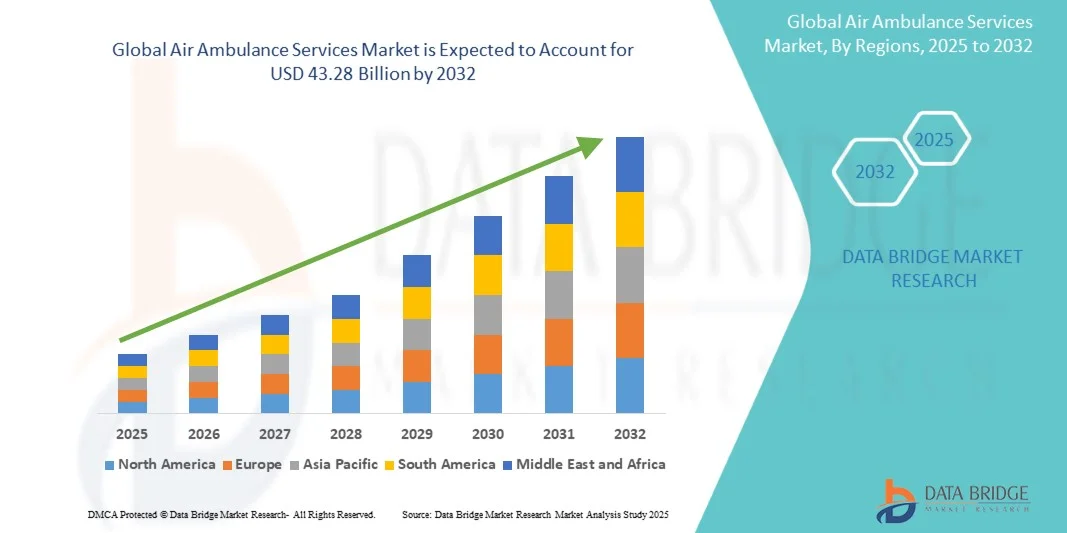
- The global air ambulance services market size was valued at USD 18.14 billion in 2024 and is expected to reach USD 43.28 billion by 2032, at a CAGR of 11.48% during the forecast period
- The market growth is primarily driven by the increasing demand for rapid emergency medical transportation and the rising prevalence of critical health conditions requiring timely medical intervention
- In addition, advancements in medical aviation technology, enhanced in-flight medical care capabilities, and growing awareness about the benefits of air ambulance services are reinforcing their adoption across both urban and remote regions. These combined factors are fueling market expansion, thereby significantly propelling the industry's growth
Air Ambulance Services Market Analysis
- Air ambulance services, providing rapid medical transportation via helicopters, fixed-wing aircraft, or ground-based air ambulances, are increasingly critical components of emergency medical response systems in both urban and remote regions due to their ability to deliver timely care and specialized medical support during transit
- The rising demand for air ambulance services is primarily driven by increasing incidences of critical illnesses and accidents, growing awareness about the benefits of rapid medical evacuation, and the need for advanced in-flight medical care during emergencies
- North America dominated the air ambulance services market with the largest revenue share of 39.2% in 2024, supported by a well-established healthcare infrastructure, high healthcare expenditure, and a strong network of private and public air medical service providers. The U.S. witnessed substantial growth in air ambulance deployments, particularly in rural and disaster-prone regions, propelled by technological innovations in aircraft and onboard medical equipment
- Asia-Pacific is expected to be the fastest-growing region in the air ambulance services market during the forecast period due to rising healthcare awareness, improving emergency medical infrastructure, and increasing investment in medical aviation services
- Rescue Helicopter Services segment dominated the air ambulance services market with a market share of 47% in 2024, driven by its capability to access remote and congested areas quickly and provide advanced life support en route to medical facilities
Report Scope and Air Ambulance Services Market Segmentation
|
Attributes |
Air Ambulance Services Key Market Insights |
|
Segments Covered |
|
|
Countries Covered |
North America
Europe
Asia-Pacific
Middle East and Africa
South America
|
|
Key Market Players |
|
|
Market Opportunities |
|
|
Value Added Data Infosets |
In addition to the insights on market scenarios such as market value, growth rate, segmentation, geographical coverage, and major players, the market reports curated by the Data Bridge Market Research also include in-depth expert analysis, pricing analysis, brand share analysis, consumer survey, demography analysis, supply chain analysis, value chain analysis, raw material/consumables overview, vendor selection criteria, PESTLE Analysis, Porter Analysis, and regulatory framework. |
Air Ambulance Services Market Trends
Integration of Advanced Medical and Navigation Technologies
- A notable and accelerating trend in the global air ambulance services market is the increasing integration of advanced medical devices, telemedicine solutions, and real-time navigation systems, significantly enhancing patient care and operational efficiency
- For instance, some modern air ambulances are equipped with tele-ICU systems allowing remote physicians to monitor and guide in-flight treatment, improving patient outcomes during critical transfers
- Integration of AI-enabled monitoring devices enables predictive assessment of patient conditions and alerts the medical crew to potential complications, ensuring timely interventions
- These technological integrations facilitate seamless coordination with hospitals, emergency response teams, and ground transport, creating a centralized and efficient emergency medical ecosystem
- This trend towards more intelligent, connected, and technology-driven air ambulance solutions is redefining patient expectations for emergency care, prompting service providers such as Air Methods and PHI Air Medical to adopt advanced onboard medical systems and real-time communication platforms
- The demand for air ambulance services with enhanced medical and navigational capabilities is growing rapidly across both urban and remote regions, as healthcare providers prioritize patient safety and timely interventions
Air Ambulance Services Market Dynamics
Driver
Rising Demand Due to Growing Medical Emergencies and Critical Care Needs
- The increasing incidence of medical emergencies, critical illnesses, and accidents is a significant driver for the rising demand for air ambulance services
- For instance, in June 2024, Medjet expanded its critical care transport network across North America to provide rapid medical evacuation for high-risk patients in remote locations
- As patients and healthcare providers recognize the importance of timely medical intervention, air ambulance services offering advanced in-flight care are gaining preference over traditional transport options
- Furthermore, growing awareness about the benefits of rapid medical evacuation and the availability of specialized onboard medical equipment are making air ambulance services an integral part of emergency healthcare systems
- The ability to provide continuous monitoring, advanced life support, and seamless coordination with hospitals for critical patients is a key factor propelling the adoption of air ambulance services globally
- Increasing investments in medical aviation infrastructure and expansion of service networks further contribute to market growth
Restraint/Challenge
High Operational Costs and Regulatory Compliance Hurdles
- The substantial operational and maintenance costs of air ambulance fleets pose a significant challenge to broader market adoption
- For instance, costs associated with aircraft acquisition, medical equipment, trained personnel, and fuel expenses make the service expensive, limiting accessibility for certain patient segments
- Strict regulatory requirements, licensing, and airspace compliance regulations can delay service deployment and increase operational complexity for providers
- In addition, variations in insurance coverage and reimbursement policies across regions can restrict patient access to air ambulance services, affecting market growth
- While technological advancements are reducing certain operational inefficiencies, the high cost of advanced medical aviation systems and skilled personnel continues to hinder widespread adoption
- Overcoming these challenges through cost optimization, regulatory alignment, and partnerships with hospitals and insurance providers will be essential for sustained market expansion
Air Ambulance Services Market Scope
The market is segmented on the basis of type, service model, application, and end user.
- By Type
On the basis of type, the air ambulance services market is segmented into fixed-wing aircraft and rotary-wing aircraft. The rotary-wing aircraft segment dominated the market with the largest revenue share of 47% in 2024, driven by its ability to access congested urban areas, remote locations, and disaster-prone regions quickly. Helicopters are preferred for emergency medical evacuation and inter-hospital transfers where speed and landing flexibility are critical. The market sees strong demand for rotary-wing air ambulances due to their capacity to provide advanced life support, onboard monitoring, and in-flight critical care. In addition, rotary-wing services are often integrated with hospital networks and emergency response teams, ensuring timely patient transport. The versatility and rapid response capability of helicopters make them the preferred choice for urgent medical scenarios, particularly in regions with limited ground transport infrastructure.
Fixed-wing aircraft segment is anticipated to witness the fastest growth from 2025 to 2032, fueled by increasing demand for long-distance medical transfers and international patient transport. Fixed-wing air ambulances are suitable for transporting critical patients over longer distances with onboard intensive care facilities. They offer cost-effective solutions for cross-country or intercontinental transfers and are equipped with advanced medical devices to ensure continuous monitoring. Growing investments in specialized medical aviation services and the expansion of long-haul air ambulance networks contribute to the accelerating adoption of fixed-wing aircraft. Furthermore, collaborations between hospitals, insurance providers, and aviation companies are promoting the use of fixed-wing ambulances for planned medical transfers.
- By Service Model
On the basis of service model, the market is segmented into hospital-based, government-run, and independent air ambulance services. The hospital-based segment dominated the market in 2024, driven by its strong integration with medical facilities and the ability to provide seamless patient handovers. These services benefit from direct coordination with hospital emergency departments, ICUs, and specialized medical teams, ensuring continuous care from pickup to admission. Hospital-based air ambulances often maintain dedicated fleets and experienced medical staff, enhancing reliability and operational efficiency. The segment’s growth is further supported by increasing hospital investments in emergency transport infrastructure and patient safety initiatives. Patients and healthcare providers prefer hospital-based models due to their established protocols, quality assurance, and immediate availability during emergencies.
Independent air ambulance services are expected to witness the fastest growth from 2025 to 2032, fueled by increasing demand for private medical transport, flexibility in service routes, and rapid response in underserved areas. Independent providers often offer customizable transport solutions, including international transfers and specialized medical care during transit. They can operate across regions without being limited by hospital affiliation, enabling quicker deployment in emergencies. Growing awareness among high-net-worth individuals and corporate clients about personalized and premium emergency medical services is driving the adoption of independent air ambulances. The proliferation of telemedicine and AI-assisted in-flight monitoring further strengthens the operational capabilities of independent providers.
- By Application
On the basis of application, the market is segmented into inter-facility transfers, rescue helicopter services, organ transplant logistics, and others. The inter-facility transfers segment dominated the market in 2024, accounting for the largest share, due to its critical role in transferring patients from smaller healthcare facilities to specialized hospitals or trauma centers. Efficient inter-hospital transfers ensure timely access to advanced medical care and improve patient survival rates in critical cases. The segment benefits from established protocols, coordination with ground EMS, and integration with hospital networks for real-time patient updates. Increasing prevalence of chronic and emergency health conditions, coupled with rising hospital networks, fuels demand for inter-facility air ambulance services. Advanced onboard medical equipment and trained staff enhance patient care during these transfers, strengthening the segment’s market position.
Organ transplant logistics segment is expected to witness the fastest growth from 2025 to 2032, driven by the increasing number of organ transplant procedures and the critical need for rapid transportation of organs. Air ambulance services for organ transport reduce ischemic times and improve transplant success rates. Growing awareness among healthcare providers, government incentives, and investments in specialized organ transport fleets are accelerating adoption. Integration of real-time tracking, temperature-controlled storage, and AI-assisted route planning ensures safe and timely delivery. Rising organ transplant programs in emerging economies further fuel the growth of this application segment.
- By End User
On the basis of end user, the market is segmented into domestic air medical rescue and international air medical rescue. The domestic air medical rescue segment dominated the market in 2024, driven by the high frequency of emergency medical cases requiring rapid local transport. Domestic services benefit from faster response times, better knowledge of local geography, and integration with regional healthcare systems. Hospitals, insurance providers, and emergency response agencies frequently rely on domestic air ambulance fleets for patient stabilization and transfer. The segment also benefits from increasing healthcare spending, expansion of local emergency networks, and government support for rapid medical interventions.
International air medical rescue segment is expected to witness the fastest growth from 2025 to 2032, fueled by rising cross-border patient transfers, medical tourism, and global emergency evacuation needs. International services are equipped for long-distance flights with onboard ICU facilities and specialized medical staff. Partnerships with hospitals, travel agencies, and insurance companies facilitate smooth logistics and timely patient care. The growing trend of high-net-worth individuals seeking advanced medical treatment abroad and the expansion of air ambulance networks in Asia-Pacific and the Middle East contribute to rapid adoption. Advanced fixed-wing aircraft and telemedicine-enabled monitoring systems further enhance the efficiency and reliability of international air medical rescue.
Air Ambulance Services Market Regional Analysis
- North America dominated the air ambulance services market with the largest revenue share of 39.2% in 2024, supported by a well-established healthcare infrastructure, high healthcare expenditure, and a strong network of private and public air medical service providers
- Patients and healthcare providers in the region highly value the speed, advanced in-flight medical care, and seamless coordination with hospitals offered by air ambulance services
- This widespread adoption is further supported by a strong network of private and public service providers, advanced medical aviation technology, and growing awareness about critical care needs, establishing air ambulance services as a preferred solution for both urban and remote regions
U.S. Air Ambulance Services Market Insight
The U.S. air ambulance services market captured the largest revenue share of 79% in 2024 within North America, fueled by the high prevalence of medical emergencies and advanced healthcare infrastructure. Patients and healthcare providers increasingly prioritize rapid patient transport and advanced in-flight medical care for critical cases. The growing demand for hospital-to-hospital transfers, coupled with the expansion of private and independent air ambulance providers, further propels market growth. Moreover, technological advancements in aircraft, onboard monitoring systems, and telemedicine integration are significantly contributing to the market's expansion.
Europe Air Ambulance Services Market Insight
The Europe air ambulance services market is projected to expand at a substantial CAGR throughout the forecast period, primarily driven by stringent healthcare regulations and the rising need for timely emergency medical transportation. The increase in cross-border medical transfers, coupled with the demand for specialized medical evacuation services, is fostering the adoption of air ambulance services. European healthcare providers are also emphasizing enhanced patient care and rapid response capabilities. The region is witnessing significant growth across urban and remote areas, with air ambulance services being incorporated into hospital networks and disaster preparedness programs.
U.K. Air Ambulance Services Market Insight
The U.K. air ambulance services market is anticipated to grow at a noteworthy CAGR during the forecast period, driven by increasing awareness of critical care needs and the demand for fast emergency medical transport. In addition, the growing number of trauma cases and remote-area emergencies is encouraging healthcare institutions to invest in rotary- and fixed-wing air ambulances. The UK’s advanced healthcare infrastructure, alongside robust government and charitable support for air ambulance operations, is expected to continue to stimulate market growth.
Germany Air Ambulance Services Market Insight
The Germany air ambulance services market is expected to expand at a considerable CAGR during the forecast period, fueled by increasing awareness of timely emergency care and the demand for technologically advanced medical aviation solutions. Germany’s well-developed healthcare system, combined with its emphasis on quality and innovation, promotes the adoption of air ambulance services, particularly in urban centers and industrial regions. The integration of air ambulances with hospital networks and emergency response systems is also becoming increasingly prevalent, with a strong preference for rapid and efficient patient transfer aligning with local healthcare standards.
Asia-Pacific Air Ambulance Services Market Insight
The Asia-Pacific air ambulance services market is poised to grow at the fastest CAGR of 23% during the forecast period of 2025 to 2032, driven by increasing healthcare awareness, rising medical tourism, and the development of emergency medical infrastructure in countries such as China, Japan, and India. The region's growing inclination towards rapid medical response services, supported by government initiatives in healthcare and disaster management, is driving the adoption of air ambulance solutions. Furthermore, as APAC expands its medical aviation networks and training programs, the availability and reliability of air ambulance services are improving, increasing accessibility across urban and remote areas.
Japan Air Ambulance Services Market Insight
The Japan air ambulance services market is gaining momentum due to the country’s focus on advanced healthcare solutions, rapid urbanization, and the need for efficient patient transport. The Japanese market places significant emphasis on timely emergency response, and the adoption of air ambulance services is driven by an increasing number of critical cases requiring rapid intervention. The integration of air ambulances with hospital networks, telemedicine systems, and disaster management programs is fueling growth. Moreover, Japan's aging population is such asly to spur demand for prompt and reliable medical evacuation services in both residential and industrial regions.
India Air Ambulance Services Market Insight
The India air ambulance services market accounted for the largest market revenue share in Asia Pacific in 2024, attributed to the country’s growing population, increasing prevalence of critical health conditions, and expanding healthcare infrastructure. India stands as one of the fastest-growing markets for emergency medical transport, with air ambulances becoming increasingly popular for inter-hospital transfers and emergency rescue operations. The development of regional air ambulance networks, availability of fixed- and rotary-wing aircraft, and growing private sector participation are key factors propelling the market in India. Government initiatives promoting healthcare accessibility and rapid response services further support market growth.
Air Ambulance Services Market Share
The Air Ambulance Services industry is primarily led by well-established companies, including:
- AirMed International (U.S.)
- Global Medical Response (U.S.)
- Life Flight Network (U.S.)
- Air Methods (U.S.)
- Air Ambulance Network (U.S.)
- PHI Air Medical (U.S.)
- Flying Doctors Nigeria (Nigeria)
- Norsk Luftambulanse (Norway)
- Aero-Dienst GmbH (Germany)
- Luxembourg Air Rescue (Luxembourg)
- Med-Trans Corporation (U.S.)
- Worldwide Aircraft Services, Inc. (U.S.)
- Latitude Air Ambulance (Canada)
- LifeFlight (Australia)
- Malteser Association (Germany)
- Saim Land Flying. (Thailand)
What are the Recent Developments in Air Ambulance Services Market?
- In July 2025, B. Braun announced an expanded partnership with Yorkshire Air Ambulance, including enhanced annual sponsorship and a five-year extension. This collaboration aims to support the air ambulance service's operations and ensure timely medical care for patients in the region
- In May 2025, Avinode introduced a new digital platform aimed at streamlining air ambulance operations. Drawing on over two decades of experience in business aviation, this platform seeks to enhance efficiency and coordination in air medical services
- In March 2025, Global Medical Response (GMR) and Airbus Helicopters signed an agreement for up to 15 H140 helicopters to enhance emergency medical services. GMR, a leading provider of air ambulance services in the U.S., will incorporate these helicopters into its fleet to improve patient care and operational efficiency
- In July 2024, VoltAero and Sigma Air Mobility announced a partnership to explore advanced air mobility solutions using VoltAero's Cassio electric-hybrid aircraft. This collaboration aims to develop regional air mobility services, including air ambulance applications, leveraging Cassio's dual propulsion system for efficient and sustainable operations
- In February 2024, the U.S. Department of Veterans Affairs (VA) announced plans to reduce its reimbursement rates for emergency air medical services by aligning them with Medicare rates, which currently cover less than 50% of the costs. This decision raised concerns about the sustainability of air ambulance services, particularly in rural areas where access to emergency care is limited

- Interactive Data Analysis Dashboard
- Company Analysis Dashboard for high growth potential opportunities
- Research Analyst Access for customization & queries
- Competitor Analysis with Interactive dashboard
- Latest News, Updates & Trend analysis
- Harness the Power of Benchmark Analysis for Comprehensive Competitor Tracking
Data collection and base year analysis are done using data collection modules with large sample sizes. The stage includes obtaining market information or related data through various sources and strategies. It includes examining and planning all the data acquired from the past in advance. It likewise envelops the examination of information inconsistencies seen across different information sources. The market data is analysed and estimated using market statistical and coherent models. Also, market share analysis and key trend analysis are the major success factors in the market report. To know more, please request an analyst call or drop down your inquiry.
The key research methodology used by DBMR research team is data triangulation which involves data mining, analysis of the impact of data variables on the market and primary (industry expert) validation. Data models include Vendor Positioning Grid, Market Time Line Analysis, Market Overview and Guide, Company Positioning Grid, Patent Analysis, Pricing Analysis, Company Market Share Analysis, Standards of Measurement, Global versus Regional and Vendor Share Analysis. To know more about the research methodology, drop in an inquiry to speak to our industry experts.
Data Bridge Market Research is a leader in advanced formative research. We take pride in servicing our existing and new customers with data and analysis that match and suits their goal. The report can be customized to include price trend analysis of target brands understanding the market for additional countries (ask for the list of countries), clinical trial results data, literature review, refurbished market and product base analysis. Market analysis of target competitors can be analyzed from technology-based analysis to market portfolio strategies. We can add as many competitors that you require data about in the format and data style you are looking for. Our team of analysts can also provide you data in crude raw excel files pivot tables (Fact book) or can assist you in creating presentations from the data sets available in the report.













