


What is the Air Defense System Market Size and Growth Rate?
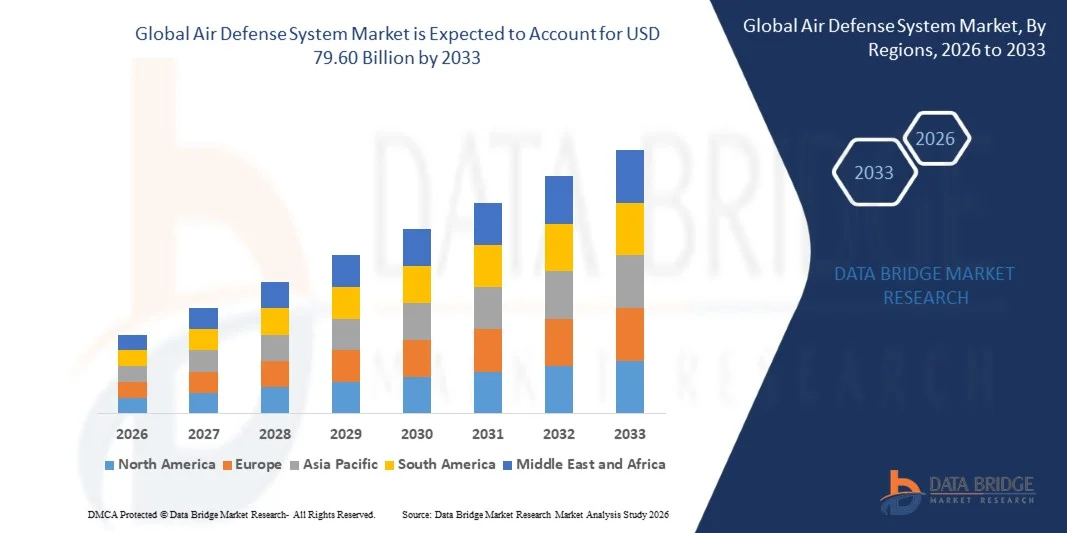
- As per Data Bridge Market Research analysis the air defense system market was valued at USD 47.50 billion in 2025 and is projected to reach USD 79.60 billion by 2033, growing at a CAGR of 7.80% from 2026 to 2033.
- The market is experiencing strong growth driven by increasing geopolitical tensions, rising defense expenditures, and growing investments in advanced missile defense and aerial threat interception technologies across developed and emerging economies.
- The increasing deployment of unmanned aerial vehicles (UAVs), cruise missiles, hypersonic weapons, and other sophisticated airborne threats is compelling defense organizations to strengthen multi-layered air defense capabilities and modernize existing defense infrastructures.
Market Size & Forecast
- Market Value (2025): USD 47.50 Billion
- Expected Market Value (2033): USD 79.60 Billion
- Forecast CAGR (2026–2033): 7.80%
- Leading Region in 2025: North America
- Fastest Growing Region: Asia-Pacific
What are the Major Takeaways of the Air Defense System Market?
- North America dominated the air defense system market with the largest revenue share in 2025, supported by substantial defense expenditures, advanced military modernization programs, and the continuous development of integrated air and missile defense capabilities.
- Asia-Pacific air defense system market is expected to witness substantial growth from 2026 to 2033, supported by rising military expenditures, territorial security concerns, and large-scale defense modernization initiatives across major economies.
- The surface-to-air missile systems segment held the largest market revenue share in 2025 driven by widespread deployment across national air defense networks and military modernization programs. These systems provide effective protection against aircraft, cruise missiles, ballistic missiles, and unmanned aerial threats, making them a critical component of layered defense architectures. Growing investments in advanced missile interceptors, integrated command-and-control systems, and long-range engagement capabilities continue to strengthen the segment's position. Increasing geopolitical tensions and rising defense expenditures across major economies are further supporting procurement activities worldwide.
- The directed energy air defense systems segment is projected to register the fastest growth at a CAGR from 2026 to 2033, driven by increasing investments in high-energy laser and microwave technologies. Defense agencies are focusing on cost-effective counter-drone solutions capable of engaging multiple threats with minimal operational costs. Continuous advancements in power generation and beam control technologies are accelerating adoption across modern military forces.
- The radar systems segment accounted for the largest market revenue share in 2025 owing to their central role in air surveillance, target acquisition, tracking, and threat identification. Modern radar systems are becoming increasingly sophisticated with active electronically scanned array (AESA) technology, improved detection ranges, and enhanced resistance to electronic warfare threats. The growing integration of radar systems into network-centric defense architectures is further driving demand. Rising investments in early warning capabilities continue to support segment expansion.
- The electro-optical and infrared systems segment is projected to register the fastest growth at a CAGR from 2026 to 2033 due to increasing demand for passive detection capabilities and enhanced target recognition performance. These systems provide improved situational awareness and operational effectiveness in contested and electronic warfare environments.
Report Scope and Air Defense System Market Segmentation
|
Attributes |
Air Defense System Key Market Insights |
|
Segments Covered |
|
|
Countries Covered |
North America
Europe
Asia-Pacific
Middle East and Africa
South America
|
|
Key Market Players |
|
|
Market Opportunities |
|
|
Value Added Data Infosets |
In addition to the market insights such as market value, growth rate, market segments, geographical coverage, market players, and market scenario, the market report curated by the Data Bridge Market Research team includes in-depth expert analysis, import/export analysis, pricing analysis, production consumption analysis, and pestle analysis. |
What is the Key Trend in the Air Defense System Market?
- Defense organizations are increasingly adopting integrated and multi-layered air defense architectures capable of detecting, tracking, and intercepting a wide range of aerial threats, including drones, cruise missiles, ballistic missiles, and hypersonic weapons.
- For instance, in January 2025, RTX's Raytheon secured a contract valued at approximately USD 529 million to supply the Netherlands with a Patriot air and missile defense system fire unit and related equipment, strengthening the country's integrated air defense capabilities and supporting modernization efforts across Europe.
- Modern air defense networks are increasingly combining advanced radars, artificial intelligence-enabled command-and-control systems, electro-optical sensors, and interceptor technologies to improve real-time threat response and battlefield awareness.
- For instance, in November 2024, Kongsberg Defence & Aerospace signed a contract worth approximately NOK 12 billion with the Netherlands for the delivery of NASAMS and NOMADS air defense systems, highlighting growing demand for network-centric and highly mobile air defense solutions among NATO members.
- As governments continue to strengthen national security and protect critical infrastructure from evolving airborne threats, the deployment of integrated air and missile defense systems is expected to accelerate, reinforcing multi-layered defense as a core trend shaping the market.
What are the Key Drivers of the Air Defense System Market?
- The increasing proliferation of advanced aerial threats, including unmanned aerial systems (UAS), cruise missiles, ballistic missiles, and hypersonic weapons, has significantly increased demand for sophisticated air defense systems worldwide.
- For instance, in December 2025, RTX's Raytheon was awarded a USD 168 million contract to provide Romania with Patriot air defense equipment, including radar systems, launchers, command-and-control systems, and support equipment, reflecting growing global investment in advanced missile defense capabilities.
- Governments are expanding defense budgets and accelerating procurement programs to strengthen airspace protection, enhance military readiness, and improve resilience against increasingly complex threats.
- For instance, in April 2024, Spain announced the acquisition and modernization of additional NASAMS air defense systems from Kongsberg Defence & Aerospace in a deal valued at approximately EUR 410 million to enhance national air defense capabilities and strengthen NATO interoperability.
- With geopolitical tensions increasing across multiple regions and military forces prioritizing layered air defense strategies, advanced air defense systems will remain critical for safeguarding military assets, critical infrastructure, and national airspace.
Which Factors are Challenging the Growth of the Air Defense System Market?
- Advanced air defense systems require substantial capital investment due to the integration of sophisticated radar networks, interceptor missiles, command-and-control infrastructure, sensor fusion technologies, and continuous system upgrades.
- These high procurement, maintenance, and lifecycle costs can limit adoption among countries with constrained defense budgets and create challenges for large-scale deployment.
- For instance, in December 2024, Norway ordered additional NASAMS air defense systems valued at approximately NOK 2.7 billion to strengthen national defense capabilities, highlighting the significant financial commitments required for modern air defense infrastructure.
- Air defense programs also involve lengthy procurement cycles, extensive testing requirements, technology integration complexities, and ongoing modernization costs, which can delay deployment timelines and increase project expenditures.
- The high cost of acquisition, maintenance, and technological upgrades continues to remain a major challenge for the market, particularly for developing nations seeking to modernize defense capabilities while balancing broader military spending priorities.
How is the Air Defense System Market Segmented?
The market is segmented on the basis of system type, component, threat type, range, platform, mobility, technology, application, end user, capability, and distribution channel.
- By System Type
On the basis of system type, the air defense system market is segmented into surface-to-air missile systems, anti-aircraft gun systems, directed energy air defense systems, and counter rocket artillery mortar systems. The surface-to-air missile systems segment held the largest market revenue share in 2025 driven by widespread deployment across national air defense networks and military modernization programs. These systems provide effective protection against aircraft, cruise missiles, ballistic missiles, and unmanned aerial threats, making them a critical component of layered defense architectures. Growing investments in advanced missile interceptors, integrated command-and-control systems, and long-range engagement capabilities continue to strengthen the segment's position. Increasing geopolitical tensions and rising defense expenditures across major economies are further supporting procurement activities worldwide.
The directed energy air defense systems segment is projected to register the fastest growth at a CAGR from 2026 to 2033, driven by increasing investments in high-energy laser and microwave technologies. Defense agencies are focusing on cost-effective counter-drone solutions capable of engaging multiple threats with minimal operational costs. Continuous advancements in power generation and beam control technologies are accelerating adoption across modern military forces.
- By Component
On the basis of component, the air defense system market is segmented into radar systems, electro-optical and infrared systems, missile launch systems, and interceptors. The radar systems segment accounted for the largest market revenue share in 2025 owing to their central role in air surveillance, target acquisition, tracking, and threat identification. Modern radar systems are becoming increasingly sophisticated with active electronically scanned array (AESA) technology, improved detection ranges, and enhanced resistance to electronic warfare threats. The growing integration of radar systems into network-centric defense architectures is further driving demand. Rising investments in early warning capabilities continue to support segment expansion.
The electro-optical and infrared systems segment is projected to register the fastest growth at a CAGR from 2026 to 2033 due to increasing demand for passive detection capabilities and enhanced target recognition performance. These systems provide improved situational awareness and operational effectiveness in contested and electronic warfare environments.
- By Threat Type
On the basis of threat type, the air defense system market is segmented into fixed wing aircraft, rotary wing aircraft, unmanned aerial systems, and cruise missiles. The fixed wing aircraft segment held the largest revenue share in 2025 due to the continued requirement for national air defense systems capable of countering conventional military aircraft threats. Countries continue to prioritize the protection of strategic assets and airspace against advanced fighter aircraft and bomber platforms. Long-range air defense systems remain critical components of national defense strategies. Continuous modernization of air defense networks is supporting sustained demand within this segment.
The unmanned aerial systems segment is projected to register the fastest growth at a CAGR from 2026 to 2033 as defense organizations increasingly focus on counter-UAS technologies. The rapid proliferation of military and commercial drones has created new security challenges, driving investments in specialized detection, tracking, and interception solutions.
- By Range
On the basis of range, the air defense system market is segmented into very short range, short range, medium range, and long range. The long-range segment dominated the market in 2025 due to growing investments in strategic missile defense systems capable of protecting large geographic areas and critical national assets. These systems play a vital role in countering ballistic missiles, cruise missiles, and advanced aerial threats. Increasing defense cooperation programs and cross-border security initiatives are also supporting deployment. Governments are prioritizing long-range capabilities to strengthen national deterrence and airspace protection.
The very short-range segment is projected to register the fastest growth at a CAGR from 2026 to 2033 owing to rising demand for mobile and portable systems designed to counter drones, helicopters, and low-altitude threats. Growing battlefield requirements for rapid-response air defense are accelerating procurement activities.
- By Platform
On the basis of platform, the air defense system market is segmented into land based, naval based, airborne, and space enabled. The land-based segment accounted for the largest market revenue share in 2025 driven by extensive deployment of ground-based air defense systems for territorial protection, military installations, and critical infrastructure defense. Land-based platforms offer flexibility, scalability, and compatibility with various missile and radar systems. Governments continue to prioritize investments in ground-based integrated air defense networks. Their ability to provide continuous and layered protection contributes significantly to market dominance.
The space-enabled segment is projected to register the fastest growth at a CAGR from 2026 to 2033 as countries increasingly invest in satellite-supported surveillance, missile warning, and integrated space-defense capabilities. Advancements in space-based sensing technologies are expected to create new opportunities for air defense modernization.
- By Mobility
On the basis of mobility, the air defense system market is segmented into fixed systems, mobile systems, transportable systems, and man portable systems. The mobile systems segment held the largest market revenue share in 2025 due to their ability to provide flexible deployment, rapid response, and enhanced survivability in dynamic combat environments. Military organizations increasingly favor mobile air defense solutions that can relocate quickly and support maneuver warfare operations. These systems are widely utilized for protecting armored formations, forward operating bases, and critical military assets. Their operational versatility continues to drive strong demand globally.
The man portable systems segment is projected to register the fastest growth at a CAGR from 2026 to 2033 driven by increasing demand for lightweight air defense solutions capable of engaging low-flying aircraft and unmanned aerial threats. Ongoing technological advancements are improving effectiveness, portability, and user capabilities.
- By Technology
On the basis of technology, the air defense system market is segmented into conventional air defense systems, network centric air defense systems, artificial intelligence enabled systems, and directed energy systems. The conventional air defense systems segment dominated the market in 2025 due to widespread deployment across existing military infrastructures and proven operational effectiveness. Many countries continue to modernize legacy systems through upgrades and capability enhancements. Established operational reliability and extensive global inventories contribute to sustained demand. Conventional systems remain an essential element of layered defense architectures.
The artificial intelligence enabled systems segment is projected to register the fastest growth at a CAGR from 2026 to 2033 as defense organizations increasingly integrate AI-powered threat analysis, automated target prioritization, predictive analytics, and decision-support capabilities. AI is expected to significantly improve reaction times and operational efficiency in complex threat environments.
- By Application
On the basis of application, the air defense system market is segmented into national air defense, military base protection, critical infrastructure protection, and border security. The national air defense segment accounted for the largest market revenue share in 2025 driven by increasing government investments in sovereign airspace protection and strategic defense modernization programs. Nations are strengthening integrated defense networks to address evolving aerial threats and regional security concerns. Long-term defense planning initiatives continue to support procurement of advanced air defense solutions. National security priorities remain a major driver of segment growth.
The critical infrastructure protection segment is projected to register the fastest growth at a CAGR from 2026 to 2033 as countries strengthen security around airports, energy facilities, military installations, government buildings, and transportation networks. Growing concerns regarding drone attacks and missile threats are accelerating investments in this area.
- By End User
On the basis of end user, the air defense system market is segmented into army, air force, navy, and joint defense commands. The air force segment held the largest market revenue share in 2025 owing to its primary responsibility for airspace control, missile defense operations, and integrated aerial threat management. Air forces operate a significant portion of advanced radar systems, interceptor missiles, and command-and-control infrastructure worldwide. Ongoing investments in modernization and network-centric warfare capabilities continue to support segment growth. The increasing complexity of airborne threats further reinforces the importance of air force-led defense operations.
The joint defense commands segment is projected to register the fastest growth at a CAGR from 2026 to 2033 due to increasing adoption of multi-domain operations and integrated command structures. Governments are emphasizing interoperability and coordinated defense strategies across military branches.
- By Capability
On the basis of capability, the air defense system market is segmented into air surveillance, threat detection, target tracking, and target engagement. The target engagement segment dominated the market in 2025 due to increasing procurement of advanced interceptor missiles and kinetic defense systems designed to neutralize aerial threats. Modern engagement systems provide higher interception accuracy, improved reaction times, and enhanced battlefield effectiveness. Growing investments in layered defense strategies continue to support segment expansion. The need to counter increasingly sophisticated threats is further driving technological advancements.
The threat detection segment is projected to register the fastest growth at a CAGR from 2026 to 2033 advancements in radar technologies, sensor fusion systems, artificial intelligence, and real-time monitoring solutions. Improved detection capabilities are becoming critical for ensuring effective air defense performance.
- By Distribution Channel
On the basis of distribution channel, the air defense system market is segmented into direct sales, channel partner sales, project-based procurement, and online sales. The direct sales segment accounted for the largest market revenue share in 2025 owing to government-to-government agreements, defense procurement contracts, and direct engagement between military organizations and defense manufacturers. Air defense systems involve highly specialized technologies that require extensive customization, integration, and long-term support services. Direct procurement ensures compliance with national security requirements and operational specifications. Large-scale modernization initiatives continue to drive this procurement model.
The project-based procurement segment is projected to register the fastest growth at a CAGR from 2026 to 2033 as governments launch comprehensive air defense modernization programs involving missile defense systems, radar networks, and command-and-control infrastructure upgrades. Rising defense budgets and long-term acquisition strategies are expected to create substantial opportunities across this segment.
Which Region Holds the Largest Share of the Air Defense System Market?
- North America dominated the air defense system market with the largest revenue share in 2025, supported by substantial defense expenditures, advanced military modernization programs, and the continuous development of integrated air and missile defense capabilities.
- The region benefits from the presence of major defense contractors, extensive investments in radar technologies, interceptor systems, and command-and-control infrastructure. Growing concerns regarding missile threats, unmanned aerial systems, and homeland security are further strengthening demand for advanced air defense solutions across military and strategic installations.
U.S. Air Defense System Market Insight
The U.S. air defense system market captured the largest revenue share in 2025 within North America, fueled by significant investments in missile defense programs, homeland security initiatives, and next-generation battlefield technologies. The U.S. Department of Defense continues to prioritize the modernization of Patriot, THAAD, Integrated Air and Missile Defense (IAMD), and counter-UAS capabilities. Increasing focus on hypersonic missile defense, space-based surveillance systems, and network-centric warfare architectures is further contributing to market growth.
Europe Air Defense System Market Insight
The Europe air defense system market is expected to witness the fastest growth rate from 2026 to 2033, primarily driven by rising geopolitical tensions, increased defense budgets, and accelerated military modernization programs across NATO member states. Governments are investing heavily in integrated air and missile defense networks to strengthen regional security and strategic deterrence capabilities. Growing procurement of advanced radar systems, interceptor missiles, and command-and-control platforms is supporting substantial market expansion throughout the region.
U.K. Air Defense System Market Insight
The U.K. air defense system market is expected to witness strong growth from 2026 to 2033, driven by increasing investments in national defense capabilities and the modernization of air surveillance and missile defense infrastructure. Rising emphasis on protecting critical infrastructure, military installations, and national airspace from evolving aerial threats is supporting procurement activities. The integration of advanced sensors, radar technologies, and network-enabled defense systems is expected to further stimulate market growth.
Germany Air Defense System Market Insight
The Germany air defense system market is expected to witness significant growth from 2026 to 2033, fueled by increasing defense spending and extensive efforts to strengthen national and regional security capabilities. Germany's commitment to NATO defense objectives and military modernization programs is accelerating investments in advanced air and missile defense technologies. The growing deployment of integrated air defense systems and long-range surveillance capabilities is contributing to increased market demand across the country.
Asia-Pacific Air Defense System Market Insight
The Asia-Pacific air defense system market is expected to witness substantial growth from 2026 to 2033, supported by rising military expenditures, territorial security concerns, and large-scale defense modernization initiatives across major economies. Countries such as China, India, Japan, South Korea, and Australia are expanding investments in missile defense systems, air surveillance networks, and counter-drone technologies. Increasing regional security challenges and growing indigenous defense manufacturing capabilities are further driving market growth.
Japan Air Defense System Market Insight
The Japan air defense system market is expected to witness strong growth from 2026 to 2033 due to increasing investments in missile defense and national security modernization programs. The country is strengthening its air defense capabilities to address evolving regional security threats, including ballistic missiles, hypersonic weapons, and unmanned aerial systems. Growing deployment of advanced radar networks, interceptor systems, and integrated command-and-control platforms is expected to support continued market expansion.
China Air Defense System Market Insight
The China air defense system market accounted for the largest market revenue share in Asia-Pacific in 2025, attributed to substantial defense investments, large-scale military modernization programs, and continuous advancements in indigenous defense technologies. China remains one of the world's largest developers and operators of integrated air defense systems, deploying advanced radar networks, surface-to-air missile systems, and long-range air surveillance capabilities. Increasing focus on anti-access and area-denial strategies, coupled with investments in next-generation missile defense technologies, continues to strengthen the country's position in the regional market.
Which are the Top Companies in Air Defense System Market?
The air defense system industry is primarily led by well-established companies, including:
- RTX (U.S.)
- Northrop Grumman (U.S.)
- L3Harris Technologies, Inc. (U.S.)
- BAE Systems (U.K.)
- Thales (France)
- Leonardo S.p.A. (Italy)
- Rheinmetall AG (Germany)
- HENSOLDT AG (Germany)
- Saab AB (Sweden)
- Hanwha Aerospace Co., Ltd. (South Korea)
- ASELSAN A.Ş. (Turkey)
- Bharat Electronics Limited (India)
- Bharat Dynamics Limited (India)
- Mitsubishi Heavy Industries, Ltd. (Japan)
- Israel Aerospace Industries Ltd. (Israel)
- Rafael Advanced Defense Systems Ltd. (Israel)
- MBDA S.A.S. (France)
- Diehl Defence GmbH & Co. KG (Germany)
- Kongsberg Defence & Aerospace AS (Norway)
- LIG Nex1 Co., Ltd. (South Korea)
- Roketsan A.Ş. (Turkey)
- China Aerospace Science and Industry Corporation Limited (China)
- Almaz-Antey Air and Space Defence Corporation JSC (Russia)
What are Latest Developments in Air Defense System Market?
- In November 2025, Saab AB secured a contract valued at approximately USD 220 million from the Swedish Defence Materiel Administration (FMV) to deliver advanced sensors and command-and-control (C2) systems for the Swedish Army. The project aims to establish a new land-based air defense layer capable of improving battlefield surveillance, target identification, and coordinated threat response. The deployment will strengthen Sweden’s integrated air defense capabilities and enhance force protection against evolving aerial threats. This development highlights the growing demand for network-centric air defense systems and supports continued modernization across European defense markets.
- In August 2025, the UK Ministry of Defence announced the procurement of six additional Land Ceptor missile systems under a three-year contract to strengthen national air defense capabilities. The systems will be integrated into the Sky Sabre air defense network, providing enhanced protection against cruise missiles, aircraft, and unmanned aerial systems. The program is intended to improve battlefield readiness, expand airspace protection, and support the modernization of the British Army's ground-based air defense infrastructure. The contract reinforces growing investments in advanced medium-range air defense technologies across NATO countries.
- In September 2024, RTX Corporation's Raytheon business introduced an advanced missile defense solution incorporating next-generation radar, sensor fusion, and threat interception technologies. The system was developed to address increasingly sophisticated aerial threats, including cruise missiles and unmanned aerial platforms. By improving detection accuracy, engagement speed, and operational effectiveness, the solution enhances integrated air and missile defense capabilities. The launch demonstrates the industry's continued focus on advanced air defense innovation and strengthens competition among leading defense contractors.
- In August 2023, Lockheed Martin announced a strategic collaboration with a European defense partner to accelerate the development of next-generation air defense technologies. The partnership focuses on integrating advanced artificial intelligence, sensor fusion, and command-and-control capabilities into future air defense architectures. The initiative is expected to improve operational efficiency, threat assessment accuracy, and response times across complex defense environments. This collaboration highlights the growing role of AI-enabled technologies in modern air defense modernization programs.
- In July 2022, BAE Systems expanded its defense cybersecurity capabilities through the acquisition of a specialist cybersecurity company focused on defense and critical infrastructure applications. The acquisition was intended to strengthen the protection of air defense networks, command systems, and mission-critical defense assets against evolving cyber threats. Enhanced cybersecurity integration helps improve the resilience, reliability, and operational effectiveness of modern air defense platforms. The development underscores the increasing importance of cyber protection as a core component of next-generation air defense systems.
- In June 2025, MBDA announced at the Paris Air Show that it had secured a contract to develop the FULGUR Very Short-Range Air Defense (VSHORAD) missile system for the Italian Army. The program is designed to address emerging low-altitude aerial threats, including drones, helicopters, and precision-guided munitions. The new missile system will enhance short-range battlefield protection and strengthen Italy's layered air defense architecture. This development reflects the growing emphasis on counter-UAS and next-generation short-range air defense capabilities within European defense modernization programs.

- Interactive Data Analysis Dashboard
- Company Analysis Dashboard for high growth potential opportunities
- Research Analyst Access for customization & queries
- Competitor Analysis with Interactive dashboard
- Latest News, Updates & Trend analysis
- Harness the Power of Benchmark Analysis for Comprehensive Competitor Tracking
Data collection and base year analysis are done using data collection modules with large sample sizes. The stage includes obtaining market information or related data through various sources and strategies. It includes examining and planning all the data acquired from the past in advance. It likewise envelops the examination of information inconsistencies seen across different information sources. The market data is analysed and estimated using market statistical and coherent models. Also, market share analysis and key trend analysis are the major success factors in the market report. To know more, please request an analyst call or drop down your inquiry.
The key research methodology used by DBMR research team is data triangulation which involves data mining, analysis of the impact of data variables on the market and primary (industry expert) validation. Data models include Vendor Positioning Grid, Market Time Line Analysis, Market Overview and Guide, Company Positioning Grid, Patent Analysis, Pricing Analysis, Company Market Share Analysis, Standards of Measurement, Global versus Regional and Vendor Share Analysis. To know more about the research methodology, drop in an inquiry to speak to our industry experts.
Data Bridge Market Research is a leader in advanced formative research. We take pride in servicing our existing and new customers with data and analysis that match and suits their goal. The report can be customized to include price trend analysis of target brands understanding the market for additional countries (ask for the list of countries), clinical trial results data, literature review, refurbished market and product base analysis. Market analysis of target competitors can be analyzed from technology-based analysis to market portfolio strategies. We can add as many competitors that you require data about in the format and data style you are looking for. Our team of analysts can also provide you data in crude raw excel files pivot tables (Fact book) or can assist you in creating presentations from the data sets available in the report.












