


Air Traffic Management Market Size
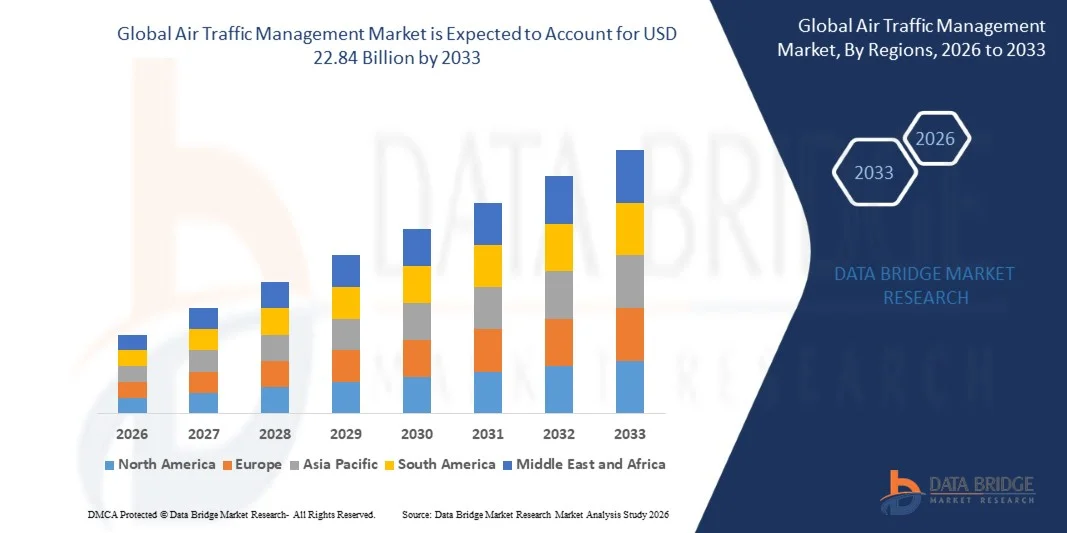
- The global air traffic management market size was valued at USD 12.82 billion in 2025 and is expected to reach USD 22.84 billion by 2033, at a CAGR of 7.49% during the forecast period
- The market growth is largely fueled by the continuous rise in global air passenger traffic and increasing demand for efficient airspace management systems, leading to higher adoption of advanced air traffic control technologies across commercial and military aviation sectors
- Furthermore, growing investments in airport infrastructure modernization and the rising need for enhanced flight safety, real-time communication, and optimized traffic flow are establishing air traffic management systems as a critical component of modern aviation. These converging factors are accelerating the deployment of next-generation solutions, thereby significantly boosting the industry’s growth
Air Traffic Management Market Analysis
- Air traffic management systems are integrated solutions that ensure the safe and efficient movement of aircraft through controlled airspace using communication, navigation, and surveillance technologies. These systems enable real-time coordination between pilots and ground control, supporting smooth flight operations and minimizing delays across global aviation networks
- The escalating demand for air traffic management solutions is primarily driven by increasing air traffic congestion, rising focus on aviation safety standards, and growing adoption of digital and satellite-based technologies. The shift toward automation and data-driven decision-making is further enhancing operational efficiency and supporting the expansion of global air transportation systems
- North America dominated the air traffic management market with a share of 33.15% in 2025, due to advanced aviation infrastructure, high air traffic volume, and strong investments in modernization programs
- Asia-Pacific is expected to be the fastest growing region in the air traffic management market during the forecast period due to rapid urbanization, rising air passenger traffic, and expanding aviation infrastructure in countries such as China, India, and Japan
- Hardware segment dominated the market with a market share of 64.60% in 2025, due to the extensive deployment of radar systems, communication equipment, navigation aids, and surveillance infrastructure. Airports and air traffic control centers continue to rely heavily on physical systems to ensure uninterrupted monitoring and safe aircraft operations. Ongoing modernization of airport infrastructure and replacement of legacy systems are further reinforcing hardware demand
Report Scope and Air Traffic Management Market Segmentation
|
Attributes |
Air Traffic Management Key Market Insights |
|
Segments Covered |
|
|
Countries Covered |
North America
Europe
Asia-Pacific
Middle East and Africa
South America
|
|
Key Market Players |
|
|
Market Opportunities |
|
|
Value Added Data Infosets |
In addition to the market insights such as market value, growth rate, market segments, geographical coverage, market players, and market scenario, the market report curated by the Data Bridge Market Research team includes in-depth expert analysis, import/export analysis, pricing analysis, production consumption analysis, and pestle analysis. |
Air Traffic Management Market Trends
“Integration of AI and Automation in Air Traffic Management Systems”
- A significant trend in the air traffic management market is the increasing integration of artificial intelligence and automation technologies into airspace operations, driven by the need for enhanced efficiency, safety, and real-time decision-making. This transformation is elevating air traffic management systems into intelligent platforms capable of handling complex and high-density air traffic environments
- For instance, Thales Group has introduced AI-enabled air traffic control solutions that optimize flight sequencing and improve controller decision support in congested airspace. These systems enhance operational efficiency and reduce delays by enabling predictive traffic management and automated coordination
- The adoption of digital towers and remote air traffic control systems is accelerating as automation allows centralized monitoring and management of multiple airports. This is reducing operational costs and improving flexibility in managing air traffic across geographically dispersed regions
- Air navigation service providers are increasingly deploying machine learning algorithms to predict traffic patterns, weather disruptions, and potential conflicts. This is improving situational awareness and enabling proactive management of airspace operations with reduced human intervention
- The integration of automation in communication, navigation, and surveillance systems is strengthening real-time data exchange between aircraft and ground control. This is enhancing flight safety and enabling seamless coordination across global aviation networks
- The market is witnessing continuous advancements in autonomous and data-driven air traffic systems that support optimized routing, fuel efficiency, and reduced environmental impact. This growing reliance on AI and automation is reinforcing the transition toward smarter and more resilient air traffic management infrastructures
Air Traffic Management Market Dynamics
Driver
“Rising Global Air Passenger Traffic and Airspace Congestion”
- The rapid increase in global air passenger traffic is driving the demand for advanced air traffic management systems that can efficiently handle growing flight volumes and reduce congestion. Expanding airline networks and rising frequency of flights are placing significant pressure on existing airspace infrastructure
- For instance, Federal Aviation Administration has been implementing the NextGen program to modernize air traffic systems and manage increasing air traffic demand through satellite-based navigation and digital communication technologies. This initiative is improving airspace capacity and operational efficiency across the aviation network
- The surge in low-cost carriers and regional aviation is contributing to higher flight density, particularly in emerging markets. This is increasing the need for advanced traffic flow and capacity management solutions to maintain safe and efficient operations
- Airports and airlines are focusing on minimizing delays and optimizing flight schedules, which is encouraging investment in real-time monitoring and predictive traffic management systems. These technologies enable better utilization of airspace and reduce operational disruptions
- The growing need to ensure safety while accommodating higher traffic volumes is reinforcing the importance of modern air traffic management solutions. This driver is significantly contributing to the sustained growth and technological advancement of the market
Restraint/Challenge
“High Implementation Costs and Complexity of Modernization”
- The air traffic management market faces challenges due to the high costs associated with upgrading legacy systems to advanced digital and automated solutions. Modernization requires substantial investment in infrastructure, technology integration, and workforce training, creating financial barriers for many regions
- For instance, European Organisation for the Safety of Air Navigation has highlighted the complexity of implementing unified airspace modernization programs across multiple countries, where coordination challenges and funding requirements slow down deployment timelines. These factors increase the difficulty of achieving seamless integration across regional airspaces
- The transition from traditional radar-based systems to satellite-based and cloud-enabled platforms involves complex system interoperability and data integration challenges. This increases implementation risks and extends project timelines for aviation authorities
- Maintaining continuous operations during system upgrades adds another layer of complexity, as disruptions in air traffic services can have significant economic and safety implications. This necessitates phased deployment strategies and careful planning
- The combination of high capital expenditure, technical complexity, and operational risks continues to restrain market growth. These challenges are compelling stakeholders to adopt gradual and strategic approaches to modernization while balancing cost and performance efficiency
Air Traffic Management Market Scope
The market is segmented on the basis of domain, component, and application.
• By Domain
On the basis of domain, the air traffic management market is segmented into air traffic control, air traffic flow and capacity management, aeronautical information management, and others. The air traffic control segment held the largest market revenue share in 2025, driven by its critical role in ensuring flight safety and real-time aircraft coordination across controlled airspace. Increasing global air traffic volume and modernization of airport infrastructure are further strengthening demand for advanced air traffic control systems. Governments and aviation authorities continue to prioritize investments in radar systems, communication networks, and control towers to maintain operational safety and efficiency. The segment benefits from its foundational position in aviation operations, making it indispensable across all regions.
The air traffic flow and capacity management segment is expected to witness the fastest growth rate from 2026 to 2033, supported by rising airspace congestion and the need for optimized flight scheduling. Increasing adoption of predictive analytics and AI-based traffic forecasting systems is improving airspace utilization efficiency and reducing delays. Airlines and airport operators are focusing on minimizing fuel consumption and operational bottlenecks through real-time flow optimization tools. The expansion of commercial aviation and growing complexity of global flight routes are accelerating deployment of advanced capacity management solutions. This segment is gaining traction as aviation networks shift toward data-driven and automated traffic coordination systems.
• By Component
On the basis of component, the air traffic management market is segmented into hardware, software, and services. The hardware segment dominated the largest market revenue share of 64.60% in 2025, driven by the extensive deployment of radar systems, communication equipment, navigation aids, and surveillance infrastructure. Airports and air traffic control centers continue to rely heavily on physical systems to ensure uninterrupted monitoring and safe aircraft operations. Ongoing modernization of airport infrastructure and replacement of legacy systems are further reinforcing hardware demand. The segment remains essential due to its direct role in enabling core air traffic control and surveillance functions.
The software segment is expected to witness the fastest growth rate from 2026 to 2033, driven by increasing digitalization of air traffic operations and adoption of AI-enabled platforms. Growing emphasis on predictive analytics, automation, and cloud-based air traffic management solutions is transforming operational efficiency. Software solutions are enabling real-time decision-making, optimized flight routing, and improved safety management across complex airspace systems. Rising integration of digital tower concepts and remote monitoring capabilities is further accelerating adoption. The shift toward intelligent aviation ecosystems is positioning software as a key growth driver in the market.
• By Application
On the basis of application, the air traffic management market is segmented into communication, navigation, surveillance, and others. The communication segment held the largest market revenue share in 2025, driven by its essential role in maintaining continuous coordination between pilots and air traffic controllers. Reliable voice and data communication systems are critical for ensuring flight safety, operational clarity, and emergency response management. Increasing air traffic density and expansion of global flight networks are further strengthening demand for advanced communication infrastructure. The segment continues to form the backbone of air traffic operations across both commercial and military aviation sectors.
The surveillance segment is expected to witness the fastest growth rate from 2026 to 2033, driven by increasing deployment of satellite-based tracking systems and advanced radar technologies. Rising focus on real-time aircraft monitoring and airspace security is encouraging adoption of ADS-B and space-based surveillance solutions. Airlines and aviation authorities are leveraging enhanced surveillance systems to improve situational awareness and reduce collision risks. Integration of AI and big data analytics is further enhancing detection accuracy and operational efficiency. The shift toward global seamless surveillance coverage is accelerating the growth of this segment.
Air Traffic Management Market Regional Analysis
- North America dominated the air traffic management market with the largest revenue share of 33.15% in 2025, driven by advanced aviation infrastructure, high air traffic volume, and strong investments in modernization programs
- The region benefits from early adoption of digital air traffic control systems and widespread implementation of satellite-based navigation and surveillance technologies. Increasing focus on flight safety, efficiency, and airspace optimization is further strengthening market demand
- Government initiatives to upgrade aging air traffic control systems and enhance operational reliability continue to support market growth. The presence of leading aviation technology providers also reinforces regional dominance in advanced air traffic management solutions
U.S. Air Traffic Management Market Insight
The U.S. air traffic management market held the largest revenue share in North America in 2025, driven by one of the busiest aviation networks globally and ongoing upgrades in air navigation infrastructure. Growing focus on enhancing airspace efficiency and minimizing flight delays is boosting the adoption of advanced traffic management technologies. Significant investments are being directed toward modernization initiatives, including improved surveillance systems and digital communication frameworks for air traffic control. The incorporation of AI-driven flight optimization tools and predictive analytics is further improving operational performance. In addition, federal aviation authorities are emphasizing safety, automation, and capacity expansion, supporting continued market growth.
Europe Smart Traffic Management Market Insight
The Europe air traffic management market is projected to expand at a substantial CAGR throughout the forecast period, driven by strict aviation safety regulations and the increasing need for cross-border airspace coordination. Rising air passenger traffic across major hubs is encouraging the adoption of advanced air traffic flow and capacity management systems. The region is focusing on harmonized air traffic operations to improve efficiency and reduce congestion across fragmented airspaces. Investments in satellite-based navigation programs and modernization of legacy systems are further supporting growth. Increasing emphasis on sustainability and fuel-efficient flight routing is also contributing to market expansion.
U.K. Air Traffic Management Market Insight
The U.K. air traffic management market is anticipated to grow at a noteworthy CAGR during the forecast period, supported by rising air travel demand and continuous upgrades in aviation infrastructure. The country is focusing on enhancing airspace capacity and improving operational safety through advanced digital control systems. Increasing deployment of automation and remote tower technologies is streamlining air traffic operations across key airports. Strong emphasis on reducing delays and improving flight efficiency is encouraging investment in next-generation traffic management solutions. Ongoing modernization initiatives by aviation authorities are further driving market growth.
Germany Air Traffic Management Market Insight
The Germany air traffic management market is expected to expand at a considerable CAGR during the forecast period, driven by strong aviation infrastructure and growing focus on technological innovation in airspace management. The country is investing in advanced surveillance and navigation systems to improve efficiency and safety across dense air traffic corridors. Increasing adoption of digital air traffic control solutions is supporting real-time monitoring and optimized flight routing. Germany’s emphasis on sustainability is also encouraging efficient air traffic flow management to reduce emissions. Continuous upgrades in airport infrastructure and air navigation systems are further strengthening market growth.
Asia-Pacific Smart Traffic Management Market Insight
The Asia-Pacific air traffic management market is poised to grow at the fastest CAGR from 2026 to 2033, driven by rapid urbanization, rising air passenger traffic, and expanding aviation infrastructure in countries such as China, India, and Japan. Increasing investments in new airports and modernization of air traffic control systems are supporting strong regional growth. Government initiatives focused on smart aviation infrastructure and digital airspace management are further accelerating adoption. The region is also benefiting from increasing deployment of cost-effective surveillance and communication technologies. Growing demand for efficient flight operations and reduced congestion is making Asia-Pacific the fastest-growing region in the market.
Japan Air Traffic Management Market Insight
The Japan air traffic management market is gaining momentum due to its advanced technological ecosystem, high aviation safety standards, and increasing air travel demand. The country is actively integrating AI-enabled traffic control systems and satellite-based navigation technologies to improve operational precision. Japan’s focus on disaster-resilient aviation infrastructure is also driving investments in robust air traffic management solutions. Increasing adoption of automated systems in airports is enhancing efficiency and reducing human error. The integration of smart surveillance and communication systems is further strengthening market growth across the region.
China Air Traffic Management Market Insight
The China air traffic management market accounted for the largest market revenue share in Asia-Pacific in 2025, driven by rapid expansion of commercial aviation, strong airport development programs, and increasing air passenger traffic. The country is heavily investing in smart aviation infrastructure, including advanced radar systems and satellite-based navigation technologies. Government-led initiatives for airspace modernization and smart city integration are further supporting market growth. Rising demand for efficient air traffic flow management in congested air routes is accelerating technology adoption. Strong domestic manufacturing capabilities in aviation systems are also contributing to market expansion.
Air Traffic Management Market Share
The air traffic management industry is primarily led by well-established companies, including:
- Honeywell International Inc. (U.S.)
- Kongsberg Gruppen ASA (Norway)
- Indra Sistemas, S.A. (Spain)
- Northrop Grumman Corporation (U.S.)
- NAV CANADA (Canada)
- Leonardo S.p.A. (Italy)
- Adacel Technologies Limited (Australia)
- Thales Group (France)
- Frequentis AG (Austria)
- RTX Corporation (U.S.)
- Advanced Navigation and Positioning Corporation (Japan)
- NATS (U.K.)
- Saab AB (Sweden)
- SITA N.V. (Switzerland)
- L3Harris Technologies, Inc. (U.S.)
- Aena, S.M.E. (Spain)
Latest Developments in Global Air Traffic Management Market
- In September 2025, Thales and Stinville secured a contract with CORPAC to deploy the TopSky-AMHS system across more than 35 locations, significantly strengthening communication links between control centers, airports, and international ANSPs. This development is accelerating Peru’s compliance with International Civil Aviation Organization standards while enhancing interoperability across global aviation networks. The initiative is improving operational efficiency and positioning Peru as a strategic hub for air traffic connectivity across multiple regions. It is also reinforcing Thales’s competitive presence in the South American air traffic management market
- In September 2025, SITA introduced the ATC Bridge, a cloud-based SaaS platform aimed at modernizing legacy air traffic control communication systems. This solution is enabling aviation authorities and ANSPs to achieve greater scalability, security, and cost efficiency in communication infrastructure. The launch is supporting the transition toward digital and cloud-native air traffic management systems. It is also strengthening SITA’s role in advancing next-generation aviation communication technologies and driving broader market digitalization
- In January 2024, EasyJet Airline Company Limited became the first airline to collaborate with the Iris program led by European Space Agency and Viasat, focusing on the integration of advanced satellite communication technologies into air traffic management. This partnership is enhancing real-time data exchange between aircraft and ground systems, improving flight efficiency and safety. It is also supporting the adoption of satellite-based air traffic control solutions across the aviation sector. The initiative is contributing to the evolution of connected and space-enabled air traffic management systems globally
- In October 2023, officials at Biju Patnaik International Airport implemented a new air traffic management automation system within the upgraded control center, significantly improving flight operation efficiency. This advancement is enhancing real-time monitoring, decision-making capabilities, and overall airspace coordination at the airport. The upgrade reflects the increasing adoption of automated air traffic solutions in emerging aviation markets. It is also contributing to improved capacity management and operational reliability in regional airspace systems
- In July 2023, Skykraft Pvt Ltd successfully conducted an initial trial of space-based VHF voice communications, marking a major step toward satellite-enabled aviation communication networks. This development is advancing the capability to provide global, real-time communication coverage beyond traditional ground-based limitations. It is supporting the future deployment of space-based monitoring and communication services for aviation. The milestone aligns with ongoing global efforts to modernize air traffic management systems and improve connectivity in remote and oceanic airspace regions

- Interactive Data Analysis Dashboard
- Company Analysis Dashboard for high growth potential opportunities
- Research Analyst Access for customization & queries
- Competitor Analysis with Interactive dashboard
- Latest News, Updates & Trend analysis
- Harness the Power of Benchmark Analysis for Comprehensive Competitor Tracking
Data collection and base year analysis are done using data collection modules with large sample sizes. The stage includes obtaining market information or related data through various sources and strategies. It includes examining and planning all the data acquired from the past in advance. It likewise envelops the examination of information inconsistencies seen across different information sources. The market data is analysed and estimated using market statistical and coherent models. Also, market share analysis and key trend analysis are the major success factors in the market report. To know more, please request an analyst call or drop down your inquiry.
The key research methodology used by DBMR research team is data triangulation which involves data mining, analysis of the impact of data variables on the market and primary (industry expert) validation. Data models include Vendor Positioning Grid, Market Time Line Analysis, Market Overview and Guide, Company Positioning Grid, Patent Analysis, Pricing Analysis, Company Market Share Analysis, Standards of Measurement, Global versus Regional and Vendor Share Analysis. To know more about the research methodology, drop in an inquiry to speak to our industry experts.
Data Bridge Market Research is a leader in advanced formative research. We take pride in servicing our existing and new customers with data and analysis that match and suits their goal. The report can be customized to include price trend analysis of target brands understanding the market for additional countries (ask for the list of countries), clinical trial results data, literature review, refurbished market and product base analysis. Market analysis of target competitors can be analyzed from technology-based analysis to market portfolio strategies. We can add as many competitors that you require data about in the format and data style you are looking for. Our team of analysts can also provide you data in crude raw excel files pivot tables (Fact book) or can assist you in creating presentations from the data sets available in the report.













