


What is the Global Aircraft Cooling Turbine Size and Growth Rate?
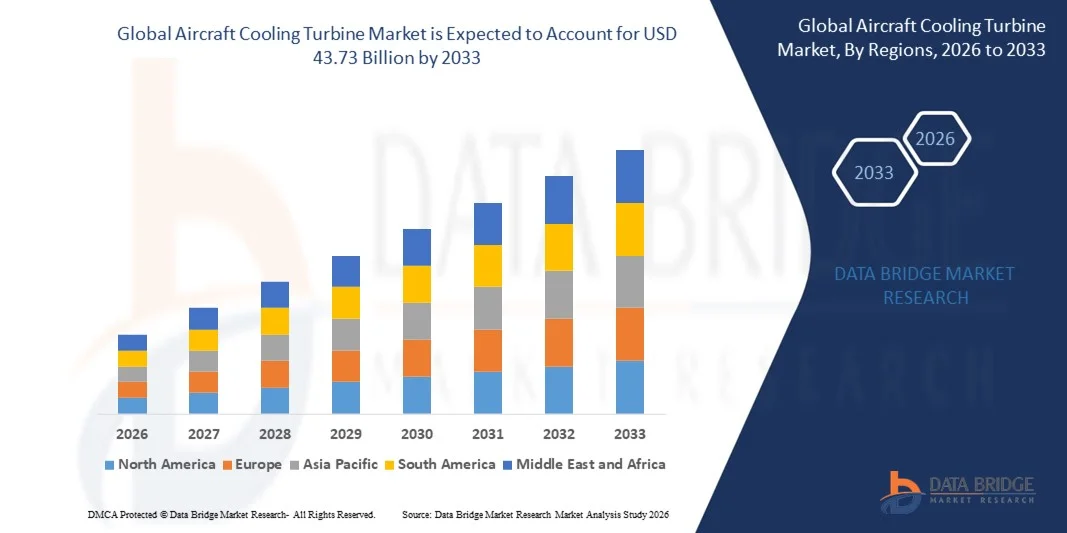
- As per Data Bridge Market Research Analysis the Global Aircraft Cooling Turbine Market size was valued at USD 26.82 billion in 2025 and is projected to reach USD 43.73 billion by 2033, expanding at a CAGR of 6.30% during the forecast period.
- Market expansion is primarily driven by increasing aircraft production, rising demand for advanced thermal management systems, and continuous technological advancements aimed at improving efficiency, reliability, and in-flight environmental control performance.
- Additionally, growing emphasis on fuel efficiency, passenger comfort, and integrated cooling solutions is positioning aircraft cooling turbines as a critical component in modern aviation systems. These combined factors are accelerating adoption across commercial and military fleets, thereby significantly boosting market growth.
Market Size & Forecast
- Global Market Value (2025): USD 26.82 billion
- Expected Market Value (2033): USD 43.73 billion
- Forecast CAGR (2026–2033): 6.30%
What are the Major Takeaways of Global Aircraft Cooling Turbine?
- Aircraft cooling turbines, which provide critical air-cycle cooling and thermal management for aircraft environmental control systems, are becoming increasingly essential components across modern commercial, military, and regional aircraft due to their high efficiency, reliability, and capability to support advanced avionics and propulsion technologies.
- The accelerating demand for aircraft cooling turbines is primarily driven by rising global aircraft production, growing preference for lightweight and energy-efficient cooling solutions, and stricter regulatory requirements related to cabin comfort, system performance, and thermal management.
- North America dominated the Global Aircraft Cooling Turbine Market with the largest revenue share of 32.4% in 2025, supported by strong aerospace manufacturing activity, high adoption of next-generation aircraft platforms, and the presence of major OEMs and suppliers, particularly in the U.S., which continues to invest heavily in advanced cooling technologies for both commercial and defense aviation.
- Asia-Pacific is expected to be the fastest-growing region in the Global Aircraft Cooling Turbine Market during the forecast period due to rapid expansion of commercial aviation, increasing air travel demand, and substantial investments in domestic aircraft manufacturing and MRO capabilities.
- The wide-body aircraft segment dominated the market with the largest revenue share of 52.5% in 2025, driven by the higher number of cooling turbines required to manage the thermal load in larger aircraft cabins and advanced avionics systems.
Report Scope and Global Aircraft Cooling Turbine Market Segmentation
|
Attributes |
Aircraft Cooling Turbine Key Market Insights |
|
Segments Covered |
|
|
Countries Covered |
North America
Europe
Asia-Pacific
Middle East and Africa
South America
|
|
Key Market Players |
|
|
Market Opportunities |
|
|
Value Added Data Infosets |
|
What is the Key Trend in the Global Aircraft Cooling Turbine?
Enhanced Performance Through Digitalization and Smart System Integration
- A significant and accelerating trend in the Global Aircraft Cooling Turbine Market is the deepening integration of cooling turbines with advanced digital aviation technologies, including real-time monitoring, predictive maintenance systems, and intelligent environmental control platforms. This convergence is greatly improving operational efficiency, reliability, and overall aircraft performance.
- For Instance, modern cooling turbines used in next-generation commercial aircraft are increasingly designed to integrate with onboard health-monitoring systems, enabling continuous performance tracking, fault detection, and optimized thermal management across flight cycles. Similarly, advanced ECS (Environmental Control System) architectures allow cooling turbines to operate in coordination with smart sensors to maintain optimal cabin conditions.
- AI-driven analytics are also enhancing turbine functionality by enabling systems to learn performance patterns, forecast maintenance needs, and automatically adjust airflow or cooling output based on flight conditions. Some leading aerospace manufacturers are incorporating machine-learning models to improve component longevity, reduce energy consumption, and deliver intelligent alerts for abnormal thermal behavior.
- The seamless integration of aircraft cooling turbines with broader digital aviation platforms allows centralized management of environmental control, propulsion thermal systems, and avionics cooling—providing a unified, automated, and highly efficient operational ecosystem.
- This shift toward more intelligent, interconnected, and self-optimizing cooling technologies is reshaping aircraft design and performance expectations. Consequently, major players are developing cooling turbines equipped with advanced sensors and digital interfaces that support real-time data exchange with cockpit and maintenance systems.
- The demand for digitally integrated, AI-enhanced cooling turbines is growing rapidly across commercial, military, and regional aircraft segments as operators prioritize efficiency, reliability, and reduced maintenance downtime.
Global Aircraft Cooling Turbine Market Dynamics
Driver
Growing Need Due to Rising Aircraft Production and Advanced Thermal Management Requirements
- The increasing global aircraft production across commercial, military, and regional segments—combined with the rising complexity of onboard systems—is a major driver for the accelerating demand for advanced aircraft cooling turbines.
- For instance, major aerospace manufacturers continue to expand their fleets with next-generation aircraft that require more efficient and compact thermal management solutions to support high-performance avionics and environmental control systems. Such developments by key industry players are expected to drive the aircraft cooling turbine market growth during the forecast period.
- As aircraft incorporate more electronics, electric propulsion components, and high-efficiency engines, the need for reliable cooling turbines capable of maintaining optimal thermal conditions is growing rapidly, offering a critical upgrade over traditional cooling methods.
- Furthermore, the global expansion of commercial air travel and increasing preference for fuel-efficient aircraft are making advanced cooling turbines indispensable, as they offer improved energy efficiency, reduced emissions, and enhanced cabin comfort.
- The ability of modern cooling turbines to deliver stable airflow, reduce thermal load, and integrate seamlessly with digitally controlled environmental systems is a key factor propelling adoption across all aircraft categories. The trend toward lightweight, modular, and highly efficient thermal management components continues to strengthen market demand.
Restraint/Challenge
Concerns Regarding High Development Costs and Technical Complexity
- The significant cost associated with developing and manufacturing advanced aircraft cooling turbines—driven by complex engineering requirements, precision machining, and rigorous aviation certification processes—acts as a major challenge for broader market expansion.
- For instance, the stringent testing, validation, and compliance standards demanded by aviation authorities can extend development timelines and increase costs, making it difficult for smaller manufacturers to compete in the market.
- Addressing these cost and complexity challenges requires continued innovation in materials, manufacturing processes, and system integration. Leading companies emphasize advanced engineering solutions, such as high-temperature alloys and digital design tools, to ensure improved turbine efficiency and durability. Additionally, the high initial investment required for integrating next-generation cooling systems can be a barrier for cost-sensitive operators and developing aerospace industries.
- While technological advancements are gradually improving efficiency and reducing lifecycle costs, the upfront capital requirements can still hinder widespread adoption, particularly for smaller airlines and regional manufacturers.
- Overcoming these challenges through cost-optimized designs, modular product development, and broader adoption of digital engineering technologies will be essential for sustaining long-term market growth in the aircraft cooling turbine industry.
How is the Global Aircraft Cooling Turbine Segmented?
Aircraft cooling turbine market is segmented on the basis of aircraft type, product type, and end use.
- By Aircraft Type
On the basis of aircraft type, the Global Aircraft Cooling Turbine Market is segmented into wide-body aircraft and narrow-body aircraft. The wide-body aircraft segment dominated the market with the largest revenue share of 52.5% in 2025, driven by the higher number of cooling turbines required to manage the thermal load in larger aircraft cabins and advanced avionics systems. Wide-body aircraft, commonly used for long-haul commercial flights, require highly efficient and reliable cooling turbines to maintain cabin comfort, ensure system stability, and optimize energy usage. Additionally, the growing demand for wide-body aircraft from major airlines in North America, Europe, and Asia-Pacific further supports segment growth.
The narrow-body aircraft segment is expected to witness the fastest CAGR of 19.8% from 2026 to 2033, fueled by the rapid expansion of short- to medium-haul fleets, increasing regional air travel, and rising adoption of advanced environmental control systems in smaller aircraft.
- By Product Type
On the basis of product type, the market is segmented into gas cooling turbines and water cooling turbines. The gas cooling turbine segment held the largest market revenue share of 57.3% in 2025, attributed to its high efficiency, lightweight design, and suitability for integration with modern environmental control systems in commercial and military aircraft. Gas turbines are widely preferred in both wide-body and narrow-body aircraft due to their ability to maintain consistent cabin temperature under varying operational conditions and their compatibility with advanced propulsion systems.
The water cooling turbine segment is expected to witness the fastest CAGR of 20.6% from 2026 to 2033, driven by increasing demand in high-performance aircraft, business jets, and military applications where water-based cooling systems offer precise thermal regulation, reduced energy consumption, and improved component longevity. Advancements in water turbine materials and compact designs are also supporting its rapid adoption.
- By End Use
On the basis of end use, the market is segmented into commercial aircraft, transportation aircraft, business jets, military aircraft, transport aircraft, and fighter jets. The commercial aircraft segment dominated the market with the largest revenue share of 49.8% in 2025, driven by the expansion of airline fleets, increasing passenger air travel, and the need for reliable environmental control systems in large-scale operations. Cooling turbines in commercial aircraft ensure cabin comfort, maintain avionics efficiency, and optimize fuel consumption across flights.
The military aircraft segment is expected to witness the fastest CAGR of 21.1% from 2026 to 2033, owing to growing investments in advanced fighter jets, transport aircraft, and unmanned aerial vehicles. Enhanced cooling requirements in defense applications, such as high-performance engines and sensitive avionics, along with increasing defense budgets in North America and Asia-Pacific, are fueling demand for highly efficient and robust cooling turbine solutions.
Which Region Holds the Largest Share of the Global Aircraft Cooling Turbine?
- North America dominated the Global Aircraft Cooling Turbine Market with the largest revenue share of 32.4% in 2025, driven by strong aerospace manufacturing activity, early adoption of next-generation aircraft technologies, and high demand for efficient environmental control systems in commercial and military fleets.
- Aircraft operators in the region prioritize advanced cooling turbines for their reliability, energy efficiency, and integration with modern avionics and environmental control systems, which help maintain optimal cabin conditions and protect sensitive onboard electronics.
- This widespread adoption is further supported by the presence of major OEMs and suppliers, substantial defense and commercial aviation investments, and a skilled workforce with expertise in advanced aerospace technologies, establishing North America as a key hub for aircraft cooling turbine demand and innovation.
U.S. Aircraft Cooling Turbine Market Insight
The U.S. aircraft cooling turbine market captured the largest revenue share of 82% in 2025 within North America, driven by a strong aerospace manufacturing base and the adoption of advanced commercial and military aircraft technologies. Operators are increasingly prioritizing high-efficiency cooling turbines to ensure optimal cabin comfort, maintain avionics performance, and reduce energy consumption. The growing trend toward digitally integrated environmental control systems, coupled with investments in fleet modernization, is further propelling market growth. Additionally, technological innovations by leading U.S. OEMs and suppliers, such as Honeywell and Collins Aerospace, are contributing to the market’s expansion by offering turbines with improved reliability, reduced weight, and enhanced thermal management capabilities.
Europe Aircraft Cooling Turbine Market Insight
The Europe aircraft cooling turbine market is projected to expand at a significant CAGR during the forecast period, driven by stringent regulatory standards, increasing aircraft production, and growing investments in commercial and business aviation. Rising adoption of energy-efficient cooling solutions and environmental control systems, particularly in Germany, France, and the U.K., is fueling demand. The trend toward digitalized, integrated turbine systems is also supporting growth across commercial, business jet, and military applications, with emphasis on reducing fuel consumption and enhancing thermal efficiency.
U.K. Aircraft Cooling Turbine Market Insight
The U.K. aircraft cooling turbine market is expected to grow at a noteworthy CAGR, supported by the country’s robust aerospace industry and increasing investments in fleet modernization. Growing focus on passenger comfort, system reliability, and regulatory compliance is encouraging airlines and defense operators to adopt advanced cooling turbines. Additionally, the U.K.’s strong manufacturing and maintenance ecosystem, combined with innovations in digital and energy-efficient turbine technologies, is expected to continue driving market expansion.
Germany Aircraft Cooling Turbine Market Insight
The Germany aircraft cooling turbine market is anticipated to expand at a considerable CAGR, fueled by rising awareness of environmental efficiency, advanced engineering capabilities, and stringent European aviation regulations. German aerospace companies are increasingly integrating high-performance cooling turbines in commercial, business, and military aircraft to meet energy efficiency and thermal management requirements. The focus on sustainability, precision engineering, and digital integration of turbine systems is further promoting adoption across the region.
Asia-Pacific Aircraft Cooling Turbine Market Insight
The Asia-Pacific aircraft cooling turbine market is poised to grow at the fastest CAGR of 23% from 2026 to 2033, driven by rapid aircraft fleet expansion, increasing air travel demand, and rising investments in domestic aerospace manufacturing in countries such as China, Japan, and India. Government initiatives to modernize aviation infrastructure, coupled with technological advancements and the emergence of the region as a manufacturing hub for aircraft components, are significantly contributing to market growth.
Japan Aircraft Cooling Turbine Market Insight
The Japan aircraft cooling turbine market is gaining momentum due to high technological adoption, modernization of commercial and business aircraft, and rising demand for energy-efficient environmental control systems. Japanese airlines and defense operators are prioritizing cooling turbines that ensure cabin comfort, maintain avionics efficiency, and integrate with digital aircraft management systems. Additionally, the growing fleet of regional and business jets is supporting turbine adoption in both residential and commercial sectors.
China Aircraft Cooling Turbine Market Insight
The China aircraft cooling turbine market accounted for the largest market revenue share in Asia-Pacific in 2025, driven by rapid urbanization, increasing domestic aircraft production, and growing commercial aviation demand. The country’s push toward modernizing airline fleets and integrating advanced environmental control technologies is fueling the adoption of efficient cooling turbines. Additionally, the presence of domestic manufacturers offering competitive, high-quality solutions is expanding accessibility and supporting market growth across commercial, business, and military aviation sectors.
Which are the Top Companies in Global Aircraft Cooling Turbine?
The Aircraft Cooling Turbine industry is primarily led by well-established companies, including:
• Honeywell Aerospace (U.S.)
• Collins Aerospace (U.S.)
• Safran Aerosystems (France)
• Liebherr-Aerospace (Switzerland)
• Pratt & Whitney (U.S.)
• Rolls-Royce Holdings (U.K.)
• General Electric Aviation (U.S.)
• Parker Hannifin Corporation (U.S.)
• Meggitt PLC (U.K.)
• MTU Aero Engines (Germany)
• Thales Group (France)
• Raytheon Technologies (U.S.)
• JAMCO Corporation (Japan)
• Ametek Airtechnology (U.K.)
• Aerospace Industrial Development Corporation – AIDC (Taiwan)
• United Technologies Aerospace Systems – UTAS (U.S.)
• Triumph Group (U.S.)
• Zodiac Aerospace (France)
• Korean Aerospace Industries – KAI (South Korea)
• China Aviation Industry Corporation – AVIC (China)
What are the Recent Developments in Global Aircraft Cooling Turbine Market?
- In April 2024, Honeywell Aerospace launched a strategic initiative in South Africa focused on deploying advanced aircraft cooling turbine solutions for commercial and regional fleets. The project aims to enhance thermal management efficiency, improve cabin environmental control, and reduce energy consumption in aircraft operating under challenging climatic conditions. By leveraging its global expertise and cutting-edge turbine technologies, Honeywell is strengthening its presence in the rapidly growing Global Aircraft Cooling Turbine Market while addressing region-specific aviation demands.
- In March 2024, Collins Aerospace introduced its next-generation high-efficiency cooling turbine system, specifically engineered for business jets and regional aircraft. The advanced design optimizes thermal performance, integrates with digital environmental control systems, and reduces maintenance downtime. This launch highlights Collins Aerospace’s commitment to providing innovative, reliable, and energy-efficient solutions that enhance aircraft operational performance across commercial and private aviation segments.
- In March 2024, Safran Aerosystems successfully deployed its upgraded cooling turbine technology as part of the Bengaluru Smart Aviation Project, aimed at improving aircraft environmental control and passenger comfort in urban hubs. The project demonstrates the increasing importance of advanced thermal management solutions in modern aircraft operations and underscores Safran’s focus on innovation and efficiency in the Global Aircraft Cooling Turbine Market.
- In February 2024, Pratt & Whitney announced a strategic partnership with several Asian airlines to implement next-generation cooling turbines in commercial and regional aircraft fleets. The collaboration focuses on enhancing turbine reliability, reducing operational energy costs, and improving system integration with aircraft environmental control units. This initiative reinforces Pratt & Whitney’s commitment to driving innovation and operational excellence within the aviation sector.
- In January 2024, Liebherr-Aerospace unveiled its newly designed modular aircraft cooling turbine at the Singapore Airshow 2024. Equipped with digital monitoring and predictive maintenance capabilities, the system allows operators to optimize thermal management in both wide-body and narrow-body aircraft. The launch emphasizes Liebherr’s focus on integrating advanced technology into aircraft environmental control systems to deliver higher efficiency, reliability, and passenger comfort.

- Interactive Data Analysis Dashboard
- Company Analysis Dashboard for high growth potential opportunities
- Research Analyst Access for customization & queries
- Competitor Analysis with Interactive dashboard
- Latest News, Updates & Trend analysis
- Harness the Power of Benchmark Analysis for Comprehensive Competitor Tracking
Data collection and base year analysis are done using data collection modules with large sample sizes. The stage includes obtaining market information or related data through various sources and strategies. It includes examining and planning all the data acquired from the past in advance. It likewise envelops the examination of information inconsistencies seen across different information sources. The market data is analysed and estimated using market statistical and coherent models. Also, market share analysis and key trend analysis are the major success factors in the market report. To know more, please request an analyst call or drop down your inquiry.
The key research methodology used by DBMR research team is data triangulation which involves data mining, analysis of the impact of data variables on the market and primary (industry expert) validation. Data models include Vendor Positioning Grid, Market Time Line Analysis, Market Overview and Guide, Company Positioning Grid, Patent Analysis, Pricing Analysis, Company Market Share Analysis, Standards of Measurement, Global versus Regional and Vendor Share Analysis. To know more about the research methodology, drop in an inquiry to speak to our industry experts.
Data Bridge Market Research is a leader in advanced formative research. We take pride in servicing our existing and new customers with data and analysis that match and suits their goal. The report can be customized to include price trend analysis of target brands understanding the market for additional countries (ask for the list of countries), clinical trial results data, literature review, refurbished market and product base analysis. Market analysis of target competitors can be analyzed from technology-based analysis to market portfolio strategies. We can add as many competitors that you require data about in the format and data style you are looking for. Our team of analysts can also provide you data in crude raw excel files pivot tables (Fact book) or can assist you in creating presentations from the data sets available in the report.













