


Global Aircraft De Icing Market
Market Size in USD Billion
CAGR :
% 
 USD
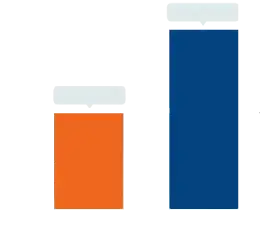
1.06 Billion
USD
1.58 Billion
2025
2033
USD
1.06 Billion
USD
1.58 Billion
2025
2033
 Forecast Period Forecast Period |
2026 –2033 |
 Market Size (Base Year) Market Size (Base Year) |
USD 1.06 Billion |
 Market Size (Forecast Year) Market Size (Forecast Year) |
USD 1.58 Billion |
 CAGR CAGR |
% |
| Major Markets Players |
|
What is the Global Aircraft De-Icing Market Size and Growth Rate?
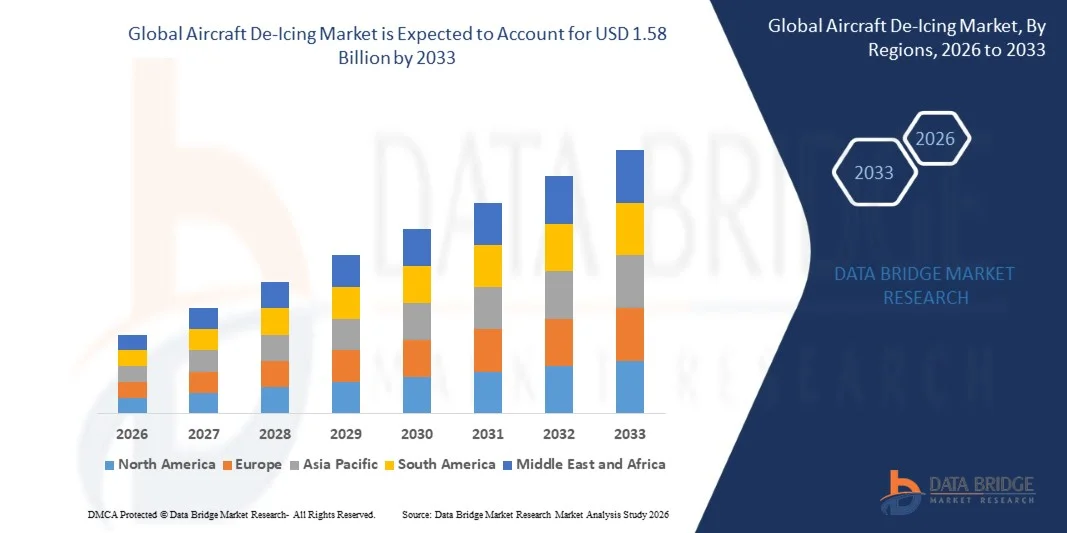
- The global aircraft de-icing market size was valued at USD 1.06 billion in 2025 and is expected to reach USD 1.58 billion by 2033, at a CAGR of 5.13% during the forecast period
- Rise in the need for passenger comfort is the major driver escalating the market growth, also rise in the safe take-off & landing operations during wintry weather conditions, increase in the technological advancements and rise in the flight delays during snow are the major factors among others driving the aircraft de-icing market growth
What are the Major Takeaways of Aircraft De-Icing Market?
- Rise in the airport ground handling equipment will further create new opportunities for the aircraft de-icing market manufacturers
- However, rise in the initial investments and increase in the regulatory issues acts as the major factor acting as restraints, and will further challenge the growth of aircraft de-icing market in the forecast period
- North America dominated the aircraft de-icing market with a 41.8% revenue share in 2025, driven by the presence of large commercial aviation networks, well-developed airport infrastructure, and frequent winter weather conditions across the U.S. and Canada
- Asia-Pacific is projected to register the fastest CAGR of 9.84% from 2026 to 2033, driven by rapid expansion of airport infrastructure, increasing air passenger traffic, and rising investments in aviation safety technologies across China, Japan, South Korea, and India
- The Type I segment dominated the market with a 44.8% share in 2025, as it is the most widely used de-icing fluid for removing ice, snow, and frost from aircraft surfaces before takeoff
Report Scope and Aircraft De-Icing Market Segmentation
|
Attributes |
Aircraft De-Icing Key Market Insights |
|
Segments Covered |
|
|
Countries Covered |
North America
Europe
Asia-Pacific
Middle East and Africa
South America
|
|
Key Market Players |
|
|
Market Opportunities |
|
|
Value Added Data Infosets |
In addition to the insights on market scenarios such as market value, growth rate, segmentation, geographical coverage, and major players, the market reports curated by the Data Bridge Market Research also include in-depth expert analysis, pricing analysis, brand share analysis, consumer survey, demography analysis, supply chain analysis, value chain analysis, raw material/consumables overview, vendor selection criteria, PESTLE Analysis, Porter Analysis, and regulatory framework. |
What is the Key Trend in the Aircraft De-Icing Market?
“Increasing Adoption of Environment-Friendly and Advanced Electro-Thermal De-Icing Technologies”
- The aircraft de-icing market is witnessing growing adoption of environment-friendly de-icing fluids, advanced electro-thermal systems, and automated de-icing equipment designed to improve aircraft safety and operational efficiency during winter operations
- Manufacturers are introducing high-performance de-icing trucks, infrared heating systems, and electric wing de-icing technologies that provide faster ice removal, lower fluid consumption, and improved environmental compliance
- Growing demand for sustainable airport operations, reduced glycol contamination, and improved turnaround times is driving the shift toward automated and eco-efficient de-icing solutions across global airports
- For instance, companies such as Collins Aerospace, Vestergaard Company, JBT Corporation, and Cryotech Deicing Technology have introduced advanced de-icing systems with improved spray technologies, precision control, and reduced environmental impact
- Increasing focus on airport operational efficiency, aviation safety regulations, and advanced winter maintenance systems is accelerating innovation in aircraft de-icing technologies
- As global air traffic expands and airports seek more efficient winter operations, Aircraft De-Icing systems will remain essential for maintaining flight safety, minimizing delays, and ensuring reliable aircraft performance in cold weather conditions
What are the Key Drivers of Aircraft De-Icing Market?
- Rising demand for safe and efficient aircraft operations during winter conditions is driving adoption of advanced de-icing equipment and technologies across airports and airline operators
- For instance, in 2025, major aviation service providers and equipment manufacturers such as Vestergaard Company, JBT Corporation, and Global Ground Support expanded their de-icing vehicle and fluid product portfolios to support improved aircraft turnaround and winter safety operations
- Growing expansion of global air travel, airport infrastructure, and airline fleets across the U.S., Europe, and Asia-Pacific is increasing the need for reliable de-icing solutions
- Advancements in infrared de-icing technology, automated spray systems, and heated aircraft surface protection technologies have improved efficiency, safety, and environmental performance
- Rising deployment of next-generation aircraft, larger commercial fleets, and increased flight frequency in cold regions is creating strong demand for high-capacity and rapid de-icing systems
- Supported by increasing investments in airport modernization, aviation safety standards, and winter operations infrastructure, the Aircraft De-Icing market is expected to experience steady long-term growth
Which Factor is Challenging the Growth of the Aircraft De-Icing Market?
- High operational and equipment costs associated with advanced de-icing vehicles, specialized fluids, and automated de-icing systems can limit adoption among smaller airports and regional airlines
- For instance, during 2024–2025, fluctuations in chemical raw material prices, environmental regulations on glycol-based fluids, and rising equipment manufacturing costs increased operational expenses for several airport service providers
- Environmental concerns regarding glycol-based de-icing fluids and their impact on surrounding ecosystems have created stricter regulatory compliance requirements
- Complex winter operations management, including storage, application, and disposal of de-icing fluids, increases operational challenges for airport authorities
- Competition from alternative ice-prevention technologies such as anti-icing coatings, heated aircraft components, and improved aircraft design can reduce dependence on conventional de-icing systems
- To address these challenges, companies are focusing on eco-friendly fluid formulations, automated de-icing equipment, and improved fluid recovery systems to enhance efficiency and expand global adoption of Aircraft De-Icing technologies
How is the Aircraft De-Icing Market Segmented?
The market is segmented on the basis of fluid type, equipment used, and application.
• By Fluid Type
On the basis of fluid type, the aircraft de-icing market is segmented into Type I, Type II, Type III, and Type IV. The Type I segment dominated the market with a 44.8% share in 2025, as it is the most widely used de-icing fluid for removing ice, snow, and frost from aircraft surfaces before takeoff. Type I fluids are primarily glycol-based and heated prior to application, allowing them to effectively remove existing ice buildup from wings, fuselage, and control surfaces. Their fast action, cost efficiency, and compatibility with various aircraft types make them the preferred choice across commercial airports and airline ground handling operations. The widespread use of Type I fluids during routine winter operations and their effectiveness in immediate ice removal contribute significantly to their market dominance.
The Type IV segment is expected to grow at the fastest CAGR from 2026 to 2033, driven by increasing demand for long-lasting anti-icing protection. These fluids provide extended holdover time and improved resistance against ice formation, making them increasingly important for modern aviation safety requirements.
• By Equipment Used
On the basis of equipment used, the aircraft de-icing market is segmented into De-icing Trucks, Sweepers, and Others. The De-icing Trucks segment dominated the market with a 58.6% share in 2025, as these vehicles remain the primary equipment used for aircraft de-icing operations at airports. De-icing trucks are equipped with elevated spray booms, heated fluid tanks, and precision spray nozzles that enable operators to remove ice and snow from aircraft surfaces efficiently. Their flexibility, mobility, and ability to service different aircraft sizes make them essential for airport winter maintenance operations. Major international airports rely heavily on advanced de-icing vehicles capable of delivering high-pressure fluid application and accurate coverage to ensure aircraft safety before departure.
The Others segment is expected to grow at the fastest CAGR from 2026 to 2033, driven by increasing adoption of advanced technologies such as infrared de-icing systems, automated de-icing platforms, and electric heating solutions designed to improve operational efficiency and reduce environmental impact.
• By Application
On the basis of application, the aircraft de-icing market is segmented into Commercial and Others. The Commercial segment dominated the market with a 69.7% share in 2025, supported by the large volume of passenger and cargo aircraft operations across global airports located in cold and temperate regions. Commercial airlines require regular de-icing procedures during winter conditions to ensure flight safety, regulatory compliance, and on-time departures. High passenger traffic, expansion of airline fleets, and increasing international flight connectivity have significantly increased demand for reliable aircraft de-icing solutions. Airport ground handling service providers and airlines heavily invest in advanced de-icing equipment and high-performance fluids to maintain operational efficiency and safety standards.
The Others segment is expected to grow at the fastest CAGR from 2026 to 2033, driven by rising demand from military aviation, private aircraft operators, and cargo aviation services operating in extreme weather conditions. Increasing defense aviation activities and growth in private jet fleets are further supporting segment expansion.
Which Region Holds the Largest Share of the Aircraft De-Icing Market?
- North America dominated the aircraft de-icing market with a 41.8% revenue share in 2025, driven by the presence of large commercial aviation networks, well-developed airport infrastructure, and frequent winter weather conditions across the U.S. and Canada. Major international airports in the region require advanced aircraft de-icing systems to ensure safe flight operations and minimize delays during severe winter conditions. High demand for efficient winter maintenance solutions, strict aviation safety regulations, and strong airline fleet operations continue to support the adoption of advanced de-icing fluids and equipment
- Leading aviation service providers and equipment manufacturers in North America are introducing advanced de-icing vehicles, automated spray systems, and environmentally friendly glycol-based fluids, improving operational efficiency and environmental compliance. Continuous investments in airport modernization and aviation safety infrastructure further strengthen the region’s market leadership
- Strong aviation safety standards, extensive airline networks, and growing investments in airport ground support equipment continue to reinforce North America’s dominant position in the global Aircraft De-Icing market
U.S. Aircraft De-Icing Market Insight
The U.S. is the largest contributor in North America due to its extensive aviation network and high number of commercial airports operating in cold-weather regions. Increasing airline traffic, expansion of cargo aviation, and strict aviation safety regulations drive the demand for reliable aircraft de-icing operations. Airports across northern states rely heavily on advanced de-icing vehicles, heated fluid systems, and automated spraying technologies to ensure aircraft safety during winter months. Continuous investment in airport infrastructure upgrades and strong presence of aviation equipment manufacturers further supports market growth across the country.
Canada Aircraft De-Icing Market Insight
Canada contributes significantly to regional growth due to its long winter seasons and heavy snowfall conditions that require frequent aircraft de-icing operations. Major Canadian airports rely on advanced de-icing trucks, high-performance fluids, and specialized winter maintenance systems to maintain efficient flight operations. Increasing investment in airport modernization, expansion of international flight connectivity, and strong adoption of environmentally friendly de-icing solutions continue to support market growth across the country.
Asia-Pacific Aircraft De-Icing Market
Asia-Pacific is projected to register the fastest CAGR of 9.84% from 2026 to 2033, driven by rapid expansion of airport infrastructure, increasing air passenger traffic, and rising investments in aviation safety technologies across China, Japan, South Korea, and India. Growth in commercial aviation fleets and increasing international flight routes are creating strong demand for efficient winter maintenance equipment and aircraft de-icing systems across major airports in the region. Rapid expansion of airline operations, growing aircraft deliveries, and increasing focus on aviation safety standards are encouraging airports to adopt advanced de-icing technologies, including automated spraying systems and eco-friendly de-icing fluids.
China Aircraft De-Icing Market Insight
China represents one of the largest aviation markets in Asia-Pacific due to rapid airport expansion and rising domestic air travel demand. Increasing construction of new airports and expansion of airline fleets are creating strong demand for aircraft ground support equipment, including de-icing systems. Government investment in aviation infrastructure and modernization of airport operations further support the adoption of advanced de-icing technologies.
Japan Aircraft De-Icing Market Insight
Japan shows steady growth supported by its well-developed aviation infrastructure and strong focus on operational efficiency and safety. Airports located in northern regions of the country frequently experience heavy snowfall, requiring efficient de-icing systems to maintain flight schedules. Continuous modernization of airport ground operations and adoption of advanced de-icing equipment contribute to steady market growth.
India Aircraft De-Icing Market Insight
India is gradually emerging as a developing market for aircraft de-icing solutions due to increasing airport expansion and rising international flight connectivity. While severe winter weather is limited to northern regions, airports operating in colder climates require specialized de-icing equipment to maintain safe aircraft operations. Government investments in aviation infrastructure and modernization initiatives are supporting gradual market growth.
South Korea Aircraft De-Icing Market Insight
South Korea contributes significantly to regional growth due to increasing international flight operations and modern airport infrastructure. Major airports require advanced de-icing solutions during winter months to maintain safe and efficient flight operations. Growing investments in airport technology, aviation safety systems, and next-generation ground support equipment continue to strengthen the adoption of aircraft de-icing solutions across the country
Which are the Top Companies in Aircraft De-Icing Market?
The aircraft de-icing industry is primarily led by well-established companies, including:
- Collins Aerospace (U.S.)
- JBT Corporation (U.S.)
- Radiant Energy Corp (U.S.)
- Kelly Aerospace Inc. (U.S.)
- UTC Aerospace Systems (U.S.)
- Cryotech Deicing Technology (U.S.)
- Infra-Red Technologies, Inc. (U.S.)
- SDI Aviation (U.S.)
- Global Ground Support LLC (U.S.)
- Contego De-icing Solutions (Canada)
- Vestergaard Company A/S (Denmark)
- Weihai Guangtai Airport Equipment Co., Ltd. (China)
What are the Recent Developments in Global Aircraft De-Icing Market?
- In August 2025, Aviator Airport Alliance, an aviation services provider operating at 15 Nordic airports and part of Avia Solutions Group, extended its partnership with Wizz Air for an additional three years to continue delivering ground handling services, including aircraft de-icing operations, at Copenhagen Airport, Gothenburg Landvetter Airport, and Malmö Airport, strengthening long-term winter operations support and improving service reliability across key Nordic aviation hubs
- In July 2025, Boeing entered an exclusive master distribution agreement with Ice Shield, a company specializing in aircraft de-icing products, to enhance operational safety and efficiency in the Business and General Aviation (BAGA) and regional aviation markets, supporting wider adoption of advanced de-icing technologies and strengthening winter flight safety solutions
- In January 2025, Pulkovo Airport in Russia began deploying domestically manufactured aircraft de-icing equipment for the first time, marking a strategic shift toward local sourcing that reduced procurement costs by approximately three to four times compared to imported systems, helping improve operational cost efficiency and strengthen regional aviation infrastructure capabilities
- In October 2024, Air Canada equipped its A320 aircraft with a pilot-controlled de-icing system featuring thin fuselage-mounted heating strips that operate through a process similar to induction technology to melt ice accumulation, enabling simultaneous ground operations such as passenger boarding and baggage loading while reducing reliance on traditional chemical sprays and improving airline operational efficiency
- In October 2024, Equipmake partnered with airport ground support vehicle manufacturer Textron Ground Support Equipment Inc. to develop an all-electric version of its airside aircraft de-icing vehicle, supporting the aviation industry’s transition toward sustainable airport ground operations and reducing emissions from winter maintenance equipment
- In September 2024, Vestergaard Company introduced the first generation of its OPTIM-ICE operator-assisted aircraft de-icing system designed for narrowbody aircraft wings and stabilizers, utilizing LIDAR radar technology to scan aircraft surfaces and guide automated nozzle movement based on predefined spray patterns, improving precision, operational speed, and overall efficiency in airport de-icing procedures
SKU-
Get online access to the report on the World's First Market Intelligence Cloud

- Interactive Data Analysis Dashboard
- Company Analysis Dashboard for high growth potential opportunities
- Research Analyst Access for customization & queries
- Competitor Analysis with Interactive dashboard
- Latest News, Updates & Trend analysis
- Harness the Power of Benchmark Analysis for Comprehensive Competitor Tracking
Research Methodology
Data collection and base year analysis are done using data collection modules with large sample sizes. The stage includes obtaining market information or related data through various sources and strategies. It includes examining and planning all the data acquired from the past in advance. It likewise envelops the examination of information inconsistencies seen across different information sources. The market data is analysed and estimated using market statistical and coherent models. Also, market share analysis and key trend analysis are the major success factors in the market report. To know more, please request an analyst call or drop down your inquiry.
The key research methodology used by DBMR research team is data triangulation which involves data mining, analysis of the impact of data variables on the market and primary (industry expert) validation. Data models include Vendor Positioning Grid, Market Time Line Analysis, Market Overview and Guide, Company Positioning Grid, Patent Analysis, Pricing Analysis, Company Market Share Analysis, Standards of Measurement, Global versus Regional and Vendor Share Analysis. To know more about the research methodology, drop in an inquiry to speak to our industry experts.
Customization Available
Data Bridge Market Research is a leader in advanced formative research. We take pride in servicing our existing and new customers with data and analysis that match and suits their goal. The report can be customized to include price trend analysis of target brands understanding the market for additional countries (ask for the list of countries), clinical trial results data, literature review, refurbished market and product base analysis. Market analysis of target competitors can be analyzed from technology-based analysis to market portfolio strategies. We can add as many competitors that you require data about in the format and data style you are looking for. Our team of analysts can also provide you data in crude raw excel files pivot tables (Fact book) or can assist you in creating presentations from the data sets available in the report.












