


Aircraft Nacelle Market Size
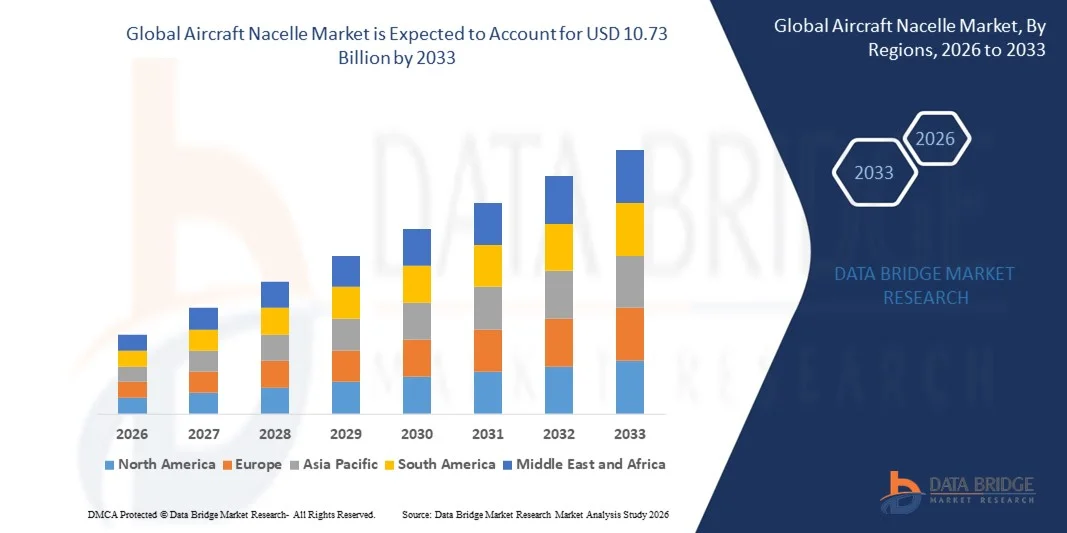
- The global aircraft nacelle market size was valued at USD 7.1 billion in 2025 and is expected to reach USD 10.73 billion by 2033, at a CAGR of 5.30% during the forecast period
- The market growth is largely fueled by the increasing demand for fuel-efficient and lightweight aircraft, driving adoption of advanced nacelle materials and aerodynamic designs that enhance engine performance and reduce operational costs
- Furthermore, rising airline and defense operator requirements for reliable, low-maintenance, and high-performance nacelle solutions are establishing advanced nacelle systems as critical components for both commercial and military aircraft. These converging factors are accelerating the development and adoption of innovative nacelle technologies, thereby significantly boosting the market’s growth
Aircraft Nacelle Market Analysis
- Aircraft nacelles, providing the protective casing for engines while improving aerodynamics, noise reduction, and thermal management, are increasingly vital components in modern commercial and military aircraft due to their impact on fuel efficiency, engine performance, and regulatory compliance
- The escalating demand for advanced nacelle systems is primarily fueled by the growth of global airline fleets, modernization of aging aircraft, rising defense procurement, and increasing adoption of lightweight materials such as composites and titanium alloys for improved performance and operational efficiency
- North America dominated the aircraft nacelle market with a share of 38.80% in 2025, due to increasing demand for fuel-efficient aircraft, fleet modernization, and adoption of next-generation materials such as composites and titanium alloys
- Asia-Pacific is expected to be the fastest growing region in the aircraft nacelle market during the forecast period due to rapid urbanization, rising air travel demand, and expansion of commercial and regional aircraft fleets in countries such as China, Japan, and India
- Turbofan segment dominated the market with a market share of 78.60% in 2025, due to its widespread use in commercial aircraft and efficiency at high speeds. Turbofan engines require advanced nacelle designs for optimal airflow, noise reduction, and thermal management, which drives demand for sophisticated nacelle solutions. The segment also benefits from the growing global fleet of commercial airliners and ongoing replacement of older engine models with high-bypass turbofan engines
Report Scope and Aircraft Nacelle Market Segmentation
|
Attributes |
Aircraft Nacelle Key Market Insights |
|
Segments Covered |
|
|
Countries Covered |
North America
Europe
Asia-Pacific
Middle East and Africa
South America
|
|
Key Market Players |
|
|
Market Opportunities |
|
|
Value Added Data Infosets |
In addition to the market insights such as market value, growth rate, market segments, geographical coverage, market players, and market scenario, the market report curated by the Data Bridge Market Research team includes in-depth expert analysis, import/export analysis, pricing analysis, production consumption analysis, and pestle analysis. |
Aircraft Nacelle Market Trends
Growing Adoption of Lightweight Composite Materials for Nacelle Structures
- A prominent trend in the aircraft nacelle market is the increasing use of lightweight composite materials such as carbon fiber reinforced polymers and thermoplastics for nacelle structures, driven by the need to reduce overall aircraft weight and improve fuel efficiency. This shift is enhancing engine performance, reducing emissions, and extending aircraft operational range
- For instance, Spirit AeroSystems and GKN Aerospace supply advanced composite nacelle components that are widely integrated into commercial aircraft programs such as Boeing 737 MAX and Airbus A320neo. These materials contribute to lower weight and improved durability while supporting engine aerodynamics
- Airlines and OEMs are increasingly prioritizing nacelle designs that optimize aerodynamic efficiency, reduce drag, and minimize maintenance requirements. This is positioning composite nacelles as critical enablers of next-generation aircraft that meet stringent environmental and performance standards
- Emerging aircraft programs focusing on regional jets and business jets are adopting composite nacelles to achieve operational cost reductions and comply with regulatory emissions limits. Such applications are driving innovation in lightweight structural solutions for smaller airframes
- Advanced manufacturing technologies, including automated fiber placement and resin transfer molding, are being applied to nacelle production. This is supporting higher precision, structural integrity, and repeatability in mass production of composite nacelles
- The market is witnessing a shift toward nacelle systems capable of supporting hybrid-electric and ultra-efficient turbofan engines. These trends are reinforcing the adoption of composite materials as fundamental enablers for sustainable and fuel-efficient aviation
Aircraft Nacelle Market Dynamics
Driver
Rising Demand for Fuel-Efficient and Low-Emission Aircraft
- The growing emphasis on fuel efficiency and emission reduction in commercial and military aviation is driving demand for advanced nacelle systems that minimize aerodynamic losses and improve engine efficiency. Airlines and OEMs seek nacelle solutions that contribute to operational cost savings and compliance with international emissions regulations
- For instance, Collins Aerospace provides nacelle systems for the Airbus A320neo that improve engine airflow and reduce fuel burn. These innovations allow airlines to achieve lower operational costs while adhering to ICAO emission standards
- The introduction of next-generation high-bypass turbofan engines requires optimized nacelle designs to achieve noise reduction and aerodynamic efficiency. This is increasing demand for nacelle solutions that integrate acoustic liners, thrust reversers, and lightweight materials
- Environmental regulations and carbon reduction initiatives across Europe and the U.S. are motivating aircraft manufacturers to adopt advanced nacelles that contribute to lower CO2 emissions. This is influencing procurement strategies and design priorities in the aerospace sector
- Continuous R&D in aerodynamics, materials, and noise reduction technologies is driving innovations in nacelle design. These advancements are reinforcing the market’s growth trajectory as aircraft manufacturers focus on sustainable, fuel-efficient solutions
Restraint/Challenge
High Manufacturing and Maintenance Costs of Advanced Nacelle Systems
- The aircraft nacelle market faces challenges due to the high costs associated with manufacturing advanced nacelle structures, which involve expensive composite materials, precise fabrication processes, and extensive testing to ensure safety and performance standards
- For instance, Safran Nacelles invests heavily in composite layup, assembly, and testing processes for commercial aircraft nacelles, leading to significant capital and operational expenditures
- Maintenance and inspection of composite nacelles require specialized equipment and skilled personnel, which increases lifecycle costs for airlines. These factors can influence fleet management strategies and delay adoption of newer nacelle technologies
- The integration of complex systems such as thrust reversers, acoustic liners, and anti-icing components further increases production and maintenance complexity. This adds to supply chain and operational challenges for nacelle manufacturers
- Limited scalability of advanced nacelle production and dependence on specific raw materials can affect cost efficiency and lead times. This continues to pose a barrier for widespread adoption despite the operational benefits offered by lightweight and fuel-efficient nacelle systems
Aircraft Nacelle Market Scope
The market is segmented on the basis of type, engine type, application, and end user.
- By Type
On the basis of type, the Aircraft Nacelle market is segmented into composites, stainless steel, aluminum alloys, titanium alloys, and nickel chromium. The composites segment dominated the market with the largest market revenue share in 2025, driven by their superior strength-to-weight ratio, corrosion resistance, and fuel efficiency benefits. Aircraft manufacturers favor composite nacelles as they contribute to overall weight reduction, enhancing aircraft performance and reducing operational costs. The segment also benefits from increasing adoption in next-generation aircraft designs where lightweight and durable materials are prioritized. Composites offer design flexibility, enabling integration of advanced aerodynamic features and noise reduction systems, further strengthening their market position.
The aluminum alloys segment is anticipated to witness the fastest growth rate from 2026 to 2033, fueled by their cost-effectiveness, ease of fabrication, and proven performance in various nacelle components. Aluminum alloys are particularly attractive for regional and business jets due to their balance of strength, weight, and corrosion resistance. OEMs increasingly adopt aluminum alloys for secondary structures and nacelle components where composites may not be necessary, allowing for optimized manufacturing and maintenance processes.
- By Engine Type
On the basis of engine type, the Aircraft Nacelle market is segmented into gas turbine, turboprop, and turbofan. The turbofan segment dominated the market with the largest revenue share of 78.60% in 2025, driven by its widespread use in commercial aircraft and efficiency at high speeds. Turbofan engines require advanced nacelle designs for optimal airflow, noise reduction, and thermal management, which drives demand for sophisticated nacelle solutions. The segment also benefits from the growing global fleet of commercial airliners and ongoing replacement of older engine models with high-bypass turbofan engines. Turbofan nacelles integrate advanced materials and technologies, contributing to reduced fuel consumption and regulatory compliance with noise standards.
The turboprop segment is expected to witness the fastest CAGR from 2026 to 2033, fueled by its growing adoption in regional and short-haul aircraft. Turboprop nacelles are lighter and simpler, offering cost and fuel efficiency advantages for smaller aircraft. Manufacturers increasingly choose turboprop engines for new regional fleet orders to address expanding domestic air travel markets, particularly in emerging economies.
- By Application
On the basis of application, the Aircraft Nacelle market is segmented into regional jet, business jet, and commercial aircraft. The commercial aircraft segment dominated the market with the largest revenue share in 2025, driven by the increasing global demand for air travel and expansion of airline fleets. Commercial aircraft require high-performance nacelles that improve aerodynamics, fuel efficiency, and noise reduction, making them a key focus area for OEMs. Large-scale production of commercial aircraft further supports the adoption of advanced nacelle materials and technologies. Airlines also prioritize nacelle upgrades for fleet modernization, reinforcing the segment’s dominance.
The regional jet segment is anticipated to witness the fastest growth rate from 2026 to 2033, fueled by rising air connectivity and demand for short-haul flights in emerging regions. Regional jets benefit from lighter, cost-effective nacelle designs that support operational efficiency while meeting regulatory requirements. Manufacturers increasingly focus on regional jet nacelles for fuel savings, noise reduction, and simplified maintenance.
- By End User
On the basis of end user, the Aircraft Nacelle market is segmented into commercial and military. The commercial segment dominated the market with the largest revenue share in 2025, driven by the growth of global airline operations and increasing fleet modernization initiatives. Commercial operators demand high-performance nacelles that contribute to fuel efficiency, noise reduction, and compliance with environmental regulations. Continuous investments by airlines in new aircraft and upgrades of existing fleets further support the adoption of advanced nacelle solutions.
The military segment is expected to witness the fastest growth rate from 2026 to 2033, fueled by rising defense budgets and modernization of air force fleets. Military aircraft nacelles require high durability, stealth, and performance under extreme conditions, driving demand for advanced materials and manufacturing technologies. Growth in tactical and multi-role aircraft programs also supports increased nacelle production for military applications.
Aircraft Nacelle Market Regional Analysis
- North America dominated the aircraft nacelle market with the largest revenue share of 38.80% in 2025, driven by increasing demand for fuel-efficient aircraft, fleet modernization, and adoption of next-generation materials such as composites and titanium alloys
- Aircraft manufacturers in the region prioritize lightweight, durable nacelle designs that enhance aircraft performance, reduce operational costs, and comply with stringent environmental regulations
- This widespread adoption is further supported by the presence of leading aerospace OEMs, high R&D investments, and robust defense and commercial aviation sectors, establishing advanced nacelle solutions as a preferred choice in North America
U.S. Aircraft Nacelle Market Insight
The U.S. Aircraft Nacelle market captured the largest revenue share in North America in 2025, fueled by extensive production of commercial airliners, ongoing fleet modernization, and expansion of military aircraft programs. Manufacturers increasingly focus on integrating advanced materials and aerodynamic designs to improve fuel efficiency and reduce noise. The presence of major OEMs such as Boeing and GE Aerospace, along with strong demand for both commercial and military aircraft, continues to drive market growth. In addition, government regulations promoting environmental sustainability and emission reductions further support the adoption of innovative nacelle solutions.
Europe Aircraft Nacelle Market Insight
The Europe Aircraft Nacelle market is projected to expand at a substantial CAGR throughout the forecast period, driven by increasing adoption of fuel-efficient and lightweight nacelles, rising commercial air travel, and modernization of airline fleets. Stringent aviation regulations and growing defense procurement initiatives are fostering demand for advanced nacelle designs. European manufacturers focus on composites and titanium alloys to meet performance and sustainability requirements. The region also benefits from a strong aerospace manufacturing ecosystem that supports both OEMs and Tier-1 suppliers.
U.K. Aircraft Nacelle Market Insight
The U.K. Aircraft Nacelle market is anticipated to grow at a noteworthy CAGR during the forecast period, supported by investments in commercial and military aircraft programs. The country’s aerospace sector emphasizes lightweight, durable materials and innovative nacelle designs for fuel efficiency and noise reduction. The presence of key suppliers, coupled with advanced R&D capabilities, encourages the adoption of next-generation nacelle solutions. In addition, U.K.-based aerospace initiatives for sustainability and emissions reduction further promote market growth.
Germany Aircraft Nacelle Market Insight
The Germany Aircraft Nacelle market is expected to expand at a considerable CAGR during the forecast period, driven by the country’s focus on advanced aerospace manufacturing, innovation, and environmental compliance. German OEMs prioritize nacelles that reduce weight and enhance performance, supporting both commercial and defense aircraft programs. Integration of high-performance composites and alloys is increasingly prevalent, aligning with local demands for durable, energy-efficient solutions. Germany’s strong infrastructure and skilled workforce further contribute to market development.
Asia-Pacific Aircraft Nacelle Market Insight
The Asia-Pacific Aircraft Nacelle market is poised to grow at the fastest CAGR during the forecast period, driven by rapid urbanization, rising air travel demand, and expansion of commercial and regional aircraft fleets in countries such as China, Japan, and India. The region’s growing aerospace manufacturing capabilities, supported by government initiatives and cost advantages, are promoting adoption of advanced nacelle solutions. Increasing focus on fuel efficiency, noise reduction, and next-generation materials further boosts market growth.
Japan Aircraft Nacelle Market Insight
The Japan Aircraft Nacelle market is gaining momentum due to the country’s advanced aerospace technologies, high-quality manufacturing standards, and demand for efficient and reliable aircraft components. Japanese OEMs emphasize lightweight nacelles for commercial and business jets to enhance fuel efficiency and performance. Integration with advanced propulsion systems and focus on noise reduction contribute to market expansion. In addition, government support for technological innovation and sustainable aviation practices drives adoption of modern nacelle solutions.
China Aircraft Nacelle Market Insight
The China Aircraft Nacelle market accounted for the largest revenue share in Asia-Pacific in 2025, attributed to rapid growth of the domestic commercial aviation sector and increasing defense aircraft programs. China is emerging as a hub for aerospace manufacturing and advanced nacelle production, driven by government initiatives, expanding airline fleets, and adoption of lightweight, durable materials. Rising investments in next-generation aircraft and local manufacturing capabilities support high market growth. The availability of cost-effective nacelle solutions and strong domestic OEMs further propels the market in China.
Aircraft Nacelle Market Share
The aircraft nacelle industry is primarily led by well-established companies, including:
- Safran (France)
- Collins Aerospace (U.S.)
- Bombardier (Canada)
- IBM Corporation (U.S.)
- Samson Motors, Inc. (U.S.)
- Melrose Industries PLC (U.K.)
- Triumph Group (U.S.)
- The NORDAM Group LLC (U.S.)
- Raytheon Technologies Corporation (U.S.)
- Spirit AeroSystems, Inc. (U.S.)
- Woodward, Inc. (U.S.)
- GENERAL ELECTRIC (U.S.)
Latest Developments in Global Aircraft Nacelle Market
- In January 2026, LOT Polish Airlines expanded its nacelle maintenance, repair, and overhaul (MRO) agreement with ST Engineering to cover its Boeing 787 Dreamliner fleet, incorporating predictive maintenance strategies into the nacelle lifecycle. This expansion strengthens ST Engineering’s position as a long-term nacelle support provider and also enhances operational reliability by reducing unscheduled downtime and extending component life. By implementing advanced predictive maintenance technologies, the agreement allows LOT Polish Airlines to optimize maintenance schedules, lower overall operational costs, and improve fleet availability for long-haul routes, reflecting a broader industry trend toward lifecycle-based nacelle servicing
- In December 2025, AAR CORP. and Air France Industries KLM Engineering & Maintenance (AFI KLM E&M) completed the formation of their joint venture, xCelle Asia, in Thailand, significantly expanding nacelle MRO capabilities in the Asia-Pacific region. The venture provides comprehensive overhaul, repair, and rotable support for next-generation aircraft nacelles, catering to both commercial and military operators. This expansion strengthens the presence of high-quality, localized maintenance solutions in APAC, addressing the growing demand for timely, cost-effective support amid rapid fleet growth. It also enhances operational efficiency for airlines in the region, helping reduce turnaround times and ensure compliance with global aviation standards
- In March 2025, AAR CORP. entered into a multi-year agreement with Cebu Pacific Air to provide nacelle MRO services for the airline’s A320 fleet equipped with CFM56-5B engines. This deal reinforces AAR CORP.’s strategic presence in Asia’s commercial aviation support market and highlights the increasing demand for OEM-standard nacelle maintenance. The partnership ensures enhanced fleet reliability, streamlined maintenance operations, and reduced aircraft downtime, allowing Cebu Pacific Air to maintain consistent operational performance while optimizing maintenance costs and lifecycle management of critical engine components
- In November 2024, GKN Aerospace delivered the first two C-27J nacelles to Leonardo Aircraft, demonstrating the restoration of its supply chain and production capabilities. This achievement signals renewed strength in military nacelle manufacturing and reinforces GKN Aerospace’s ability to deliver complex, high-performance components on schedule. By restoring production capacity and ensuring supply chain reliability, the company supports ongoing defense programs, strengthens relationships with key OEMs, and positions itself to meet increasing demand for durable, lightweight, and aerodynamically optimized nacelle solutions
- In April 2023, Spirit AeroSystems signed an exclusive cooperation agreement with ST Engineering’s Commercial Aerospace business to provide aircraft engine nacelle MRO solutions across Middle Eastern countries. This strategic partnership expands regional maintenance coverage and brings advanced technical expertise to emerging aviation markets in Qatar, UAE, Saudi Arabia, Jordan, and Kuwait. By offering high-quality support for both commercial and military aircraft, the collaboration enhances operational efficiency, reduces unscheduled maintenance, and ensures fleet reliability, addressing the growing need for localized, dependable nacelle services in high-growth Middle Eastern aviation markets

- Interactive Data Analysis Dashboard
- Company Analysis Dashboard for high growth potential opportunities
- Research Analyst Access for customization & queries
- Competitor Analysis with Interactive dashboard
- Latest News, Updates & Trend analysis
- Harness the Power of Benchmark Analysis for Comprehensive Competitor Tracking
Data collection and base year analysis are done using data collection modules with large sample sizes. The stage includes obtaining market information or related data through various sources and strategies. It includes examining and planning all the data acquired from the past in advance. It likewise envelops the examination of information inconsistencies seen across different information sources. The market data is analysed and estimated using market statistical and coherent models. Also, market share analysis and key trend analysis are the major success factors in the market report. To know more, please request an analyst call or drop down your inquiry.
The key research methodology used by DBMR research team is data triangulation which involves data mining, analysis of the impact of data variables on the market and primary (industry expert) validation. Data models include Vendor Positioning Grid, Market Time Line Analysis, Market Overview and Guide, Company Positioning Grid, Patent Analysis, Pricing Analysis, Company Market Share Analysis, Standards of Measurement, Global versus Regional and Vendor Share Analysis. To know more about the research methodology, drop in an inquiry to speak to our industry experts.
Data Bridge Market Research is a leader in advanced formative research. We take pride in servicing our existing and new customers with data and analysis that match and suits their goal. The report can be customized to include price trend analysis of target brands understanding the market for additional countries (ask for the list of countries), clinical trial results data, literature review, refurbished market and product base analysis. Market analysis of target competitors can be analyzed from technology-based analysis to market portfolio strategies. We can add as many competitors that you require data about in the format and data style you are looking for. Our team of analysts can also provide you data in crude raw excel files pivot tables (Fact book) or can assist you in creating presentations from the data sets available in the report.













