


Aircraft Pushback Tugs Market Size
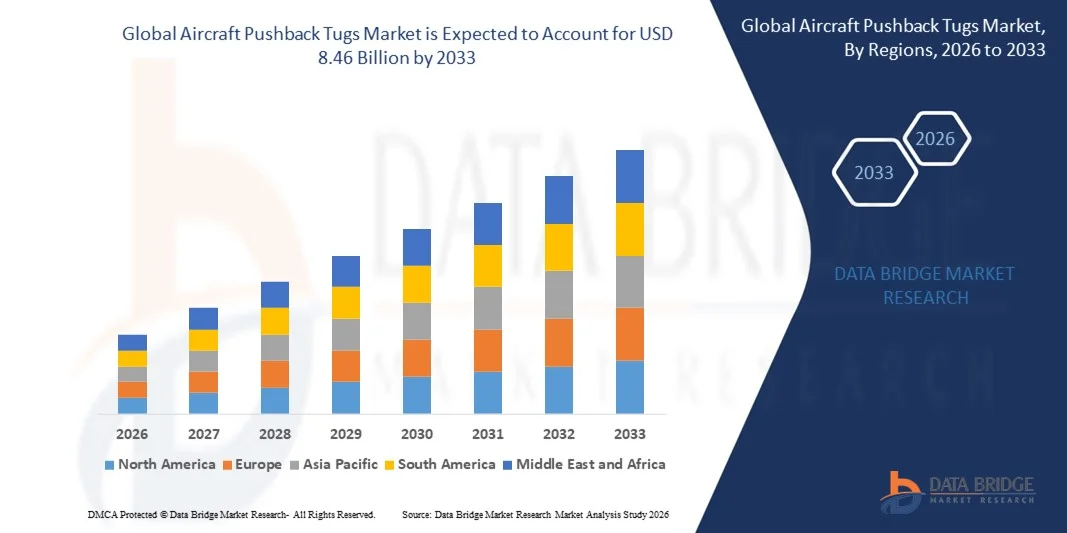
- The global aircraft pushback tugs market size was valued at USD 5.51 billion in 2025 and is expected to reach USD 8.46 billion by 2033, at a CAGR of 5.50% during the forecast period
- The market growth is largely fueled by increasing air traffic, expanding airport infrastructure, and rising investments in modern ground handling equipment, which are driving the adoption of advanced aircraft pushback tugs across civil and military aviation sectors
- Furthermore, the growing focus on operational efficiency, safety, and sustainability is establishing electric and remotely operated pushback tugs as essential solutions for airports and ground handling service providers. These converging factors are accelerating the modernization of airport ground support fleets, thereby significantly boosting the industry’s growth
Aircraft Pushback Tugs Market Analysis
- Aircraft pushback tugs, designed to move aircraft safely and efficiently on the ground, are becoming critical components of modern airport operations in both civil and military settings due to their ability to reduce turnaround times, enhance safety, and support automated ground handling processes
- The escalating demand for pushback tugs is primarily fueled by airport expansion projects, the adoption of electric and hybrid models, and the integration of AI-driven operational analytics. In addition, the need to lower carbon emissions and optimize ground operations is further driving market adoption and technological innovation in pushback tug solutions
- North America dominated the aircraft pushback tugs market with a share of over 35%in 2025, due to the increasing air traffic volume, expansion of airport infrastructure, and growing emphasis on ground operation efficiency
- Asia-Pacific is expected to be the fastest growing region in the aircraft pushback tugs market during the forecast period due to increasing air traffic, airport expansion projects, and rising demand for efficient ground handling solutions in countries such as China, Japan, and India
- Towbarless pushback tugs segment dominated the market with a market share of 58.5% in 2025, due to their efficiency in handling different aircraft sizes and eliminating the need for a towbar, which reduces turnaround time on the apron. Airlines and ground handling service providers prefer towbarless tugs for their enhanced maneuverability, improved safety, and lower maintenance requirements. Their capability to handle wide-body and narrow-body aircraft with minimal ground crew involvement further strengthens their adoption across busy airports
Report Scope and Aircraft Pushback Tugs Market Segmentation
|
Attributes |
Aircraft Pushback Tugs Key Market Insights |
|
Segments Covered |
|
|
Countries Covered |
North America
Europe
Asia-Pacific
Middle East and Africa
South America
|
|
Key Market Players |
|
|
Market Opportunities |
|
|
Value Added Data Infosets |
In addition to the market insights such as market value, growth rate, market segments, geographical coverage, market players, and market scenario, the market report curated by the Data Bridge Market Research team includes in-depth expert analysis, import/export analysis, pricing analysis, production consumption analysis, and pestle analysis. |
Aircraft Pushback Tugs Market Trends
Rising Adoption of Electric and Hybrid Pushback Tugs
- A significant trend in the aircraft pushback tugs market is the increasing adoption of electric and hybrid models across civil and military aviation, driven by the growing focus on sustainability, operational efficiency, and reduced emissions at airports. The shift toward electric solutions is encouraging airports to modernize their ground handling fleets while complying with environmental regulations
- For instance, companies such as Textron GSE and Doll Fahrzeugbau are supplying advanced electric pushback tugs with improved power efficiency and operational reliability, enabling airports to lower fuel consumption and reduce maintenance costs. Such developments are positioning electric and hybrid tugs as key components for modern, eco-friendly airport operations
- The integration of AI and automation in pushback tugs is also gaining momentum, providing predictive maintenance, optimized aircraft positioning, and enhanced safety for ground personnel. These features support more efficient turnaround times and operational accuracy in busy airport environments
- The rising trend toward hybrid and electric solutions is complemented by increased adoption in emerging markets, where airports are investing in modern ground support equipment to meet growing air traffic demands. This expansion is accelerating the overall uptake of advanced pushback tugs
- Airports and ground handling operators are increasingly valuing tugs with energy-efficient technologies that reduce environmental impact while maintaining high performance, particularly for large aircraft and high-frequency operations
- The market is witnessing strong growth in advanced, data-enabled pushback solutions that integrate with airport fleet management systems, reinforcing the transition toward automated, intelligent, and sustainable ground support operations
Aircraft Pushback Tugs Market Dynamics
Driver
Increasing Demand for Efficient and Automated Ground Handling Solutions
- The growing need to optimize aircraft turnaround times and improve operational efficiency is driving the adoption of advanced pushback tugs that offer automated and remotely controlled operations. Airports are prioritizing solutions that reduce manual labor, minimize human error, and enhance safety during aircraft movement
- For instance, JBT and MULAG are supplying AI-enabled and remotely operated pushback tugs that allow precise control and predictive maintenance, supporting efficient operations even in high-traffic airports. Such solutions enable operators to streamline ground handling processes, reduce delays, and optimize fleet utilization
- Airports are investing in pushback tugs with improved energy efficiency, load handling, and multi-aircraft compatibility, reflecting the focus on performance and operational flexibility
- The adoption of modern pushback tugs is reinforced by airport modernization initiatives, where both civil and military operators seek to enhance safety, sustainability, and overall ground operation productivity.
- The increasing automation and integration of pushback tugs with fleet management ystems and airport operations platforms are boosting the efficiency, reliability, and scalability of ground handling operations, making advanced tugs indispensable for modern airports
Restraint/Challenge
High Initial Investment and Maintenance Costs
- The aircraft pushback tugs market faces challenges due to the high capital expenditure required for purchasing electric, hybrid, or advanced remotely operated tugs, which can strain budgets, particularly for smaller airports. Maintenance of high-tech tugs also demands specialized skills, technical infrastructure, and consistent investment, adding to operational costs
- For instance, operators deploying advanced AI-enabled or hybrid pushback tugs must invest in specialized training, charging infrastructure, and technical support to ensure optimal performance. These requirements increase the total cost of ownership and can slow adoption in cost-sensitive regions
- Manufacturers face the challenge of balancing innovation with affordability, as integrating AI, electric drivetrains, and enhanced safety features raises production complexity
- Supply chain dependencies on specialized components for electric or hybrid tugs further contribute to elevated costs and potential delays in delivery
- Overall, the combination of high upfront investment, ongoing maintenance requirements, and the need for skilled operators poses a restraint on widespread adoption, particularly among smaller or developing airports seeking cost-effective solutions
Aircraft Pushback Tugs Market Scope
The market is segmented on the basis of product type, power source, mode of operation, sales channel, and application.
- By Product Type
On the basis of product type, the aircraft pushback tugs market is segmented into conventional pushback tugs and towbarless pushback tugs. The towbarless pushback tugs segment dominated the market with the largest market revenue share of 58.5% in 2025, driven by their efficiency in handling different aircraft sizes and eliminating the need for a towbar, which reduces turnaround time on the apron. Airlines and ground handling service providers prefer towbarless tugs for their enhanced maneuverability, improved safety, and lower maintenance requirements. Their capability to handle wide-body and narrow-body aircraft with minimal ground crew involvement further strengthens their adoption across busy airports.
The conventional pushback tugs segment is anticipated to witness the fastest growth rate from 2026 to 2033, fueled by ongoing investments in regions with smaller airports where budget constraints favor conventional systems. These tugs are valued for their robustness, cost-effectiveness, and familiarity among ground staff, allowing airports to maintain operations without significant training. Manufacturers are increasingly offering upgraded conventional tugs with better power efficiency and ergonomic features, which contributes to rising demand in regional and developing markets.
- By Power Source
On the basis of power source, the aircraft pushback tugs market is segmented into electric and fuel-powered tugs. The electric segment held the largest market revenue share in 2025, driven by increasing focus on sustainable airport operations and government regulations targeting carbon emission reductions. Electric pushback tugs offer advantages such as low operational costs, minimal noise levels, and reduced maintenance requirements, making them ideal for both domestic and international airports. Operators are increasingly adopting electric tugs to align with environmental targets and improve ground operation efficiency.
The fuel-powered segment is expected to witness the fastest CAGR from 2026 to 2033, driven by their high torque output and suitability for extreme weather conditions where electric tugs may face limitations. Fuel-powered tugs remain essential in airports with limited charging infrastructure and high aircraft traffic, ensuring continuous operation without downtime. Manufacturers are innovating fuel-efficient models to reduce emissions and operating costs, supporting their growing adoption in both civil and military aviation sectors.
- By Mode of Operation
On the basis of mode of operation, the aircraft pushback tugs market is segmented into manually operated and remotely operated tugs. The remotely operated segment dominated the market with the largest market revenue share in 2025, driven by increasing automation in airport ground handling operations and the growing emphasis on safety. Remotely operated tugs allow operators to control pushback operations from a safe distance, reducing the risk of ground accidents and ensuring precision during aircraft positioning. Integration with airport fleet management systems further enhances operational efficiency and reduces turnaround times for busy airports.
The manually operated segment is anticipated to witness the fastest growth rate from 2026 to 2033, fueled by its reliability and cost-effectiveness in smaller airports and military bases. Manually operated tugs are preferred in regions where advanced remote control infrastructure is limited, offering simplicity in training and operation. Manufacturers are enhancing these tugs with ergonomic designs and improved maneuverability, which supports their adoption in developing markets and tactical aviation applications.
- By Sales Channel
On the basis of sales channel, the aircraft pushback tugs market is segmented into aftermarkets and original equipment manufacturers (OEMs). The OEM segment held the largest market revenue share in 2025, driven by airlines’ preference for procuring tugs directly from aircraft and ground support vehicle manufacturers to ensure compatibility and reliability. OEM-supplied tugs often come with integrated warranty and service packages, providing operators with long-term operational security and minimized downtime. Collaborations between OEMs and airports also allow customization according to fleet requirements and apron layouts.
The aftermarket segment is expected to witness the fastest CAGR from 2026 to 2033, fueled by increasing refurbishment, replacement, and upgrade demand for existing pushback tug fleets. Aftermarket services provide cost-effective alternatives for operators who wish to extend the life of their tugs without investing in new units. Manufacturers and service providers are expanding their aftermarket offerings, including retrofitting and electric conversion kits, which supports growth in mature markets.
- By Application
On the basis of application, the aircraft pushback tugs market is segmented into military aviation and civil aviation. The civil aviation segment dominated the market with the largest market revenue share in 2025, driven by the increasing air traffic volume and airport expansion projects globally. Civil aviation operators prioritize high-capacity, efficient tugs to manage aircraft movements on busy aprons while minimizing delays and operational risks. Investments in advanced ground support equipment and integration with airport operations systems further enhance the adoption of pushback tugs in commercial aviation.
The military aviation segment is anticipated to witness the fastest growth rate from 2026 to 2033, fueled by modernization initiatives and increased defense spending in emerging economies. Military bases require specialized tugs capable of handling diverse aircraft types under tactical conditions, which supports the demand for innovative pushback solutions. Manufacturers are developing ruggedized, multi-terrain tugs with high reliability to cater to military applications, contributing to the rapid growth of this segment.
Aircraft Pushback Tugs Market Regional Analysis
- North America dominated the aircraft pushback tugs market with the largest revenue share of over 35% in 2025, driven by the increasing air traffic volume, expansion of airport infrastructure, and growing emphasis on ground operation efficiency
- Airlines and ground handling service providers in the region are investing in advanced pushback tugs to reduce turnaround times and enhance safety during aircraft movement
- The widespread adoption is further supported by technologically advanced airports, high operational budgets, and the preference for efficient, automated ground support equipment, establishing pushback tugs as a critical solution for both civil and military aviation
U.S. Aircraft Pushback Tugs Market Insight
The U.S. aircraft pushback tugs market captured the largest revenue share in North America in 2025, fueled by modernization initiatives in major airports and the growing adoption of electric and remotely operated tugs. Airlines are increasingly prioritizing investments in high-capacity and efficient tugs to streamline apron operations and reduce operational costs. The rising trend of green airport initiatives and the integration of pushback tugs with fleet management and automated ground handling systems further propels market growth. Moreover, the presence of leading pushback tug manufacturers and strong aftermarket support significantly contributes to the U.S. market expansion.
Europe Aircraft Pushback Tugs Market Insight
The Europe aircraft pushback tugs market is projected to expand at a substantial CAGR throughout the forecast period, driven by the increasing air traffic, airport modernization projects, and regulatory focus on operational safety. European airports are adopting advanced pushback tugs, including electric and towbarless models, to enhance efficiency and reduce turnaround times. The growing emphasis on sustainable operations and low-emission ground support equipment is fostering market growth. The region witnesses notable adoption across civil aviation hubs and military airbases, supported by ongoing technological upgrades and infrastructure development.
U.K. Aircraft Pushback Tugs Market Insight
The U.K. aircraft pushback tugs market is anticipated to grow at a noteworthy CAGR during the forecast period, fueled by modernization of airport ground support fleets and increasing air traffic. Airports and ground handling operators are emphasizing the use of high-efficiency tugs for both civil and defense applications. The adoption of electric and remotely operated pushback tugs is rising due to their operational safety, energy efficiency, and reduced labor requirements. Furthermore, strong government focus on airport infrastructure and growing demand for technologically advanced ground support solutions are expected to continue driving market growth.
Germany Aircraft Pushback Tugs Market Insight
The Germany aircraft pushback tugs market is expected to expand at a considerable CAGR during the forecast period, driven by the country’s focus on advanced airport operations and safety regulations. Germany’s well-developed airport infrastructure and investment in eco-friendly ground support equipment promote the adoption of electric and towbarless tugs. Civil and military aviation sectors are increasingly utilizing modern pushback solutions to optimize turnaround times and minimize operational risks. Integration with automated fleet management systems and the preference for high-reliability tugs further support market growth in the region.
Asia-Pacific Aircraft Pushback Tugs Market Insight
The Asia-Pacific aircraft pushback tugs market is poised to grow at the fastest CAGR during the forecast period of 2026 to 2033, driven by increasing air traffic, airport expansion projects, and rising demand for efficient ground handling solutions in countries such as China, Japan, and India. The region’s rapid urbanization, growing aviation infrastructure, and government initiatives promoting modern airport operations are driving pushback tug adoption. Moreover, Asia-Pacific is emerging as a manufacturing hub for pushback tugs, improving affordability and availability of advanced models, which is expanding their adoption across both civil and military applications.
Japan Aircraft Pushback Tugs Market Insight
The Japan aircraft pushback tugs market is gaining momentum due to the country’s focus on automation, safety, and operational efficiency in airport ground handling. Japanese airports are adopting electric and remotely operated tugs to improve turnaround times and reduce labor dependency. The integration of pushback tugs with airport management systems and the demand for high-reliability equipment for both civil and military aviation are fueling growth. In addition, Japan’s advanced technological landscape and aging workforce are increasing the need for ergonomic and automated pushback solutions.
China Aircraft Pushback Tugs Market Insight
The China aircraft pushback tugs market accounted for the largest market revenue share in Asia-Pacific in 2025, attributed to the rapid expansion of airport infrastructure, rising air traffic, and strong domestic manufacturing capabilities. Chinese airlines and ground handling service providers are increasingly investing in electric, towbarless, and remotely operated tugs to enhance operational efficiency and reduce turnaround times. The government’s focus on smart airports and sustainable ground support equipment further supports market growth. Affordable domestic options and extensive aftermarket support are accelerating the adoption of advanced pushback tugs across civil and military aviation sectors in China.
Aircraft Pushback Tugs Market Share
The aircraft pushback tugs industry is primarily led by well-established companies, including:
- MOTOTOK International GmbH (Germany)
- Aero Specialties, Inc. (U.S.)
- Goldhofer (Germany)
- Eagle Tugs (U.S.)
- Charlatte America (U.S.)
- Wollard International (U.S.)
- Victory Ground Support Equipment (U.S.)
- Tronair (U.S.)
- Nepean (U.K.)
- LEKTRO, Inc. (U.S.)
- TLD (France)
- Guangtai (China)
- MULAG Fahrzeugwerk (Germany)
- TowFLEXX Inc. (U.S.)
- VOLK Fahrzeugbau GmbH (Germany)
- Textron Ground Support Equipment Inc. (U.S.)
- JBT (U.S.)
- TREPEL Airport Equipment GmbH (Germany)
- Airtug (U.S.)
- Kalmar Motor AB (Sweden)
Latest Developments in Global Aircraft Pushback Tugs Market
- In July 2025, MULAG entered a strategic partnership with a major Asian airport operator to supply pushback tugs equipped with AI-driven operational analytics. This development is expected to revolutionize airport ground handling by enabling data-driven decision-making, predictive maintenance, and enhanced operational efficiency. Airlines and ground service providers can optimize turnaround times, reduce equipment downtime, and improve safety, setting a new standard for smart ground support solutions in the region
- In June 2025, Doll Fahrzeugbau unveiled an expanded electric pushback tug lineup featuring improved power output, reduced noise, and advanced on-board diagnostics. This innovation strengthens the market shift toward electric and eco-friendly tugs, allowing airports to reduce carbon emissions, lower operational costs, and maintain high performance standards. The enhanced capabilities also attract operators looking for reliable and sustainable ground handling solutions in both civil and military aviation
- In May 2025, Textron GSE launched a new battery-powered pushback tug as part of its electrification strategy for ground support equipment. The introduction of this tug accelerates the adoption of electric solutions, helping airports meet environmental targets while ensuring efficient aircraft handling. The product’s reliability, low maintenance requirements, and energy efficiency make it an attractive option for high-traffic airports seeking to modernize their ground support fleets
- In May 2025, JBT Corporation completed the acquisition of a leading European ground support equipment manufacturer to expand its global presence in the pushback tug market. This move strengthens JBT’s portfolio, enhances its ability to supply diversified tug solutions, and increases its competitive advantage in key regions. It also signals industry consolidation, enabling the company to leverage advanced technologies and economies of scale to meet growing demand
- In May 2025, TUG Technologies Corporation launched a new line of hybrid diesel-electric pushback tugs. This development addresses the need for sustainable yet high-performance ground handling equipment, offering operators flexibility in energy management while maintaining operational efficiency. The hybrid tugs allow airports and airlines to reduce fuel consumption, lower emissions, and navigate diverse operational environments, thereby supporting the ongoing trend toward greener airport operations

- Interactive Data Analysis Dashboard
- Company Analysis Dashboard for high growth potential opportunities
- Research Analyst Access for customization & queries
- Competitor Analysis with Interactive dashboard
- Latest News, Updates & Trend analysis
- Harness the Power of Benchmark Analysis for Comprehensive Competitor Tracking
Data collection and base year analysis are done using data collection modules with large sample sizes. The stage includes obtaining market information or related data through various sources and strategies. It includes examining and planning all the data acquired from the past in advance. It likewise envelops the examination of information inconsistencies seen across different information sources. The market data is analysed and estimated using market statistical and coherent models. Also, market share analysis and key trend analysis are the major success factors in the market report. To know more, please request an analyst call or drop down your inquiry.
The key research methodology used by DBMR research team is data triangulation which involves data mining, analysis of the impact of data variables on the market and primary (industry expert) validation. Data models include Vendor Positioning Grid, Market Time Line Analysis, Market Overview and Guide, Company Positioning Grid, Patent Analysis, Pricing Analysis, Company Market Share Analysis, Standards of Measurement, Global versus Regional and Vendor Share Analysis. To know more about the research methodology, drop in an inquiry to speak to our industry experts.
Data Bridge Market Research is a leader in advanced formative research. We take pride in servicing our existing and new customers with data and analysis that match and suits their goal. The report can be customized to include price trend analysis of target brands understanding the market for additional countries (ask for the list of countries), clinical trial results data, literature review, refurbished market and product base analysis. Market analysis of target competitors can be analyzed from technology-based analysis to market portfolio strategies. We can add as many competitors that you require data about in the format and data style you are looking for. Our team of analysts can also provide you data in crude raw excel files pivot tables (Fact book) or can assist you in creating presentations from the data sets available in the report.













