


What is the Global Aircraft Survivability Equipment Market Size and Growth Rate?
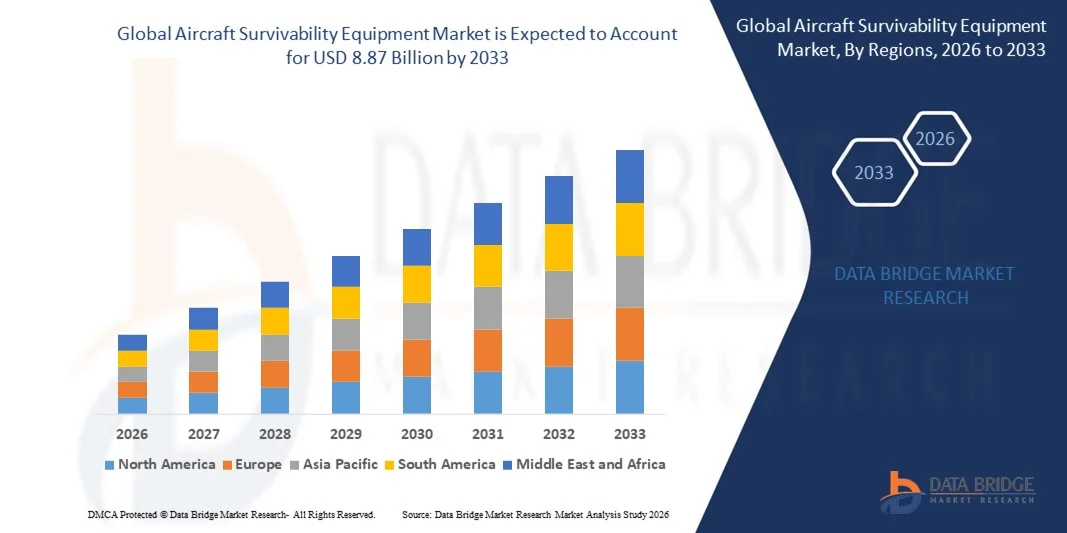
- As per Data Bridge Market Research Analysis the global aircraft survivability equipment market size was valued at USD 5.91 billion in 2025 and is expected to reach USD 8.87 billion by 2033, at a CAGR of 5.20% during the forecast period
- The increase in the prevalence of asymmetric warfare across the globe acts as one of the major factors driving the growth of the aircraft survivability equipment market
- The rise in the threat from advanced infrared (IR) and radio-frequency (RF) targeting systems and governments in various regions encouraging the replacement of legacy systems for aircraft surveillance and safety by multi-threat and technologically advanced protection systems accelerates market growth
Market Size & Forecast
- Global Market Value (2025): USD 5.91 billion in 2025
- Expected Market Value (2033): USD 8.87 billion by 2033
- Forecast CAGR (2026–2033): 5.20%
What are the Major Takeaways of Aircraft Survivability Equipment Market?
- The rise in the troubles related to insurgency and guerilla warfare and increase in the need for equipping other platforms with ASE further influence the market
- In addition, an increase in safety regulations for aircraft, surge in the investments, high disposable income, and expansion of commercial aircraft positively affect the aircraft survivability equipment market. Furthermore, system upgrade for the aging fleet of fighter jets and combat helicopters extends profitable opportunities to the market players
- North America dominated the aircraft survivability equipment market with a 39.55% revenue share in 2025, driven by strong growth in aerospace and defence electronics, embedded system integration, and R&D activities across the U.S. and Canada
- Asia-Pacific is projected to register the fastest CAGR of 7.69% from 2026 to 2033, driven by growing defence budgets, expansion of aerospace manufacturing, and rising adoption of survivability suites across China, Japan, India, South Korea, and Southeast Asia
- The Line Fit segment dominated the market with a 52.3% share in 2025, as it is preferred during the initial aircraft manufacturing process, allowing seamless integration of survivability systems directly into new platforms
Report Scope and Aircraft Survivability Equipment Market Segmentation
|
Attributes |
Aircraft Survivability Equipment Key Market Insights |
|
Segments Covered |
|
|
Countries Covered |
North America
Europe
Asia-Pacific
Middle East and Africa
South America
|
|
Key Market Players |
|
|
Market Opportunities |
|
|
Value Added Data Infosets |
In addition to the insights on market scenarios such as market value, growth rate, segmentation, geographical coverage, and major players, the market reports curated by the Data Bridge Market Research also include in-depth expert analysis, pricing analysis, brand share analysis, consumer survey, demography analysis, supply chain analysis, value chain analysis, raw material/consumables overview, vendor selection criteria, PESTLE Analysis, Porter Analysis, and regulatory framework. |
What is the Key Trend in the Aircraft Survivability Equipment Market?
Increasing Shift Toward Integrated, Lightweight, and Next‑Gen Survivability Systems
- The aircraft survivability equipment market is shifting toward integrated, lightweight, and modular systems that enhance situational awareness and threat protection for military aircraft
- Manufacturers are developing miniaturized radar warning receivers, advanced countermeasure dispensers, and software‑defined electronic warfare suites that can be easily integrated into modern avionics architectures
- Growing deployment of open‑architecture and software‑reconfigurable platforms enables real‑time updates and adaptive survivability responses against evolving threats
- For instance, key defense OEMs are enhancing systems with multi‑spectral threat detection, automated response algorithms, and digital signal processing to counter advanced radar, missile, and RF threats
- Increasing emphasis on reduced system weight and power consumption is driving adoption across fixed‑wing jets, helicopters, and unmanned aerial systems (UAS)
- As modern combat and asymmetric warfare evolve, aircraft survivability equipments remain central for enabling rapid threat detection, survivability decisioning, and mission success
What are the Key Drivers of Aircraft Survivability Equipment Market?
- Escalating global defense expenditures and modernization programs are increasing procurement of advanced survivability systems for fighter aircraft, transport platforms, and rotary wings
- For instance, defense budgets in major military powers are prioritizing upgrades to integrated defensive aids suites (IDAS) and next‑generation ECM/EW systems to counter advanced air defense threats
- Evolving aerial threats — including advanced surface‑to‑air missiles, stealth detection challenges, and drone swarms — are driving demand for robust threat warning and decoy systems
- Technological progress in software‑defined radios, digital RF memory (DRFM), and active electronic countermeasures enhances capability flexibility and threat coverage
- Increased adoption of unmanned aircraft systems (UAS) and next‑gen fighters with low observability features is boosting demand for compact, adaptable survivability solutions
- Supportive government defense initiatives and long‑term procurement contracts are strengthening investment confidence and long‑term market growth
Which Factor is Challenging the Growth of the Aircraft Survivability Equipment Market?
- High development and integration costs for advanced survivability suites restrict budgets, especially among small and mid‑tier defense contractors
- For instance, rising prices for specialized RF components, DRFM modules, and high‑performance processors have increased system unit costs in 2024–25
- Complexity of system certification and interoperability testing across multiple aircraft platforms raises development timelines and technical risk
- Shortages of skilled engineers with expertise in radar, EW, and signal processing slow deployment readiness and technology adoption
- Cybersecurity and software vulnerability concerns — linked to networked survivability systems — create additional compliance and validation overhead
- To mitigate these challenges, industry players are focusing on modular open systems architectures (MOSA), scalable solutions, and enhanced training programs for integration teams
How is the Aircraft Survivability Equipment Market Segmented?
The market is segmented on the basis of fit, subsystem, and platform.
- By Fit
On the basis of fit, the aircraft survivability equipment market is segmented into Line Fit and Forward Fit. The Line Fit segment dominated the market with a 52.3% share in 2025, as it is preferred during the initial aircraft manufacturing process, allowing seamless integration of survivability systems directly into new platforms. Line Fit installations offer higher reliability, better system performance, and lower retrofitting costs, making them popular among aerospace manufacturers and defense contractors. These systems are essential for embedded electronics testing, digital protocol validation, and multi-channel signal monitoring during aircraft production.
The Forward Fit segment is expected to grow at the fastest CAGR from 2026 to 2033, driven by increasing retrofitting of legacy aircraft with advanced Electronic Support (ES), Electronic Attack (EA), and Non-Combat Systems. Rising defense modernization programs, upgrades of avionics suites, and demand for enhanced mission survivability are boosting adoption of Forward Fit equipment across global aerospace fleets.
- By Subsystem
On the basis of subsystem, the market is segmented into Electronic Support (ES), Electronic Attack (EA), and Non-Combat Systems. The Electronic Support segment dominated with a 44.7% share in 2025, driven by widespread use in radar warning receivers, threat detection systems, and signal intelligence platforms. ES systems rely on Aircraft Survivability Equipments for testing high-speed signal acquisition, protocol validation, and embedded system integration.
The Electronic Attack segment is projected to grow at the fastest CAGR from 2026 to 2033, fueled by rising demand for jamming, countermeasure, and electronic warfare capabilities. Increasing investment in modern warfare systems, UAVs, and special mission aircraft requires advanced analyzers for multi-channel signal monitoring, real-time debugging, and rapid deployment across defense R&D centers and test labs. Non-Combat Systems maintain steady growth due to applications in training, simulation, and mission support electronics.
- By Platform
On the basis of platform, the aircraft survivability equipment market is segmented into Combat Aircraft, Combat Helicopter, Special Mission Aircraft, and UAVs. The Combat Aircraft segment dominated the market with a 41.5% share in 2025, supported by the high adoption of integrated survivability suites in fighter jets and strike aircraft. These platforms require rigorous testing for embedded systems, multi-bus communication, and protocol decoding using portable analyzers for rapid prototyping and in-field validation.
The UAV segment is expected to grow at the fastest CAGR from 2026 to 2033, propelled by the expanding use of unmanned platforms in surveillance, ISR, and combat support roles. Increasing payload complexity, multi-sensor integration, and digital avionics in UAVs demand high-speed, multi-channel Aircraft Survivability Equipments to ensure mission readiness and reliability across civilian and defense applications. Special Mission Aircraft and Combat Helicopters show steady adoption due to upgrades in embedded electronics and mission-critical survivability systems.
Which Region Holds the Largest Share of the Aircraft Survivability Equipment Market?
- North America dominated the aircraft survivability equipment market with a 39.55% revenue share in 2025, driven by strong growth in aerospace and defence electronics, embedded system integration, and R&D activities across the U.S. and Canada. High adoption of missile warning systems, countermeasure suites, radar warning receivers, and multi-channel signal analyzers continues to fuel demand for Aircraft Survivability Equipments across fighter jets, helicopters, UAVs, and special mission aircraft
- Leading North American companies are developing advanced survivability solutions with integrated missile warning, directed infrared countermeasure systems, and electronic support tools, strengthening the region’s technological leadership. Continuous investment in defence modernization programs, AI-enabled threat detection, and avionics upgrades drives long-term market expansion
- High concentration of aerospace engineering talent, strong innovation ecosystems, and sustained funding for defence electronics manufacturing reinforce North America’s market dominance in Aircraft Survivability Equipments
U.S. Aircraft Survivability Equipment Market Insight
The U.S. is the largest contributor in North America, supported by strong defence R&D, rapid adoption of integrated aircraft survivability systems, and extensive utilization of electronic warfare and countermeasure solutions across military platforms. Rising development of AI-based threat detection, high-speed digital signal processing, and advanced avionics drives demand for Aircraft Survivability Equipments capable of real-time missile warning, threat analysis, and electronic support functions. Presence of major defence contractors and testing facilities further strengthens market growth.
Canada Aircraft Survivability Equipment Market Insight
Canada contributes to regional growth through expanding defence electronics programs, aerospace R&D, and adoption of survivability solutions in military and training aircraft. Aircraft Survivability Equipments are increasingly used in radar warning, countermeasure integration, and mission-critical system testing. Government-backed defence modernization and skilled aerospace workforce support the country’s adoption of advanced survivability technologies.
Asia-Pacific Aircraft Survivability Equipment Market
Asia-Pacific is projected to register the fastest CAGR of 7.69% from 2026 to 2033, driven by growing defence budgets, expansion of aerospace manufacturing, and rising adoption of survivability suites across China, Japan, India, South Korea, and Southeast Asia. Increasing development of fighter jets, UAVs, and naval aviation platforms fuels demand for advanced Aircraft Survivability Equipments, including missile warning systems, electronic attack suites, and countermeasure technologies.
China Aircraft Survivability Equipment Market Insight
China is the largest contributor to Asia-Pacific due to heavy investment in military avionics, electronic warfare systems, and domestic aerospace production. Demand for high-channel, multi-protocol Aircraft Survivability Equipments capable of radar detection, missile warning, and countermeasure deployment is increasing rapidly.
Japan Aircraft Survivability Equipment Market Insight
Japan shows steady growth driven by modernization of defence platforms and integration of advanced avionics in fighter jets and special mission aircraft. Premium Aircraft Survivability Equipments supporting missile warning and electronic protection systems are widely adopted for operational reliability and mission safety.
India Aircraft Survivability Equipment Market Insight
India is emerging as a key growth hub, supported by defence modernization programs, indigenous fighter and UAV development, and rising procurement of aircraft survivability suites. Demand for radar warning receivers, countermeasure systems, and electronic support solutions fuels adoption in testing and operational deployments.
South Korea Aircraft Survivability Equipment Market Insight
South Korea is contributing to regional growth due to rising defence electronics manufacturing, advanced UAV programs, and integrated missile warning system deployment. Aircraft Survivability Equipments with high-speed signal processing and electronic attack capabilities are increasingly used for national defence and aerospace modernization programs.
Which are the Top Companies in Aircraft Survivability Equipment Market?
The aircraft survivability equipment industry is primarily led by well-established companies, including:
- Northrop Grumman (U.S.)
- BAE Systems (U.K. headquarters) (U.K.)
- Saab AB (Sweden)
- ASELSAN A.S. (Turkey)
- Elbit Systems Ltd. (Israel)
- Chemring Group PLC (U.K.)
- Thales Group (France) (France)
- Israel Aerospace Industries (IAI) (Israel)
- Terma A/S (Denmark)
- RUAG (Switzerland)
- Orbital ATK (U.S.)
- Raytheon Technologies Corporation (U.S.)
What are the Recent Developments in Global Aircraft Survivability Equipment Market?
- In September 2024, Survitec enhanced its aircrew flight equipment and initiated the development program for the F-16 Viper Block 70/72, following a proposal made in August 2024 after three years of development, the final advanced ensemble is now ready for delivery in all future configurations, marking a significant step forward in modernizing pilot safety and mission readiness
- In February 2023, BAE Systems and Leonardo UK were licensed by the United States Government to build a comprehensive aircraft survivability suite, which includes BAE’s AN/AAR-57 common missile warning system and Leonardo’s Miysis directed infrared countermeasure system, this integrated solution is designed to enhance aircraft protection against missile threats and provides a cost-effective, proven capability for international customers, reinforcing global aircraft defense capabilities
- In July 2021, the Department of Defense Information Analysis Center awarded a contract to KBR, a technology and engineering solutions company, for procurement of services in support of Navy training systems and aircraft survivability equipment, valued at USD 64.9 million, covering development, training system hardware and software, and aircraft survivability equipment, strengthening U.S. naval operational readiness and technical support
- In March 2021, the U.K. Ministry of Defence awarded BAE Systems a contract worth USD 21 million for aircraft survivability equipment support and sustainment, spanning four and a half years and including annual repair and engineering services, ensuring continued maintenance, reliability, and operational efficiency of the U.K. Air Force’s survivability systems

- Interactive Data Analysis Dashboard
- Company Analysis Dashboard for high growth potential opportunities
- Research Analyst Access for customization & queries
- Competitor Analysis with Interactive dashboard
- Latest News, Updates & Trend analysis
- Harness the Power of Benchmark Analysis for Comprehensive Competitor Tracking
Data collection and base year analysis are done using data collection modules with large sample sizes. The stage includes obtaining market information or related data through various sources and strategies. It includes examining and planning all the data acquired from the past in advance. It likewise envelops the examination of information inconsistencies seen across different information sources. The market data is analysed and estimated using market statistical and coherent models. Also, market share analysis and key trend analysis are the major success factors in the market report. To know more, please request an analyst call or drop down your inquiry.
The key research methodology used by DBMR research team is data triangulation which involves data mining, analysis of the impact of data variables on the market and primary (industry expert) validation. Data models include Vendor Positioning Grid, Market Time Line Analysis, Market Overview and Guide, Company Positioning Grid, Patent Analysis, Pricing Analysis, Company Market Share Analysis, Standards of Measurement, Global versus Regional and Vendor Share Analysis. To know more about the research methodology, drop in an inquiry to speak to our industry experts.
Data Bridge Market Research is a leader in advanced formative research. We take pride in servicing our existing and new customers with data and analysis that match and suits their goal. The report can be customized to include price trend analysis of target brands understanding the market for additional countries (ask for the list of countries), clinical trial results data, literature review, refurbished market and product base analysis. Market analysis of target competitors can be analyzed from technology-based analysis to market portfolio strategies. We can add as many competitors that you require data about in the format and data style you are looking for. Our team of analysts can also provide you data in crude raw excel files pivot tables (Fact book) or can assist you in creating presentations from the data sets available in the report.













