Global Aircraft Thrust Reverser Market
Market Size in USD Billion
CAGR :
% 
 USD
2.69 Billion
USD
3.27 Billion
2025
2033
USD
2.69 Billion
USD
3.27 Billion
2025
2033
 Forecast Period Forecast Period |
2026 –2033 |
 Market Size (Base Year) Market Size (Base Year) |
USD 2.69 Billion |
 Market Size (Forecast Year) Market Size (Forecast Year) |
USD 3.27 Billion |
 CAGR CAGR |
% |
| Major Markets Players |
|
What is the Global Aircraft Thrust Reverser Market Size and Growth Rate?
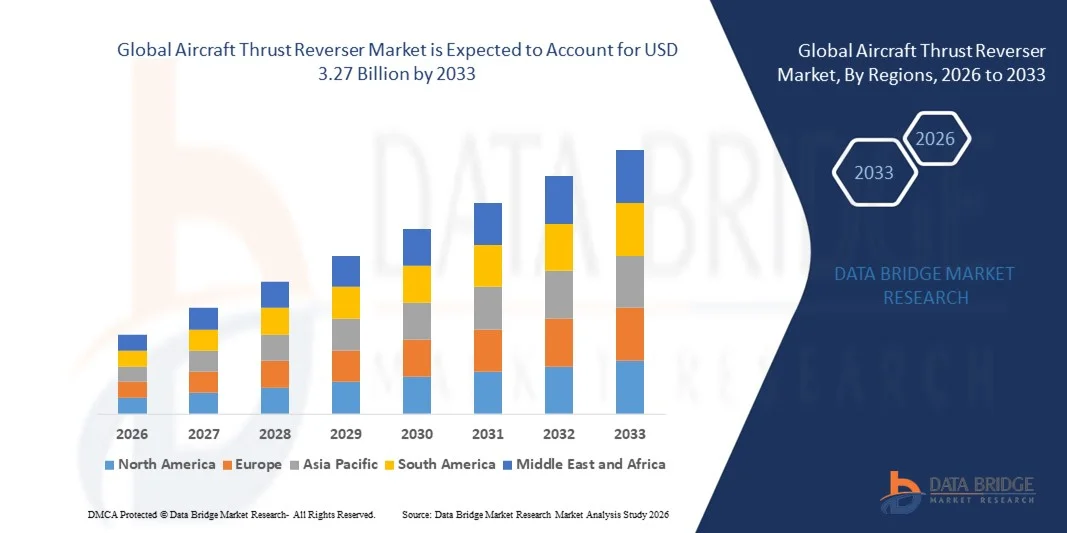
- The global aircraft thrust reverser market size was valued at USD 2.69 billion in 2025 and is expected to reach USD 3.27 billion by 2033, at a CAGR of 2.50% during the forecast period
- The increase in the air travel and use of narrow-body aircrafts across the globe especially in the Asia-Pacific region, acts as one of the major factors driving the growth of aircraft thrust reverser market
- The rise in the concerns regarding the safety and security of their passengers because of the past number of cases causing high casualties and employment of numerous workers for cross-checking of the safety of an aircraft by the government accelerate the market growth
What are the Major Takeaways of Aircraft Thrust Reverser Market?
- The growing popularity of strategic agreements to design and develop thrust reverser for single-aisle aircraft and the surge in the short to medium haul air travel demand further influence the market
- In addition, rise in safety regulations for aircraft, increase in the investments, growth in commercial aircraft and surge in disposable income of people positively affect the aircraft thrust reverser market
- North America dominated the Aircraft Thrust Reverser market with a 44.3% revenue share in 2025, driven by strong aircraft production, presence of major OEMs, and extensive MRO infrastructure across the U.S. and Canada
- Asia-Pacific is projected to register the fastest CAGR of 8.8% from 2026 to 2033, driven by rising air passenger traffic, expanding low-cost carrier fleets, and increasing aircraft procurement across China, India, Japan, South Korea, and Southeast Asia
- The Cascade segment dominated the market with a 54.6% share in 2025, as it is widely used in high-bypass turbofan engines for commercial aircraft. Cascade thrust reversers offer superior aerodynamic efficiency, lighter weight, and better noise control compared to traditional systems
Report Scope and Aircraft Thrust Reverser Market Segmentation
|
Attributes |
Aircraft Thrust Reverser Key Market Insights |
|
Segments Covered |
|
|
Countries Covered |
North America
Europe
Asia-Pacific
Middle East and Africa
South America
|
|
Key Market Players |
|
|
Market Opportunities |
|
|
Value Added Data Infosets |
In addition to the insights on market scenarios such as market value, growth rate, segmentation, geographical coverage, and major players, the market reports curated by the Data Bridge Market Research also include in-depth expert analysis, pricing analysis, brand share analysis, consumer survey, demography analysis, supply chain analysis, value chain analysis, raw material/consumables overview, vendor selection criteria, PESTLE Analysis, Porter Analysis, and regulatory framework. |
What is the Key Trend in the Aircraft Thrust Reverser Market?
Increasing Shift Toward Lightweight, Composite-Based, and Fuel-Efficient Thrust Reverser Systems
- The aircraft thrust reverser market is witnessing strong adoption of lightweight composite materials and advanced actuation systems designed to improve fuel efficiency and reduce aircraft weight
- Manufacturers are introducing electrically actuated and digitally monitored thrust reverser systems that enhance reliability, reduce hydraulic complexity, and support predictive maintenance
- Growing demand for next-generation narrow-body aircraft and fuel-efficient engines is accelerating integration of compact, aerodynamically optimized cascade and blocker door systems
- For instance, companies such as Safran, Collins Aerospace, Spirit AeroSystems, Inc., and Leonardo S.p.A. are expanding composite-based nacelle and thrust reverser production capabilities
- Increasing focus on noise reduction, emission control, and operational efficiency is accelerating innovation in advanced cascade and target-type reverser configurations
- As global aircraft fleets expand and sustainability becomes critical, lightweight and high-performance thrust reversers will remain central to next-generation aircraft development
What are the Key Drivers of Aircraft Thrust Reverser Market?
- Rising commercial aircraft deliveries and expanding air passenger traffic are increasing demand for efficient and durable thrust reverser systems
- For instance, in 2025, major OEM collaborations involving Bombardier and Honeywell International Inc. focused on improving nacelle integration and performance optimization
- Growing production of fuel-efficient turbofan engines for narrow-body and wide-body aircraft is boosting installation rates of advanced reverser assemblies
- Advancements in composite structures, thermal resistance materials, and electric actuation technologies are improving system lifespan and reducing maintenance costs
- Rising military aircraft modernization programs and MRO (maintenance, repair, and overhaul) activities are further strengthening aftermarket demand
- Supported by steady aircraft procurement and fleet expansion globally, the Aircraft Thrust Reverser market is expected to experience sustained long-term growth
Which Factor is Challenging the Growth of the Aircraft Thrust Reverser Market?
- High development and certification costs associated with advanced composite thrust reverser systems restrict entry for smaller suppliers
- For instance, during 2024–2025, supply chain disruptions and raw material price fluctuations increased production costs across aerospace component manufacturers
- Stringent aviation safety regulations and lengthy certification processes extend product development timelines
- Complexity in integrating thrust reversers with next-generation engine architectures increases engineering challenges
- Dependence on aircraft production cycles and OEM order volumes creates revenue volatility for suppliers
- To address these challenges, companies are investing in cost-efficient composite manufacturing, strategic partnerships, and digital predictive maintenance technologies to enhance competitiveness and global adoption
How is the Aircraft Thrust Reverser Market Segmented?
The market is segmented on the basis of product, component, manufacturing process, mechanism, aircraft and end user.
- By Product
On the basis of product, the aircraft thrust reverser market is segmented into Cascade, Pivot, and Bucket. The Cascade segment dominated the market with a 54.6% share in 2025, as it is widely used in high-bypass turbofan engines for commercial aircraft. Cascade thrust reversers offer superior aerodynamic efficiency, lighter weight, and better noise control compared to traditional systems. Their integration within nacelle systems and compatibility with modern fuel-efficient engines make them the preferred choice for narrow-body and wide-body aircraft programs.
The Pivot segment is expected to grow at the fastest CAGR from 2026 to 2033, driven by increasing adoption in advanced engine architectures and next-generation aircraft platforms. Rising demand for lightweight and compact reverser mechanisms is supporting innovation in pivot-based systems.
- By Component
On the basis of component, the market is segmented into Engine Cowl, Fan Cowl, and Thrust Reverser. The Fan Cowl segment dominated the market with a 41.2% share in 2025, supported by its critical role in enclosing engine components, improving aerodynamics, and supporting integrated thrust reverser assemblies. Increasing production of composite fan cowls for fuel-efficient aircraft further strengthens segment dominance.
The Thrust Reverser component segment is projected to grow at the fastest CAGR from 2026 to 2033, driven by rising demand for lightweight composite structures, improved actuation systems, and noise-reduction technologies. Expanding aircraft fleet modernization programs are further accelerating replacement and upgrade cycles.
- By Manufacturing Process
On the basis of manufacturing process, the aircraft thrust reverser market is segmented into Hand Layup, ATL/AFP, and Resin Infusion. The ATL/AFP (Automated Tape Laying/Automated Fiber Placement) segment dominated the market with a 48.7% share in 2025, owing to its precision, reduced material waste, and suitability for large composite aerostructures. OEMs increasingly prefer automated processes for high-quality, repeatable production.
The Resin Infusion segment is expected to grow at the fastest CAGR from 2026 to 2033, driven by cost-effectiveness, improved structural integrity, and rising adoption in mid-sized aircraft programs. Advancements in composite material technologies continue to enhance manufacturing efficiency.
- By Mechanism
On the basis of mechanism, the market is segmented into Hydraulics and Electrical. The Hydraulics segment dominated the market with a 63.5% share in 2025, as hydraulic systems have long been the standard for thrust reverser actuation due to their reliability, high force output, and proven operational safety in commercial aviation.
The Electrical segment is projected to grow at the fastest CAGR from 2026 to 2033, driven by the industry shift toward more-electric aircraft architectures. Electrical actuation systems reduce weight, lower maintenance requirements, and improve fuel efficiency, making them increasingly attractive for next-generation aircraft platforms.
- By Aircraft
On the basis of aircraft, the aircraft thrust reverser market is segmented into Commercial, Regional, Business, and Military. The Commercial segment dominated the market with a 58.9% share in 2025, supported by high production volumes of narrow-body and wide-body aircraft to meet growing global passenger traffic. Fleet expansion and replacement of aging aircraft significantly contribute to demand.
The Military segment is expected to grow at the fastest CAGR from 2026 to 2033, driven by modernization programs, increasing defense budgets, and development of advanced fighter jets and transport aircraft requiring specialized thrust reverser configurations.
- By End User
On the basis of end user, the market is segmented into OEM and MRO. The OEM segment dominated the market with a 67.4% share in 2025, due to strong aircraft production rates and integration of thrust reversers during initial manufacturing stages. Long-term contracts between aircraft manufacturers and component suppliers further strengthen OEM dominance.
The MRO segment is projected to grow at the fastest CAGR from 2026 to 2033, driven by expanding global aircraft fleets, increasing maintenance cycles, and demand for replacement of aging composite and actuation components. Rising focus on lifecycle cost optimization continues to support aftermarket growth.
Which Region Holds the Largest Share of the Aircraft Thrust Reverser Market?
- North America dominated the Aircraft Thrust Reverser market with a 44.3% revenue share in 2025, driven by strong aircraft production, presence of major OEMs, and extensive MRO infrastructure across the U.S. and Canada. High demand for next-generation narrow-body and wide-body aircraft, along with ongoing fleet modernization programs, continues to fuel regional growth
- Leading aerospace manufacturers in North America are investing in lightweight composite thrust reverser systems, advanced actuation technologies, and fuel-efficient nacelle integration solutions to enhance aircraft performance and sustainability. Continuous R&D in electric actuation and noise-reduction technologies strengthens the region’s competitive advantage
- Strong defense spending, high concentration of aerospace engineering talent, and well-established supply chain ecosystems further reinforce North America’s leadership in the global Aircraft Thrust Reverser market
U.S. Aircraft Thrust Reverser Market Insight
The U.S. is the largest contributor within North America, supported by robust commercial aircraft manufacturing, defense aircraft production, and a well-developed aerospace supply chain. Presence of major aircraft OEMs and Tier-1 suppliers drives high demand for cascade and electrically actuated thrust reverser systems. Increasing aircraft deliveries, military modernization programs, and investments in sustainable aviation technologies further accelerate market growth. Expansion of MRO facilities and focus on lightweight composite integration continue to strengthen long-term demand.
Canada Aircraft Thrust Reverser Market Insight
Canada contributes significantly due to strong presence of regional aircraft manufacturers and specialized aerostructure suppliers. Growing exports of aircraft components, increasing participation in global aircraft programs, and advancements in composite manufacturing technologies support market expansion. Government-backed aerospace innovation initiatives and skilled workforce availability further enhance Canada’s role in the regional value chain.
Asia-Pacific Aircraft Thrust Reverser Market
Asia-Pacific is projected to register the fastest CAGR of 8.8% from 2026 to 2033, driven by rising air passenger traffic, expanding low-cost carrier fleets, and increasing aircraft procurement across China, India, Japan, South Korea, and Southeast Asia. Growing domestic aircraft manufacturing capabilities and strengthening MRO infrastructure significantly boost demand for thrust reverser systems. Increasing defense modernization and regional aerospace investments further accelerate market growth.
China Aircraft Thrust Reverser Market Insight
China is the largest contributor in Asia-Pacific due to expanding commercial aviation, indigenous aircraft development programs, and strong government support for aerospace manufacturing. Increasing aircraft assembly activities and rising MRO investments drive demand for advanced thrust reverser systems.
Japan Aircraft Thrust Reverser Market Insight
Japan shows steady growth supported by strong aerospace component manufacturing, participation in global aircraft supply chains, and focus on high-precision composite technologies. Continuous innovation in lightweight aerostructures strengthens market adoption.
India Aircraft Thrust Reverser Market Insight
India is emerging as a high-growth market driven by rapid fleet expansion, increasing defense procurement, and development of domestic aerospace manufacturing capabilities. Expansion of MRO hubs further supports long-term demand.
South Korea Aircraft Thrust Reverser Market Insight
South Korea contributes through growing defense aircraft programs, increasing aerospace exports, and investments in advanced aerostructure manufacturing. Technological innovation and government-backed aerospace initiatives support sustained market expansion.
Which are the Top Companies in Aircraft Thrust Reverser Market?
The aircraft thrust reverser industry is primarily led by well-established companies, including:
- Bombardier (Canada)
- Safran (France)
- Collins Aerospace (U.S.)
- The NORDAM Group LLC (U.S.)
- GKN Aerospace Services Limited (U.K.)
- Honeywell International Inc. (U.S.)
- Parker Hannifin Corp (U.S.)
- Woodward Inc. (U.S.)
- CTRM Sdn. Bhd. (Malaysia)
- Spirit AeroSystems, Inc. (U.S.)
- FACC AG (Austria)
- Triumph Group (U.S.)
- Leonardo S.p.A. (Italy)
- NIKKISO AMERICA, INC. (U.S.)
- S.S. White Technologies Inc. (U.S.)
What are the Recent Developments in Global Aircraft Thrust Reverser Market?
- In April 2024, Air France Industries KLM Engineering & Maintenance (AFI KLM E&M) announced a long-term partnership with Hawaiian Airlines under a ten-year contract, extendable by two additional years, to provide comprehensive component support for Hawaiian Airlines’ newly acquired Boeing 787-9 fleet, thereby reinforcing AFI KLM E&M’s global leadership in customized MRO solutions and expanding its long-term service portfolio
- In November 2023, Lufthansa Technik Middle East (LTME) and Gulf Air formalized a strategic collaboration through a memorandum of understanding signed at the Dubai Airshow 2023, focusing on enhancing aircraft maintenance capabilities through technical cooperation and shared expertise, thereby strengthening regional MRO competencies and operational efficiency
- In September 2022, Cathay Pacific extended its five-year service agreement with Safran Nacelles for maintenance and support of thrust reversers on its 51 Airbus A330ceo aircraft, while Cathay Pacific and HK Express also selected Safran Nacelles to support nacelles for 32 Airbus A321neo aircraft powered by CFM International LEAP-1A engines, thereby reinforcing long-term aftermarket collaboration and fleet reliability
- In March 2022, the FAA approved 12 new PMA parts and three DER repairs for Jet Parts Engineering and its affiliates, Airline Components Parts and Aero Parts Mart, covering multiple commercial aircraft components including thrust reverser seals and cowl rub strips, thereby strengthening certified aftermarket supply capabilities and maintenance flexibility
SKU-
Get online access to the report on the World's First Market Intelligence Cloud

- Interactive Data Analysis Dashboard
- Company Analysis Dashboard for high growth potential opportunities
- Research Analyst Access for customization & queries
- Competitor Analysis with Interactive dashboard
- Latest News, Updates & Trend analysis
- Harness the Power of Benchmark Analysis for Comprehensive Competitor Tracking
Research Methodology
Data collection and base year analysis are done using data collection modules with large sample sizes. The stage includes obtaining market information or related data through various sources and strategies. It includes examining and planning all the data acquired from the past in advance. It likewise envelops the examination of information inconsistencies seen across different information sources. The market data is analysed and estimated using market statistical and coherent models. Also, market share analysis and key trend analysis are the major success factors in the market report. To know more, please request an analyst call or drop down your inquiry.
The key research methodology used by DBMR research team is data triangulation which involves data mining, analysis of the impact of data variables on the market and primary (industry expert) validation. Data models include Vendor Positioning Grid, Market Time Line Analysis, Market Overview and Guide, Company Positioning Grid, Patent Analysis, Pricing Analysis, Company Market Share Analysis, Standards of Measurement, Global versus Regional and Vendor Share Analysis. To know more about the research methodology, drop in an inquiry to speak to our industry experts.
Customization Available
Data Bridge Market Research is a leader in advanced formative research. We take pride in servicing our existing and new customers with data and analysis that match and suits their goal. The report can be customized to include price trend analysis of target brands understanding the market for additional countries (ask for the list of countries), clinical trial results data, literature review, refurbished market and product base analysis. Market analysis of target competitors can be analyzed from technology-based analysis to market portfolio strategies. We can add as many competitors that you require data about in the format and data style you are looking for. Our team of analysts can also provide you data in crude raw excel files pivot tables (Fact book) or can assist you in creating presentations from the data sets available in the report.