


Airless Dispenser Market Size
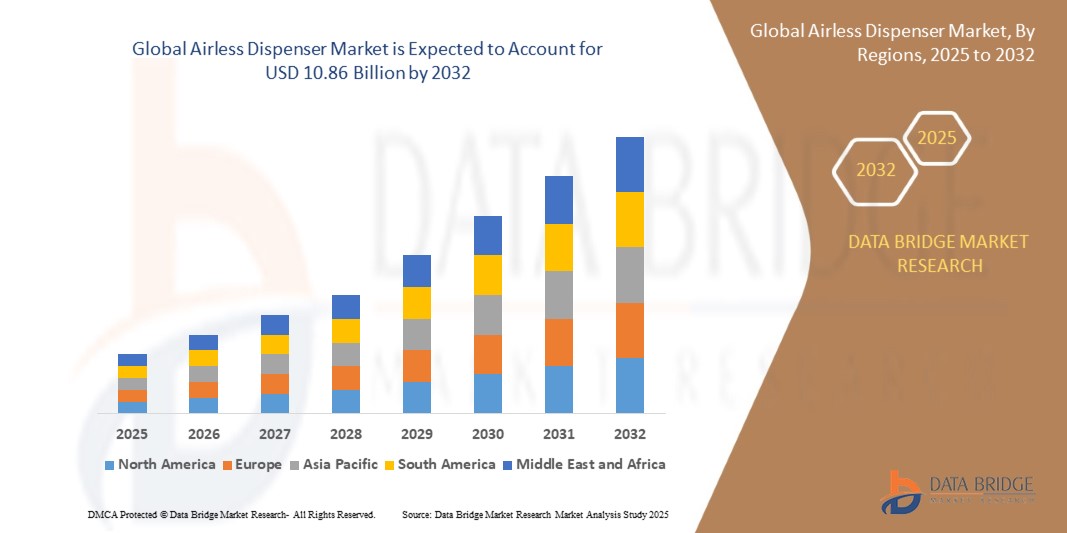
- The global airless dispenser market size was valued at USD 6.27 billion in 2024 and is expected to reach USD 10.86 billion by 2032, at a CAGR of 7.1% during the forecast period
- The market growth is largely fuelled by the increasing demand for product protection and longer shelf life in the personal care, pharmaceutical, and cosmetic sectors
- The shift towards sustainable packaging solutions and consumer preference for hygienic, precise dispensing mechanisms is also propelling market expansion
Airless Dispenser Market Analysis
- Airless dispensers eliminate air exposure, preventing oxidation and contamination of sensitive formulations, thereby preserving product integrity
- These systems are widely adopted across skin care, foundation creams, serums, and liquid-based treatments due to their clean dispensing, controlled dosage, and extended product life
- Asia-Pacific dominated the airless dispenser market with the largest revenue share of 36.84% in 2024, driven by a rapidly expanding personal care industry, growing consumer preference for hygienic and waste-reducing packaging, and the rising demand for premium cosmetics
- North America region is expected to witness the highest growth rate in the global airless dispenser market, driven by strong retail infrastructure, increasing investments in sustainable packaging, and growing demand for advanced dispensing solutions in pharmaceuticals, cosmetics, and nutraceuticals
- The pumps segment dominated the market with the largest revenue share in 2024, driven by its widespread usage across cosmetics, pharmaceuticals, and personal care products. Pumps offer user-friendly dispensing, minimize product waste, and provide protection against contamination, making them the preferred option in high-value formulations. Their compatibility with a wide range of viscosities and sleek design integration also enhances brand appeal across premium packaging lines
Report Scope and Airless Dispenser Market Segmentation
|
Attributes |
Airless Dispenser Key Market Insights |
|
Segments Covered |
|
|
Countries Covered |
North America
Europe
Asia-Pacific
Middle East and Africa
South America
|
|
Key Market Players |
|
|
Market Opportunities |
|
|
Value Added Data Infosets |
In addition to the insights on market scenarios such as market value, growth rate, segmentation, geographical coverage, and major players, the market reports curated by the Data Bridge Market Research also include import export analysis, production capacity overview, production consumption analysis, price trend analysis, climate change scenario, supply chain analysis, value chain analysis, raw material/consumables overview, vendor selection criteria, PESTLE Analysis, Porter Analysis, and regulatory framework. |
Airless Dispenser Market Trends
“Rising Demand for Sustainable and Premium Packaging Solutions”
- Consumers are increasingly preferring eco-friendly, high-quality packaging formats that align with clean beauty and sustainability goals
- Brands are adopting airless dispensers to reduce product waste and improve shelf-life without using synthetic preservatives
- The push toward luxury aesthetics in personal care and cosmetic products is leading to the premiumization of packaging formats, including airless pumps
- Airless dispensers support minimalist branding and sleek design, appealing to modern consumer sensibilities focused on both function and visual appeal
- For instance, REN Clean Skincare transitioned to airless and recyclable packaging to reduce environmental impact and boost brand perception among eco-conscious buyers
Airless Dispenser Market Dynamics
Driver
“Growing Demand for Extended Product Shelf Life and Hygiene”
- The growing demand for preservative-free skincare and cosmetic products is prompting brands to adopt airless dispensers, which offer better protection against external contaminants and oxygen exposure
- Enhanced product safety and hygiene are important drivers, especially in dermatology and baby care segments, where formulation integrity is critical
- Increasing focus on accurate dosing, extended shelf life, and premium user experience is leading to widespread application of airless systems in creams, serums, and pharmaceuticals
- The compatibility of airless packaging with sensitive or high-viscosity products makes it a preferred choice across high-value product categories
- For instance, Estée Lauder uses airless packaging for its advanced repair serums to preserve active ingredient stability and extend product life
Restraint/Challenge
“Higher Manufacturing Costs and Compatibility Limitations”
- The high cost of production due to complex internal mechanisms and use of multiple materials makes airless dispensers unaffordable for many small-scale manufacturers
- Recycling challenges arise due to the combination of plastics, springs, and rubber components, limiting their appeal in circular economy initiatives
- Compatibility limitations with certain product types, such as exfoliants or thick suspensions, can lead to pump failures and hinder user satisfaction
- Emerging brands often struggle to balance innovation and affordability, making traditional packaging formats more viable in competitive pricing environments
- For instance, an organic skincare startup in Southeast Asia reported challenges in scaling production using airless technology due to its higher tooling and unit costs
Airless Dispenser Market Scope
The market is segmented on the basis of product type, material, packaging type, distribution channel, and end-user.
• By Product Type
On the basis of product type, the airless dispenser market is segmented into pumps, twist and click, and droppers. The pumps segment dominated the market with the largest revenue share in 2024, driven by its widespread usage across cosmetics, pharmaceuticals, and personal care products. Pumps offer user-friendly dispensing, minimize product waste, and provide protection against contamination, making them the preferred option in high-value formulations. Their compatibility with a wide range of viscosities and sleek design integration also enhances brand appeal across premium packaging lines.
The twist and click segment is expected to witness the fastest growth rate from 2025 to 2032, supported by its rising popularity in targeted applications such as eye serums, lip balms, and medical ointments. These dispensers offer precise control over dosage, are travel-friendly, and ensure minimal product exposure to air, gaining traction among consumers demanding both functionality and hygiene.
• By Material
On the basis of material, the market is segmented into plastic, glass, metal, and others. The plastic segment held the largest revenue share in 2024 due to its lightweight, cost-effectiveness, and design flexibility. Plastic-based airless dispensers are widely used in skincare and personal care packaging, supporting high-volume production and custom branding options.
The glass segment is expected to witness the fastest growth rate from 2025 to 2032, fuelled by increasing consumer demand for sustainable and premium packaging. Glass offers superior recyclability, barrier protection, and visual appeal, making it a preferred choice for luxury cosmetic products.
• By Packaging Type
On the basis of packaging type, the airless dispenser market is segmented into bottles, jars, and tubes. Bottles accounted for the largest market share in 2024 owing to their broad adoption in facial creams, serums, and body lotions. Their upright design and pumping mechanism enhance product usability and appeal to brands seeking ergonomic yet stylish packaging.
The tubes segment is expected to witness the fastest growth rate from 2025 to 2032, driven by demand for compact, mess-free, and portable solutions. Airless tubes offer excellent protection for sensitive formulations and are increasingly used in sunblocks, gels, and travel-size skincare kits.
• By Distribution Channel
On the basis of distribution channel, the market is segmented into cosmetic stores, pharmacies, supermarkets/hypermarkets, e-commerce, specialty stores, and others. The e-commerce segment held the largest share in 2024, supported by the booming online beauty and health product market, particularly among millennials and Gen Z consumers. The convenience of direct delivery, wide product variety, and ease of comparison are key factors influencing the channel’s growth.
The pharmacy segment is expected to witness the fastest growth rate from 2025 to 2032, driven by the growing demand for medical-grade skincare and prescription-based dermatology products that require hygienic, protective dispensing formats.
• By End-User
On the basis of end-user, the airless dispenser market is segmented into cosmetics, medical, food and beverages, and others. The cosmetics segment dominated the market in 2024 due to strong consumer demand for high-quality, air-sensitive skincare and makeup products. The shift towards clean beauty and preservative-free formulations is boosting the adoption of airless dispensers across facial creams, serums, and foundation lines.
The medical segment is expected to witness the fastest growth rate from 2025 to 2032, supported by the need for sterile and accurate dispensing in topical medications, wound care products, and ophthalmic solutions.
Airless Dispenser Market Regional Analysis
- Asia-Pacific dominated the airless dispenser market with the largest revenue share of 36.84% in 2024, driven by a rapidly expanding personal care industry, growing consumer preference for hygienic and waste-reducing packaging, and the rising demand for premium cosmetics
- The region's strong presence of contract manufacturing and packaging facilities, combined with the increasing adoption of innovative skincare routines in countries such as China, Japan, and South Korea, has further accelerated market penetration
- High population density, urbanization, and growing disposable incomes are contributing to the broadening adoption of airless dispensing systems across beauty, medical, and food packaging sectors, making the region a dominant force in market growth
China Airless Dispenser Market Insight
The China airless dispenser market captured the largest revenue share in the Asia-Pacific region in 2024, propelled by the booming domestic cosmetics industry and the growing trend toward sustainable and tamper-proof packaging. With a strong manufacturing base and a wide consumer base inclined towards quality skincare and cosmetic products, China continues to witness high demand for airless bottles, jars, and pumps. Leading cosmetic brands are increasingly incorporating airless packaging to enhance product shelf life and reduce contamination, further reinforcing market growth in the country.
Japan Airless Dispenser Market Insight
The Japan airless dispenser market is expected to witness the fastest growth rate from 2025 to 2032, supported by the country’s strong skincare culture, preference for high-precision dispensing, and the rising popularity of premium cosmetics. Japanese consumers value functionality, minimalism, and hygiene in packaging, making airless dispensers a natural fit for local preferences. Furthermore, with a mature pharmaceutical industry and increasing interest in advanced packaging technologies for medical applications, the adoption of airless systems is expected to accelerate. The presence of innovative packaging manufacturers and brand partnerships is further advancing the market in Japan.
Europe Airless Dispenser Market Insight
The Europe airless dispenser market is expected to witness the fastest growth rate from 2025 to 2032, supported by strict environmental regulations promoting recyclable and eco-friendly packaging formats. Countries such as Germany, France, and Italy are seeing increased adoption of airless dispensers in both the cosmetic and pharmaceutical sectors. Consumer inclination toward premium skincare, along with technological advancements in dispensing mechanisms, is pushing brands to invest in airless solutions. The growing demand for clean-label beauty and medical products is also a key factor bolstering the market outlook in the region.
Germany Airless Dispenser Market Insight
The Germany airless dispenser market is expected to witness the fastest growth rate from 2025 to 2032, driven by a strong cosmetics manufacturing ecosystem and a consumer preference for sophisticated, hygienic packaging. Germany’s emphasis on sustainability, innovation in design, and efficient distribution networks contributes to the rising usage of airless packaging across sectors. Moreover, pharmaceutical and nutraceutical companies in the country are also shifting to airless solutions to ensure sterility and dosage accuracy, boosting market traction.
U.K. Airless Dispenser Market Insight
The U.K. airless dispenser market is expected to witness the fastest growth rate from 2025 to 2032, driven by increasing awareness of sustainability, consumer hygiene, and product preservation. British cosmetic and personal care brands are increasingly integrating airless packaging to meet clean-label and contamination-free standards. In addition, the rising demand for plant-based, natural skincare products is creating a need for packaging that maintains ingredient integrity without preservatives. The country's well-established retail infrastructure and focus on eco-conscious innovation are supporting the widespread adoption of airless dispensers in both beauty and pharmaceutical applications.
North America Airless Dispenser Market Insight
The North America airless dispenser market is expected to witness the fastest growth rate from 2025 to 2032, supported by growing consumer demand for safe, convenient, and mess-free product dispensing across cosmetic, healthcare, and food applications. Rising awareness of contamination-free application and extended product shelf life has led to increasing adoption in the U.S. and Canada. In addition, rapid expansion in the organic and natural skincare product categories is encouraging companies to adopt airless formats for better preservation.
U.S. Airless Dispenser Market Insight
The U.S. airless dispenser market is expected to witness the fastest growth rate from 2025 to 2032, driven by the growing popularity of premium personal care products and strong innovations in packaging. Consumers are increasingly valuing precision, hygiene, and sustainability, leading to wider usage of airless dispensers among top cosmetic and pharmaceutical brands. The country’s advanced retail and e-commerce infrastructure supports rapid product launches, and the demand for eco-friendly and user-friendly dispensing systems continues to rise across key industries.
Airless Dispenser Market Share
The Airless Dispenser industry is primarily led by well-established companies, including:
- LUMSON S.p.A (Italy)
- HCP Packaging (China)
- APC PACKAGING (U.S.)
- AptarGroup, Inc. (U.S.)
- Albéa Services S.A.S (France)
- Quadpack (Spain)
- Silgan Holdings Inc. (U.S.)
- Qosmedix (U.S.)
- Nemera (France)
- LABLABO (France)
- CHONGWOO (South Korea)
- Verla International, Ltd. (U.S.)
- SHENZHEN BONA PHARMA TECHNOLOGY CO., LTD (China)
- FLOCON, INC. (U.S.)
- Anomatic (U.S.)
- Fusion Packaging I, LLC (U.S.)
- Berlin Packaging | Premi Industries (Italy)
Latest Developments in Global Airless Dispenser Market
- In January 2023, Aptar Pharma launched APF Futurity, the first metal-free, multi-dose nasal spray pump designed for airless dispenser market. This innovation by AptarGroup Inc. enhances safety and convenience in administering nasal saline and OTC formulations, meeting evolving consumer needs for precise and reliable dispensing
- In January 2023, Stella McCartney Skin Care Line collaborated with LVMH Group to revamp its refillable glass airless packaging for the airless dispenser market. This partnership reflects a commitment to sustainability and aesthetics, offering recyclable solutions for a diverse range of vegan skincare products, enhancing both environmental responsibility and consumer appeal

- Interactive Data Analysis Dashboard
- Company Analysis Dashboard for high growth potential opportunities
- Research Analyst Access for customization & queries
- Competitor Analysis with Interactive dashboard
- Latest News, Updates & Trend analysis
- Harness the Power of Benchmark Analysis for Comprehensive Competitor Tracking
Global Airless Dispenser Market, Supply Chain Analysis and Ecosystem Framework
To support market growth and help clients navigate the impact of geopolitical shifts, DBMR has integrated in-depth supply chain analysis into its Global Airless Dispenser Market research reports. This addition empowers clients to respond effectively to global changes affecting their industries. The supply chain analysis section includes detailed insights such as Global Airless Dispenser Market consumption and production by country, price trend analysis, the impact of tariffs and geopolitical developments, and import and export trends by country and HSN code. It also highlights major suppliers with data on production capacity and company profiles, as well as key importers and exporters. In addition to research, DBMR offers specialized supply chain consulting services backed by over a decade of experience, providing solutions like supplier discovery, supplier risk assessment, price trend analysis, impact evaluation of inflation and trade route changes, and comprehensive market trend analysis.
Data collection and base year analysis are done using data collection modules with large sample sizes. The stage includes obtaining market information or related data through various sources and strategies. It includes examining and planning all the data acquired from the past in advance. It likewise envelops the examination of information inconsistencies seen across different information sources. The market data is analysed and estimated using market statistical and coherent models. Also, market share analysis and key trend analysis are the major success factors in the market report. To know more, please request an analyst call or drop down your inquiry.
The key research methodology used by DBMR research team is data triangulation which involves data mining, analysis of the impact of data variables on the market and primary (industry expert) validation. Data models include Vendor Positioning Grid, Market Time Line Analysis, Market Overview and Guide, Company Positioning Grid, Patent Analysis, Pricing Analysis, Company Market Share Analysis, Standards of Measurement, Global versus Regional and Vendor Share Analysis. To know more about the research methodology, drop in an inquiry to speak to our industry experts.
Data Bridge Market Research is a leader in advanced formative research. We take pride in servicing our existing and new customers with data and analysis that match and suits their goal. The report can be customized to include price trend analysis of target brands understanding the market for additional countries (ask for the list of countries), clinical trial results data, literature review, refurbished market and product base analysis. Market analysis of target competitors can be analyzed from technology-based analysis to market portfolio strategies. We can add as many competitors that you require data about in the format and data style you are looking for. Our team of analysts can also provide you data in crude raw excel files pivot tables (Fact book) or can assist you in creating presentations from the data sets available in the report.













