


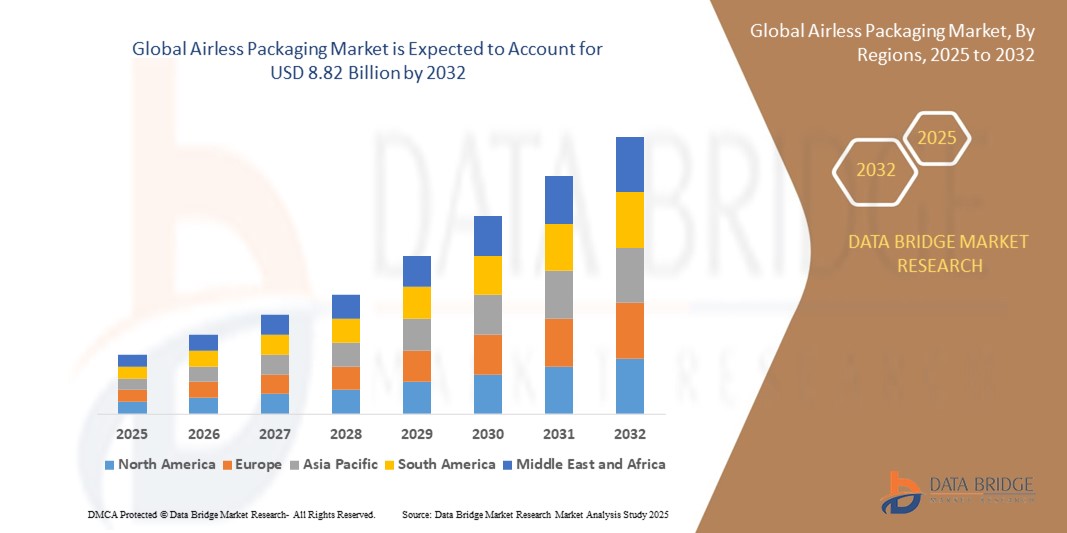
Airless Packaging Market Size
- The global airless packaging market size was valued at USD 5.79 billion in 2024 and is expected to reach USD 8.82 billion by 2032, at a CAGR of 5.4% during the forecast period
- The market growth is largely driven by the rising demand for premium cosmetic and skincare products, which require effective, contamination-free dispensing and longer shelf life—benefits offered by airless packaging formats
- In addition, increased consumer preference for sustainable and eco-friendly packaging is prompting brands to shift toward recyclable airless systems made from mono-materials and refillable containers, further propelling market adoption
- Moreover, advancements in packaging technologies, including precision pumps, 360-degree dispensing, and vacuum-based mechanisms, are expanding the use of airless packaging across not only cosmetics but also pharmaceuticals and food applications, thus significantly boosting global market growth
Airless Packaging Market Analysis
- Airless packaging, which eliminates air exposure to preserve product integrity, is becoming increasingly essential in the cosmetics, personal care, and pharmaceutical industries due to its ability to extend shelf life, reduce contamination, and minimize product waste
- The escalating demand for airless packaging is primarily fueled by the growing consumer preference for premium, natural, and preservative-free formulations, which require packaging solutions that maintain efficacy and hygiene without external air interference
- North America dominates the airless packaging market, accounting for the largest revenue share of 40.01% in 2025, driven by a mature cosmetics industry, strong demand for sustainable and innovative packaging, and the presence of leading packaging solution providers. The U.S., in particular, is experiencing significant growth with brands increasingly adopting airless formats for skincare, serums, and pharmaceutical creams
- Asia-Pacific is expected to be the fastest-growing region in the airless packaging market during the forecast period, propelled by rapid urbanization, rising disposable incomes, and expanding beauty and personal care markets in countries such as China, India, and South Korea
- The plastic segment is expected to dominate the airless packaging market with a projected market share of 43.2% in 2025, owing to its versatility, cost-effectiveness, and ease of molding into innovative designs that appeal to both manufacturers and consumers seeking lightweight, functional packaging
Report Scope and Airless Packaging Market Segmentation
|
Attributes |
Airless Packaging Key Market Insights |
|
Segments Covered |
|
|
Countries Covered |
North America
Europe
Asia-Pacific
Middle East and Africa
South America
|
|
Key Market Players |
|
|
Market Opportunities |
|
|
Value Added Data Infosets |
In addition to the insights on market scenarios such as market value, growth rate, segmentation, geographical coverage, and major players, the market reports curated by the Data Bridge Market Research also include import export analysis, production capacity overview, production consumption analysis, price trend analysis, climate change scenario, supply chain analysis, value chain analysis, raw material/consumables overview, vendor selection criteria, PESTLE Analysis, Porter Analysis, and regulatory framework. |
Airless Packaging Market Trends
“Enhanced Convenience through Smart and Sustainable Innovations”
- A key and rapidly evolving trend in the global Airless Packaging market is the integration of smart technologies and sustainable materials, aiming to boost convenience, user experience, and eco-friendliness in personal care, pharmaceutical, and cosmetic industries
- For instance, some next-gen airless packaging solutions are being designed with embedded smart sensors that track product usage and expiration, notifying users via smartphone apps when a refill or replacement is needed. This enhances product lifecycle management and consumer convenience
- In addition, innovative companies are exploring voice assistant integration where users can reorder products hands-free through Amazon Alexa, Google Assistant, or Apple HomeKit by linking packaging sensors to digital assistants. This seamless connectivity simplifies restocking routines, particularly for skincare and wellness consumers
- AI-enabled airless packaging prototypes leverage machine learning to optimize dispensing patterns based on user habits, reducing product waste and enhancing dosage precision. For instance, smart pumps can adjust dispensed quantity according to time of day or skin condition data collected from integrated health apps
- The rise of eco-conscious smart airless packaging is another significant trend, where manufacturers combine biodegradable or recyclable materials with intelligent dispensing technology to address environmental concerns without sacrificing functionality or aesthetic appeal
- Integration of airless packaging within the broader Internet of Things (IoT) ecosystem enables centralized management of beauty or health products alongside other smart home devices, offering a holistic wellness environment controlled through a single interface
- This wave of innovation is driving higher demand in both residential and commercial sectors, including luxury beauty brands, pharmacies, and wellness clinics, where consumers seek products that combine hygiene, convenience, and technology-enabled personalization
- Leading market players such as AptarGroup and Silgan Dispensing Systems are investing in AI-driven and smart airless packaging R&D, focusing on automated refill alerts, customizable dispensing modes, and voice-activated reorder systems, positioning themselves to meet growing consumer expectations
Airless Packaging Market Dynamics
Driver
“Rising Demand Driven by Sustainability and Consumer Convenience”
- Increasing consumer awareness of environmental sustainability and product preservation is a key driver fueling the growth of the global Airless Packaging market. Airless packaging minimizes product contamination, oxidation, and waste, extending shelf life—attributes highly valued in cosmetics, skincare, pharmaceuticals, and nutraceutical sectors
- For instance, in March 2024, AptarGroup launched a new line of recyclable airless pumps designed to reduce plastic waste while maintaining product integrity, reflecting strong industry commitment to sustainability and driving market expansion
- The surge in e-commerce and direct-to-consumer sales channels for beauty and health products is accelerating demand for airless packaging, which offers superior protection during shipping and longer product freshness post-delivery
- Additionally, consumers increasingly prioritize packaging that enhances convenience—easy-to-use, hygienic, and spill-proof airless systems perfectly meet these needs, making them popular in both premium and mass-market segments
- Technological advancements, such as smart dispensing pumps capable of tracking usage and connecting to mobile apps, are emerging as important growth catalysts, aligning with the rising trend of digital health monitoring and personalized skincare regimes
- The shift towards refillable and customizable packaging options also supports market growth, enabling brands to offer sustainable solutions while maintaining luxury appeal
Restraint/Challenge
“High Manufacturing Costs and Limited Recycling Infrastructure”
- Despite strong demand, the relatively high production costs of sophisticated airless packaging components remain a challenge, limiting widespread adoption among cost-sensitive brands and markets, particularly in emerging economies
- For instance, the integration of multi-material layers, pumps, and valves essential for airless function requires advanced manufacturing techniques that increase costs compared to traditional packaging solutions
- Moreover, recycling complexity poses a significant environmental challenge: airless packaging often combines plastics, metals, and elastomers, complicating recycling efforts and raising sustainability concerns among eco-conscious consumers and regulators
- The lack of standardized recycling infrastructure for such multi-component packaging restricts the circular economy potential, which could slow down regulatory approvals and limit market growth in regions with strict environmental policies
- Consumer hesitation toward novel packaging formats due to unfamiliarity or concerns about product dispensing consistency may also act as a restraint in certain demographics
- Overcoming these barriers requires continued innovation in cost-effective manufacturing, development of recyclable or biodegradable materials, and consumer education to highlight airless packaging benefits. Industry collaborations and investment in recycling technologies will be critical to address environmental challenges sustainably
Airless Packaging Market Scope
The market is segmented on the basis of packaging type, material type, category, distribution channel, end-user, and dispensing systems.
By Packaging Type
On the basis of packaging type, the Airless Packaging market is segmented into rigid plastics, bottles, jars, tubes, bags, and flexible plastics. The rigid plastics segment dominates the largest market revenue share of 43.2% in 2025, driven by its durability and cost-effectiveness. Manufacturers often prioritize rigid plastics for their ability to protect sensitive products and ease of customization. The market also sees strong demand for rigid plastics due to their compatibility with various product formulations and sustainability initiatives
The bottles segment is anticipated to witness the fastest growth rate of 21.7% from 2025 to 2032, fueled by increasing adoption in personal care and healthcare sectors. Bottles offer convenience and aesthetic appeal, making them suitable for premium products. Their integration with advanced dispensing systems provides users with controlled and hygienic access, enhancing product usability. The design flexibility of bottles also contributes to their growing popularity in modern packaging
• By Material Type
On the basis of material type, the Airless Packaging market is segmented into plastic, glass, aluminum, and others. The plastic segment held the largest market revenue share in 2025, driven by its lightweight nature and cost efficiency. Plastic packaging often offers superior barrier properties and design versatility, making it a popular choice across multiple industries
The glass segment is expected to witness the fastest CAGR from 2025 to 2032, driven by increasing consumer preference for premium and eco-friendly packaging. Glass provides excellent product protection and a perception of quality, appealing to high-end markets and specialty products
• By Category
On the basis of category, the Airless Packaging market is segmented into premium and mass. The premium segment held the largest market revenue share in 2025, fueled by growing consumer demand for luxury personal care and healthcare products. Premium packaging often features innovative designs and high-quality materials, enhancing brand image and customer loyalty
The mass segment is expected to witness the fastest CAGR from 2025 to 2032, driven by expanding accessibility and affordability across emerging markets. Mass packaging caters to a broader consumer base with practical and economical solutions
• By Distribution Channel
On the basis of distribution channel, the Airless Packaging market is segmented into supermarkets, hypermarkets, specialist retailers, convenience stores, and e-commerce. The supermarkets segment accounted for the largest market revenue share in 2024, driven by wide product availability and consumer trust in retail outlets. Real estate developments and increasing retail expansion also encourage adoption
The e-commerce segment is expected to witness the fastest CAGR from 2025 to 2032, driven by growing online shopping trends and the convenience of doorstep delivery. E-commerce offers brands a direct-to-consumer channel, increasing product accessibility and customization
• By End-User
On the basis of end-user, the Airless Packaging market is segmented into personal care and home care, healthcare, food and beverages, and others. The personal care and home care segment accounted for the largest market revenue share in 2024, driven by rising demand for hygienic and aesthetically pleasing packaging solutions. Growing consumer awareness about product safety and convenience further supports this trend
The healthcare segment is expected to witness the fastest CAGR from 2025 to 2032, driven by stringent regulatory requirements and increasing demand for sterile and tamper-evident packaging. Healthcare packaging prioritizes safety, accuracy, and ease of use
• By Dispensing Systems
On the basis of dispensing systems, the Airless Packaging market is segmented into pumps, dropper, and twist and clicks. The pumps segment held the largest market revenue share in 2025, driven by the ease of use and controlled dosage features. Pumps are favored in personal care and healthcare products for their hygienic dispensing and user convenience
The twist and clicks segment is expected to witness the fastest CAGR from 2025 to 2032, driven by innovative design and increasing adoption in premium packaging. Twist and click mechanisms offer secure closure and precise dispensing, enhancing product appeal and functionality
Airless Packaging Market Regional Analysis
- North America dominates the Airless Packaging market with the largest revenue share of 40.01% in 2025, driven by the strong presence of personal care and pharmaceutical manufacturers, early adoption of premium packaging technologies, and growing demand for preservative-free products
- Consumers in the region prefer innovative, contamination-free packaging that ensures longer product shelf life and supports natural ingredient formulations. The emphasis on convenience, sustainability, and hygiene is significantly boosting the adoption of airless packaging in skincare and medical applications
- This widespread growth is further fueled by high disposable incomes, advanced manufacturing capabilities, and strong R&D investments, positioning North America as a key contributor to market expansion.
U.S. Airless Packaging Market Insight
The U.S. Airless Packaging market captured the largest revenue share of 81% within North America in 2025, driven by the booming personal care, cosmetics, and pharmaceutical sectors. Consumers are increasingly demanding products with longer shelf life, better hygiene, and minimal product waste—criteria where airless packaging excels. Sustainability concerns are also propelling growth, as brands adopt airless systems that minimize preservatives and offer recyclable or refillable formats. The rise of e-commerce and consumer preference for high-end, tamper-evident packaging further fuel the expansion of the airless packaging industry in the U.S.
Europe Airless Packaging Market Insight
The European Airless Packaging market is projected to expand at a substantial CAGR throughout the forecast period, led by increasing regulatory pressure on sustainability and recyclability in packaging. Stringent EU policies regarding plastic waste and product safety have led to a surge in the use of airless solutions, especially in skincare and pharmaceutical applications. Consumers in Europe also favor premium, functional packaging that offers precise dispensing and protection from contamination. The market is expanding in both legacy markets such as France and Germany and emerging Eastern European countries
U.K. Airless Packaging Market Insight
The U.K. Airless Packaging market is anticipated to grow at a noteworthy CAGR during the forecast period, bolstered by a strong cosmetic and personal care industry. As British consumers increasingly prioritize environmentally responsible choices, brands are shifting towards airless systems that support reduced waste and enhanced product protection. The expansion of indie beauty brands and the rapid digitalization of retail and direct-to-consumer channels are also contributing to increased adoption of innovative, functional airless packaging solutions in the U.K.
Germany Airless Packaging Market Insight
The German Airless Packaging market is expected to expand at a considerable CAGR during the forecast period, driven by the country's focus on engineering excellence and environmental sustainability. German manufacturers are pioneering recyclable and biodegradable airless packaging materials, appealing to eco-conscious consumers and businesses. The pharmaceutical and dermatological sectors also play a major role in the market, as airless dispensers are increasingly used to ensure sterility and dosage accuracy. The integration of smart packaging features is gradually gaining traction in the country as well
Asia-Pacific Airless Packaging Market Insight
The Asia-Pacific Airless Packaging market is poised to grow at the fastest CAGR of over 24% in 2025, fueled by rising disposable incomes, rapid urbanization, and increasing demand for premium consumer goods. Countries such as China, Japan, and South Korea are experiencing a surge in skincare, cosmetics, and wellness product consumption, which drives the need for sophisticated packaging. Government initiatives supporting sustainable packaging and investments in smart manufacturing are also accelerating regional adoption. The growth of regional packaging suppliers makes airless solutions more affordable and accessible across diverse product categories
Japan Airless Packaging Market Insight
The Japan Airless Packaging market is gaining momentum due to its advanced manufacturing capabilities and a strong emphasis on consumer hygiene and product integrity. With Japan's aging population and a preference for convenience, airless systems that offer ease of use, reduced waste, and contamination prevention are in high demand. The market is particularly strong in cosmeceuticals and luxury skincare, where precision dispensing and product protection are key. Technological innovation and integration with RFID and QR codes for traceability are also helping reshape the Japanese packaging landscape
China Airless Packaging Market Insight
The China Airless Packaging market accounted for the largest market revenue share in Asia-Pacific in 2025, supported by the country’s fast-growing middle class, high-tech manufacturing infrastructure, and strong domestic demand for beauty and healthcare products. Airless packaging is becoming a staple for skincare and wellness brands targeting urban, health-conscious consumers. With China’s leadership in e-commerce and private-label manufacturing, local brands are increasingly adopting airless formats to enhance product positioning and meet consumer expectations around safety, longevity, and convenience
Airless Packaging Market Share
The airless packaging industry is primarily led by well-established companies, including:
- O.Berk Company, LLC (U.S.)
- Sonoco Products Company (U.S.)
- Albéa Services S.A.S. (France)
- Silgan Dispensing Systems. (U.S.)
- AptarGroup, Inc. (U.S.)
- HCT by kdc/one (U.S.)
- Cospack America Corp (U.S.)
- LUMSON SpA (Italy)
- Rieke (U.S.)
- HCP Packaging (U.K.)
- Fusion Packaging I, LLC (U.S.)
- TricorBraun (U.S.)
- Wounded Warrior Project (U.S.)
- Ball Corporation (U.S.)
- Ningbo Gidea Packaging Co., Ltd (China)
- Amcor plc (Australia)
Latest Developments in Global Airless Packaging Market
- In April 2024, APC Packaging introduced ERAJ, the EcoReady Refillable Airless Jar, at LPNY. This innovative beauty packaging merges sophistication with sustainability, featuring a center dispensing design and an airtight double-wall structure to preserve product integrity and extend shelf life. Tailored for thick formulations, ERAJ ensures precise dosing while maintaining hygiene
- In March 2024, APC Packaging introduced the EAPP EcoReady All Plastic Airless Pump, an innovative dispensing solution designed with airless technology and durable plastic materials. This eco-friendly pump eliminates the traditional metal spring, ensuring precise and consistent dispensing while reducing environmental impact. The design prioritizes sustainability, offering a reliable and efficient packaging option for skincare product
- In October 2023, Lumson expanded its airless packaging range with new designs, reinforcing its commitment to sustainability and innovation in the cosmetics industry. The latest additions, including TAG – Techno Airless Glass, feature advanced technology to prevent product contamination and extend shelf life. These solutions enhance formulation preservation while reducing waste, aligning with eco-friendly trends in beauty packaging
- In October 2023, Quadpack introduced the Light Me Up refillable airless pen, designed to revolutionize beauty packaging with sustainability and convenience. This innovative pen features an airless dispensing system that preserves formulations while reducing waste. The refillable design allows users to replace the inner bottle easily, ensuring long-term usability. With four different sensorial cold-touch applicators, it offers a personalized skincare and makeup experience

- Interactive Data Analysis Dashboard
- Company Analysis Dashboard for high growth potential opportunities
- Research Analyst Access for customization & queries
- Competitor Analysis with Interactive dashboard
- Latest News, Updates & Trend analysis
- Harness the Power of Benchmark Analysis for Comprehensive Competitor Tracking
Global Airless Packaging Market, Supply Chain Analysis and Ecosystem Framework
To support market growth and help clients navigate the impact of geopolitical shifts, DBMR has integrated in-depth supply chain analysis into its Global Airless Packaging Market research reports. This addition empowers clients to respond effectively to global changes affecting their industries. The supply chain analysis section includes detailed insights such as Global Airless Packaging Market consumption and production by country, price trend analysis, the impact of tariffs and geopolitical developments, and import and export trends by country and HSN code. It also highlights major suppliers with data on production capacity and company profiles, as well as key importers and exporters. In addition to research, DBMR offers specialized supply chain consulting services backed by over a decade of experience, providing solutions like supplier discovery, supplier risk assessment, price trend analysis, impact evaluation of inflation and trade route changes, and comprehensive market trend analysis.
Data collection and base year analysis are done using data collection modules with large sample sizes. The stage includes obtaining market information or related data through various sources and strategies. It includes examining and planning all the data acquired from the past in advance. It likewise envelops the examination of information inconsistencies seen across different information sources. The market data is analysed and estimated using market statistical and coherent models. Also, market share analysis and key trend analysis are the major success factors in the market report. To know more, please request an analyst call or drop down your inquiry.
The key research methodology used by DBMR research team is data triangulation which involves data mining, analysis of the impact of data variables on the market and primary (industry expert) validation. Data models include Vendor Positioning Grid, Market Time Line Analysis, Market Overview and Guide, Company Positioning Grid, Patent Analysis, Pricing Analysis, Company Market Share Analysis, Standards of Measurement, Global versus Regional and Vendor Share Analysis. To know more about the research methodology, drop in an inquiry to speak to our industry experts.
Data Bridge Market Research is a leader in advanced formative research. We take pride in servicing our existing and new customers with data and analysis that match and suits their goal. The report can be customized to include price trend analysis of target brands understanding the market for additional countries (ask for the list of countries), clinical trial results data, literature review, refurbished market and product base analysis. Market analysis of target competitors can be analyzed from technology-based analysis to market portfolio strategies. We can add as many competitors that you require data about in the format and data style you are looking for. Our team of analysts can also provide you data in crude raw excel files pivot tables (Fact book) or can assist you in creating presentations from the data sets available in the report.













